Preparation, Sem Characterisation And Proportion
Optimization Of Nano Composite Based Cost Effective
Solar Absorber
P.H.Sudharlin Paul* And R.V.Jeba Rajasekhar**
*Research scholar, Nesamony memorial Christian college, Marthandam, Kanyakumari District
** Assistant Professor, PG and Research Department of Physics Government Arts College, Melur 625 106, Madurai District
ABSTRACT
The merge of solar technology and nano technology is the need of the hour, as this
combination can enhance the thermal performance of solar collector. In this connection, it is
essential to prepare the nano-composite based absorptive coating for its usage in solar
absorbers. It is also essential to characterize the absorptive coating and optimize the
proportion of the constituents of the composites. In the present investigation, the
nano-composite based absorptive coating was prepared and it was coated on galvanized iron
absorber. The prepared coating was characterized and it was found that the sizes of grains
were in nano scales. The proportion of the constituents of the nano-composite was optimized
and the optimal ratio of carbon and metal oxide was 75:25. On the basis of the generated
reliable database of the present investigation, it could be concluded that the nano-structured
solar absorber (especially with optimal quantity of constituent based nano-composite
coating) would be used in solar collectors not only to have enhanced absorption of radiation
but also to have cost effectiveness.
KEY WORDS : Nano-structured solar absorber – SEM characterization – Proportion optimization of absorptive coating – Energy Efficacy
INTRODUCTION
Preparation, characterization and utilization of nano-composite based solar absorbers
are mandatory, as the solar absorbers that are now in use in solar collectors are large in size
and also expensive. In this connection, it is essential to (i) prepare the nano-composite based
coat effective solar absorber, (ii) characterize the nano-composite based cost effective solar
absorber and (iii) optimize the ratio of carbon and metal oxide in the cost effective solar
absorber. All these mandatory objectives are to be materialized so as to reap the energy and
economic benefits and hence the present investigation. The research outcomes have been
documented in the present research paper for the benefit of manufacturers, researchers and
end users of solar thermal gadgets.
EXPERIMENTAL
In the present investigation, the nano-structured absorber in standard size was
prepared and it was integrated with the solar collector. Initially, the nano-sized carbon was
prepared from charred coconut shell and the nano-sized metal oxide was commercially
procured. Subsequently, the nano-sized carbon and metal oxide was mixed up in different
ratios such as 75:25, 50:50 and 25:75 and the present nano-composites were blended in
black emulsion. Finally, the resultant solution was coated on the pre-cleaned galvanized iron
substrates by spray coating method. The sample absorber was characterized through SEM
analysis and the ratio optimization of nano-composites was studied by testing the solar
collector integrated with galvanized iron absorber having nano-composite coatings in three
different ratios.
FINDINGS AND CONCLUSION
In the present investigation, nano-carbon based cost effective absorber was prepared
and it was characterized. In addition, the ratio of nano carbon and metal oxide was
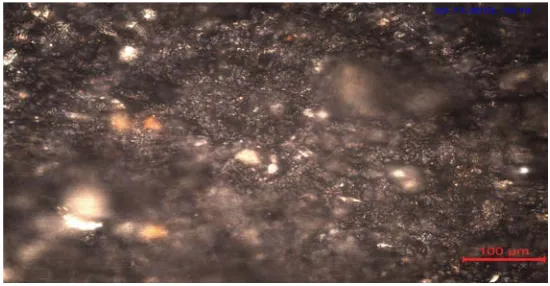
optimized so as to have maximum absorption of solar radiation. The characterization
outcomes of the microscopic and SEM analyses have been presented in figure 1 and figure
2. The research outcomes of the ratio optimization studies have also been presented in
Table 1.
Figure 1 : Microscopic image of carbon and metal oxide
Figure 1 : SEM image of carbon and metal oxide
The microscopic images of the carbon nano particles and morphology of metal oxide
on the absorber plate showed square, cubic, spherical and triangular edged micro patterns.
Of course, the structure of the carbon and metal oxide samples were analyzed by using a
scanning electron microscope (SEM). The outcomes of SEM revealed the surface
characteristics and the chemical constitutes of the coating that was deposited on the
absorber. The measurable parameters provided the size of carbon and metal oxide particles
and they were in the size range from 62.7 nm to 108.8 nm.
Table 1 : Temperature enhancement of working fluid
Ratio of nano carbon and metal oxide
Temperature enhancement (Minimum) oC
Temperature enhancement (Maximum) oC
25:75 33.9 86.9
50:50 34.5 89.2
75:25 35.1 92.7
absorber having the nano-composite coating in different ratios was noted periodically during
the sunshine hours. The minimum and the maximum temperature enhancements of the
working fluid were noted and they have been presented. It was noted that the GI absorber
(with nano carbon and metal oxide in the ratio of 25 and 75) integrated solar air heating
collector had the rise of temperature that varied from 33.9 oC to 86.9 oC. It was noticed that
the GI absorber (with nano carbon and metal oxide in the ratio of 50 and 50) integrated solar
air heating collector had the elevation of temperature that varied from 34.5 oC to 89.2 oC. It
was observed that the GI absorber (with nano carbon and metal oxide in the ratio of 75 and
25) integrated solar air heating collector had the elevation of temperature that varied from
35.1 oC to 92.7oC. On the basis of the thermal enhancements, the ratio of 75 and 25 (carbon
and metal oxide) was optimized and this ratio based nano-composite was used for further
research works. The thermal enhancements of working fluid could be attributed with the
nature of nano absorptive coating, optical characteristics of nano absorptive coating and
thermal characteristics of the material of the absorber. On the basis of the generated reliable
database of the present investigation, it could be concluded that the solar absorber with
nano-composite (with 75% carbon and 25% metal oxide) based coating would be used in
solar collectors not only to have enhanced absorption of radiation but also to have cost
effectiveness.
References
1) Duffie, J.A., Beckman, W.A., 1980, Solar thermal engineering processes, A Wiley Interscience publication, New York, U.S.A.
2) Furbo, S., Jivan shah, L., 2003, Thermal advantages for solar heating systems with a glass cover with anti reflection surfaces, Solar Energy 2003: 74:513-523.
3) IS 12933 (Part 1, 2, 3 & 5: 2003 together with amendment No.1 of June 2005), Bureau of Indian Standards, India.
4) Kalogirou, S.A., 2004, Solar Thermal Collectors and Applications, Progress in Energy and Combustion Science. New York: Elsevier Science Publishing Company, 30: 231 - 295. 5) Mohanraj, M., Chandrasekar, P., 2009, Performance of a solar drier with and without heat
storage material for copra drying, International Journal of Energy Issues, 32 (2): 112-121. 6) N.M. Nahar (2003). Year round performance and potential of a natural circulation solar
water heater in India. Energy and Buildings (35) pp. 239 – 247.
7) Test procedure for Thermosyphon – Type domestic solar hot water systems. Ministry of New and Renewable Energy. Government of India.