ISSN: 2319-8753
I
nternational
J
ournal of
I
nnovative
R
esearch in
S
cience,
E
ngineering and
T
echnology
(An ISO 3297: 2007 Certified Organization)
Vol. 2, Issue 10, October 2013
APPLICATION OF CHICKEN FEATHERS
IN TECHNICAL TEXTILES
Dr. S.K .Chinta.¹ , Prof. S.M .Landage.², Krati yadav³
Professor, Dept. of Technical Textile, D.K.T.E.S, Ichalkaranji, kolhapur, India1 Professor, Dept. of Textile Engineering D.K.T.E.S, Ichalkaranji, kolhapur, India2 PG student, Dept. of Textile Engineering D.K.T.E.S, Ichalkaranji, kolhapur, India3
Abstract: In this work chicken feathers were utilized to produce nonwoven by spray bonding technique using three chemicals such as polyvinyl acetate (PVAc), Dimethylol Dihydroxyl Ethylene Urea (DMDHEU) and polyurethane(PU) at different concentration varying from 10-50 parts. It is observed that, polyvinyl acetate gives better performance as compared to PU, DMDHEU in all respects. The values of GSM, Bursting strength, Thickness, water resistance is good in all respects as compared to other resins. Also as the concentration of resin an increases there is decrease in air permeability in as of polyvinyl acetate as compared to other resins.
Keywords: Chicken Feathers, Chemical Bonding, Nonwoven, Thermal Bonding
I. INTRODUCTION
An estimated 15 million tons of chicken feathers are produced globally each year as a by-product of meat manufacture. The raw material is tough and chemically resistant. Currently the feathers are disposed of in landfill, burned or processed to make a low-grade animal feedstock. These methods are environmentally unsound and are restricted. To overcome this problem, the chicken feathers are used in manufacturing of nonwoven. Nonwoven fabrics are broadly defined as sheet or web structures bonded together by entangling fibre or filaments (and by perforating films) mechanically, thermally or chemically. They are flat, porous sheets that are made directly from separate fibres or from molten plastic or plastic film. They are not made by weaving or knitting and do not require converting the fibres to yarn. In the present work, chemical bonding process is used for manufacturing of nonwoven.
.
II. MATERIALSANDMETHODS A.Materials
In the present work chicken feathers were collected from different poultry farms in the local area. PU, DMDHEU, Polyvinyl acetate and other chemical were used of LR grade.
B.Methods
Collected chicken feathers were cleaned to remove dirt ,dust by using soap solution After cleaning feathers were dried and cut. The quill has been separated from the feathers
.
C.Manufacturing of nonwoven
ISSN: 2319-8753
I
nternational
J
ournal of
I
nnovative
R
esearch in
S
cience,
E
ngineering and
T
echnology
(An ISO 3297: 2007 Certified Organization)
Vol. 2, Issue 10, October 2013
III.TESTPROCEDURES
Following tests are performed for evaluating the performance properties of nonwoven. Air Permeability: ASTM 737 , Thickness: ASTM D 5729, Bursting strength :ASTM D 3786,GSM D 3786, Water resistance.
IV.RESULT AND DISCUSSION
A.EFFECT OF CONCENTRATION OF RESIN ON THICKNESS
TABLE 1.EFFECT OF CONCENTRATION OF RESIN ON THICKNESS
Concentration (parts)
Thickness (mm) Polyvinyl
Acetate
Polyurethane DMDHEU
10 2.45 2.43 0 20 2.48 2.46 0 30 2.53 2.49 2.44 40 2.86 2.82 2.74 50 3.10 3.04 3.00
Figure 1. Effect of concentration of resin on thickness
From Table No.-1 & Fig.No.-1 it is observed that as the concentration of resins an increases there is an increase in thickness of composites irrespective
of type of resin. As concentration an increase from 10 to 50 parts
there is an increase in thickness. This may be because of an increase in crosslinking resin used for
composite manufacturing.
It is also observed that an increase in thickness trend in following manner in resins.PVAc>PU>DMDHEU. In case of DMDHEU at a concentration of 10 to 20 parts it is observed that ,there is no composite formation,that may be because that the concentration is not sufficient for bonding of chicken fibres.B. Effect of concentration of Resin on GSM 0 0.5 1 1.5 2 2.5 3 3.5
10 20 30 40 50
Th
ic
kn
e
ss(m
m
)
Concentration of resin (parts)
PVAc
PU
DMD
ISSN: 2319-8753
I
nternational
J
ournal of
I
nnovative
R
esearch in
S
cience,
E
ngineering and
T
echnology
(An ISO 3297: 2007 Certified Organization)
Vol. 2, Issue 10, October 2013
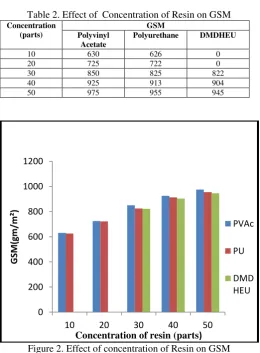
Table 2. Effect of Concentration of Resin on GSM
Concentration (parts)
GSM Polyvinyl
Acetate
Polyurethane DMDHEU
10 630 626 0 20 725 722 0 30 850 825 822 40 925 913 904 50 975 955 945
Figure 2. Effect of concentration of Resin on GSM
From Table no-2 & fig.no.-2 it is observed that as the concentration of resin an increases there is an increase in GSM of composites irrespective of type of resin.As concentration an increases from 10 to 50 parts. There is an increase in GSM ,this may be because of an increase in crosslinking resin used for composite manufacturing. It is also observed that an increase in thickness trend in following manner in resins.PVAc>PU>DMDHEU. In case of DMDHEU at a concentration of 10 to20 parts it is observed that there is no composite formation,that may be because that the concentration is not sufficient for bonding of chicken fibres.
C. Effect of concentration of Resin on Air permeability
Table 3.Effect of Concentration of Resin on Air permeability
Concentration (parts)
Air permeability (cm³/cm²/sec) Polyvinyl
Acetate
Polyurethane DMDHEU
10 4.62 4.64 0 20 4.49 4.53 0 30 3.73 3.88 3.98 40 2.94 3.17 3.25 50 2.15 2.34 2.44
0 200 400 600 800 1000 1200
10 20 30 40 50
GSM
(gm
/m
²)
Concentration of resin (parts)
PVAc
PU
DMD
ISSN: 2319-8753
I
nternational
J
ournal of
I
nnovative
R
esearch in
S
cience,
E
ngineering and
T
echnology
(An ISO 3297: 2007 Certified Organization)
Vol. 2, Issue 10, October 2013
Figure 3. Effect of Concentration of Resin on Air permeability
From Table No-3 & Fig.No.-3 it is observed that as the concentration of resins an increases there is a decrease in air permeability of composites irrespective of type of resin, as concentration increases from 10 to 50 parts, there is a decrease in air permeability.This may be because of an increase in cross linking resin used for composite manufacturing. This may be because of cross linking behaviour of resins. In case of DMDHEU there is a continuous film formation. Which leads to decrease in air permeability.
D.Effect of concentration of Resin on Bursting strength
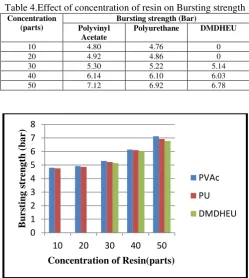
Table 4.Effect of concentration of resin on Bursting strength
Concentration (parts)
Bursting strength (Bar) Polyvinyl
Acetate
Polyurethane DMDHEU
10 4.80 4.76 0 20 4.92 4.86 0 30 5.30 5.22 5.14 40 6.14 6.10 6.03 50 7.12 6.92 6.78
Figure 4. Effect of concentration of Resin on Bursting strength
0 0.5 1 1.5 2 2.5 3 3.5 4 4.5 5
10 20 30 40 50
Air perm ea bil it y (cm ³/c m²/s ec )
Concentration of Resin(parts)
Pvac PU DMDH EU 0 1 2 3 4 5 6 7 8
10 20 30 40 50
B urs ting s tre ng th ( ba r)
Concentration of Resin(parts)
PVAc
PU
ISSN: 2319-8753
I
nternational
J
ournal of
I
nnovative
R
esearch in
S
cience,
E
ngineering and
T
echnology
(An ISO 3297: 2007 Certified Organization)
Vol. 2, Issue 10, October 2013
From Table No-4 & Fig.no.-4 It is observed that as the concentration of resins an increases there is an increase in Bursting strength of composites irrespective of type of resin, as concentration an increases from 10 to 50 parts, there is an increase in bursting strength, this may be because of an increase in crosslinking resin used for composite manufacturing. It is also observed that an increase in bursts trend in following manner in resins, PVAc>PU>DMDHEU. Also in case of PVAc there is a strong bond formation,which leads to higher bursting strength.
E. Effect of concentration of Resin on Water Resistance
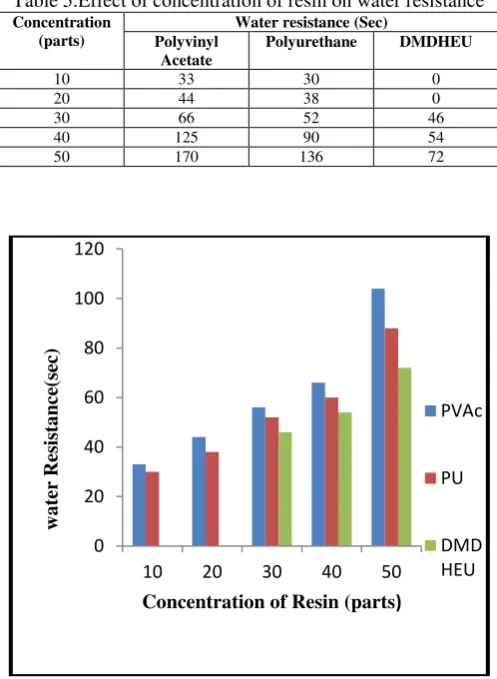
Table 5.Effect of concentration of resin on water resistance
Concentration (parts)
Water resistance (Sec) Polyvinyl
Acetate
Polyurethane DMDHEU
10 33 30 0 20 44 38 0 30 66 52 46 40 125 90 54 50 170 136 72
Figure 5. Effect of concentration of Resin on water resistance
From Table No-5 & Fig.No.-5 it is observed that as the concentration of resins an increases there is an increase in water Resistance of composites irrespective of type of resin.As concentration increases from 10 to 50 parts, there is an increase in Water Resistance, this may be because of an increase in crosslinking resin used for composite manufacturing. It is also observed that an increase in thickness trend in following manner in resins.PVAc>PU>DMDHEU. In this case PVAc forms thick film on the surface which causes an increase in water resistance.
V. CONCLUSION
From the above results and discussion we can conclude that, chicken feathers can be used for manufacturing of nonwoven by using chemical bonding technique .In this case polyvinyl acetate gives better results as compared to other
0 20 40 60 80 100 120
10 20 30 40 50
w
a
ter
Res
is
ta
n
ce(
sec)
Concentration of Resin (parts)
PVAc
PU
DMD
ISSN: 2319-8753
I
nternational
J
ournal of
I
nnovative
R
esearch in
S
cience,
E
ngineering and
T
echnology
(An ISO 3297: 2007 Certified Organization)
Vol. 2, Issue 10, October 2013
resins used for study. So chicken feathers along with polyvinyl acetate can be safely used for manufacturing of nonwoven.which controls the pollution load of chicken feathers.
REFERENCES
[1] Schmidt, W., “Agricultural Research Service”, USDA, Personal communication, 1999.
[2] Kumar, B.K., Kannaian, T., “Utilization of chicken feathers for the development of non-woven and characterization for value addition”, Journal of non-woven and technical textile, 2008, pp. 29-33.
[3] Barone, J.R., and Schmidt, W.F., “Compos SciTechnol”, Vol.65, 2005, pp.173–181.
[4] Jones, L.N., Riven, D.E., Tucker, D.J., “Handbook of Fibre Chemistry”, Marcel Dekker, Inc., New York 1998.
[5] Reddy, N., and Yang, Y., “Structure and Properties of Chicken Feather Barbs as Natural Protein Fibres”, Journal of polymers and the environment, 2007 ,pp. 81–87. .