International Journal of Research (IJR)
e-ISSN: 2348-6848, p- ISSN: 2348-795X Volume 2, Issue 3, March 2015Available at http://internationaljournalofresearch.org
To Study the Implementation of A Proposed Banking System
Teenam
College: - Malwa College Bathinda, India EMAIL ID: - [email protected]
ABSTRACT
Bank is the place where customers feel the sense of safety for their property. In the bank, customers deposit and withdraw their money. Transaction of money also is a part where customer takes shelter of the bank. Now to keep the belief and trust of customers, there is the positive need for management of the bank, which can handle all this with comfort and ease. Smooth and efficient management affects the satisfaction of the customers and staff members, indirectly. And of course, it encourages management committee in taking some needed decision for future enhancement of the bank. Now a day, managing a bank is tedious job up to certain limit. So software that reduces the work is essential. Also today’s world is a genuine computer world and is getting faster and faster day-by-day. Thus, considering above necessities, the software for bank management has became necessary which would be useful in managing the bank more efficiently.Hereby, our main objective is the customer’s satisfaction considering today’s faster world.
In the recent years, computers are included in almost all kind of works and jobs everyone come across in the routine. The availability of the software’s for almost every process or every system has taken the world in its top-gear and fastens the day-to-day life. So, we have tried our best to develop the software program for the Bank Management System where all the tasks to manage the bank system are performed easily and efficiently. It manages all the transactions like new account entry, deposit as well as withdraw entry, transaction of money for various processes, loan entry, managing bills cash or cheque, etc. Thus, above features of this software will save transaction time and therefore
increase the efficiency of the system. Requirements definition and management is recognized as a necessary step in the delivery of successful system s and software projects, discipline is also required by standards, regulations, and quality improvement initiatives. Creating and managing requirements is a challenge of IT, systems and product development projects or indeed for any activity where you have to manage a contractual relationship. Organization need to effectively define and manage requirements to ensure they are meeting needs of the customer, while proving compliance and staying on the schedule and within budget. The impact of a poorly expressed requirement can bring a business out of compliance or even cause injury or death. Requirements definition and management is an activity that can deliver a high, fast return on investment.
International Journal of Research (IJR)
e-ISSN: 2348-6848, p- ISSN: 2348-795X Volume 2, Issue 3, March 2015Available at http://internationaljournalofresearch.org
Keywords: -
Visual Basic 6.0 Programming; Database; Visual Basic Programming Control i.e. ADO and Reporting tool Crystal Report.
INTRODUCTION
The definition of a bank varies from country to country. See the relevant country page (below) for more information.Under English common law, a banker is defined as a person who carries on the business of banking, which is specified as:
conducting current accounts for his
customers,
paying cheques drawn on him/her, and
Collecting cheques for his/her customers.
In most common law jurisdictions there is a Bills of Exchange Act that codifies the law in relation to negotiable instruments, including cheques, and this Act contains a statutory definition of the term banker: banker includes a body of persons, whether incorporated or not, who carry on the business of banking' (Section 2, Interpretation). Although this definition seems circular, it is actually functional, because it ensures that the legal basis for bank transactions such as cheques does not depend on how the bank is structured or regulated.
The business of banking is in many English common law countries not defined by statute but by common law, the definition above. In other English common law jurisdictions there are statutory definitions of the business of banking or banking business. When looking at these definitions it is important to keep in minds that they are defining the business of banking for the purposes of the legislation, and not necessarily in general. In particular, most of the definitions are from legislation that has the purpose of regulating and supervising banks rather than regulating the actual business of banking. However, in many cases the statutory definition
closely mirrors the common law one. Examples of statutory definitions:
banking business" means the business of
receiving money on current or deposit account, paying and collecting cheques drawn by or paid in by customers, the making of advances to customers, and includes such other business as the Authority may prescribe for the purposes of this Act; (Banking Act (Singapore), Section 2, Interpretation).
"banking business" means the business of
either or both of the following:
receiving from the general public money
on current, deposit, savings or other similar account repayable on demand or within less than [3 months] ... or with a period of call or notice of less than that period;
Paying or collecting checks drawn by or
paid in by customers.
Since the advent of EFTPOS (Electronic Funds Transfer at Point Of Sale), direct credit, direct debit and internet banking, the cheque has lost its primacy in most banking systems as a payment instrument. This has led legal theorists to suggest that the cheque based definition should be broadened to include financial institutions that conduct current accounts for customers and enable customers to pay and be paid by third parties, even if they do not pay and collect checks
Economic Functions
The economic functions of banks include:
Issue of money, in the form of banknotes
International Journal of Research (IJR)
e-ISSN: 2348-6848, p- ISSN: 2348-795X Volume 2, Issue 3, March 2015Available at http://internationaljournalofresearch.org
drawing a check that the payee may bank or cash.
Netting and settlement of payments –
banks act as both collection and paying agents for customers, participating in
interbank clearing and settlement
systems to collect, present, be presented with, and pay payment instruments. This enables banks to economize on reserves held for settlement of payments, since inward and outward payments offset each other. It also enables the offsetting of payment flows between geographical areas, reducing the cost of settlement between them.
Credit intermediation – banks borrow
and lend back-to-back on their own account as middle men.
Credit quality improvement – banks lend
money to ordinary commercial and personal borrowers (ordinary credit quality), but are high quality borrowers.
The improvement comes from
diversification of the bank's assets and capital which provides a buffer to absorb losses without defaulting on its obligations. However, banknotes and deposits are generally unsecured; if the bank gets into difficulty and pledges assets as security, to raise the funding it needs to continue to operate, this puts the note holders and depositors in an economically subordinated position.
Asset liability mismatch/Maturity
transformation – banks borrow more on demand debt and short term debt, but provide more long term loans. In other words, they borrow short and lend long. With a stronger credit quality than most other borrowers, banks can do this by aggregating issues (e.g. accepting deposits and issuing banknotes) and redemptions (e.g. withdrawals and redemption of banknotes), maintaining reserves of cash, investing in marketable
securities that can be readily converted to cash if needed, and raising replacement funding as needed from various sources (e.g. wholesale cash markets and securities markets).
Money creation – whenever a bank gives
out a loan in a fractional-reserve banking system, a new sum of virtual money is created.
PROBLEM FORMULATION
Beforedevelopingresearchwekeepfollowing thingsinmindsothatwecan developpowerfulandqualityresearch. PROBLEM STATEMENTProblem statement was to design a module:
Which will be user friendly?
Which will restrict the user from
accessing other user’s data?
Which will help the user in viewing his
data and privileges?
Which will help the administrator to
handle all changes?
In which further additions can be made
without changing its design drastically.
Which would restrict the server traffic?
Risk management is an issue that needs to be stressed and investigated, especially in thebanking industry, where the need for a good
risk management structure is
International Journal of Research (IJR)
e-ISSN: 2348-6848, p- ISSN: 2348-795X Volume 2, Issue 3, March 2015Available at http://internationaljournalofresearch.org
the organizational structure of a bank. At thesame time an obvious effect from centralization can be that decisions are moreconcentrated to one level of the organizational hierarchy, whilst the opposite can be true for the decentralized structure (Andrews et al., 2009, pp. 58- 59). Through this, internalcontrol can also be affected by the degree
of centralization; therefore we argue
thatcentralization is a subject that needs to be
addressed in research of risk
management.Further the development of the Basel agreements has increased the requirements ofbanks risk management and therefore the question can be asked if the more stringentrequirements have affected the financial risk management structure of the Swedish banks.And as argued by Alonso, et al. (2008, pp. 145- 146) in that case has it contributed to amore centralized management structure with the focus to have control or a moredecentralized risk management with decisions taken closer to the operations. Thereforewe will combine these
concepts into the following problem
formulations:How does the financial risk management structure look like at three major SwedishBanks?How are the banks approach to financial risk management affected by howdecentralized their organizations are, and what effect does the increasingly stringentrules in the financial community have on the structure of the organization and its riskmanagement?
FUNCTIONS TO BE PROVIDED
The various features that the proposed system will possess will be:
The system will be user friendly and
completely menu-driven so that users shall have no problem in using all the options provided.
The system will be efficient and fast in
response by careful programming.
The system will be customized according
to the needs of the organization.
It will provide overall security to
database both from user as well as administrator side.
According to the situation of the problem, a solution is provided to use a Visual Basic programming connects with database of Bank according to requirement of the user.
The purpose of this study is to outline the relationship between the three variables ofcentralization, rules and regulations and financial risk management at three major banksin Sweden. We want to show the effect
more stringent rules and regulations,
stemmingfrom the Basel agreements, have on the degree of centralization in the bank’s riskmanagement. If we cannot observe any effect from these variables we will provide analternative explanation of what variables that relates to each other and how they relate toeach other. Further we wish to increase the general knowledge of which of the risksfacing the banks that are most likely to be managed at the different levels and contraston the differences between the banks investigated
The research on To Study the Implementation
of a Proposed Banking Systemis completely attached with database system. In this research we can attach visual basic 6.0 programming language, database with Crystal Reports. We can attach with database of a Bank and generate the Banking System with its development and implementation. If we required enter information on the form and create the print using print command then we are making a proposed system of Banking. So my research is that if we required enter the data of employees or Customers of any Bank then we can create a proposed Banking System, which is better for the Bank to make an efficient system. This research is completely based on coding.
RESEARCH METHODOLOGY
What is Algorithm in Computer
Science?
International Journal of Research (IJR)
e-ISSN: 2348-6848, p- ISSN: 2348-795X Volume 2, Issue 3, March 2015Available at http://internationaljournalofresearch.org
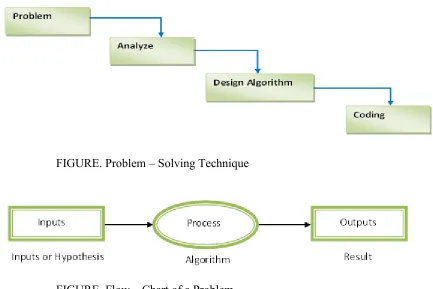
importance for programmers to do computer programming because it figures out the programming process. Algorithm is a part of problem-solving techniques. After the problem
has been raise, we have to analyze the problem first then the inputs and outputs are defined. After that we start to design the algorithm that is a process to transform inputs into outputs.
FIGURE. Problem – Solving Technique
FIGURE. Flow – Chart of a Problem
Problem: -Risk management is an issue that needs to be stressed and investigated, especially in thebanking industry, where the need for a good risk management structure is extremelyimportant. The European banking system has been very troubled by recent financialcrises, Swedish banks have however been resilient and managed these crises reasonablywell (FI, 2011, pp. 4-5) making it interesting to look more in depth in the Swedishbanks and their risk management.Since recent events in the financial industry have proven that one
person can beresponsible for a
companywide crisis, it is also very important to investigate the impactorganizational structure and internal control has on risk management. We argue thatcentralization can be a way to organize the organizational structure of a bank. At thesame time an obvious effect from centralization can be that decisions are moreconcentrated to one
International Journal of Research (IJR)
e-ISSN: 2348-6848, p- ISSN: 2348-795X Volume 2, Issue 3, March 2015Available at http://internationaljournalofresearch.org
management structure look like at three major SwedishBanks?How are the banks approach to financial risk management
affected by howdecentralized their
organizations are, and what effect does the increasingly stringentrules in the financial community have on the structure of the organization and its riskmanagement?
Analyze: - I analyze this problem which is serious and it should have easy solution. Then I have made an algorithm which is necessary to solve this problem. With the help of this algorithm and database model diagram in my research I am able to access the data or also able to generate the Proposed Banking System with the programming and support with database and give the results better for any Bank.
Design Algorithm: - The steps of this algorithm used in my research are as follow: -
1. Firstly I have made a database which
is Bank.mdb in MS Access. This database has several tables which are necessary for my research project.
2. My research project front-end is
Visual Basic 6.0 and back-end is MS
Access and platform used in this research is Window XP.
3. Then I have made the Bank Main
Form, New Account, Delete
Account, Transaction Form and etc which are used in visual basic programming language and make a connection provider with ODBC Connection and ADO which is used in VB components.
4. I connect this form with database and
database table through the
connection provider OLEDB.
5. These forms have the Account, Daily
Transaction and Monthly
Transaction form and etc. then I create all Banking reports which are used to generate the printout.
6. Finally I am able to create the Daily
and Monthly Transaction Details of the Customers sheets with the help of above forms and full analysis, study and implementation of banking system and maintain the Banking Transaction of any Bank which has the better and efficient system of any Bank. All the work is based on Visual basic programming, Database
system and crystal reports
RESULT
EXPERIMENTAL RESULTS
6.1 A PROPOSED PAYROLL SYSTEM
The research on To Study the Implementation of a Proposed Banking Systemis completely
International Journal of Research (IJR)
e-ISSN: 2348-6848, p- ISSN: 2348-795X Volume 2, Issue 3, March 2015Available at http://internationaljournalofresearch.org
FIGURE 1.My Research Banking Login Form
International Journal of Research (IJR)
e-ISSN: 2348-6848, p- ISSN: 2348-795X Volume 2, Issue 3, March 2015Available at http://internationaljournalofresearch.org
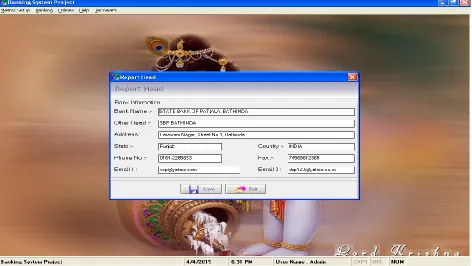
FIGURE 3.My Research Banking Report Head Form
International Journal of Research (IJR)
e-ISSN: 2348-6848, p- ISSN: 2348-795X Volume 2, Issue 3, March 2015Available at http://internationaljournalofresearch.org
FIGURE 5.My Research Banking Open New Account Form
International Journal of Research (IJR)
e-ISSN: 2348-6848, p- ISSN: 2348-795X Volume 2, Issue 3, March 2015Available at http://internationaljournalofresearch.org
FIGURE 7.My Research Banking Individual AccountForm
International Journal of Research (IJR)
e-ISSN: 2348-6848, p- ISSN: 2348-795X Volume 2, Issue 3, March 2015Available at http://internationaljournalofresearch.org
FIGURE 9.My Research Banking Daily Transaction Form
International Journal of Research (IJR)
e-ISSN: 2348-6848, p- ISSN: 2348-795X Volume 2, Issue 3, March 2015Available at http://internationaljournalofresearch.org
FIGURE 11.My Research Banking Close Account Form
International Journal of Research (IJR)
e-ISSN: 2348-6848, p- ISSN: 2348-795X Volume 2, Issue 3, March 2015Available at http://internationaljournalofresearch.org
CONCLUSION AND FUTURE
WORK
This chapter is based upon the conclusion of what we have done so far andhow the system can be further enhanced with an increase in requirements.
Conclusion
The threats to traditional banks may not happen overnight, but they will surely arrive. Peopleoften overestimate the impact of change in the short term, but they also underestimate it inthe long term. They recall that earlier promises about home banking and the cashlesssociety failed to materialize, and they now believe that even a vastly more effectiveinteractive medium will meet the same fate, forever. Those who hold these views will pay forthem, eventually.This is the most exciting period the world of finance has ever seen. There are tremendousopportunities for those who
succeed in marrying finance with
information technology, andtechnology with relationship management. Yes, banks have more opportunities than everbefore, but their customers opportunities have grown even more, and with it, the customers’bargaining strength. Yes, there is a chance for some of
those dinosaurs, as Bill Gates
hasdismissively called banks. There is a chance for some of them to quickly seize on thisopportunity and take a giant leap forward. For those who fail to be in the forefront, there willbe trying times ahead.As we begin to ponder on a way forward, let us
make sure that we keep these
globaldevelopments in mind and that we move towards building and Iraqi banking industry that iswell-positioned for the 21st century.
Future Enhancements
One could imagine that all these changes strengthened banks by making them faster,smarter, broader, and more global. But this is not so. Even though banks have becomebigger, they have been weakened.
One of the major reasons is that the new technologieshave accelerated the entry of rival institutions that were more adept in utilizing them. Today,American banks' share in borrowing has dropped from 36% in 1974 to less than 20%. Forthrift institutions, it dropped from 21% in 1976 to less than 8% in 2004. Commercial banks'share of total financial intermediary assets dropped from a steady 40% in the 60s through80s to below 30% in the latter half of the 1990s, the first time that deposits in non-bankswere greater than in banks.One major reason for the decline was the growth of alternative sources of funds. Informationtechnology enabled investors to evaluate securities and to be reached directly by borrowers.Thus, commercial paper outstanding as a percentage of business loans rose from around5% in the 1970s to above 35% in the 2000s. Computers could be used to evaluate credit riskby using various quantitative methods, and this made it possible for non-banks to transformloans into marketable securities. This technique of securitization by non-banks is now alsomoving to small business loans.In response, banks increased non-lending activities. The share of their non-interest incomerose, their commercial real estate loans; as a percentage of assets doubled. And theybegan to be heavily active
in financial derivatives. Widespread