In-medium
K
¯
interactions and bound states
Avraham Gal1,a, Eli Friedman1, Nir Barnea1, Aleš Cieplý2, Jiˇrí Mareš2, and Daniel Gazda3
1Racah Institute of Physics, The Hebrew University, Jerusalem 91904, Israel 2Nuclear Physics Institute, 25068 ˇRež, Czech Republic
3ECT*, Villa Tambosi, I-38123 Villazzano (Trento), Italy
Abstract.Correct treatment of subthreshold ¯KNdynamics is mandatory inK−-atom and ¯
K-nuclear bound-state calculations, as demonstrated by using in-medium chirally-based models of ¯KNinteractions. Recent studies of kaonic atom data reveal appreciable multi-nucleon contributions. ¯K-nuclear widths larger than 50 MeV are anticipated.
1 Introduction
The ¯KNinteraction near and below threshold is attractive in models that generate dynamically the subthresholds-wave resonanceΛ(1405), providing sound motivation to search forK−bound states in nuclei [1]. SubthresholdK−N scattering amplitudes are needed for calculating such states, even in kaonic atoms for which the kaon energy is essentially at threshold [2–4]. However, subthreshold
¯
KN scattering amplitudes are highly model dependent, as demonstrated in Fig. 1 showing that two distinct NLO chiral-model fits to scattering and reaction data above and at threshold could generate
K−p scattering amplitudes differing substantially from each other in the subthreshold region. Fit-I amplitude, nevertheless, is quite similar to the NLO amplitudes derived by Ikeda, Hyodo and Weise (IHW) [7] and by Cieplý and Smejkal (CS) [8], both of which were used in our recent calculations.
The present review follows Refs. [9, 10], highlighting recent progress made by the Prague-Jerusalem Collaboration towards incorporating medium modifications, particularly those implied by the energy dependence ofK−Nscattering amplitudes [11–16]. In-medium ¯KN scattering amplitudes are discussed in Sect. 2, focusing on the connection between their (subthreshold) energy and density dependencies. The use of such in-mediumK−N scattering amplitudes in kaonic-atom calculations and fits is discussed in Sect. 3. Related applications to kaonic bound-state calculations are discussed in Sect. 4 for few-body systems, and in Sect. 5 for many-body systems. A brief summary and outlook in Sect. 6 concludes this presentation.
2 In-medium amplitudes and energy versus density dependence
Here we follow Cieplý and Smejkal [8] who introduced meson-baryon coupled-channel energy-dependent separable s-wave interactions matched to SU(3) scattering amplitudes in up to next-to-leading order (NLO) of the chiral expansion for strangeness−1. It is gratifying that the Tomozawa-Weinberg LO term provides fair approximation to the corresponding ¯KN amplitudes [7, 8]. Solving
a. e-mail: [email protected]
C
Figure 1.Real (left panel) and imaginary (right panel) parts of theK−pcenter-of-mass (cm) scattering amplitudes generated in two NLO chiral-model fits [5]. TheK−pthreshold values marked by solid dots follow from the SIDDHARTA measurement of kaonic hydrogen 1slevel shift and width [6]. Figure adapted from Ref. [5].
the in-medium coupled-channel Lippmann-Schwinger equationsF =V+VGFwith these potential kernels leads to a separable form of in-medium scattering amplitudesFi j, given in the two-body cm system by
Fi j(k,k; √
s, ρ)=gi(k2)fi j( √
s, ρ)gj(k2), (1) with momentum-space form factorsgj(k2), where jruns over channels, and in-medium reduced am-plitudes fi j(
√
s, ρ) expressed as
fi j( √
s, ρ)=(1−v(√s)·G(√s, ρ))−1·v(√s)
i j . (2)
Here,Gis a channel-diagonal Green’s function in the nuclear medium:
Gn( √
s, ρ)=−4π
Ωn(ρ)
d3p (2π)3
g2 n(p2)
k2
n−p2−Π(n)( √
s, ρ)+i0 , (3)
where the integration on intermediate meson-baryon momenta is limited to a regionΩn(ρ) ensuring that the intermediate nucleon energy is above the Fermi level in channelsninvolving nucleons. The self-energyΠ(n)(√s, ρ) stands for the sum of hadron self-energies in channeln. Of particular interest is the meson (h) self-energyΠ(hhN) =(EN/
√
s)Πhin the diagonaln ≡ (hN) channel, where the lab self-energyΠhis given by
Πh( √
s, ρ)≡2ωhVh =− √
s EN
4πFhN(√s, ρ)ρ , (4)
depending implicitly onωh=mh−Bhand on the off-shell two-body momentak,k. This self-energy, once evaluatedself-consistentlywhile converting its √s dependence into a full density dependence, serves as input to the Klein-Gordon bound-state equation
[∇2+ω˜2h−m2h−Πh(ωh, ρ) ]ψ=0, (5)
in which ˜ωh =ωh−iΓh/2, withBh andΓh the binding energy and the width of the meson-nuclear bound state, respectively.
(MeV) 1/2 s
1300 1350 1400 1450 1500
(fm)
N
-K
Re f
0.0 0.5 1.0 1.5
Pauli+SE
free
Pauli
(MeV) 1/2 s
1300 1350 1400 1450 1500
(fm)
N
-K
Im f
0.0 0.5 1.0 1.5
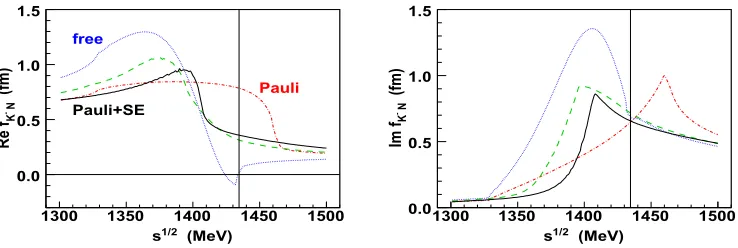
Figure 2.Near-threshold energy dependence ofK−Ncm reduced scattering amplitudes (left: real, right: imagi-nary) in model NLO30 of Ref. [8] for free-space (dotted) and Pauli-blocked amplitudes atρ=ρ0with (solid) and
without (dot-dashed) meson and baryon self-energies (SE). The dashed curves show Pauli-blocked amplitudes with SE atρ=0.5ρ0. TheK−Nthreshold is marked by a thin vertical line.
discussion below are relevant toK−atomic and nuclear states. The attraction as well as the imaginary-part absorptivity get moderately weaker forρ≥0.5ρ0, as demonstrated by comparing on the left panel the solid curves (ρ=ρ0) with the dashed curves (ρ=0.5ρ0). This implies thatK−bound states are very likely to exist, but with rather large widths generated by the imaginary-part absorptivity.
To determine the subthreshold energies for use in in-medium hadron-nucleon scattering ampli-tudes, we consider the downward energy shift δ√s ≡ √s− √sth where √sth ≡ mh +mN and
s = (√sth −Bh−BN)2−(ph+pN)2, with Bh andBN meson and nucleon binding energies. Since
ph+pN 0 in the meson-nuclear cm frame (approximately the lab frame), the associated negative contribution toshas to be included. To leading order in binding energies and kinetic energies with respect to rest masses, and specializing to ¯Kmesons (denotedh=K),δ√sis expressed as
δ√s≈ −BN−BK−ξN
p2 N 2mN
−ξK p2K 2mK
, ξN(K) ≡ mN (K) mN+mK
. (6)
Using the Fermi Gas model for nucleons and the local density approximation for ¯K, assuming also the minimal substitution (MS) principle [17], one obtains
δ√s≈ −BN
ρ
¯
ρ−ξN[BK
ρ ρ0
+TN(
ρ
¯
ρ)2
/3+ Vc(
ρ ρ0
)1/3]−ξK √
s
ωKEN
2πReFKN¯ (√s, ρ)ρ , (7)
whereVcis theK−Coulomb potential due to the finite-size nuclear charge distribution,TN =23.0 MeV is the average nucleon kinetic energy,BN ≈ 8.5 MeV is an average nucleon binding energy and ¯ρandρ0are the average nuclear density and nuclear-matter density, respectively. Expression (7) respects the low-density limit,δ√s → 0 uponρ → 0. For attractive scattering amplitudes, the last term of (7), in particular, provides substantial downward energy shift overlooked by many previous calculations that assumedpK =0 which is inappropriate forfinitenuclei. Since √s depends through Eq. (7) on ReFKN¯ (√s, ρ) which by itself depends on √s, it is clear that for a given value of BK,
0 0.2 0.4 0.6 0.8 1
ρ/ρ0
−90 −70 −50 −30 −10
E−E
th
(MeV)
Ni kaonic atoms
0.0 0.2 0.4 0.6 0.8
ρ/ρ0
0.0 0.2 0.4 0.6 0.8 1.0 1.2
F
eff K−N
(fm)
KNi
full Re
full Im
0.02 0.01 1N Re
1N Im
Figure 3.Left: subthreshold energies probed inK−-Ni atom as a function of nuclear density, calculated self-consistently within the IHW-based global fit to kaonic atoms using Eq. (7). Right: Kaonic-atom globally fitted amplitudeFeff
K−(ρ), marked “full", and the in-medium IHW-based amplitude FK−N(ρ) in the absence of many-nucleon contributions, marked “1N", as a function of nuclear density in Ni [16]. Solid (dashed) curves are for matching to free-space amplitudes at 0.02(0.01)ρ0.
state-dependent function of the densityρalone, denoted for brevity by FKN¯ (ρ). This correlation is shown on the left side of Fig. 3 for kaonic atoms, whereBK−≈0. The figure demonstrates appreciable
energy shifts below threshold in kaonic atoms, although these are somewhat smaller (by∼10 MeV in Ni) than the shifts evaluated in [16] without incorporating MS.
3
K
−interactions in kaonic atoms
The most recent kaonic-atom calculations are due to Friedman and Gal in Ref. [14], using in-mediumK−N scattering amplitudes generated from the Cieplý-Smejkal (CS) NLO30 model as de-scribed in the previous section, and in Ref. [16] using Pauli blockedK−Nscattering amplitudes gen-erated from the Ikeda-Hyodo-Weise (IHW) NLO work. The CS [8] and IHW [7] free-space ampli-tudesFK−N(
√
s) agree semi-quantitatively with each other. The kaonic-atom fit in Ref. [16] considers in addition to the in-medium IHW-based one-nucleon (1N) amplitudeFK−N(
√
s, ρ) input also many-nucleon absorptive and dispersive contributions, represented by energy-independent phenomenolog-ical amplitudeFmanyK−N(ρ) with prescribed density dependence form that includes several fit
parame-ters. The assumption of energy independence is motivated by observing thatK−absorption on two nucleons, which is expected to dominateFKmany−N, releases energy ∼mK− considerably larger than the subthreshold energies of less than 100 MeV encountered in kaonic-atom calculations. The self-energy inputΠK− to the KG equation (5) is now constructed from an effective K−N scattering amplitude FeKff−N =FKone−N+FKmany−N which is iterated through the self-consistency expression (7). This introduces
coupling between the many-nucleon fitted amplitudeFmanyK−N and the converged one-nucleon amplitude FoneK−Nthat evolves from the 1N input amplitudeFK−N(ρ):FoneK−N(ρ)→FK−N(ρ) uponFmanyK−N →0.
The full effective amplitudeFeff
K−N(ρ) resulting from the global kaonic-atom fit in [16] is shown in the right panel of Fig. 3 marked “full", along with the in-medium IHW-based amplitudeFK−N(ρ)
0 1 2 3 4 5 6 7
r (fm)
−100 −60 −20
Im V
K
− (MeV)
−200 −160 −120 −80 −40 0
Re V
K
− (MeV)
K− Ni potentials
IHW
NLO30
IHW NLO30
0 1 2 3 4 5 6 7
r (fm)
−100 −60 −20
Im V
K
− (MeV)
−200 −160 −120 −80 −40 0
Re V
K
− (MeV)
K− Ni potentials
IHW
IHW 1N
1N
mN
mN
Figure 4.Left: Self-consistentK−nuclear potentialsVK−forK−atoms of Ni derived from global fits based on in-medium IHW amplitudes [16], with the corresponding 1N and many-nucleon (mN) components on the right panel. The dashed curves in the left panel are derived from in-medium NLO30 amplitudes [14].
The K− nuclear attraction and absorptivity deduced from global kaonic-atom fits are sizable at central nuclear densities. This is demonstrated for Ni in Fig. 4 by the real and imaginary parts of the potentialVK− defined by (4). Although the potential depths might reflect merely a smooth extrapo-lation provided by the input components of theK−N amplitude, the potential at 0.5ρ0 and perhaps up to 0.9ρ0is reliably determined in kaonic-atom fits [18]. It is reassuring that both IHW-based and NLO30-based fits agree with each other semi-quantitatively as shown on the left panel. The right panel of Fig. 4 shows a non-additive splitting of the fittedK−-nuclear potential into a 1N in-medium component, obtained on the assumption that there is no many-nucleon (mN) component present, and a fitted mN component. The composition of the imaginary part of the potential is of particular interest, indicating that the mN component which is sizable in the nuclear interior becomes negligible about half a fermi outside of the half-density radius. This has implications for choosing optimally kaonic-atom candidates where widths of two kaonic-atomic levels can be measured so as to substantiate the 1N vs mN pattern observed in global fits [19].
4 Few-body kaonic quasibound states
ForK−-nuclear three- and four-body calculations, a variant of the downward energy shift Eq. (7) derived for many-body calculations was formulated by Barnea, Gal and Liverts [13]:
δ√s=−B
A− A−1
A BK−ξN A−1
A TN:N −ξK
A−1
A 2
TK, (8)
s
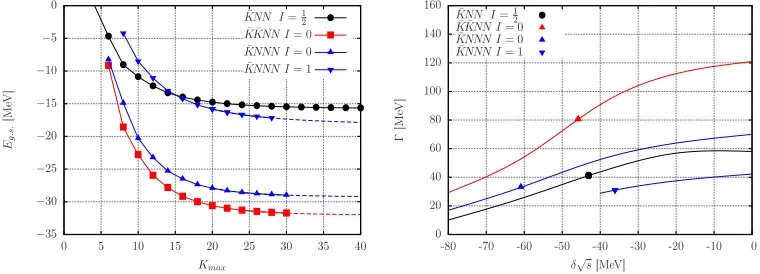
cycle upon requiring that√s derived through Eq. (8) from the solution of the Schroedinger equation agrees with the value of√s used for the inputVKN¯ (√s). Converged total binding energies calculated variationally in the hyperspherical basis are shown on the left panel of Fig. 5 for three- and four-body kaonic bound states. The corresponding ¯KN →πYwidths, calculated using the approximation
Γ
2 ≈ Ψg.s.| −ImVKN¯ |Ψg.s., (9)
whereVKN¯ consists of all pairwise ¯KN interactions, are plotted on the right panel as a function of
δ√s, with self-consistent values marked on each one of theΓ-vs-δ√s curves. Eq. (9) provides a good approximation owing to|ImVKN¯ | |ReVKN¯ |[20]. Expressions similar to (8) and (9) were used in
¯
KKNN¯ calculations. For details of the chirally-based energy-dependent ¯KNinteraction input and the actual calculations of these few-body kaonic clusters, see Ref. [13].
−35
−30
−25
−20
−15
−10
−5 0
0 5 10 15 20 25 30 35 40
Eg.
s.
[Me
V
]
Kmax ¯
KNN I=1 2
¯
KKNN I¯ = 0 ¯
KNNN I= 0 ¯
KNNN I= 1
0 20 40 60 80 100 120 140 160
-80 -70 -60 -50 -40 -30 -20 -10 0
Γ
[Me
V
]
δ√s[MeV] ¯
KNN I=1 2
¯
KKNN I¯ = 0 ¯
KNNN I= 0 ¯
KNNN I= 1
Figure 5.Left: binding energies of ¯K and ¯KK¯ few-body quasibound states from Ref. [13] calculated self-consistently and plotted here as a function of the maximal total grand angular momentumKmax in the
hyper-spherical basis. Right: ¯KN→πYwidths (9) plotted as a function ofδ√s (8).
¯
KNN−πΣNcoupled-channel Faddeev calculation [22]. The 6 MeV missing in this crude estimate is of the order of magnitude expected [24] from upgrading a ¯KNN single-channel calculation to a
¯
KNN−πΣNcoupled-channel calculation. In this respect we reject the unfounded criticism made by RS of the self-consistency procedure application in Ref. [13].
The widths exhibited in the figure, of order 40 MeV for single- ¯Kclusters and twice that for double-¯
Kclusters, are due to ¯KN → πY. Additional ¯KNN → YNcontributions of up to∼10 MeV inK−pp
[23] (see, however, the estimateΓKNN¯ →YN ∼30 MeV made in Ref. [25]) and∼20 MeV in the four-body systems [13] are foreseen. Altogether, widths of order 50 MeV or higher are anticipated for few-body kaonic quasibound states.
5 Many-body kaonic quasibound states
In-medium ¯KNscattering amplitudes derived from the chirally motivated NLO30 model [8] were employed by Gazda and Mareš [15] to evaluate self-consistently K− quasibound states across the periodic table, using static RMF nuclear-core densities. CalculatedK−binding energies and widths in Ca are listed in Table 1 for several choices of input interactions.
Table 1.Self-consistently calculated binding energiesBKand widthsΓK(in MeV) ofK−quasibound states in Ca, using a static RMF Ca density and NLO30 in-mediumK−Nsubthreshold amplitudes, see text.
NLO30 +pwave +2Nabs.
BK ΓK BK ΓK BK ΓK 1sK 70.5 14.9 73.0 14.8 68.9 58.9 1pK 50.6 18.0 53.1 17.9 49.2 53.6 1dK 28.8 30.3 32.1 29.3 27.7 59.7 2sK 23.9 33.8 26.3 34.2 21.6 67.1
In addition to BK andΓK values for NLO30 in-medium s-waveK−N interactions, we listed in Table 1 values derived (i) by adding aΣ(1385)-motivated p-wave K−N interaction from Ref. [26], thereby increasingBK marginally by a few MeV and modifyingΓK by less than 1 MeV, or (ii) by adding a two-nucleon (2N)K−NN→YNabsorption term estimated from fitting to kaonic atoms, re-sulting in2 MeV decrease of BK but substantially increasing the width to ΓK ∼ (50−70) MeV. Given these large widths, it is unlikely that distinct quasibound states can be uniquely resolved, ex-cept perhaps in very lightK−nuclei.
The hierarchy of widths listed in Table 1 is also worth noting. With energy-independent poten-tials one expects maximal widths for the lowest, most localized 1sK states, and gradualy decreased widths in excited states which are less localized within the nucleus. The reverse is observed here, in particular upon excluding 2Nabsorption. This is a corollary of requiring self consistency: the more excited aK−quasibound state is, the lower nuclear density it feels, and a smaller downward shift into subthreshold energies it probes via the s(ρ) dependence. Since ImfK−N(ρ) decreases strongly upon going below threshold, see Fig. 2, its contribution to the calculated width gets larger, the higher the excited quasibound-state energy is.
6 Summary and outlook
K
data we argued that the in-medium chiral model input has to be supplemented by appreciable many-nucleon dispersive and absorptive potential contributions which imply uniformly large widths of order 50 MeV and more for ¯K-nuclear bound states. The experimental thrust at present and in the near future hinges onK−ppsearches, as reviewed by Nagae in this conference [27].
Acknowledgements
This work was supported by the GACR Grant No. 203/12/2126, as well as by the EU initiative FP7, Hadron-Physics3, under the SPHERE and LEANNIS cooperation programs.
References
[1] T. Hyodo, Nucl. Phys. A914, 260 (2013) [2] S. Wycech, Nucl. Phys. B28, 541 (1971)
[3] W.A. Bardeen, E.W. Torigoe, Phys. Lett. B38, 135 (1972) [4] J.R. Rook, Nucl. Phys. A249, 466 (1975)
[5] Z.-H. Guo, J.A. Oller, Phys. Rev. C87, 035202 (2013)
[6] M. Bazzi et al. (SIDDHARTA Collaboration), Phys. Lett. B704, 113 (2011), Nucl. Phys. A881, 88 (2012)
[7] Y. Ikeda, T. Hyodo, W. Weise, Phys. Lett. B706, 63 (2011), Nucl. Phys. A881, 98 (2012) [8] A. Cieplý, J. Smejkal, Nucl. Phys. A881, 115 (2012)
[9] A. Gal, Nucl. Phys. A914, 270 (2013)
[10] A. Gal, E. Friedman, N. Barnea, A. Cieplý, J. Mareš, D. Gazda, Acta Phys. Polon. B45, 673 (2014)
[11] A. Cieplý, E. Friedman, A. Gal, D. Gazda, J. Mareš, Phys. Lett. B702, 402 (2011), Phys. Rev. C84, 045206 (2011)
[12] A. Cieplý, E. Friedman, A. Gal, V. Krejˇciˇrík, Phys. Lett. B698, 226 (2011) [13] N. Barnea, A. Gal, E.Z. Liverts, Phys. Lett. B712, 132 (2012)
[14] E. Friedman, A. Gal, Nucl. Phys. A881, 150 (2012) [15] D. Gazda, J. Mareš, Nucl. Phys. A881, 159 (2012) [16] E. Friedman, A. Gal, Nucl. Phys. A899, 60 (2013) [17] E. Friedman, A. Gal, Nucl. Phys. A928, 128 (2014) [18] N. Barnea, E. Friedman, Phys. Rev. C75, 022202(R) (2007) [19] E. Friedman, S. Okada, Nucl. Phys. A915, 170 (2013) [20] T. Hyodo, W. Weise, Phys. Rev. C77, 035204 (2008)
[21] S. Maeda, Y. Akaishi, T. Yamazaki, Proc. Jpn. Acad. B89, 418 (2013) [22] J. Révai, N.V. Shevchenko, Phys. Rev. C90, 034004 (2014)
[23] A. Doté, T. Hyodo, W. Weise, Nucl. Phys. A804, 197 (2008), Phys. Rev. C79, 014003 (2009) [24] Y. Ikeda, T. Sato, Phys. Rev. C79, 035201 (2009)
![Figure 1. Real (left panel) and imaginary (right panel) parts of thegenerated in two NLO chiral-model fits [5]](https://thumb-us.123doks.com/thumbv2/123dok_us/8187832.1367453/2.482.62.419.81.209/figure-real-panel-imaginary-right-panel-thegenerated-chiral.webp)
![Figure 3. Left: subthreshold energies probed innucleon contributions, marked “1N", as a function of nuclear density in Ni [16]](https://thumb-us.123doks.com/thumbv2/123dok_us/8187832.1367453/4.482.48.437.80.211/figure-subthreshold-energies-innucleon-contributions-function-nuclear-density.webp)
![Figure 4. Left: Self-consistent K− nuclear potentials VK− for K− atoms of Ni derived from global fits based onin-medium IHW amplitudes [16], with the corresponding 1N and many-nucleon (mN) components on the rightpanel](https://thumb-us.123doks.com/thumbv2/123dok_us/8187832.1367453/5.482.44.436.83.279/consistent-potentials-derived-amplitudes-corresponding-nucleon-components-rightpanel.webp)