Running head: ETHICAL BELIEFS AND BEHAVIOURS
The Ethical Beliefs and Behaviours of Victorian Fitness Professionals
Andrew Dawson, Mark B. Andersen and Dennis Hemphill Victoria University
Date Submitted: July 14, 2000
All correspondence concerning this article should be addressed to: Mark Andersen, Centre for Rehabilitation, Exercise and Sport Science, Victoria University, P.O. Box 14428, Melbourne City MC, 8001, Australia. Email may be sent via the internet to:
Abstract
Ethical Beliefs and Behaviours of Victorian Fitness Professionals Literature Review
Several professions in the area of health and human development have emerged in the 20th century to complement the role of medicine in improving health, promoting well being, and treating disease. Such professions include physiotherapy, osteopathy, podiatry, dietetics, and psychology. Over the past two decades, there has been rapid growth in the development of what is now termed the fitness “industry” in Australia. This growth has followed similar trends in the U.S.A., U.K., and Canada. The fitness industry is gradually evolving to establish itself as an allied health and helping profession.
The complex roles of the fitness professional can be grouped into three types of activities: health evaluation and fitness testing, exercise prescription and leadership, and health education. Detailed health evaluations often require personal information about health behaviours, and fitness assessments usually involve “hands-on” techniques for skinfold and girth measurements. Exercise prescription and leadership revolve around designing and implementing exercise programs, conducting exercise-to-music sessions, supervising fitness activities such as circuit training and power-walking with small groups of people, and
providing personalised fitness training services. Fitness professionals are also involved in the education and promotion of exercise and physical activity for the health and well-being of individuals and groups.
practitioner, creating relationships and situations that may present the fitness professional with some ethical challenges. Some of these challenges may relate to the degree and
appropriateness of body contact or intimacy in the practitioner-client relationship. Hemphill (1993) also raised concerns dealing with informed and voluntary consent, privacy, and confidentiality of results in fitness testing.
Survey Research in the Fitness Profession
The only research that has involved ethics in the fitness profession is that of Gavin (1996) who surveyed 228 experienced North American personal trainers on perceived role responsibilities, conflicts, and boundary issues. The most problematic behaviours of the personal trainers in his study were that some of them believed their clients came to them with more than exercise agendas, often compelling them to give advice about diet, health, and emotional issues. Personal trainers’ qualifications in dispensing such information is questionable, and Gavin suggested that some personal trainers were knowingly violating professional boundaries of competence by responding to pressure from their clients to work outside their realms of expertise.
Gavin (1996) considered the high frequency of consultations, often as many as three sessions per week with one client over an average of more than half a year, to be a
contributing factor for personal trainers developing special relationships with their clients. The intense physical nature of the training, coupled with clients being physically exposed in their workout apparel, enhanced their vulnerability. Several behaviours not endorsed by the APA (1992) ethical principles and code of conduct, but evident in Gavin’s research (e.g., establishing social friendships) were considered acceptable for personal trainers.
they should be responsible for their clients’ satisfaction about training and emotional well-being. Gavin believed that some clients had a greater interest in the social and psychological aspects of the professional relationship, indicating that the boundary slippage originated more with the clients than the trainers. These findings were supported by interviews Gavin
conducted with several personal trainers who believed that some of their clients were hiring them for social support and personal affirmation instead of their stated physical goals. The Australian Fitness Industry
There are major shortcomings in the Australian fitness industry with respect to professionalism and ethics. Compared to the psychology, physiotherapy, and to a lesser degree, the massage therapy professions, the fitness industry has not fully developed the professionalism of its workers, nor has it established comprehensive ethical principles and a code of practice. There are no useful codes of conduct for fitness professionals. The only codes available in Australia have been limited to the professional-consumer business
relationship and resemble risk management guidelines. Little has been done to address client-practitioner relationships. A recent development to emerge from the USA is the publication of a code of ethics for personal trainers by the International Dance and Exercise Association (IDEA) in 1998. It addresses issues such as the erosion of professional boundaries, the prevalence of exploitative dual relationships, and deceptive business practices.
In addition, there are few provisions for, or adequate training in, ethics in either the Technical and Further Education (TAFE) colleges or university fitness related courses, and there are minimal certification standards. Given this background, it was the aim of this study to examine the ethical beliefs and behaviours of Victorian fitness professionals. The key research questions are: (a) what are the ethical beliefs and behaviours of Victorian fitness professionals?, (b) are there any behaviours where fitness professionals are in near universal agreement as to whether the behaviour is ethical or unethical?, (c) are there any ethical beliefs or behaviours where opinion varies widely (is controversial)?, and (d) are there any
Method
The methods used in this investigation were adapted from previous surveys of ethical issues within various subfields of psychology such as Petitpas, Brewer, Rivera, and Van Raalte (1994), Pope, Tabachnick, and Keith-Spiegel (1987), Tabachnick, Keith-Spiegel and pope (1991), and Pope and Vetter (1992).
The 52-item “Professional Practice Questionnaire” used in this study is a modified version of the questionnaire Petitpas et al. (1994) used for a sport psychology ethics investigation. The reason for making the modifications was to present questions in an Australian fitness industry-relevant manner. The survey contained items on demographic information (i.e., gender, age, fitness education, discipline, specialisation, primary work setting, registration, hours per week in applied fitness work, membership of professional organisations, current studies in fitness), one question on coursework training in ethics, six questions on formal supervision, three questions concerning knowledge of a professional code of conduct, and 37 structured response questions about ethical beliefs and behaviours. The 37 items required two-part responses to: (a) behaviours “how often does this occur in your work,” rated on a Likert scale from 1 (never) to 5 (very often); and (b) beliefs, “how ethical do you believe this behaviour is,” rated from 1 (no, definitely unethical) to 3 (don’t know/not sure) to 5 (yes, definitely ethical). Two open-ended response questions on ethical beliefs and behaviours and one item for participants to make any further comments
completed the survey. Thirteen irrelevant items were removed from the original survey (e.g., reporting recruiting violations to appropriate officials), and three fitness industry specific items added (i.e., providing dietary advise without proper training in nutrition; using measurement equipment without proper training; and prescribing injury rehabilitation exercises without proper training) (survey available from the first author).
questionable ethical practices in the fitness industry that you have observed, and mention any actions that you may have taken in response to these questionable practices” and (c) “please make additional comments regarding specific items or ethical issues in the fitness industry here.” Using a procedure similar to Petitpas et al. (1994), the incidents were content analyzed and divided into nine general categories that reflect the principles of the Australian
Psychological Society (1994) code of ethics, the Australian Physiotherapy Association (1994) ethical principles, and the National Council of Massage and Allied Health Practitioners (1997) code of ethics.
Participants who were mailed the survey were either professional members of the Victorian Council on Fitness and General Health (VICFIT) (n = 572) or private and
government fitness professionals not registered with VICFIT (n = 100). Of the 672 surveys distributed, 105 were returned because of incomplete or wrong addresses, for a total of 567 participants contacted.
Results
The first section of the survey generated information about the demographic
privately owned fitness facilities, 29% at local government owned and managed fitness facilities, and 12% indicated they worked at other venues such as clients’ homes.
Exposure to ethical standards. One fifth of the respondents received specific training in ethics. Close to one quarter (24%) of the respondents reported that they had taken one or more courses with an ethics component. A small portion of the sample (6%) indicated that they had gained information on ethical standards in a workshop context (e.g., at professional conferences). Less than one tenth (9%) of respondents reported that they had been exposed to ethical standards through independent study (e.g., reading journal articles, textbooks, ethical guidelines).
Supervised practice. Most respondents indicated they had completed supervised practice (83%). Less than one fifth (19%) of all respondents were being supervised at the time the survey was being conducted. Less than 1 in 10 (6%) reported they received
supervision on a regular basis, and 6% reported they received supervision on an “as needed” basis. A small proportion of respondents (13%) reported that they had not been supervised as part of their training. The most commonly cited source of supervision was a fellow gym instructor (24%), followed by the gym manager (19%). Almost one quarter of all respondents (24%) were supervising the work of others, but fewer (17%) had received any training in supervision.
Knowledge of ethical codes More than one fifth (21%) of the respondents knew of the existence of a business related code of ethics for the fitness industry. Only 19% of fitness professionals used the code to guide their professional behaviour. Just over a third (37%) of respondents indicated that they used other codes to guide their professional behaviour. Beliefs and Behaviours
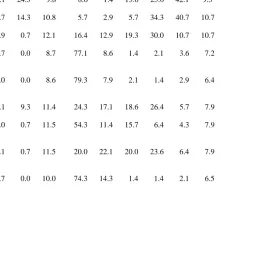
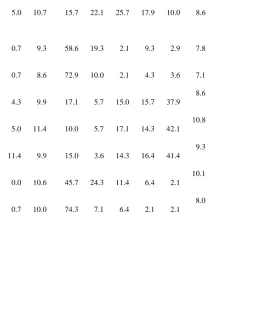
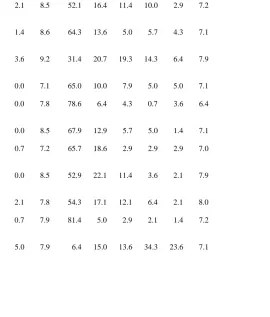
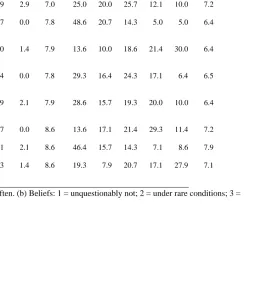
were disparities between the distribution of responses for beliefs and behaviours for several items.
Each item was visually examined, with substantial differences in distribution appearing in items categorized as business practices, professional competence, personal issues, breaches in confidentiality, and dual relationships. For the items that had substantial differences between the distribution of scores for a behaviour and beliefs about it, the following sums were made. For behaviours, all categories where the behaviour was present were added (e.g., rarely, sometimes, fairly often, often, always). For example, on the items about sexual involvement, the investigators wanted to know how many people had at any time engaged in such behaviour, so all responses 2 to 5 needed to be added. For beliefs, all categories where the belief could be considered ethical at some time were added (e.g., ethical under rare circumstances, ethical under many circumstances, yes, definitely ethical). For example, on the items about sexual involvement the investigators wanted know how many people believed it was ethical to engage in such behaviour, so responses 2, 4, and 5 needed to be added. Response 3 “don’t know/not sure” was not included, but was reported separately as it represented uncertainty about the behaviour rather than a belief.
Business practices. Disparities in distribution appeared in several items relating to the business practices of respondents. For example, on item 9 “Accepting goods/services in exchange for fitness instruction/personal training consultation,” there was a considerable discrepancy between respondents’ behaviours and beliefs; 65% of fitness professionals said they had never received goods or services for their work, but more than half of the
respondents believed it was acceptable behaviour.
training. A similar result appeared for item 20 “Prescribing injury rehabilitation exercises without proper training.” Almost two fifths (19%) of respondents had at some stage prescribed injury rehabilitation exercises without proper training, and close to a quarter (24%) believed it was ethical behaviour.
Personal issues. Discrepancies appeared for several items relating to personal issues. For example, item 37, “Refusing to continue working with a client after you discover he or she is involved in illegal activity,” a high proportion of respondents (74%) had not
participated in such activities but a large proportion of respondents (53%) believed it was acceptable behaviour.
Breaches in confidentiality. A discrepancy appeared between the behaviours and beliefs of respondents for item 14 “Reporting a client who is using or selling illegal substances,” and item 15 “Reporting a client who has committed a serious crime.” A large proportion of respondents believed that these behaviours were acceptable.
Dual relationships. In response to item 30, close to half (48%) of the fitness
professionals reported “Being sexually attracted to a client,” whereas more than two fifths of respondents believed it was acceptable behaviour. Item 31 “Becoming sexually involved with a client while delivering professional services” also provided some interesting results. A small proportion (14%) of respondents had engaged in sexual activities with at least one of their clients at some stage in their work. A larger proportion fitness professionals (31%) believed it was acceptable behaviour and a quarter of the respondents were unsure. A small proportion of respondents (17%) had become sexually involved with a client after
Procedures adapted from Petitpas et al. (1994), Pope et al. (1987), and Tabachnick et al. (1991) were used to examine beliefs and behaviours identifying rare behaviours, nearly universal behaviours, difficult judgements, and controversial behaviours. Pope et al. (1987) defined a “rare behaviour” as “one acknowledged by less than 5% of the respondents” (p. 144). None of the 37 behaviours met the criterion. More than 5% of respondents participated in each of the 37 behaviours. According to Pope et al. (1987) and Tabachnick et al. (1991), the criterion for a “nearly universal behaviour” is to be acknowledged by at least 90% of the respondents. None of the 37 behaviours met this criterion. Tabachnick et al. (1991) defined a “difficult judgement” as “one in which at least 25% of respondents indicated “don’t know/not sure” in terms of beliefs about whether the behavior was ethical” (pp. 512-513). Applying this definition to the current study, nine items were identified as difficult judgements. For example, item 11 “Consulting with a client who is receiving fitness/personal training services from another professional at the same time.” More than a quarter of the difficult judgements related to sexual issues and several difficult judgements related to business concerns. The difficult judgement items are shown in Table 2.
For items scored on a 1 to 5 scale, Tabachnick et al. (1991) defined a controversial behaviour as “one in which the ethical judgements were so diverse that the SD > 1.25” (p. 513). Using this criterion, six items were identified as controversial behaviours These controversial behaviours are displayed in Table 3. Using the same criterion for controversial beliefs, there were numerous items where there was little consensus for the ethical beliefs of fitness professionals. There were 19 items identified as controversial beliefs; they are
displayed in Table 4.
Open-Ended Responses Ethical Dilemmas
troubling incidents reported by respondents fell into thee categories: client welfare and/or gym safety, intimacy or sexual behaviour, and business/management practices. Frequencies of incidents relating to the nine categories are displayed in Table 5.
Questionable Practices
The majority of respondents (n = 98) did not report any ethically questionable
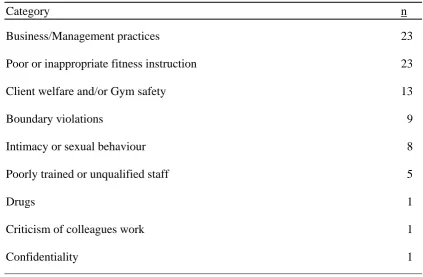
practices. Forty-two respondents identified 84 questionable ethical practices. The behaviours were divided into the nine general categories used in the analysis of the first open-ended item. The majority of questionable practices reported by respondents fell into three categories: business/management practices, poor or inappropriate fitness instruction, and client welfare and/or gym safety. Frequencies of incidents relating to the nine categories are displayed in Table 6.
Specific Items or Ethical Issues
The third open ended response item, asking respondents to “Please make any additional comments regarding specific items or ethical issues in the fitness industry here,” generated responses relating to themes of “Professionalism” where several respondents expressed concern that the level of education for neophyte fitness professionals was
inadequate for the ethically and technically challenging situations they faced on a daily basis. The second theme to emerge was based on respondents concern about “Industry Image” in relation to the elitist attitudes of some colleagues and their general disregard for the poor image of the fitness industry. The final general theme to emerge was “Work Issues” where job satisfaction was low and instructors were frustrated at the lack of incentives and low pay.
Discussion
contributed to a lack of understanding and confusion about appropriate and inappropriate behaviour.
Ethical Beliefs and Behaviours
Investigations into the beliefs and behaviours of American psychologists by Pope et al. (1987) and sport psychologists by Petitpas et al. (1994) revealed that both groups of professionals practiced in accordance with their ethical beliefs. Because there were
discrepancies between the beliefs and behaviours of fitness professionals for several of the 37 structured response items, and the responses to the open-ended survey items presented a range of questionable professional behaviours, the results suggest that the fitness
professionals (in this sample), in some cases, are not practicing in accordance with their beliefs and are often unsure of the appropriateness of some behaviours with clients.
Substantial differences in distribution appeared in several items when visually comparing behaviours to beliefs suggesting that Victorian fitness professionals not only had some questionable ethical beliefs but in some cases acted inappropriately (at least by most helping profession standards), possibly jeopardising the welfare of their clients. The
responses to the open-ended questions also revealed a broad range of questionable behaviours by Victorian fitness professionals such as dual relationships, breaches in confidentiality, unsafe exercise prescription, and deceptive business practices.
Business practices. Discrepancies between beliefs and behaviours of respondents were evident when fitness professionals in this sample were asked about promoting themselves and their services. A large proportion of respondents believed that publicly claiming their
professional status was acceptable behaviour, but few actually did so on a regular basis. Similarly, when it came to advertising their fitness services, the majority of respondents believed it was acceptable behaviour, but a large proportion had never engaged in such behaviour. One possible explanation for this belief is that many Australian health
professionals, including medical practitioners, psychologists, physiotherapists, and massage therapists, advertise their services via the electronic and print media and, therefore, it is reasonable for fitness professionals to assume that marketing themselves to attract customers is in line with other helping professions (and so it is). Another reason for so few respondents actually advertising their services is that marketing oneself is expensive, and a large referral source for personal training is the fitness centres they already work at and, therefore, they do not need to market themselves.
Professional issues. Questionable behaviours such as consulting with a client who is receiving fitness services from another professional at the same time and some breaches in confidentiality occurred on a moderate basis and were considered acceptable behaviour by many of the respondents. One could speculate that limited ethics education has contributed to the prevalence of these questionable behaviours and beliefs.
Ethical misconduct such as breaches in confidentiality is dealt with by the ethics committees of professional societies (e.g., in psychology, the APS or the state registration board if the behaviour is in breach of the registration act). A point of considerable concern is that Australian fitness professionals have no professional society to provide guidance and education on ethical matters. Organisations such as VICFIT and Fitness Victoria can only provide minimal regulation and are more concerned with the business practice of fitness centres and the basic technical education of fitness professionals than the behaviour of
individual registrants. VICFIT can suspend or cancel the registration of offending individuals but are unable to stop them from continuing work as fitness professionals. Individuals who have been exposed to unethical conduct by fitness professionals also have no way of taking action against an offending professional except by complaining to management or initiating litigation. Another concern that emerged from the qualitative data was the lack of action taken by fitness professionals when they observed questionable ethical practices by either a colleague or management. Several respondents feared reprisals such as losing their jobs if they spoke out, and several felt powerless to do anything because management were generally unresponsive.
Personal issues. Close to half of the respondents in this investigation were working with clients even though they were opposed to their sexual orientation or religious practices, and a high proportion believed it was acceptable behaviour (and in may cases it is as long as the “opposition” does not affect service). Such behaviour raises concerns that clients may not be receiving adequate professional service. One possible explanation for this finding is that fitness professionals have no choice about the clients they initially work with and advise.
Breaches in confidentiality. Another disturbing trend to emerge from the results was the number of respondents who believed that sharing client information with colleagues and, to a lesser extent, gym members was in some cases acceptable behaviour. Respondents also believed that reporting illegal substance users or sellers and criminals to authorities was acceptable. Breaching the confidentiality between the client and the professional is in most cases unethical and seriously undermines the trust that is implied in that relationship. All of the helping professional codes of ethics and practice are explicit in their direction that
confidentiality must be maintained unless permission from the client is given (unless harm to self or others seems possible). Some fitness professionals may accidentally reveal personal information about their clients when seeking assistance from a colleague about designing a difficult exercise program. These results suggest that education about issues of confidentiality and protection of client information need to be improved.
in the service industries. A large proportion of ethical misconduct by North American
psychologists has been related to dual relationships between the client and practitioner where the psychologist became either socially or intimately involved with a client (Borys & Pope, 1989; Pope & Vetter, 1992; Pope et al., 1987). More than half of the respondents admitted to being sexually attracted to their clients at some stage in their work, which is not surprising considering the physical contact, the revealing exercise attire of clients, and the social nature of their work.
The belief that sexual activity with a client while delivering services is acceptable is of major concern because it indicates that some fitness professionals either have no concern for the emotional welfare of their clients or have little understanding of how such intimate relationships can compromise professional service delivery and be harmful. Professions such as psychology (APS, 1994) and physiotherapy (APA, 1994) stipulate that a set period of time must pass after termination of the professional relationship before intimacy between the client and practitioner can commence. A small proportion of respondents became sexually involved with clients after discontinuing their professional relationship. More than two thirds of the sample also believed sexual involvement with clients after termination of the professional relationship was acceptable behaviour.
Entering into a business relationship with a client was also considered acceptable behaviour by more than half of the sample, even though three quarters had never engaged in such activity. The potential for fitness professionals to engage in activities such as intimate and business relationships with clients is quite high and troublesome. These results suggest that further education in professional ethics in the fitness industry is needed to reduce the potential for exploitation of clients.
Limitations
unprofessional, even though anonymity was assured. Alternatively, Victorian fitness professionals might not have considered the issues contained in the questionnaire to be
important, and thus, did not feel the need to respond, which if true, would be a troubling issue in itself.
Conclusions and Recommendations
Although there is evidence to suggest that Victorian fitness professionals are knowledgeable about some general ethical principles, the results of this study suggest that there is some lack of consensus among Victorian fitness professionals about the ethical appropriateness of a number of complex issues relating to business practices, confidentiality, dual relationships, and personal and professional boundaries. The limited ethics education available suggests that fitness professionals are ill-equipped to handle some of the complex ethical issues at a personal and professional level.
Although some fitness professionals in this sample are displaying questionable behaviours and have dubious ethical beliefs, many do not. The disturbing trends that have appeared relate mostly to the complex dual relationships that fitness professionals find themselves in due to the social nature of their work. Without any specific education or code of ethics to guide them, it is likely fitness professionals will continue to behave in ways that other professions, such as psychology, deem to be unethical and potentially harmful. Such behaviour could, as a result, undermine the credibility of the fitness profession in the eyes of the public and other helping professions.
Future Education of Fitness Professionals.
leaders to examine their own beliefs, assess their own boundaries, and adopt a more
professional approach to relationships with clients. The next step for the fitness profession is to introduce specific courses in ethics and professional practice at all levels of fitness
leadership education. There are a number of ways to educate fitness professionals about ethical issues such as continuing education workshops, lectures for registered professionals, and published articles in professional journals.
Recommendations
The protection of the client and the improvement in professionalism are two legitimate reasons for the establishment of a code of ethics for Australian fitness
professionals. There is a need for a reporting mechanism where professionals are able to question the behaviour of colleagues and superiors without fear of losing their jobs. A review or tribunal process comparable to the APS ethics committee would also help improve public confidence in the fitness profession. Fitness professionals could be confident that action would be taken if they report questionable behaviours of colleagues. There is also a need for the establishment of a national professional society, such as IDEA, that can offer protection of both the public and professionals from dubious behaviour. A professional society would also represent the interests of individual fitness industry workers by promoting a set of practice-specific standards such as those set out by the IDEA code of ethics and the APA (1992) ethical principles and code of conduct.
The lack of current Australian fitness ethics codes has been discussed, and it is timely to review these codes in terms of their ability to cater for recent developments in the fitness industry that have occurred in recent years. Current codes need to deal with more than business practices. A code of conduct for fitness also needs to deal with the more “hands-on” practitioner-client relationships.
and skills to deal with ethically challenging situations is necessary for the development of the Australian fitness industry. Raising the standard of ethics education for all professionals during formal training and providing professional workshops as part of continuing education are needed to improve professionalism at all levels in the Australian fitness industry.
Developing a code of practice incorporating values, virtues, and standards to guide fitness professionals through ethically challenging situations would also align fitness with other Australian health professions such as psychology, physiotherapy, and massage therapy. The formation of a working party or professional association consisting of industry
References
Australian Association for Exercise and Sports Science. (1995). Code of ethics. Northfield, SA: Author.
Australian Physiotherapy Association. (1994). Ethical principles. Melbourne, VIC: Author.
American Psychological Association. (1992). Ethical principles of psychologists and code of conduct. American Psychologist, 47, 1597-1611.
Australian Psychological Society. (1994). Code of professional conduct. Carlton, VIC: Author.
Fitness Victoria. (1999). Code of practice. Melbourne, VIC: Author.
Gavin, J. (1996). Personal trainers’ perceptions of role responsibilities, conflicts, and boundaries. Journal of Ethics and Behavior, 6, 55-77.
Gavin, J., & Gavin, N. (1995). Psychology for health fitness professionals. Champaign, IL: Human Kinetics.
Griffin, J. C. (1998). Client-centered exercise prescription, Champaign, IL: Human Kinetics.
Hemphill, D. (1997). Safeguarding your clients’ rights and welfare. Network, 3, 34. Hemphill, D. (1993). Ethical principles and guidelines for fitness testing and
leadership. VICFIT Notes, 3, 4.
International Dance and Exercise Association (1998). Code of ethics. San Diego, CA: Author.
Ministry of Consumer Affairs. (1992). Code of ethics and business practice for the fitness industry. Melbourne, VIC: Author.
Petitpas, A. J., Brewer, B. W., Rivera, P. M., & Van Raalte, J. L. (1994). Ethical beliefs and behaviors in applied sport psychology: The AAASP ethics survey. Journal of Applied Sport Psychology, 6, 135-151.
Pope, K. S., Tabachnick, B. G., & Keith-Spiegel, P. (1987). The beliefs and behaviors of psychologists as therapists. American Psychologist, 42, 993-1006.
Pope, K. S., & Vetter, V. A. (1992). Ethical dilemmas encountered by members of the American Psychological Association. American Psychologist, 47, 397-411.
Tabachnick, B. G., Keith-Spiegel, P., & Pope, K. S. (1991). Ethics of teaching: Beliefs and behaviors of psychologists as educators. American Psychologist, 46, 506-515.
Victorian Council on Fitness and General Health. (1993). Course accreditation policy. Melbourne, VIC: Author.
Victorian Council on Fitness and General Health. (1995). Annual report. Melbourne, VIC: Author.
Table 1
Percentage of Participants Responding to Ethical Beliefs and Behaviours in Each Category.
Rating
Behavioursa Beliefsb
1 2 3 4 5 N/A 1 2 3 4 5 N/A
1. Publicly claiming to be a fitness instructor 15.9 7.9 25.0 17.1 24.3 9.8 8.6 1.4 13.6 25.0 42.1 9.3
2. Advertising fitness instruction services 42.1 12.1 10.0 10.7 14.3 10.8 5.7 2.9 5.7 34.3 40.7 10.7
3. Including client testimonials in advertising 69.3 5.7 9.3 2.9 0.7 12.1 16.4 12.9 19.3 30.0 10.7 10.7
4. Promoting unjustified expectations through advertising
87.1 1.4 2.1 0.7 0.0 8.7 77.1 8.6 1.4 2.1 3.6 7.2
5. Including unverified claims in promotional materials
84.3 5.0 2.1 0.0 0.0 8.6 79.3 7.9 2.1 1.4 2.9 6.4
7. Practicing without supervision or peer consultation 34.3 13.6 19.3 12.1 9.3 11.4 24.3 17.1 18.6 26.4 5.7 7.9
8. Practicing without clearly defined financial arrangements
70.7 7.1 10.0 0.0 0.7 11.5 54.3 11.4 15.7 6.4 4.3 7.9
9. Accepting goods/services in exchange for fitness instruct/ personal training consultation
65.0 8.6 12.1 2.1 0.7 11.5 20.0 22.1 20.0 23.6 6.4 7.9
Table 1 (cont.)
Rating
Behavioursa Beliefsb
1 2 3 4 5 N/A 1 2 3 4 5 N/A
11. Consulting with a client who is receiving fitness/personal-training services from another professional at the same time
45.0 15.0 18.6 5.7 5.0 10.7 15.7 22.1 25.7 17.9 10.0 8.6
12. Sharing client information with other
professionals without the client’s written consent
67.1 13.6 7.9 1.4 0.7 9.3 58.6 19.3 2.1 9.3 2.9 7.8
13. Sharing client information with other gym members without the client’s written consent
80.7 7.1 2.9 0.0 0.7 8.6 72.9 10.0 2.1 4.3 3.6 7.1
14. Reporting a client who is using or selling illegal substances
74.3 2.9 5.7 2.9 4.3 9.9 17.1 5.7 15.0 15.7 37.9
8.6
15. Reporting a client who has committed a serious crime
74.3 0.0 5.0 4.3 5.0 11.4 10.0 5.7 17.1 14.3 42.1
10.8
16. Working with a client whose sexual orientation or religious practices you oppose
47.9 7.9 10.0 12.9 11.4 9.9 15.0 3.6 14.3 16.4 41.4
9.3
17. Working with a client’s problems for which you have had no formal training
55.7 17.9 12.9 2.9 0.0 10.6 45.7 24.3 11.4 6.4 2.1
10.1
18. Using measurement equipment without proper training
81.4 2.9 2.9 2.1 0.7 10.0 74.3 7.1 6.4 2.1 2.1
Table 1 (cont.)
Rating
Behavioursa Beliefsb
1 2 3 4 5 N/A 1 2 3 4 5 N/A
19. Providing dietary advice without proper training in nutrition
62.9 12.9 10.0 3.6 2.1 8.5 52.1 16.4 11.4 10.0 2.9 7.2
20. Prescribing injury rehabilitation exercises without proper training
71.4 9.3 6.4 2.9 1.4 8.6 64.3 13.6 5.0 5.7 4.3 7.1
21. Working with clients while obviously affected by personal concerns
42.9 25.0 14.3 5.0 3.6 9.2 31.4 20.7 19.3 14.3 6.4 7.9
22. Using illegal substances in your personal life 73.6 7.9 9.3 2.1 0.0 7.1 65.0 10.0 7.9 5.0 5.0 7.1
23. Insulting or ridiculing a client in his or her absence
67.9 20.0 4.3 0.0 0.0 7.8 78.6 6.4 4.3 0.7 3.6 6.4
24. Using cursing/swearing in your professional life 63.6 18.6 6.4 2.9 0.0 8.5 67.9 12.9 5.7 5.0 1.4 7.1
25. Criticising all fitness programs except for those you personally prefer
67.1 20.7 3.6 0.7 0.7 7.2 65.7 18.6 2.9 2.9 2.9 7.0
26. Practicing without evaluating the effectiveness of your work
48.6 27.9 12.9 2.1 0.0 8.5 52.9 22.1 11.4 3.6 2.1 7.9
27. Ignoring unethical behaviour by your colleagues 49.3 22.9 14.3 3.6 2.1 7.8 54.3 17.1 12.1 6.4 2.1 8.0
28. Claiming affiliation with organizations that falsely implies sponsorship or certification
85.0 3.6 2.1 0.7 0.7 7.9 81.4 5.0 2.9 2.1 1.4 7.2
Table 1 (cont.)
Rating
Behavioursa Beliefsb
1 2 3 4 5 N/A 1 2 3 4 5 N/A
30. Being sexually attracted to a client 45.0 24.3 17.9 2.9 2.9 7.0 25.0 20.0 25.7 12.1 10.0 7.2
31. Becoming sexually involved with a client while delivering professional services
78.6 8.6 4.3 0.7 0.0 7.8 48.6 20.7 14.3 5.0 5.0 6.4
32. Becoming sexually involved with a client after discontinuing a professional relationship
75.0 11.4 4.3 0.0 1.4 7.9 13.6 10.0 18.6 21.4 30.0 6.4
33. Allowing out of town clients to reside in your home while services are being provided
84.3 3.6 2.9 1.4 0.0 7.8 29.3 16.4 24.3 17.1 6.4 6.5
34. Using institutional affiliation to recruit private clients
67.1 10.7 9.3 2.9 2.1 7.9 28.6 15.7 19.3 20.0 10.0 6.4
35. Entering into a business relationship with a client 75.0 9.3 6.4 0.7 0.0 8.6 13.6 17.1 21.4 29.3 11.4 7.2
36. Working with a client who uses steroids 70.7 7.9 8.6 2.1 2.1 8.6 46.4 15.7 14.3 7.1 8.6 7.9
37. Refusing to continue working with a client after you discover he or she is involved in illegal activity
74.3 5.7 5.7 4.3 1.4 8.6 19.3 7.9 20.7 17.1 27.9 7.1
Table 2
Belief Items Identified as Difficult Judgements Item
3. Including client testimonials in advertising
7. Practicing without supervision or peer consultation
11. Consulting with a client who is receiving fitness/personal training services from another professional at the same time.
21. Working with clients while obviously affected by personal concerns 30. Being sexually attracted to a client.
32. Becoming sexually involved with a client after discontinuing a professional relationship.
33. Allowing out-of-town clients to reside in your home while services are being provided.
35. Entering into a business relationship with a client
Table 3
Items Identified as Controversial Behaviours Item
1. Publicly claiming to be a fitness instructor. 2. Advertising fitness instruction services.
7. Practicing without supervision or peer consultation.
11. Consulting with a client who is receiving fitness/personal training services from another professional at the same time.
15. Reporting a client who has committed a serious crime.
Table 4
Items Identified as Controversial Beliefs for Fitness Professionals. Item
1. Publicly claiming to be a fitness instructor. 3. Including client testimonials in advertising.
8. Practicing without clearly defined financial arrangements.
9. Accepting goods/services in exchange for fitness instruct/ personal training consultation.
11. Consulting with a client who is receiving fitness/personal-training services from another professional at the same time.
12. Sharing client information with other professionals without the client’s written consent.
14. Reporting a client who is using or selling illegal substances. 15. Reporting a client who has committed a serious crime.
16. Working with a client whose sexual orientation or religious practices you oppose. 19. Providing dietary advice without proper training in nutrition.
20. Prescribing injury rehabilitation exercises without proper training. 21. Working with clients while obviously affected by personal concerns. 29. Socializing with clients.
30. Being sexually attracted to a client.
32. Becoming sexually involved with a client after discontinuing a professional relationship.
33. Allowing out of town clients to reside in your home while services are being provided.
34. Using institutional affiliation to recruit private clients. 35. Entering into a business relationship with a client.
Table 5
Frequencies of Ethically Challenging or Troubling Incidents Identified by Respondents
Category n
Client welfare and/or Gym safety 8
Intimacy or sexual behaviour 8
Business/Management practices 7
Poorly trained or unqualified staff 4
Poor or inappropriate fitness instruction 3
Lack of referral networks 3
Boundary violations 1
Drugs 1
Table 6
Frequencies of Questionable Ethical Practices
Category n
Business/Management practices 23
Poor or inappropriate fitness instruction 23
Client welfare and/or Gym safety 13
Boundary violations 9
Intimacy or sexual behaviour 8
Poorly trained or unqualified staff 5
Drugs 1
Criticism of colleagues work 1