1528
INTEGRATING NEURAL NETWORK AND COLONIAL COMPETITIVE
ALGORITHM: A NEW APPROACH FOR PREDICTING BANKRUPTCY IN
TEHRAN SECURITY EXCHANGE
Sajad Abdipour
M.A in accounting, USB universityAhmad Nasseri
P.H.D in accounting, USB universityMojtaba Akbarpour
M.A in accounting, USB universityHossein Parsian
M.A in accounting, Raja universityShahrzad Zamani
M.A in accounting, USB universityABSTRACT
Bankruptcy filings are as high today as ever, calling into question the efficacy of existing
bankruptcy prediction models. This paper tries to provide an alternative for bankruptcy prediction
by integrated Multi Layered Perceptron with Imperialist Competitive Algorithm (MLP-ICA) and
Kohonen self organizing map. Research sample consist of 70 bankrupts and non-bankrupt
company in 2001-2009 and in listed firms of Tehran Stock Exchange. Results indicate that
MLP-ICA model outperform Kohonen self organizing map.
Keywords:
Bankruptcy, Prediction, Neural Network, imperialist competitive algorithm.INTRODUCTION
In today’s dynamic economic environment, the number and the magnitude of bankruptcy filings are increasing significantly. Even auditors, who have good knowledge of firms’ situations, often fail to make an accurate judgment on firms’ going-concern conditions (e.g., (Hopwood et al., 1994; McKee, 2003)). Therefore, bankruptcy prediction models have become important decision aids for organizations’ stakeholders, including auditors, creditors, and stockholders. (Sun and Shenoy, 2007).
Asian Economic and Financial Review
1529
Bankruptcy prediction literature has experienced a rapid growth during recent decades and
techniques employed to develop bankruptcy prediction Models have evolved from the simple
univariate analysis (Beaver, 1966) and multiple discriminant analysis (MDA) (Altman, 1968), to
logit and probit models (Ohlson, 1980; Zmijewski, 1984), to neural network models (NN) (Tam
and Kiang, 1992), discrete hazard models (Shumway, 2001), Bayesian network (BN) models
(Sarkar and Sriram, 2001), and genetic programming (McKee and Lensberg, 2002). Artificial
neural networks (ANNs) as alternative classification technologies to statistical modeling have been
frequently used in business largely due to improved prediction accuracy (Lee et al., 2005). In
particular, the back-propagation (BP) network, one of the supervised networks, has been the most
popular neural network model used for bankruptcy prediction during the last decade (Tam and
Kiang, 1992; O’Leary, 1998).
Although numerous theoretical and experimental studies reported the usefulness of the
back-propagation neural network (BPN) in classification studies, there are several limitations in building
the model. First, it is an art to find an appropriate NN model, which can reflect problem
characteristics because there are large numbers of controlling parameters and processing elements
in the layer. Second, the gradient descent search process to compute the synaptic weights may
converge to a local minimum solution that is a good fit for the training examples. Finally, the
empirical risk minimization principle that seeks to minimize the training error does not guarantee
good generalization performance. To determine the size of the training set is also the main issue to
be resolved in the generalization because the sufficiency and efficiency of the training set is one
most commonly influenced factor (Shin et al., 2005).
To overcome this disadvantage we try to utilize a new optimization approach as imperialist
competitive algorithm (ICA) for training multi-layered perceptron (MLP). Artificial neural
networks are often classified into two distinctive training types, supervised or unsupervised. The
supervised networks (such as BPN) need input vectors and target vector together to make training
possible. Often this target vector is available only in the retrospective way, which is the major
limitation of supervised training. For the same reason, the supervised approach may also be unable
to provide a real-time response to a problem. Because of the fast changing nature of information
technologies today, it is difficult to assume that the improved accuracy of a study is easily
transferable and applicable to future studies (Lee et al., 2005). In today’s fast changing business
environment, we need to develop a method that can detect the changing pattern of a firm in a more
timely fashion, rather than retrospectively. In such circumstances, unsupervised neural networks
might be more appropriate technologies to be use. Unlike supervised networks, unsupervised neural
networks need only input vectors for training (Lee et al., 2005). One of the more important
unsupervised neural networks is the Kohonen's self-organizing map (KN) proposed by Kohonen
1530
It is, however, desirable that these two different approaches, supervised and unsupervised, be
investigated so that the feasibility and effectiveness of diverse neural network algorithms may be
better understood. As a result, this study would be an attempt to compare the efficiency of
MLP-ICA and KN models as representative of supervised and unsupervised networks respectively. Other
parts of this study are as follows: in part two, research literature relating with bankruptcy would be
offered. In part three, introduction of utilized models and methodology of the research would be
explained in details. In part four, the results of models would be offered and in last part, final
conclusions of the study would be explained.
A LITERATURE REVIEW
Predicting bankruptcy researches which used neural networks can be studied from several views.
Using input data for neural network, assigning research data to training and examine group,
supervised or unsupervised networks, combining neural networks with other models and comparing
different neural network are subjects that we can study about the neural networks. Using financial
ratios as model input has a long history in bankruptcy literature that it dates back to 1960s. Altman
(1968) financial ratios are most famous financial ratios in this field (Odom and Sharda, 1990; Coats
and Fant, 1993; Rahimian et al., 1993; Wilson and Shard, 1994; Lacher et al., 1995; Sharda and
Wilson, 1996; Zhang et al., 1999). In other hand there is norm multiple analyses in which industry
norm of firm is calculated by using nonparametric regression and by this we can classify healthy
and bankrupt firms (Andrés et al., 2012). In this regard we can point to Zhou (2013) study in which
he review the healthy and bankrupt firms in 5 different models by balanced and unbalanced
samples.
Most of the studies in this field used supervised network, however Martin-del-Brio and
Serrano-Cinca (1995), (Kiviluoto, 1998), Alam et al. (2000), Lee et al. (2005) used unsupervised networks.
Lee et al. (2005) compared supervised and unsupervised neural networks, in order to predicting
Bankruptcy. They compared the back propagation algorithm as a representative for supervised
algorithms with the algorithm of Cohonen as a representative for unsupervised algorithms in neural
network. In this study, Altman (1968) variables have been applied. The number of utilized samples
in present study is 113 pairs of bankrupt and healthy companies, which were chose among South
Korea’s stock exchanges. They concluded that back propagation algorithm has better performance compared with Cohonen algorithm.
Multi-Layer Perceptron Neural Network (MLP)
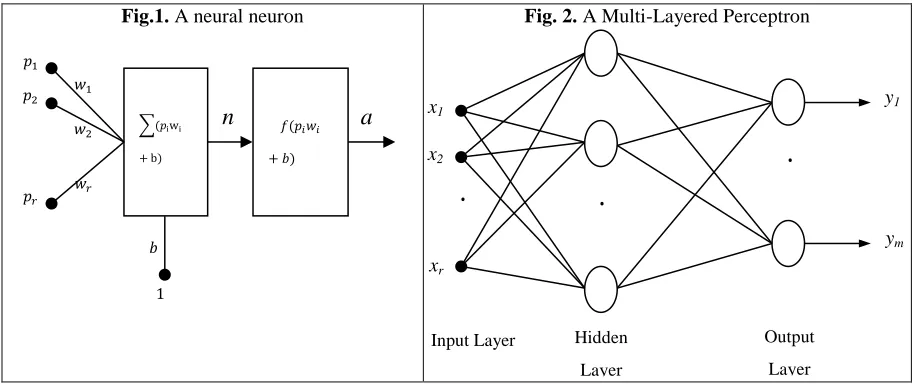
A neural network is composed of uniting some neural neurons. Neuron is a processing unit that
plays essential role in functioning artificial neural network. Fig.1represents a neural neuron, which
is composed of some key elements such as weight, w, activation function, , and bias, b. output of
1531
( ⃗⃗ )Equation 1
Where p is input vector(r is the amount of input vector’s dimension), w is the row vector of weight,
b is the amount of bias, and ,the activation function and a, the neuron’s output.
Fig.1. A neural neuron Fig. 2. A Multi-Layered Perceptron
Middle layer or layers process received data from input layer and give it to output layer. Output of
this network is obtained by applying equation 2:
( ⃗ ( ⃗ ) )Equation 2
In which pis input vector, ، and are biases of hidden and output layers respectively, and
are weight matrices of hidden and output layers respectively, and و are activation
functions of neurons located in hidden and output layers and output vector of network (Fig.2).
Activation function utilized in middle layers is tangent sigmoid function, which is calculated
through equation 3.
1
))
2
exp(
1
(
2
j iX
Y
Equation 3The performance indicator in network training is sum of squared error; in other words it is tried to
update weight matrices and bias vectors so that mean square error is minimum. Equation 4 shows
how to evaluate it.
∑ ( ) Equation 4
Imperialist Competitive Algorithm (ICA)
Imperialist competitive algorithm (ICA) is a new algorithm in the field of evolutionary
computations and like other evolutionary algorithms. It is a population-based stochastic search
algorithm. It has been introduced by Atashpaz and Lucas, recently (Atashpaz-Gargari and Lucas,
2007a, 2007b; Jasour et al., 2008; Roshanaei et al., 2008; Atashpaz-Gargari et al., 2008a, 2008b;
Rajabioun et al., 2008a, 2008b). Since then, it is used to solve some kinds of optimization problem (𝑝iwi
b) 𝑓(𝑝𝑖𝑤𝑖 𝑏)
. .
𝑝 𝑝 𝑝𝑟 𝑤 𝑤 𝑤𝑟 𝑏 1n
a
1532
(Atashpaz-Gargari and Lucas, 2007a, 2007b; Jasour et al., 2008; Roshanaei et al., 2008;
Atashpaz-Gargari et al., 2008a, 2008b; Rajabioun et al., 2008a, 2008b). The algorithm is inspired by
imperialistic competition. It attempts to present the social policy of imperialisms to control more
countries and use their sources when colonies are dominated by some rules. If one empire loses its
power, the rest of them will compete to take its possession. In ICA, this process is simulated by
individuals that are known as countries. This algorithm starts with a randomly initial population
and objective function which is computed for them. The most powerful countries are selected as
imperialists and the others are colonies of these imperialists .Then the competition between
imperialists take place to get more colonies .The best imperialist has more chance to possess more
colonies. Then one imperialist with its colonies makes an empire. Fig. 3 shows the initial
populations of each empire (Atashpaz-Gargari and Lucas, 2007a, 2007b; Jasour et al., 2008;
Roshanaei et al., 2008; Atashpaz-Gargari et al., 2008a, 2008b; Rajabioun et al., 2008a, 2008b). If
the empire is bigger, its colonies are greater and the weaker ones are less. In this figure Imperialist
1 is the most powerful and has the greatest number of colonies.
Fig-3. Generating the initial empires
(Rajabioun et al, 2008)
Fig-4. Moving colonies toward their related imperialist(Niknam et al., 2011)
After dividing colonies between imperialists, these colonies approach their related imperialist
countries. Fig. 4 represents this movement. Based on this concept each colony moves toward the
imperialist by a units and reaches its new position. Where a is a random variable with uniform (or
any proper) distribution, β, a number greater than1, causes colonies move toward their imperialists
from different direction and S is the distance between colony and imperialist (Niknam et al.,
2011). a˷U(0, β×S)
It should be mentioned that every problem in optimization needs a cost function, which the process
of optimization would be implemented for its minimization. Respecting efficiency index in this
network, the cost function is determined based on the value of MSE. Along with each evolution
circle (it is called decade in this algorithm) in imperialist competitive algorithm, the best countries
would be utilized as weights of neural network and for those weights, the process of optimization
would be continued until reaching the desired value of accuracy. However, other stop conditions
1533
Kohonen's Self-Organizing Map (KN)
A one-dimensional KN with input ( ) and output ( )
is shown in fig. 5. For the th output neuron, i is given by :
i ∑ wi i wi Equation 5
Where wi is the th weith, and wi (wi wi wi ) , the th weith vector. To train the KN, the
winning output neuron is determined first by comparing the similarity between the input and the
weight vectors {wi 1 }. The weight vector of the winning output neuron is then updated.
A common measure of similarity between two vectors is the Euclidean distance (Kohonen, 1988),
i ‖ wi‖ Equation 6
Where i is the intensity. The weight vectors of the KN are updated as follows (Kohonen, 1988):
( ) 1 Equation. 7
Where , , is the learning rate, and is unity for the winning neuron that has the smallest i,
but is zero otherwise. The learning algorithm given by Eq.7 reduces to
(1 ) Equation 8
1
The convergence of the learning algorithm given by Eq. (8) is given in Ritter and Schulten (1988).
RESEARCH METHODOLOGY
The definition provided in this study for bankruptcy is the same definition in141 article of Iranian
commercial law for bankruptcy so that we regard firms with accumulated losses more than half of
capital as a bankrupt company. The procedure is as follows: after selecting population and sample,
research data is extracted and divided into two data sets of training and testing. By using first type
of data, we would elaborate on neural network training and then by applying remaining data we
Z
1W
11W
12W
1nW
21W
22W
2nW
m1W
m2………
...…
y
ny
2y
1Z
m1534
would test considered networks. Applied population in this study consists of firms present in
Tehran stock exchange during period of 2001-2009 inclusive in 141 article of Iranian commercial
law for bankruptcy. Therefore, those firms that had following conditions were used for neural
network training:
1-Those firms inclusive in 141 article of Iranian commercial law, should have been accepted in
Tehran stock exchange at least since 1999 (because data of two years before bankruptcy would be
used)
2-Those firms selected in this study as bankrupt were not financial brokerage companies.
3-They are included in trade act of 141 during period of 2001 till 2009 (they have accumulated
losses greater than half of capital)
Through examinations accomplished by researchers in present study, 80 firms during this period
are included in the act. Because the number of firms for neural network training is important, it has
been tried to apply most of available data for neural networks training as much as possible.
However, the ratios of some firms had considerable difference with other samples in the study and
it would lead to decrease in performance of neural network, hence some of bankrupt firms would
be eliminated from the study. Consequently, the number of bankrupt firms in this study reached to
70. Also, in an industry that every bankrupt company is active, a healthy company, which has
nearest amount of assets to that company, was selected. It is done so because a neural network with
training data from healthy firms is able to distinguish between these firms and bankrupt companies. Healthy firms are selected from those firms that bankrupt pairs were present at Tehran’s stock exchange. There was a problem with this matter that due to having small size of industry in some
of industries, selecting healthy pair for bankrupt firms was not feasible, hence it was tried to select
among healthy firms in upstream and downstream industry, and in the case of lack of these
companies, a healthy company with the same assets from a non-similar industry would be selected.
It can be considered as one of limitations in this study.
In next step, research data is divided into two sets of training and testing data sets. To do so, among
research data, some shall be selected randomly and assigned to these sets. Therefore, 20-80 percent
of data was assigned to training and testing respectively.
Research Variables
Since financial ratios have long history in predicting bankruptcy, we tried to apply financial ratios
for this aim and also due to special limitations in Altman’s proposed variable (1968)(Odom and
Sharda, 1990; Coats and Fant, 1993; Rahimian et al., 1993; Wilson and Shard, 1994; Lacher et al.,
1995; Sharda and Wilson, 1996), we considered these variable as input variable. These ratios
1535
(1) Working capital/total assets; (2) retained earnings/total assets; (3) earnings before interest
and taxes/total assets; (4) exchange value equity/book value of total debt; (5) sales/total
assets.
Utilized data is financial ratios of two years before bankruptcy in bankrupt firms and selecting
healthy pairs.
In order to training neural network using supervised algorithms, output data or target data is
needed; thereby a neural network can be familiar with the relationship between ratios of each
healthy company and bankrupt one and also their outputs.
In this research as well as other researches which are used for classification, we segregate the
outputs of research with two different class definitions. 0 shows healthy firms and 1 shows
bankrupt firm.
Predicting accuracy is calculate on the base of network output and real output. This error is
occurring when we classify healthy firm as bankrupt firm and vice versa. Final comparative review
in this study will be applied with regard to MLP-ICA neural network and KN neural network-
colonial rivalry in accurate classification rate of healthy and bankrupt firms. (Accurate prediction
percentage)
NETWORK TESTING AND RESULTS ANALYSIS
After training research networks, it is the turn of offering test data to the research and recording
relevant results. Details related to the way of prediction in these models have been provided in
table.1. According to table.1, MLP-ICA neural network could have classified 85.71 % of healthy
firms and 78.57 % of bankrupt ones properly. Also, error type 1 for this model is 14.29% and error
type 2 is 21.43%. Total results indicate that the performance of MLP-ICA network was in such a
way that 82.14% of firms present in test data have been classified properly.
Table-1. The results obtained from testing KN and MLP-ICA networks
Model Sum of prediction
Status The number of correct predictions
The number of correct predictions
The errors type 1 and 2
The percentage of correct predictions
The error type 1 or 2
MLP-ICA
28 healthy 14 12 2 85.71% 14.29%
bankrupt 14 11 3 78.57% 21.43%
total 28 23 5 82.14% 17.86%
KN
28 healthy 14 10 4 71.42% 28.58%
bankrupt 14 11 3 78.57% 21.43%
1536
Looking at performance of KN in table.2, it could be found that it has suitable power in predicting
bankruptcy. The details about prediction of this network indicate that its performance is similar to
the model of MLP-ICA relatively. KN could show a 71.42% performance for predicting healthy
firms with 10 correct predictions out of 14 predictions, also KN model could have classified 78.57
% of healthy firms properly and error type 1 for this model is 28.58% and error type 2 is 21.43%.
In relation to predicting bankrupt firms we can is no difference between the performance of
MPL-ICA and KN and the results confirm that the prediction accuracy of the KN model is lower than the
other MLP-ICA model.
CONCLUSION
The main purpose of this study is to investigate two different training (or learning) types of neural
networks using their representative networks—the MLP-ICA network (supervised) versus the
Kohonen self-organizing feature map (unsupervised)—in terms of their performance accuracy in
the area of bankruptcy prediction. Applied data in this study includes 70 bankrupt firms inclusive
in 141article of Iranian commercial law relating bankruptcy and 70 healthy firms in period of
2001-2009 that are working in Tehran stock exchange.
We divided study data to training and examining and allocated 80 and 20 percent of all study data
to each group. With regard to accuracy of prediction as a measure for research model performance,
it indicated that MLP-ICA network has better performance in compare with KN model with 85.71
of healthy firms and 78.57 % of bankrupt firms. Generally we find that although in order to
classification of bankrupt firms is no difference between the performance of MPL-ICA and KN
models but in general (healthy and bankrupt firms) the MLP-ICA model outperform the KN model.
RESEARCH LIMITATION
Being small of population of accepted firms in Tehran’s stock exchange caused we could not pair non-bankrupt firms with bankrupt ones in all of industrial aspects.
REFERENCES
Alam, P., D. Booth, K. Lee and T. Thordarson, 2000. The use of fuzzy clustering
algorithm and self organizing neural networks for identifying potentially failing
banks: An experimental study. Expert Systems With Applications, 18: 185-199.
1537
Andrés, J.D., M. Landajo and P. Lorca, 2012. Bankruptcy prediction models based on
multinorm analysis: An alternative to accounting ratios. Knowledge-Based
Systems, 30: 67-77.
Atashpaz-Gargari, E., F. Hashemzadeh and C. Lucas, 2008a, 2008b. Designing mimo piid
controller using colonial competitive algorithm: Applied to distillation column
process. Hong Kong: In: Proceeding of IEEE CEC 2008, within IEEE WCCI
2008.
Atashpaz-Gargari, E. and C. Lucas, 2007a, 2007b. Imperialist competitive algorithm: An
algorithm for optimization inspired by imperialistic competition. In: Proceed- ings
of the IEEE Congress on Evolutionary Computation, Singapore.
Beaver, W., 1966. Financial ratios as predictors of failure. Journal of Accounting
Research, 5: 71-111.
Coats, P.K. and L.F. Fant, 1993. Recognizing financial distress patterns using a neural
network tool. Financial Management: 142-155.
Hopwood, W.S., J.C. Mckeown and J.P. Mutchler, 1994. A reexamination of auditor
versus model accuracy within the context of the going concern opinion decision.
Contemporary Accounting Research 10: 409-431.
Jasour, A.M., G. Atashpaz, E. and C. Lucas, 2008. Vehicle fuzzy controller design using
imperialist competitive algorithm. In: Proceedings of the Second First Iranian
Joint Congress on Fuzzy and Intelligent Systems. Tehran, Iran.
Kiviluoto, K., 1998. Predicting bankruptcies with the self-organizing map.
Neurocomputing, 21(1-3): 191-201.
Kohonen, T., 1988. Self-organization and associative memory. Berlin:Springer.
Lacher, R.C., P.K. Coats, S.C. Sharma and L.F. Fant, 1995. A neural network for
classifying the financial health of a firm. European Journal of Operations
Research, 85: 53-65.
Lee, k., D. Booth and P. Alam, 2005. A comparison of supervised and unsupervised
neural networks in predicting bankruptcy of korean firms. Expert Systems with
Applications. (29): 1-16.
Martin-del-Brio, B. and C. Serrano-Cinca, 1995. Self-organizing neural networks: The
financial state of spanish companies. Neural network in the capital markets.
McKee, T.E., 2003. Rough sets bankruptcy prediction models versus auditor signaling
rates. Journal of Forecasting, 55: 569-586.
McKee, T.E. and T. Lensberg, 2002. Genetic programming and rough sets: A hybrid
approach to bankruptcy classification. European Journal of Operational Research
138: 436-451.
Niknam, T., T.F. Elahe, Narges Pourjafarian and A. Rousta, 2011. An efficient hybrid
1538
O’Leary, D.E., 1998. Using neural networks to predict corporate failure. International
Journal of Intelligent Systems in Accounting, finance and Management, 7:
187-197.
Odom, M. and R. Sharda, 1990. Bankruptcy prediction using neural networks. pp:
133-168.
Ohlson, J.A., 1980. Financial ratios and the probabilistic prediction of bankruptcy. Journal
of Accounting Research, 19: 109-131.
Rahimian, E., S. Singh, T. Thammachote and R. Virmani, 1993. Bankruptcy prediction by
neural network. Neural Networks in Finance and Investing: Using Artificial
Intelligence to Improve Real-World Performance, Chicago, IL: Probus Publishing
Co.
Rajabioun,
R.,
F.
Hashemzadeh
and
E. Atashpaz-Gargari,
2008a,
2008b.
Colonialcompetitive algorithm anovel approach for pid controller design in mimo
distillation column process International Journal of Intelligent Computing and
Cybernetics, 1(3): 337-355.
Ritter, H. and K. Schulten, 1988. Convergence properties of kohonen topology conserving
maps: Fluctuations, stability and dimension selection. Biological Cybernetics,
60(1): 59-71.
Roshanaei, M., E. Atashpaz-Gargari and C. Lucas, 2008. Adaptive beamforming using
colonial competitive algorithm.
Sarkar, S. and R.S. Sriram, 2001. Bayesian models for early warning of bank failures.
Management Science, 47(11): 1457-1475.
Sharda, R. and R.L. Wilson, 1996. Neural network experiments in business-failure
forecasting: Predictive performance measurement issues. International Journal of
Computational Intelligence and Organizations, 1(2): 107-117.
Shin, K.S., T.S. Lee and H.j. Kim, 2005. An application of support vector machines in
bankruptcy prediction model. Expert Systems with Applications, 28: 127-135.
Shumway, T., 2001. Forecasting bankruptcy more accurately: A simple hazard model. The
Journal of Business, 74: 101-124.
Sun, L. and P.P. Shenoy, 2007. Using bayesian networks for bankruptcy prediction:Some
methodological issues. European Journal of Operational Research, 180: 738-753.
Tam, K.Y. and M.Y. Kiang, 1992. Managerial applications of neural networks: The case
of bank
Wilson, R.L. and R. Shard, 1994. Bankruptcy prediction using neural networks. Decision
Support Systems, 11: 545-557.
Zhang, G., M.Y. Hu, B.E. Patuwo and D.C. Indro, 1999. Artificial neural networks in
bankruptcy prediction: General framework and cross validation analysis.
1539