Sentential Paraphrase Generation for Agglutinative Languages Using
SVM with a String Kernel
Hancheol Park
1, Gahgene Gweon
1, Ho-Jin Choi
2, Jeong Heo
3, Pum-Mo Ryu
3 1Department of Knowledge Service Engineering, KAIST
2
Department of Computer Science, KAIST
3Knowledge Mining Research Team, ETRI
{hancheol.park, ggweon, hojinc}@kaist.ac.kr
{jeonghur, pmryu}@etri.re.kr
Abstract
Paraphrase generation is widely used for various natural language processing (NLP) applications such as question answering, multi-document summarization, and machine translation. In this study, we identify the problems occurring in the process of applying existing probabilistic model-based methods to agglutinative languages, and provide solutions by reflecting the inherent characteristics of agglutinative languages. More specifically, we propose and evaluate a sentential paraphrase generation (SPG) method for the Korean language using Support Vector Machines (SVM) with a string kernel. The quality of generated paraphrases is evaluated using three criteria: (1) meaning preservation, (2) grammaticality, and (3) equivalence. Our experiment shows that the proposed method outperformed a probabilistic model-based method by 12%, 16%, and 17%, respectively, with respect to the three criteria.
1
Introduction
Paraphrase generation (PG) is a useful technique in various natural language processing (NLP) applications, where it expands natural language expressions. In question answering systems, PG can be utilized to generate semantically equivalent questions. It can solve word mismatch problems when searching for answers (Lin and Pantel, 2001; Riezler et al., 2007). For multi-document summarization, it also helps to generate a summary sentence by identifying repeated information
among semantically similar sentences (McKeown et al., 2002). In addition, for machine translation, paraphrasing can mitigate the scarcity of training data by expanding the reference translations (Callison-Burch, 2006).
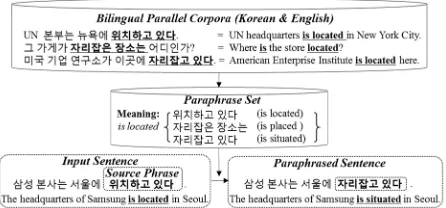
In this study, we focus on a paraphrase generation approach, namely, sentential paraphrase generation (SPG), which takes a whole sentence as an input and generates a paraphrased output sentence that has the same meaning. Figure 1 shows an overview of the SPG process in general.
Figure 1: Example of the SPG process.
For example, let us assume that we would like to generate a paraphrased sentence using bilingual parallel corpora for a Korean input sentence
“삼성본사는 서울에 위치하고 있다 (The
Since we use a trigram LM to decide how
acceptable each is for a given input, and
are the two words preceding , and and
are the two words following . The phrase is substituted with the best paraphrase , which has the highest probability.
2.2
Classification Using SVM with a String KernelIn this study, we propose an SPG method using SVM, instead of using the probabilistic-based model, which is used in the approach described in section 2.1.
An SVM is a linear classifier that finds a linear hyper-plane that separates positive and negative instances of labeled samples with the largest margin. This classifier is designed to reduce the generalization error rate, which is the ratio of incorrectly predicted classes to the novel inputs, because it is less overfitted to the training data set than other methods (Kozareva and Montoyo, 2006). With reference to sparseness of each lexical variant in agglutinative languages, it is also more tolerant than probabilistic-based models because it does not largely depend on the frequency of instances.
For problems that are not linearly separable, SVM uses a kernel function that implicitly transforms a non-linear problem into a higher-dimension space and makes the problem into a linearly separable one. A kernel is a similarity function between a pair of instances. In particular, since string kernels are useful in terms of measuring the similarity of non-fixed size feature vectors (e.g., text documents, the dependency tree of a sentence, and syntax trees) (Erkan et al., 2007), we used a string kernel given that the features that consider the morphological structures of words are variable in length. More specifically, we use the
edit distance kernel function (Erkan et al., 2007) as follows:
K (xi,xj) = exp (-γ edit_distance(xi,xj))
Here, edit_distance is defined as the
Levenshtein distance between string xi and xj. i.e., the minimum number of edits (deletions, insertions, or substitutions at the word level) required to transform one string into another. One of the advantages of using this kernel is that it takes into account the order of the strings in the structured data (e.g., a dependency path tree) as opposed to other string kernels (e.g., cosine similarity kernel) which consider only the common terms when measuring similarity.
In our study, the class for SVM is each phrase in a paraphrase set, which contains a source phrase. In addition, the SPG used in our study can be regarded as a multiclass classification problem. Thus, to solve this problem with a binary classifier, we adopted a “one-against-one” approach (Chang and Lin, 2011). This approach constructs k(k–1)/2
classifiers, where k is the number of classes, with a
training data set from two classes. A new data point is allocated to the class with the most votes during each binary classification.
3
Paraphrase Generation Using SVM
with a String Kernel
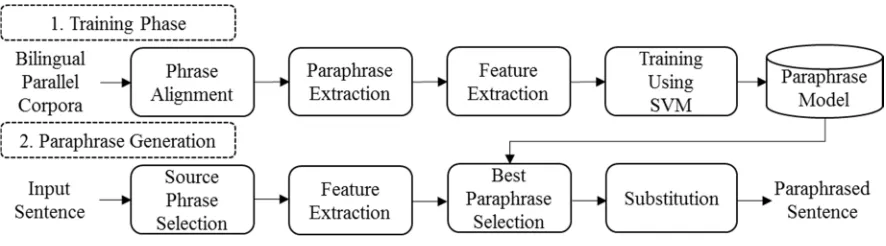
This section describes our proposed SPG method, which uses an SVM with a string kernel. Figure 2 shows an overview of this method.
3.1
Training Phasetrained together using the SVM to generate a paraphrase model. This model is used in the paraphrase generation phase, as described in section 3.2. Figure 3 illustrates the three types of features used in our model for one sentence from the bilingual parallel corpora example shown in Figure 1.
Figure 3: Sample sentence with the three types of features extracted.
3.2
Paraphrase GenerationIn the paraphrase generation step, a source phrase in the input sentence is replaced by a candidate phrase in its corresponding paraphrase set, and as a result, a paraphrased sentence is produced. This step starts by locating a source phrase in an input sentence. For the input sentence “삼성 본사는
서울에 위치하고 있다. (The headquarters of Samsung is located in Seoul.),” as shown in Figure 1, our method first selects a source phrase. If multiple candidates appear, one with the maximum length of words is selected. If both phrases, “위치하고 있다 (is located)” and “위치하고 (located)” are possible candidates, for instance, the longer phrase “위치하고 있다 (is located)” will be selected. Next, dependent words preceding and following the source phrase are used together with the source phrase to obtain the three types of features described in section 3.1. Next, the SVM classifier is used to identify the best phrase in the paraphrase set for the source phrase that was built during the training phase.
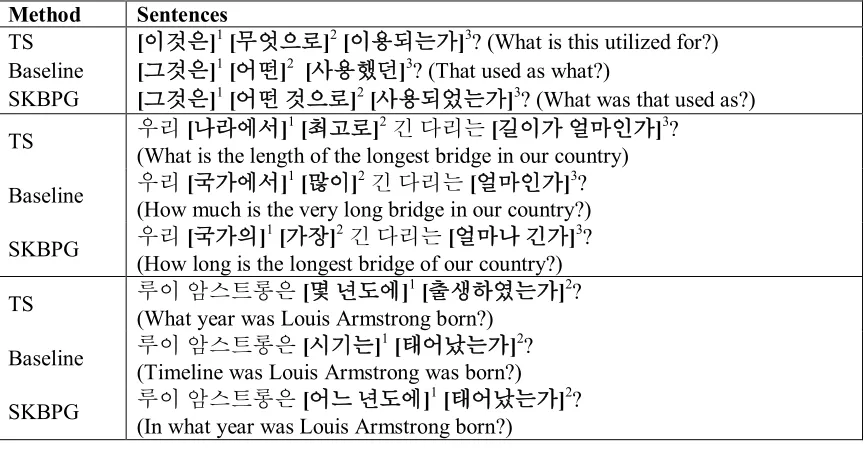
Finally, the source phrase is substituted with the selected best paraphrase. Although in this example, we assumed the input sentence to have only one source phrase for simplicity, in our actual implementation the paraphrase generation process was repeated for multiple source phrases in the input sentence as shown in Table 1.
4
Evaluation
We evaluated our proposed method by comparing it with the popular method proposed by Bannard
Method Sentences
TS [이것은]1 [무엇으로]2 [이용되는가]3? (What is this utilized for?) Baseline [그것은]1[어떤]2 [사용했던]3? (That used as what?)
SKBPG [그것은]1[어떤것으로]2 [사용되었는가]3? (What was that used as?)
TS 우리[나라에서]1[최고로]2긴다리는[길이가얼마인가]3? (What is the length of the longest bridge in our country)
Baseline 우리[국가에서]1 [많이]2긴다리는[얼마인가]3? (How much is the very long bridge in our country?) SKBPG 우리[국가의]1 [가장]2긴다리는[얼마나긴가]3?
(How long is the longest bridge of our country?)
TS 루이암스트롱은[몇년도에]1 [출생하였는가]2? (What year was Louis Armstrong born?)
Baseline 루이암스트롱은[시기는]1[태어났는가]2? (Timeline was Louis Armstrong was born?)
SKBPG 루이암스트롱은[어느년도에]1 [태어났는가]2? (In what year was Louis Armstrong born?)
and Callison-Burch (2005). This baseline1 method
was implemented by using probabilistic models and is described in section 2.1. Our proposed method, string kernel-based paraphrase generation (SKBPG), was implemented by using the edit distance string kernel, which is described in section 2.2.
4.1
Experimental ResourcesIn order to generate paraphrase sets, we used 998 randomly selected English sentences from the Text REtrievial Conference (TREC) question answering track (2003-2007)2 and their translations (Korean words: 5,286, English words: 7,474). The question answering track was selected so that we could apply our method to a question answering system.
For the test sentences, 100 quiz sentences from Korean TV quiz shows (e.g., Golden Bell Challenge!) were selected. The sentences had to contain at least one possible source phrase with multiple candidates in its corresponding paraphrase set. Table 1 shows examples of the test sentences and the paraphrased sentences obtained using each method.
For the baseline method, we used 52,732 Korean sentences (Korean words: 322,306) in KAIST language resources (Choi, 2001) for training trigram LMs, in addition to the questions from TREC. This additional resource was included to make probability distribution in LM stable by expanding size of corpus. The LM probability was acquired using the IRSTLM toolkit (Federico and Cettolo, 2007), and conditional probability in LM was calculated by applying modified Kneser-Ney smoothing.
For the SKBPG method, we used ETRI linguistics analyzer (Lee and Jang, 2011) for dependency parsing and morphological analysis. For the SVM, we used LIBSVM-string (Guo-Xun Yuan, 2010; Chang and Lin, 2011), which supports the edit distance kernel option and multiclass classification based on the one-against-one approach, as described in section 2.2. The parameter of edit distance kernel (γ) was 0.1.
1 We were not able to obtain Bannard and Callison-Burch’s implementation, so we implemented it ourselves.
2 These resources are available at http://trec.nist.gov/data/qa.html.
4.2
Evaluation MetricsThe Korean paraphrase pairs that we generated were evaluated by two native Korean speakers according to the following three criteria:
• Meaning Preservation (MP): Does a generated paraphrase preserve the meaning of the source phrase?
• Grammaticality (G): Is the generated paraphrase grammatical?
• Equivalence (E): Are the paraphrased pairs equivalent?
We used two types of scales as shown in Table 2. These criteria were adopted from previous research (Callison-Burch, 2008; Fujita et al., 2012).
Criterion 5-point Binary scale
MP (1: worst 5: best) false: otherwise) (true: MP > 3,
G (1: worst
5: best)
(true: G > 4, false: otherwise) E N/A (true: MP > 3 & G > 4, false: otherwise)
Table 2: Two types of scales used by the three evaluation criteria.
In terms of the inter-annotator agreement using Kappa, K = .412 for the 5-point scale, which is considered as “Moderate.” For the binary scale, K = .612, which is regarded as “Substantial” (Landis and Koch, 1977; Carletta, 1996).
4.3
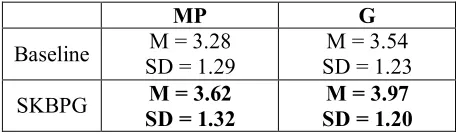
Results and DiscussionIn the section, we summarize the results of our manual evaluation, which show that our method outperformed the baseline method, as shown in Table 3 and Table 4.
MP G
Baseline SD = 1.29 M = 3.28 SD = 1.23 M = 3.54
SKBPG M = 3.62
SD = 1.32
M = 3.97 SD = 1.20
Translation Using Paraphrases. In Proceedings of HLT-NAACL, pages 17-24.
Colin Bannard and Chris Callison-Burch. 2005. Paraphrasing with Bilingual Parallel Corpora. In Proceedings of ACL, pages 597-604.
Dekang Lin and Patrick Pantel. 2001. Discovery of Inference Rules for Question Answering. Natural Language Engineering, 7(4):343-360.
Franz Josef Och and Hermann Ney. 2003. A Systematic Comparison of Various Statistical Alignment Models. Computational Linguistics, 29(1):19-51.
Guo-Xun Yan. 2010. LIBSVM-String: An Extension to
LIBSVM for Classifying String Data.
http://www.csie.ntu.edu.tw/~cjlin/libsvmtools/#libsv m_for_string_data.
Günes Erkan, Arzucan Özgür, and Dragomir R. Radev. 2007. Semi-Supervised Classification for Extracting Protein Interaction Sentences Using Dependency Parsing. In Proceedings of EMNLP-CoNLL, pages 228-237.
J. Richard Landis, Gary G. Koch. 1977. The Measurement of Observer Agreement for Categorical Data. Biometrics, 33(1):159-174.
Jean Carletta. 1996. Assessing Agreement on Classification Tasks: The Kappa Statistic. Computational Linguistics, 22(2):249-254.
Kathlenn R. McKeown, Regina Barzilay, David Evans, Vasileios Hatzivassiloglou, Judith L. Klavans, Ani Nenkova, Carl Sable, Barry Schiffman, and Sergey Sigelman. 2002. Tracking and Summarizing News on a Daily Basis with Columbia’s Newsblaster. In Proceedings of HLT. pages 280-285.
Key-Sun Choi. 2001. KAIST language resources v.2001. Result of Core Software Project from Ministry of
Science and Technology, Korea
(http://kibs.kaist.ac.kr).
Marcello Federico, and Mauro Cettolo. 2007. Efficient Handling of N-gram Language Models for Statistical Machine Translation. In Proceedings of Second Workshop on StatMT, pages 88-95.
Philipp Koehn, Franz josef Och, and Daniel Marcu. 2003. Statistical Phrase-Based Translation. In Proceedings of HLT-NAACL,pages 48-54.
Sander Wubben, Antal van den Bosch, and Emiel Krahmer. 2010. Paraphrase Generation as Monolingual Translation: Data and Evaluation. In Proceedings of INLG, pages 203-207.
Shiqi Zhao, Xiang Lan, Ting Liu, and Sheng Li. 2009. Application-Driven Statistical Paraphrase Generation. In Proceedings of ACL-AFNLP, pages 834-842. Stefan Riezler, Alexander Vasserman, Ioannis
Tsochantaridis, Vibhu Mittal, and Yi Liu. 2007. Statistical Machine Translation for Query Expansion in Answer Retrieval. In Proceedings of ACL, pages 464-471.
Zhiyang Wang, Yajuan Lü, Meng Sun, and Qun Liu. 2013. Stem Translation with Affix-Based Rule Selection for Agglutinative Languages. In Proceedings of ACL, pages 364-369.