International Conference on Machine Learning and Computational Intelligence-2017 International Journal of Scientific Research in Computer Science, Engineering and Information Technology © 2017 IJSRCSEIT | Volume 2 | Issue 7 | ISSN : 2456-3307
A Comparative Study of Statistical and Machine Learning
Techniques of Background Subtraction in Visual Surveillance
ABSTRACT
Video is basically collection of images. Through a single image we can take a screenshot of a scene, which helps in detecting motion with sequence. Now a days, video has popular usage in many applications like identification of exceptional behavior in parking, monitoring of traffic, finding the cause of road accidents, detection of pedestrians, ATMs etc. This is done with the help of many applications that include object tracking, motion segmentation using one of its part background subtractions with the help of various algorithms such as particle filter, mean shift method, kalman filter etc. This paper presents a survey on various algorithms that helps in improving the motion of the object. Research is made on motion detection and tracking in videos along with comparative analysis on various algorithms.
Keywords : Meanshift, Kalman Filter, Particle Filter, Motion Segmentation, Background Subtraction.
I.
INTRODUCTIONIn todays world with increasing technology and population it becomes very challenging for a human eye to analyze and detect each and everything be it in marketing, bussiness, traffic regulation, health, education and so on.Thus, video analytics comes as a life saver in this situation.a video is basically a collection of images.Video anlysis is the process of automatic analysis of videos in order to detect temporal and spatial activities of an object.There are three important aspects to analyze real world objects through videos :Object detection, Object tracking and analysis.Detection in moving object is the way of recognizing the movement of an object in a given region or area.Tracking is defined as evaluating the path of an object in image plane as it moves around in a scene.In this paper ,a detailed anlysis of various algorithms and techniques of motion detection and object tracking has been made with advantages and drawbacks of each [1].
signalsare represented by sin waves whereas digital signals are easy to analyse and are not continuous signal. Digital means discrete values and uses proper values to provide any information. As compared to analog signal thay are less accurate because they are distinct samples of analog signal that are taken with respect to time. They are not subjected to noise and denoted by square waves. Digital image is formed by taking an image from camera , sunlight is also used as being a source of energy. Some signal is used for producing the image. When sunlight falls upon the object, the amount of light reflected back by the object is sensed by sensor and a continuous voltage signal is produced by the amount of data which is sensed. Then we replace such data into digital form in order to create digital image[2]. Sampling and quantization techniques are involed which providesa digital image. Frame is basically bit by bit transmission of data.
II.
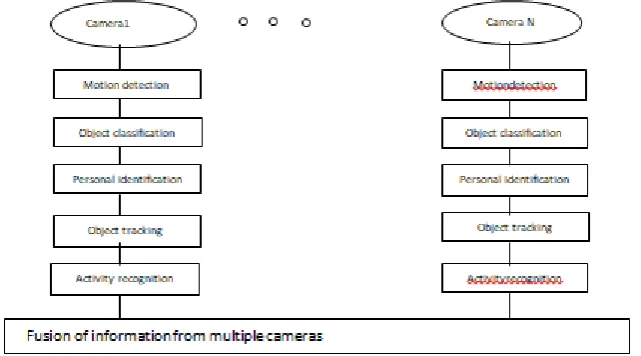
LITERATURE SURVEYVISUAL SURVEILLANCE :- From vision of computer,visual survelliance is one of the research topic that is used to detect, identify and monitor objects by getting the set of images that helps in understanding and describing the behaviour of object simply by converting the old method of monitoring
camers by human operators. Depending upon the human involvement, visual survilliance is defined as manual, semi-automatic and fully automatic. In manual visual survillance, only the human is responsible for detecting and performs all the job while viewing the visual information obtaining from several camers. In semi-automatic visual surveillance both human and system , responsible as object tracking is under computer vision algorithm and human operator is responsible for personal identification, job of classification and recognising activity. Low level of video processing is used in it, and most of the task is performed by human . Whereas in fully automatic, no human involvement and the whole job is performed by the system. On comparing all the three , fully automatic system is more intelligent to track, classify and identify object. Also it helps in reporting and detecting the doubtful behaviour and recognizing the activity of object[3],[4],[5].
Various stages of Visual surveillance
visual surveillance has the following stages such as: background modeling, motion segmentation, classification of foreground moving objects, human recognition , monitoring and examining the behavior of object .
III.
MOTION DETECTIONThe first step in visual surveillance system is detecting the motion of an object . Motion detection is the process of segmenting object moving foreground from the remainig image. Motion segmentation is basically done with many techniques such as background subtraction , temporal differencing andso on. Background subtraction is the most popular method among them that helps in detecting the moving regions in an image by taking the exact difference between current image and the background image which is referred and very common technique for detecting the moving object. Very much easy and inexpensive for real time systems, but also sensitive to extraneous events etc. The goal of such technique is to extract current
image from reference background image, that is taken during period of time. Otherwise no change occurs and the pixel belongs to the object. The subtracting operations that are applied helps in finding the absolute difference for each pixel, by detecting object that differs from background. If difference is below the threshold then no change in the scene and pixel is observed as it belongs to background. So that is why it is very much dependent on good background maintenance model. There are several algorithms that come under background subtraction[6],[7].
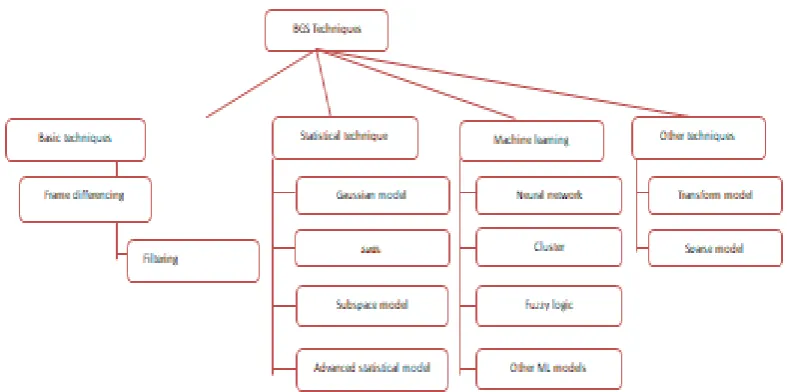
BACKGROUND SUBTRACTION:
Below figure shows the flow chart of background subtraction techniques (BGS).
Figure 2.
BGS techniques
Statistical techniques
This technique is used to identify the requirements of a process through the method of collection of data from the process and then analyzing them in order to establish control and validate the process capability. It is one such type of background subtraction technique which is more robust towards camera jitter
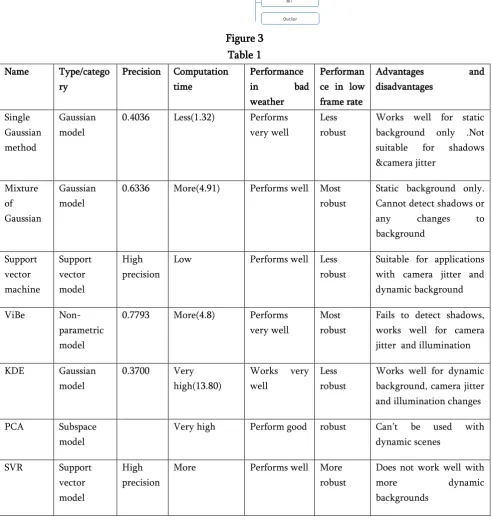
Figure 3 Table 1
Name Type/catego
ry
Precision Computation time
0.4036 Less(1.32) Performs very well
Less robust
Works well for static background only .Not suitable for shadows &camera jitter
0.6336 More(4.91) Performs well Most robust
Static background only. Cannot detect shadows or
any changes to
Suitable for applications with camera jitter and dynamic background
ViBe
Non-parametric model
0.7793 More(4.8) Performs
very well
Most robust
Fails to detect shadows, works well for camera jitter and illumination
Median
Well perform Less robust
1. Single Gaussian method:
Ideal conditions like a complete noise-free background cannot be satisfied in real life scenario. Thus, for noise every pixel is used with a Gaussian distribution .The background and foreground represented as
|(It − µt)| σt> k −→ Foreground
2. Mixture of Gaussian
Single Gaussian method works well for static background only, however, mixture of Gaussian method is a more robust method in this regard [12],[13]. It performs well in bad weather. It supports static background but cannot detect shadows or any changes to background and takes more computation time.
3. Kernel density estimation
It is a non-parametric method for estimating the probability density function of random variables. It is an unstructured approach. It has low robust and works well for dynamic background, camera jitter and illumination changes.
4.Support vector model
It is a more sophisticated model for background subtraction as it uses support vector machine(SVMs) and also uses support vector regression(SVR). In this method the frame is basically partitioned into 4x4 size block and then it is found whether the block is a part of background or not by making use of probabilistic support vector machine(PSVM). SVR also uses the same features as that of SVM for classification with only a few minor differences.
5.Principal component analysis(PCA)
This method makes use of transformation that is orthogonal ,use to convert a series of observations which are possibly correlated into linearly uncorrelated variable which are known as principal components.
6.Visual background extractor(ViBe)
In this method, a series of values taken previously is calculated for each pixel in the same location or in neighborhood. Then a compression is made of these values with the current pixel value in order to determine whether the pixel leads to the background or not. It is a non-parametric statistical approach. 7.Pixel-based adaptive segmenter(PBAS)
techniques which can be used for BGS. Now the flowchart below shows different techniques under machine learning.
Figure 4
1. Artificial Neural network.
ANN can be used in BGS in a very efficient manner. The background information is stored at each neuron and a neural network which is three layered is used that comprises of aninput layer, hidden layer and output layer. Various variants of neural network have been implemented over years.
2. Codebook
It is an efficient technique to deal with multi model background. A sequence of key values called code
words is assigned to each background pixel based on the training sequence which determines the pixel a color which is most likely to take over a certain period.
3. K-means clustering.
Clustering is the process of dividing a set of data points to a small number of clusters. It is is a method in which we find the locations of clusters that reduces the distance of cluster from data points. 4. Kalman filter
This technique uses its recursive nature. It is basically a recursive method in which weighted average of previous estimates and the new information is used and the weights are optimized to reduce the squared error.
5. Hidden Markov model
A method where there is sequence of outputs but the sequence of states the model went through to generate the output is not known. In image processing the conventional block based classification ignored the context information. Therefore in order to improve classification by context hidden markov model was proposed[14],[15].
Comparative analysis of different machine learning techniques :-
Table 2
Non parametric training is time consuming
Less accurate Less memory
required
Decision tree Non parametric Less time
consuming
Less accurate Less memory
required
k-nearest neighbor Parametric Less time
consuming
Kalman filter Non parametric Less time
consuming
exact Limited memory
Hidden markov Stochastic approach
IV.
CONCLUSION
This paper presents a comparative study of various background modeling techniques. This paper categorizes the available background modeling approaches into four general types, basic, statistical, machine learning and other approaches. The main two categories i.e statistical and machine learning techniques of background subtraction are focused upon in this paper. Comparison of such methods depends on their cpu or memory requirements as well as their capability of correctly detecting motion in different kind of videos. As far as statistical methods are concerned , methods such as MOG and KDE has proved very good model accuracy. KDE has a high memory requirement. Gaussian methods perform very well but work for static background only while SVM techniques work well with dynamic background and camera jitter and their computation time is also very efficient. In case of machine learning methods , the new approaches like fuzzy logic are less time consuming. Also the kalman filter and k-nearest neighbor approaches are good in this regard. As far as accuracy is concerned kalman filter gives a very accurate result also requires less memory than k-nearest neighbor approach. Thus, overall each method has its own advantages and disadvantages. All we can do is try to incorporate the good features of some techniques into other so that it can result intogood technique.
V.
REFERENCES
[1]. Deepak Kumar Panda, and SukadevMeher. Robust Object Tracking Under Background Clutter. In Proceedings of International Conference on Image Information Processing, Nov. 2011 JUIT Shimla, India.
[2]. Deepak Kumar Panda, and SukadevMeher. Robust Object Tracking Under Varying Illumination Conditions. InProceedings of IEEE
India Conference INDICON, Dec 2011. BITS Pilani Hyderabad Campus, India.
[3]. L. Li, S. Ranganath, H. Weimin, and K.Sengupta"Framework Framework for Real-Time Behavior Interpretation From Traffic Video "IEEE Tran. On Intelligen Transportation Systems, , Vol. 6, No. 1, pp. 43-53, 2005.
[4]. P. Kumar, H. Weimin, I. U. Gu, and Q. Tian "Statistical Modeling of Complex Backgrounds for Foreground Object Detection" IEEE Trans. On Image Processing, Vol. 13, No. 11, pp. 43-53, November 2004.
[5]. Z Zivkovi "Improving the selection of feature points for tracking" In Pattern Analysis and Applications, vol.7, no. 2, Copyright Springer-Verlag London Limited, 2004.
[6]. Vinay D R, N Lohitesh Kumar, " Object Tracking Using Background Subtraction Algorithm" in International Journal of Engineering Research and General Science Volume 3, Issue 1, January-February, 2015. [7]. Rohan K. Naik, " A Robust Background
Subtraction Technique for Object Detection" in the International Journal of Advanced Research in Computer Engineering & Technology (IJARCET) Volume 4 Issue 2, February 2015. [8]. P. Kumar, H. Weimin, I. U. Gu, and Q. Tian
"Statistical Modeling of Complex Backgrounds for Foreground Object Detection" IEEE Trans. On Image Processing, Vol. 13, No. 11, pp. 43-53, November 2004.
[9]. D.-M. Tsai and S.-C. Lai, "Independent component analysis-based background subtraction for indoor surveillance," image Processing, IEEE Transactions on, vol. 18, no. 1, pp. 158–167, 2009.
[11]. M. Piccardi, "Background subtraction techniques: a review," in Systems, man and cybernetics, 2004 IEEE international conference on, vol. 4. IEEE, 2004, pp. 3099– 3104.
[12]. S. Y. Elhabian, K. M. El-Sayed, and S. H. Ahmed, "Moving object detection in spatial domain using background removal techniques-stateof-art," Recent patents on computer science, vol. 1, no. 1, pp. 32–54, 2008.
[13]. T. Bouwmans, F. El Baf, and B. Vachon, "Background modeling using mixture of gaussians for foreground detection-a survey," Recent Patents on Computer Science, vol. 1, no. 3, pp. 219–237, 2008. 14. T. Gao, Z.-g. Liu, W.-c. Gao, and J. Zhang, "A robust technique for background subtraction in traffic video," in Advances in NeuroInformationProcessing. Springer, 2008, pp. 736–744.