Value-in-use creation from a
multi-actor perspective in the primary care
and in POCT’s.
Purpose: Master’s Thesis.
Study: Master Business Administration. Track: Innovation & Entrepreneurship. First viewer: Prof. dr. R. Kusters.
Preface
My name is Ernst-Joost van Holten and this research is written in order to obtain my Masters degree International Business Administration at the University of Twente. I followed the track Innovation & Entrepreneurship. This research concerns the concept of value-in-use, using a multi-actor perspective in a value-creating network when regarding several POCT methods.
As a child of a General Practitioner and little brother of a resident clinical chemistry I was raised with medical insights. This research shows a combination of personal interests, health care, and my study, business administration. My father always said that health care doesn’t need managerial insights and that it should be focussed on getting people better. Of course I agree that health care should be focussed on getting people better, but in this fast changing environment neglecting managerial insights can be devastating for health care organizations.
This research can provide the medical world an example that there is lots of room for managerial insights and that it can be really helpful to use these insights. And for me personally I’m the one connecting my dad, the GP, with my brother, the clinical chemist. You can imagine that I was really enjoying carrying out this research. I hope you enjoy reading this paper as much as I enjoyed writing it.
List of abbreviations. DVU= Diagnostiekvooru. DZ= Deventer Hospital.
DZL = Deventer Hospital Laboratory. JBZ= Jeroen Bosch Hospital.
JBZL= Jeroen Bosch Hospital Laboratory. GP= General-Practitioner.
POC= Point-of-care.
1. Table of content
Table of Contents
Preface ... 3
List of abbreviations. ... 3
CHAPTER 2: An introduction of POCT and the problem of value. 2.1 Introduction. ... 5
2.2 Problemstatement. ... 7
CHAPTER 3: Theoretical framework for examining the POCT service concepts. 3.1 Introduction. ... 10
3.2 Value ... 10
3.3 Value-in-use. ... 12
3.4 The multi-actor perspective. ... 14
3.5 Value-creating networks.... 15
CHAPTER 4: Methodology for examining the POCT service concepts. 4.1 Introduction. ... 17
4.2 The POCT environment.... 17
4.3 Research design. ... 19
4.4 Data collection methods. ... 21
4.5 Making it measurable. ... 23
4.6 Data analysis methods. ... 24
CHAPTER 5: Analyzing the different POCT service concepts. 5.1 Introduction. ... 27
5.2 The POCT service concepts. ... 27
5.3 Cross-case analysis. ... 33
CHAPTER 6: Conclusions concerning value-in-use from a multi-actor perspective. 6.1 Introduction ... 39
6.2 Conclusions. ... 40
6.3 Managerial and practical consequences and advices. ... 42
2. An introduction of POCT and the
problem of value.
2.1 Introduction.
The health-care sector is subject to multiple changes within the Netherlands. First of all, market forces are implemented within the Netherlands in the health-care sector. This enables competition1 and means that healthcare organizations need to be more efficient and effective. Besides the shift towards a more competitive environment within the health care sector, the aging society is increasing as well. In 1991, 12, 8% of the Dutch population could be categorized as aging while in 2011 this percentage had grown to 15,6. Since elderly are consuming more health-care related services, and thereby increasing workload of hospitals, this increases the need for quick results and faster diagnosing, to be able to provide the health care needed for the changing society.2
Although both of these trends are more a concern of the Dutch society there is a global trend as well, which is related to the POCT service concepts. Almost fourty countries are bundling forces to reduce antibiotic usage.3
Point-of-care-testing (POCT) can contribute to be more efficient and effective and in the same time create a better patient experience by providing better and quicker healthcare.4 POCT is performing laboratory diagnostics in the presence of a patient and enables immediate results Vermeer (2010) beliefs that implementing a POCT service concept successfully enables hospitals to perform laboratory diagnostics without their own laboratory. Everything will happen next to the bed; fast, reliable and cheap.5
This research examines POCT methods in primary care and its value creation for its actors. Using cases of the Jeroen Bosch Ziekenhuis (JBZ), Deventer Ziekenhuis (DZ) and DiagnostiekVoorU (DVU). POCT is not new; nevertheless POCT is currently being re-designed. Where the current way of POCT is mostly focussed on easy, quick
1 See Volkskrant (2012)
2 See CBS (2014) 3 See Nu.nl (2014) 4 Volkskrant (2012)
diagnostic tools laboratories are currently re-designing this system towards a more reliable, accurate and integrative version of POCT. Creating such a system requires a network of actors. Besides, knowledge is needed for the different value-in-uses for the different actors. In other words, what aspects of a market offering do actors value most when using this market offering?
The research of Hofland et al. showed that most GP’s value high accuracy and high reliability. This shows a positive relation. When accuracy and reliability increases value increases as well (+).6 However, this research seems to be insufficient for creating and sustaining value-in-use among several actors within a POCT network of actors. The variables of value seem to be insufficient for considering value-in-use for POCT. Besides, this research was performed from a single-actor perspective, since there were only GP’s examined in this research.
Yet, value-in-use is largely unexplored. Customer preferences, and the characteristics of a product matching those preferences, were traditionally considered to be valuable for a buyer. Kothadaraman et al. said that formally, “…firms must create better value than their competitors…” No longer the focus is on creating valuable market offerings for buyers but “…to create better value, managers must fully integrate the resources to use the core capabilities of the firm to deliver a product that fully satisfies the needs at a competitive price, which means creating superior value for the customer.”7 But how
can this concept of value be seen nowadays? Value used to be considered as created by the suppliers. Then it shifted into the service-dominant logic, which considers value as being co-created by user and supplier.8 Lately there is a shift more towards the difference between market value and value-in-use. Market value is focused on a search for additional features of products, which increases price. For instance, more attention for different colors, styles and/or upgrades in order to increase sales prices. Nowadays, not the preferences of customers is considered to be the value of a market offering, but the value-in-use is considered to be much more important. A lot of organizations are struggling with this idea of value-in-use because the buyer is not only the consumer but is also the judge of a specific product.9 This means that colors, styles and upgrades are no longer decisive but simply the fact that every increase in
6 See Hofland et al., p. 3.
price, results in an increase in functional usage of a market offering.10 In case of POCT, every spend euro should increase the value-in-use of the GP, laboratory or other actors.
Anderson & Narus (2004) consider value as: “The worth in monetary terms of the economical, technical, service and social benefits for a consumer company receives in exchange of the price it pays for the market offering.” 11 This definition indicates that Anderson & Narus (2004) mention different determining factors, which influence value. These value-boosters are economical, technical, service and social aspects of value. For instance the POCT method’s value-in-use for a GP could be increased when it shows social benefits like decreasing usage of antibiotic. Value is not the same for everyone and therefore it is good to consider value as interactive, in our example someone could fancy the POCT method because of its social benefits or perhaps because it is more reliable or is easier to use while for others these characteristics of a POCT method is not valuable at all because they might want a method, which decreases costs for them.
As value is not created solely, the network of actors should be considered as well. The focus on value-creating network derives from increasing complexity in the world. The analytical tasks of managers show growing complexity due to the increasing
importance of value-in-use from a multi-actor perspective.12 Therefore more
attention in literature went to creating a clear understanding of these concepts. This research will contribute to that.
2.2 Problem statement.
Nowadays, customer value is not determined solely by a producer of a market offering. Value depends on how the different actors, which use this market offering, consider the added value of a market offering. Pinch & Bijker (1987) conducted a research concerning the different interpretations of technological artefacts. They observed several social groups (e.g. consumers and users), in this research called actors, in order to determine these different interpretations of a technological
artefact.13 When considering businesses again, these different actors can be producers, suppliers, users etc. In perspective of this research these actors can be clinical chemists, GP’s or intermediaries. For all of these actors the market offering could have different value boosters. As mentioned before POCT will be used to examine the principle of value-in-use from a multi-actor perspective. POCT needs a solid integration of appliances, networks and collaboration between actors.
To create a solid, sustainable and competitive way of creating value it is important for companies to realize the different value judgements of actors surrounding their market offering. In literature the urge of a multi-actor perspective is considered to be more and more important to create a competitive advantage.
Besides the need for a multi-actor perspective, a closer look at value itself is needed. Value is not within a technology it self, but is created by the use of the technology. Value-in-use is a concept, which focuses on the fact that every euro spend on a product should improve the use of the product.14 In literature there is an increasing focus on value-in-use. As Ostrom et al. (2010) stated there is a need for …“creating and enhancing tools for capturing value in use for services and communicating value to customers”15There is a need for additional for theory for the concept of value-in-use
and how it interacts within its actors. Does this concept still stands when considering primary care? Therefore, this research examines several POCT service concepts, within the primary care, from a multi-actor perspective using a multiple-case study research design. To combine the concepts of a multi-actor perspective and value-in-use the question raises how to create and sustain a network in which value-in-value-in-use for the different actors is created. This is the research question of this research:
“How can value-in-use be created and sustained from a clustered multi-actor perspective in the medical sector, concerning the POCT concept?”
Before it is possible to investigate this research question there is a need for a more comprehensive understanding of the concepts. The first two sub-questions contribute to that.
1. What is value, value-in-use and what drives value?
2. What is a multi-actor perspective and can there be difference in the value-in-use of actors?
13 See Pinch & Bijker (1987), p. 18.
Besides the theoretical sub-questions there are two empirical questions, which need to be answered before the main research questions can be answered.
3. What is value-in-use generated by POCT and what are the main value-boosters within the network of POCT?
4. How does the relationship between POCT provider and actors look like and how can these contribute in a value-creating network?
In order to answer these questions a comprehensive literature review is done using the most important and up-to-date articles available when considering value, value-in-use and value-creating networks. This comprehensive literature review provides answers to the first two theoretical questions.
After the literature review a multiple-case study design is used to view this concept in a primary care perspective concerning POCT. This research followed the example of Brown & Eisenhardt (1997) whereby first every POCT method will be considered as a single-case study and later on will be cross-case analyzed. This multiple-case study answers the last two questions of this research.
3. Theoretical framework for examining
the POCT service concepts.
3.1 Introduction.
This chapter can be seen as a journey through the concepts of value, value-in-use and the multi-actor perspective. It first describes what value is, how it was seen and how it is seen nowadays. Besides, it gives clear insights what drives value. After creating a clear understanding of value, value-in-use is explained. What is value-in-use? The third topic of this chapter is the multi-actor perspective. What is a multi-actor
perspective? Do these actors perceive value differently? These two topics will answer the first two sub-questions mentioned in chapter 2.2. The last topic is more focussed on the case study. What is POCT? What actors are concerned with POCT? These insights provide an answer to the third sub-question.
3.2 Value
A lot of attention in literature went to the concept of value. Value is used to express, in monetary terms, the functionality and/or performance of a certain market offering in a certain perspective.16 Ulaga (2001) stated that it is becoming more and more relevant for companies since its becoming part of businesses’ strategies.17 According to Thomas & Wilson it is essential for a company to fully understand customers’ perspective on value in order to have success as a company.18 As Anderson & Narus (2005) said value is the cornerstone of business market management. They define value as “…the worth in monetary terms of the economic, technical, service and social benefits a customer firm receives in exchange of the price it pays for the market offering”19 This definition of value is shared Gummesson (2003).20
16 See Anderson & Narus Ch.1. (2005), p. 5. 17 See Ulaga (2001), p. 315.
18 See Thomas & Wilson, p. 2.
All of the articles concerning value show a common thread. Value is considered as the amount of benefits versus the expenses made by the customers.21 In this research the following aspects of value are taken into account.
1. The benefits for the consumer by using knowledge, feel for the market and possibility to get access.
2. The worth in monetary terms, keeping in mind that value differs for different users although the market offering might have multiple qualities. Distinction should be made between use value and exchange value.
3. The price it pays for the market offering. A good trade-off between benefits and sacrifices for the consumer company.
A company needs to recognize that value needs to be real and not only assumed.22 When functionality and performance are lowered it does not mean that it does not meet customers’ needs anymore. Meeting this real value is the main topic of the service dominant logic. This service-dominant logic (SDL) is considered as the contrary of the goods-dominant logic (GDL).
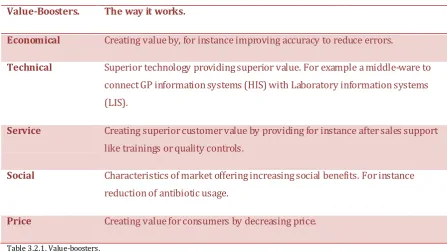
Ballantyne & Varey (2006) add knowledge renewal, communication interaction and relationship-development to the basis of fundamental exchange.23 These concepts all reflect to the definition of Anderson & Narus (2001), which said that value consists of economical, technical, service and social benefits in regard with the price paid for the market offering.24 In this research these five factors or value-boosters are used to understand value.
In addition, Kotri (2006) mentions five sources of benefits for customers. These five are product quality, quality of customer service processes; quality of customer service personnel, brand image and emotions based quality.25 These five actually contribute to the five factors mentioned by Anderson & Narus (2005). The product quality is possible due to the economical and technical aspects mentioned by
Anderson & Narus (2005) while quality of customer service processes and quality of customer service personnel contributes to the service factor mentioned by Anderson
21 Zeithaml (1988), p. 14., as well as Rintamäki et al (2007), p. 623 22 See Aaker (2008), p. 139-140.
& Narus (2005). Brand image and emotions based quality contributes to the social aspects of value mentioned by Anderson & Narus (2005). Therefore the two concepts of value of Anderson & Narus (2005) en Kotri (2006) are combined in value boosters as shown in table 1. This table can be used in order to understand value considering a market offering.
Value-Boosters. The way it works.
Economical Creating value by, for instance improving accuracy to reduce errors.
Technical Superior technology providing superior value. For example a middle-ware to
connect GP information systems (HIS) with Laboratory information systems (LIS).
Service Creating superior customer value by providing for instance after sales support
like trainings or quality controls.
Social Characteristics of market offering increasing social benefits. For instance
reduction of antibiotic usage.
Price Creating value for consumers by decreasing price.
Table 3.2.1. Value-boosters.
These value boosters contribute to the thought of value-in-use. Value can be different for the different actors when using a market offering. This makes it hard to predict according to Cantu (2012).26 This value perception depends on the value boosters mentioned in table 1. These boosters contribute to the thought of value-in-use. What do users of market offering perceive as being valuable?
3.3 Value-in-use.
Something can only carry value when it fulfills some need. These needs can be based on several value boosters as shown in the previous chapter. For instance a designer table could look very good but we should be able to sit next to it, lay something on top but still it has to look good. Not many organizations are able to gather knowledge and capabilities to assess value in practice. Most organizations are focused on reducing costs while there are many other opportunities for them to increase value.27 The
26 See Cantu (2012), p. 141.
value in use of a specific market offering is the value of that market offering under a specific use.
Goods are not bought because they are goods. They are bought to fulfil some need. Products are used to get some service done. In addition, brand image plays a role as well as social responsibility. Besides we don’t actually own goods in exchange of others. The applied knowledge and skills is what we own, our own services. Nowadays not longer should the understanding of economics and marketing be focussed on tangibles like efficiencies in the production but should be on intangibles such as skills, information, and knowledge, and towards an interactive and
connective, ongoing relationship.28
According to Vargo & Lusch (2004) value should not longer be regarded as a ratio between services, quality, and cost but value should be regarded as being created when this service is used. Service is the fundamental basis of exchange. In this sense there should be a clear distinction between services and service. Services are
intangible products while service is the process of using one’s knowledge and/or competences for the benefits of another one. The service-centred view of marketing implies that value is not created by an individual company or supplier but that it is established through co-creation with the customers. Holbrook (1994) and Vargo & Lusch (2008) confirm this.29 In short a company is not able to create value solely. Value is created in use and/or collaboration and therefore a company is only able to make value propositions instead of the actual value.30
A good example of value-in-use is the SUV. This type of car looks like it can drive through almost everything but most SUV’s do not have enough ground clearance or even 4 x 4 drive trains. This is because most users of SUV’s do not value the off-road capacities of their vehicles but they value the looks, the height, and the status of driving a SUV. Smith & Nagle (2005) mention that without a clear understanding and estimation of value in use pricing and marketing is really difficult.31 Christensen et al. (2005) explains it quite clear by stating that: “If a marketer can understand the job, design a product and associated experiences in purchase and use to do that job, and
28 See Vargo & Lusch (2004), p. 14-15
29 See Vargo & Lusch (2008), p. 28., as wel as Holbrook (1994), p. 27 30 Vargo & Lusch (2004), p. 11.
deliver it in a way that reinforces its intended use, then when customers find themselves needing to get that job done, they will hire that product”32 This idea of products being
hired to do a job is shared by Briones (2009), organizations should first think of the job, which the market offering is supposed to do and the benefits the customers has using this market offering. In addition he states that price is less relevant since the focus should be on value-in-use instead of cost-in-use.33
Value-in-use is the value of a market offering, used in a particular setting, which should be enhanced in order to create success for the market offering. The usage of the market offering in a particular setting depends on which value boosters are considered to be important for the user. In this research the POCT service concept will be examined to which extent the different users (e.q. GP’s, labs and
intermediaries) value the different value-boosters. The next chapter will dig a little bit deeper in this difference of value-in-use among actors.
3.4 The multi-actor perspective.
Previous chapters emphasized the need to understand value thoroughly. This chapter is more about the different value-in-use propositions of different actors and why actors can perceive value differently. Pinch & Bijker (1987) are mentioned earlier in this research for their findings concerning different interpretations of an artefact. In that research they created a model, which describes the flexibility of how actors think or interpret certain artefacts. Besides, they mentioned that there is flexibility as well in how these artefacts are designed. ‘There is not just one possible way or one best way of designing an artifact.”34The research of Pinch & Bijker is often used as foundation
for other researches. One of these researches is from Rosa et al. (1999). In this research they used the concept of Pinch & Bijker to further explore the different perceived value propositions by different actors. They discovered that consumers and producers determine the exchangeability or substitutability of a market offering based on context driven demands.35 On the one side consumer demands are focused on the use of a market offering and on the other side the value of producers derives from the need for a better competitive positioning within the market.
32 Christensen et al., (2005), p. 76. 33 See Briones (2009)
They claim that producers and consumers respond to changes in environment, for instance product designs, consumptions, habits, and thereby enact markets. This makes producers and consumers both market makers as it makes them takers. This means that their reactions both shape the market. The market cannot be shaped by one of them, it is an interaction of both which creates value. Ulaga (2001) mentions two perspectives of value, the seller’s perspective, which emphasizes that customers are a key asset of a firm in order to create value36 and secondly from the buyers’ perspective, which emphasizes the superior value of a market offering in perspective of the competition.
Rosa et al. (1999) consider consumers and producers as network actors, which depend on each other in ambiguous transactions.37 Rosa et al. (1999) use the word ambiguous on purpose since producers and consumers are not aware of the
preferences and competences of the other party, which obviously leads to
misunderstandings and corrections. This is emphasized by Håkansson et al. (2009), which say that there are interdependencies between activities of actors and thereby emphasizing the importance of understanding where the bottlenecks are in a
network.38 MacDonald (2010) shows that provider processes, which include service quality, and costumer processes, which include usage process quality and value-in-use, are influenced by the relationship quality.39 Since organizations are located within a web of producers and costumers this can be quite complex. This brings us to the next topic of this research: value-creating networks.
3.5 Value-creating networks.
How can the concepts of value and value-in-use survive in a network? Firms can create value jointly through relationships, partnering and alliances in these
networks.40 Wilson (1999) states that a value-creating network can only work when there is some degree of interdependence. This interdependence can be created through mutual investments.41 “Are we prepared to invest in this other firm? Even
though the investment is not likely to lead to an actual ownership position.”42In
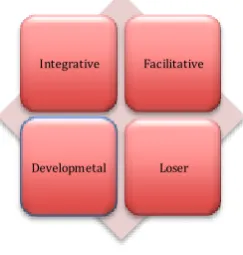
addition Kothandaraman et al. (2001) suggests that there are three aspects for companies, which are very important for creating value jointly, namely superior customer value, core competencies and relationships. Superior customer value should be the outcome of the jointly created value using ones’ competencies within a solid relationship. 43 The relationship in a value-creating network depends on two variables: value added to partner and operating risk. These two variables create the four relationship types showed in figure 3.1. On the x-axis value added to partner is shown from low value added at the left part of the figure and to high value added on the right side of the figure. The y-axis shows operating risk with a lot of risk on the bottom of the figure and little risk on top of the figure.
Figure 3.5.1 Relationship types in a value-creating network.
The integrative relationship type is the most desirable relationship type. These relationships do not only provide key components for current products but for future products as well. The facilitative relationships show a low operating risk but also add low value to the partner and usually do not concern core competences although they are important. Both relationships need deeply involved relationships. The loser
relationships show a high operating risk and a low degree of added value to the partner. These relationships should be avoided. The last relationship type, the
developmental relationships, shows a high degree of added value to the partner but also a high operating risk.
43 See Kothandaraman et al. (2001), p. 384. Facilitative
Integrative
4. Methodology for examining the POCT
service concepts.
4.1 Introduction.
The methodology part of this research functions as a bridge between what is known and what is about to be known. The first step is formulating the problem. This is done in Chapter 2. Secondly, the conceptualization and operationalization is done in
Chapter 3. A case study examines the characteristics of a phenomenon, in this case value, value-in-use its value boosters, value-creating networks and how it interacts in a multi-actor perspective. In this multiple-case study the units of analysis are the different POCT service concepts. Each POCT service concept will be regarded as a single-case study. After finishing the single-case studies, the cases are cross case examined. This workproces, of combining single-case studies into a multiple-case study, is suggested by Brown & Eisenhardt (1997).44 However, Brown & Eisenhardt use it for grounded theories while this research is not focused on building grounded theories but has a deductive character.
4.2 The POCT environment.
The term POCT came up a few times earlier in this research. But still we have no clear view of what it actually is. Why is POCT relevant? What is there to be expected of POCT in relation to value creation?
Currently, blood results are obtained by referring patients to a laboratory. These results come in a few days later. Based upon these results the GP can adjust his or her diagnosis and thereby adjust the desired treatment. For example, if a patient comes to the GP’s practice with a sore throat, which could indicate an infection, the GP had to send the patient to the laboratory to determine the CRP level of the patient, which shows the level of infection. Based upon the result of this CRP test the GP can
determine if the patient needs antibiotic. Patients have to go to a blood sample post to give some blood, which has to go to the laboratory to be examined and eventually the GP is informed. After getting the results the GP calls the patient to inform him or her results are and how the treatment should look like.
However, there is an upcoming trend in POCT. POCT is performing tests. In this case patients won’t have to go to a blood sample post anymore, the blood does not have to travel from blood sample post to laboratory and it won’t take days for the GP to know the results of the test. For determining the results of a test, an appliance is needed and several precautions are necessary. These precautions are related to reliability, accuracy and the level of quality of the results. In other words, the pre-analytical part of getting blood results is an issue, repeatability which reflects precision and bias which reflects the level of “truth” of blood results.
The speed in which these appliances provide the GP with the results of a test, makes POCT extremely patient friendly. Because of the speed and the patient friendliness POCT is gaining interest rapidly. Not only in the Netherlands but globally as well. In fact POCT has grown up to 10% annually worldwide.45 The trend of growing POCT follows another trend when considering the Netherlands. People are getting older and thereby more health-care consuming.
POCT is done for years using all kind of small tests, for instance a urine stick or a finger prick to determine one’s glucose level. Performing POCT can be done without any primary education of laboratory testing and therefore POCT can be implemented in almost every health related organization.46 Of course this requires precise
instructions to ensure quality and reliability.
However, POCT service concepts received some more attention since there are a growing number of reports showing that POCT is not reliable and accurate at all. Users of POCT are often not familiar with laboratory related concepts as “accuracy”, “precision” or “pre-analytical errors.” Insufficient practical skills can lead to incorrect results and thereby incorrect determinations by the GP.47 As Rosa et al. already mentioned consumers and producers are network actors, which depend on each other in ambiguous transactions.48 Earlier research made clear that not many GP’s recognize the importance of operator training and quality control, which are important factors for ensuring patients safety and quality of care.49
45 See Vermeer et al. (2010), p. 33. 46 See Vermeer et al. (2010), p. 36. 47 See Hooijberg et al. (2011), p. 32. 48 Rosa et al. (1999), p. 76.
Therefore the Dutch association RIVM requested organizations to come up with a clear set of guidelines to ensure patient safety and quality when performing POC.50 Laboratories have noticed the growing attention of POCT services. Several
laboratories are designing a system in which POCT can follow the same quality, reliability and accuracy standards as an accredited laboratory while maintaining the ability to provide the primary care with quick results.
4.3 Research design.
This research is designed and analyzed using techniques of Eisenhardt (1989) described in her article “Building theories from case study research.”51This research
has a deductive character while the article of Eisenhardt (1989) is focused on creating grounded theory. Nevertheless, the technique which Brown & Eisenhardt use shows a clear structure and therefore it will be used in this research as well. The first step according to this article is to formulate a research question, which is done in chapter 2. The second step is selecting a case study, which is described more
thoroughly in the previous paragraph. The single-case studies, in this research the different POCT methods and its users, are performed first and later on these cases will be cross case examined. The third step is about the data collection methods, which is described after the cases. According to Eisenhardt (1989) there should be different ways of collecting data because this makes sure that the data is more reliable and complete. In this research data will be collected by face-to-face
interviews, electronic interviews, using existing documents and observations. This is further described in chapter 4.6.
This research uses a multi-actor perspective and examines three different POCT service concepts; a multiple-case suits this study, one case study for every POCT service concept and its actors. Brown & Eisenhardt (1997) used a similar method in their article. In this article the research design is a multiple-case study, which is designed in such a way, that replication is easy.52 Yin (1984) mentioned this as
50 See RIVM (2013)
replication logic in which cases are considered as independent experiments either confirming or disconfirming the conceptual insights.53
Brown & Eisenhardt used a multiple-case study design; in which the cases are treated as a series of independent experiments that confirm or disconfirm emerging
conceptual insights.54 In their study they conducted interviews among several levels of management. In this research a similar method will be used. There are three actors within the value-creating network examined. First, the laboratories that provides the POCT method for the primary care. Secondly the GP’s using the POCT method and performing laboratory diagnostics at site55 and lastly KPN eZorg, which creates a solid IT environment in which it is possible to handle secured health related data. After the data collection an analysis is made using MacDonald (2011) as an example for this research, the cases are examined using a cross-case analysis and using illustrative quotations.56 In total nine interviews were conducted. Three of those interviews were face-to-face interviews used to gather data at the different POCT providers. These POCT providers were selected based on their dominance on the Internet. The other six interviews were conducted electronically. Five of the
remaining six interviews were conducted with GP’s. The last interview is conducted with the intermediary between POCT provider and GP within the JBZ POCT service concept.
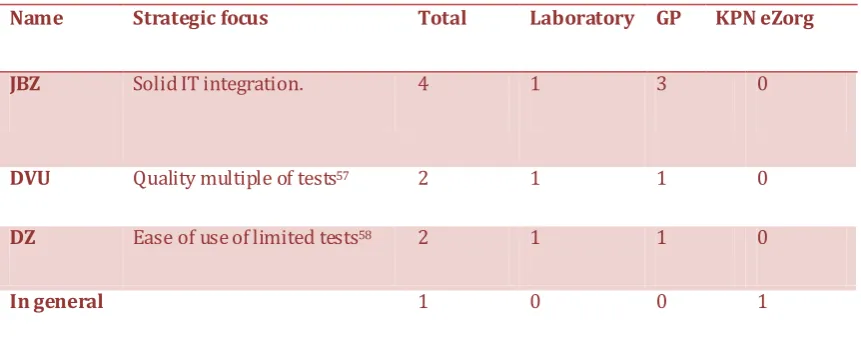
As the POCT providers were examined a bit further it turned out that the POCT providers have different strategic focuses and are therefore more relevant. The three POCT providers are the Jeroen Bosch Hospital (JBZ), DiagnostiekVoorU (DVU) and the Deventer Hospital (DZ). An overview of all interviews is shown in table 4.2.1.
53 See Yin (1984), p. 31.
Name Strategic focus Total Laboratory GP KPN eZorg
JBZ Solid IT integration. 4 1 3 0
DVU Quality multiple of tests57 2 1 1 0
DZ Ease of use of limited tests58 2 1 1 0
In general 1 0 0 1
Table 4.2.1. Overview of interviews among POCT method providers.
4.4 Data collection methods.
This chapter describes what methods are used to collect data and how they are
performed. The first part describes the procedure while observing. The second part is concerned with the procedures for the electronic interview part.
Qualitative collection through observations.
One of the most important factors of making observation is gaining access, contacting potential research participants, being prepared and be able to capture all data at sight.59 The providers of the various POCT service concepts are included in the observations. Personal contact is considered to be important to improve the (electronic) interviews, which are mentioned later on. Therefore it helps to phone and e-mail first, visit them for observations and then conduct (electronic) interviews. This is also done in this research. During those visits observations are made, which contribute to the question list in the (electronic) interviews. Instructions were given how to use the different appliances and what handlings were necessary for the
different POCT service concepts. Another important aspect is the observer effect. The impact of the observer’s participation on the setting or the participants being studied. 60 Therefore it is important to put aside assumptions and see phenomena through participants’ perspective and to write down notes as soon as observations take place.61 This is also done during this research. The goal for the observation part of
57 See Diagnostiek voor u 1 (2014) 58 See DZ 1 (2014)
59 See Cassell & Symon (2004), p. 157.
this research is to get comprehensive insights to the different POCT methods. Besides it functions as a triangulation for the (electronic) interviews.
Qualitative data collection by using electronic interviews.
To gather information concerning the different POCT methods electronic interviews are used. These electronic interviews are sent to the GP’s and intermediary to see whether there is a big difference in the value-in-use compared with the laboratories. Electronic interviews are interviews whereby electronic devices are used for
communication between participants. Instead of using closed questions in surveys, the electronic interviews in this research consist of open questions. In electronic interviews, the researcher initially sends a relative small list of questions in order to give room to the respondent to share his ideas about a topic or opening up the
discussion.62 Electronic interviews have some important advantages. Its ease of use is a big advantage. Participants, and in this research GP’s and intermediary, can respond whenever and wherever they want, which enables to reach busy people like GP’s.63 Because electronic interviews do not need to be transcript it saves time, money and errors due to transcription.64 Electronic interviews also reduce the problem
concerning interviewer effects. Since there is no non-verbal communication, participants won’t see how the interviewer reacts to particular questions and it contributes to reducing the negative effect of shyness.65
“The 'mute evidence' of written data can offer the, sometimes necessary, convenience of both spatial and temporal distance between subject and researcher.”66The follow-up questions can be formulated specific for one respondent, which makes them more motivated and connected to this research.67
However, simply emailing participants a question list is no guarantee for success. A lot of people won’t feel connected to the list or think its spam. Therefore all
participants were called by phone in order to ensure commitment and reduce the chance that it is seen as spam. In a face-to-face interview you are sitting in front of them, which makes it likely that the participants at least finish the interview. In
electronic interviews they could just stop replying or forget to reply. In this research reminder emails were sent to the participants in order to obtain the data.
4.5 Making it measurable.
First measurement procedures are determined for value-in-use followed by
measurements procedures for the value-creating network aspect. Both considered in a multi-actor perspective.
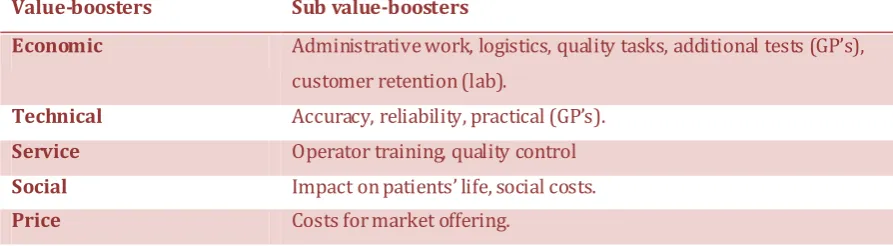
This research uses five value-boosters, which explain the value-in-use of an actor. These value-boosters are economical, technical, service, social and price related boosters. Table 4.5.1 shows how these are divided in smaller sub
value-boosters. During the interviews other related factors showed up and these are added to the existing sub value-boosters. For instance customer retention is an important part of the economic value-booster for laboratories.
Value-boosters Sub value-boosters
Economic Administrative work, logistics, quality tasks, additional tests (GP’s),
customer retention (lab).
Technical Accuracy, reliability, practical (GP’s).
Service Operator training, quality control
Social Impact on patients’ life, social costs.
Price Costs for market offering.
Table 4.5.1. value boosters and their sub-ordinates.
After the face-to-face interviews with the laboratories, the electronic interviews with the GP’s and the intermediary and the examination of the received documents all data is combined in a case for all individual POCT providers. These cases are made
regarding several topics. The first one is an introduction to the case. The following five topics are the different value boosters combining data of GP’s and related laboratory. Then the prerequisites of their POCT service concept are mentioned, followed by a topic about interaction with the GP and the GP’s perspective. Using these two topics the relation type is determined as explained in the theoretical framework using the two variables “operating risk” and “usage of superior core
4.6 Data analysis methods.
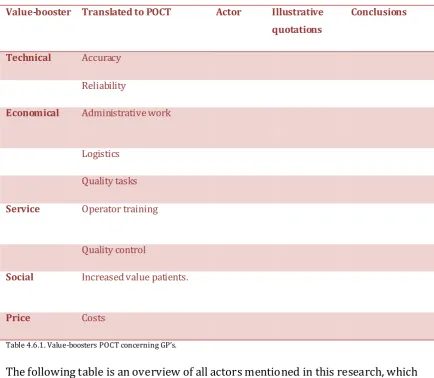
This part of the research will provide different insights to which extent the value-boosters are related to a specific POCT method. The following table shows the value boosters concerned with the POCT service concept. There are two different things to be examined. First how do the value-boosters relate to the different POCT service concepts? For measuring these value-boosters face-to-face interviews are used, as are electronic interviews. A few questions are already formulated on forehand but will be followed by more in depth questions. The answers will be used as illustrative
quotations in order to scale the different POCT methods in table 4.6.1, following the example provided by MacDonald (2011).68 The single case studies mentioned in chapter 4.5 are now combined into one table, which enables a cross-case
examination.
Table 4.6.1 is used when considering value-in-use for GP’s or laboratories regarding POCT service concepts. In this table first the value boosters, as mentioned in chapter 3.2, are listed with the translation to the POCT in the second column. The third column the specific actor is mentioned. The fourth column illustrates the
value-booster with quotations and the last column combines the quotations for conclusions. This table will be used in order to conduct four different single case studies, which are cross case examined by referring to illustrative quotations.
Value-booster Translated to POCT Actor Illustrative quotations
Conclusions
Technical Accuracy
Reliability
Economical Administrative work
Logistics
Quality tasks
Service Operator training
Quality control
Social Increased value patients.
Price Costs
Table 4.6.1. Value-boosters POCT concerning GP’s.
The following table is an overview of all actors mentioned in this research, which shows what boosters are most present at the different levels of this value-creating network. This is shown in table 4.6.3.
Value-boosters POCT provider GP KPN eZorg
Economic Technical Service
Social Price
Table 4.6.3. Overview value-boosters according to actors.
different POCT providers, which are filled in by using illustrative quotations.69 All these tables are combined in the Appendices showing the cases of the different POCT providers.
Value-creating network
Actor Illustrative quotations Conclusions
Added value to partner. Operating risk
Table 4.6.2. Measurement of relationship type POCT provider.
To sum things up the different POCT providers are approached as individual cases. Once these individual cases were completed, a cross case analysis is used as it is used by Brown & Eisenhardt (1997)70 and the data collection methods suggested by Miles & Huberman (1984) for the observational data71 together with Cassell & Symon (2004) for the electronic interviews72 and Eisenhardt (1989) for the cross case examination are used to establish conceptual insights, which are used in order to determine the above tables.
This is an explorative research in which data is collected through semi-structured face-to-face interviews, electronic interviews, observations and usage of existing documents. The different individual cases are used to gather insights of the dilemma’s or success stories by comparing them with each other.
69 See MacDonald (2010), 675.
5. Analyzing the different POCT service
concepts.
5.1 Introduction.
This chapter describes the value-in-use for actors within the different POCT service concepts. For this analysis interviews are used among all three different POCT providers and its users. Three interviews were held face-to-face, with the actor “laboratories” and 6 were conducted electronically with the actors GP’s and KPN e-Zorg. First the value-boosters for the laboratories are mentioned. Followed by the value-boosters relevant for GP’s. At the end the interview with KPN e-Zorg is examined and the relevant value-boosters are noted.
5.2 The POCT service concepts.
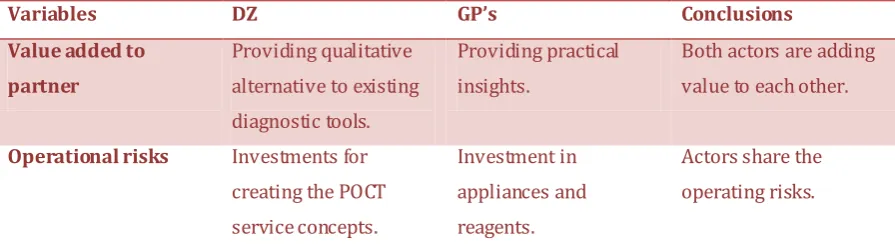
All POCT service concepts have been analysed and summaries of quotes of the
Variables DZ GP’s Conclusions Value added to
partner
Providing qualitative alternative to existing diagnostic tools.
Providing practical insights.
Both actors are adding value to each other.
Operational risks Investments for
creating the POCT service concepts.
Investment in appliances and reagents.
Actors share the operating risks.
Table 5.2.4 The variables of relationship within the POCT service concept of DZ.
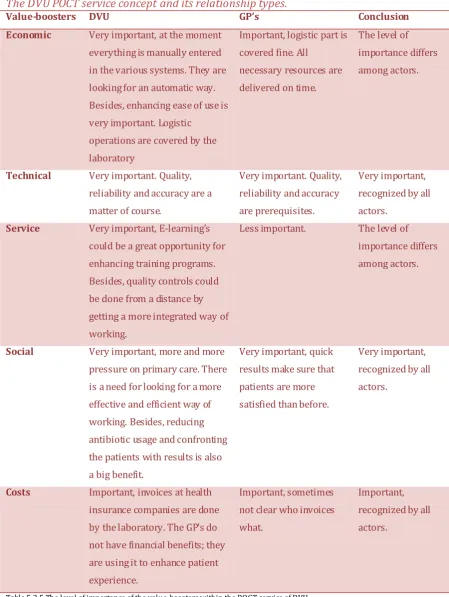
All POCT service concepts cover the logistic part. This has a few reasons. First of all when combining the needs for reagent or other resources necessary for POCT they are able to reduce costs by using power of scale. Besides, they consider this as a service towards the GP as well. GP’s in all three POCT service concepts see this part of the “economic” value-booster as a matter of course.
For concerning the “quality tasks”, the responsibility to maintain the appliances and al other quality related tasks are shared among actors. The GP’s with more an
identifying role and the laboratories in a more facilitating role.
The first additional economic value factor “Customer Retention” is an important factor for all three laboratories to engage in POCT activities. For the JBZ and the DZ it is because the more GP’s connected to their service concept the more likely it is that the GP refers his/her patients to that specific hospital. For DVU it is related to be
Technical value booster among actors.
This value booster was initially divided in two sub value boosters. The first part is
“accuracy” and the second is “reliability”. According to the interviews with the laboratories a third was necessary “Quality”. In all three cases this is considered as fundamental before being able to design a POCT service concept. The DZ approach is to first select a few appliances based on quality and then use them in pilots to figure out what GP’s prefer based on ease of use. Partly because most POCT service concept providers engaged in POCT activities to deliver a method, which is as good as an accredited laboratory. All laboratories value a high degree of quality, reliability, accuracy and ease of use. One of the GP’s connected to the POCT service concept of DVU mentions: “Sensitivity and ease-of-use is tested before implementing appliances. This is really good.” GP’s of the POCT service concept provided by the JBZ say: “No errors occur, reliable appliances.” Besides they all agree that the laboratory itself should do maintenance of these appliances to ensure the quality of the appliances and that GP’s have an identifying role. All GP’s among the different POCT service concepts recognize the importance of their identifying role and sustaining a qualitative,
reliable and accurate POCT service concept. However, this is less recognized in the POCT service concept of DZ. Despite the fact that the JBZ has a fully automatic POCT service concept there is room for improvement according to one of the GP’s. “Now all appliances are connected through cables, one for power supply and one for the Internet. This should really be wireless.”
Lastly the third actor within the POCT service concept of the JBZ, KPN e-Zorg, is able to maintain a network in which they are able to process over 350.000 healthcare related messages daily. Besides, it is not only processing it’s also about securing patient privacy.
Service value booster among actors.
next step: offering e-learning in the future. In this way they can be trained from a distance and performed more frequent. Besides, when someone finishes the E-learning they could receive their own barcode to log in automatically, in case of JBZ, and it could be automatically turned down when the follow up E-learning has not been made or is not sufficient made. The GP’s among the different POCT service concept do not see this as a service of the providers of the POCT service concept. Besides the “operator training” there is another sub value booster: “quality control”.
Again all three laboratories agree that this is the responsibility of the laboratory as well. The appliances have to be regularly checked and maintained. However, JBZ and DVU recognize the importance of an identifying role as the responsibility of the GP’s. When considering service KPN e-Zorg is able to contribute to a fast out roll of the POCT service concept of JBZ because they have a broad network of GP’s, hospitals and pharmacists and therefore they could help in sustaining a smooth and solid
integration between the laboratory and GP. Besides they have approximately 80 account managers, which can contribute to the out roll of this POCT service concept.
Social value-booster among actors.
This value booster is divided in two sub-value-boosters: “impact on patients’ life” and
to respond to this argument is hard according to DVU since they are offering the HBA1C as well, they are not encouraging it however. Therefore conclusions can be made that POCT adds value only when results are directly needed, for diagnosing or for confronting the patient, for instance when a diabetic patient did not follow his diet properly. DVU is the only laboratory to mention the D-dimer test. In this case they can offer the GP with a tool to exclude a heart attack or a stroke. Sometimes patients suffer heavy breathing or pain in the chest and the GP doubts whether the patient suffers from deep vein thrombosis or pulmonary embolism. In this case, immediate actions are necessary. Using this test could reduce the number of unnecessary
patients to the First Aid and thereby reducing cost for society. However, the D-dimer test is mentioned by DVU only.
Price value booster among actors.
The JBZ and DVU POCT service concept invoice the cost at the health insurance companies. For the GP no direct costs are charged. The drawback for the GP is that he/she is not able to invoice the test anymore and thereby not having a financial benefit for diagnostic tests anymore. The DZ however, questions if this is the right why of doing business. DZ believes that it’s not right to invoice handlings not
performed by the laboratory. Therefore they have decided to charge the GP with the costs for the appliances and needed resources and in addition to charge them for a subscription. In return of this subscription the GP’s will be provided with trainings, logistics, and they receive follow up on the results of the laboratory. Besides a
laboratory test is included in the own risk part of the health insurance and sometimes the GP has to explain to the patient why the patient has to pay for a particular test. As DVU said: “The GP’s working with this system recognize the value of the quality
delivered, they just tell the patient do you want good health care or bad health care?” Besides the laboratories there are some concerns within the POCT service concept of the JBZ and DVU. These are the POCT service concept providers who are invoicing the costs at the health insurance companies. The GP’s connected to the DZ POCT service concept recognize that purchasing the equipment is a big investment but they seem to have little problems with the way the POCT service concept is financed.
6. Conclusions concerning value-in-use
from a multi-actor perspective.
6.1 Introduction
This research contributes to existing literature in multiple ways. First in the fast changing health care in the Netherlands it is proof that business administrative concepts contribute to the health care sector as well.
Besides, the concept of value-in-use from a multi-actor perspective is yet confirmed to be useful. The findings in this research show that there can be great advantages by understanding the in-use of the actors using a market offering using value-boosters to understand the value creation better. POCT is service in its fullest, the process of using one’s knowledge and/or competences for the benefits of another one.73
However there are some tensions as well. For instance, all GP’s show great interest in the social value-booster while all laboratories are more focussed on the economic value-booster. Besides, both GP’s and laboratory within the JBZ’s POCT service concept show little interest in the price value-booster while the commercial aspect of engaging in POCT activities drives KPN. On a more practical level, GP’s within the service concept of the JBZ and DVU want extension of POCT analyzers while the laboratories within these POCT service concepts are sceptical of the added value of particular tests. HBA1C for instance is valued by the GP’s within both POCT service concepts while DVU thinks that the added value is less because it doesn’t matter if you know the result tomorrow or today. It is very important to understand where the gaps between value-in-use are in networks like these in order to establish a solid co-creation of market offerings, which suits the value proposition of the customers as it does for the providers and intermediaries.
The comprehensive literature study, in chapter 3, provided this research with the answers to the first sub-questions, which in their turn contribute to answering the research question:
“How can value-in-use be created and sustained from a clustered multi-actor perspective in the medical sector, concerning the POCT concept?”
This section will answer the research questions using the theoretic framework mentioned in Chapter 3.
6.2 Conclusions.
Value-in-use matches within POCT service concepts.
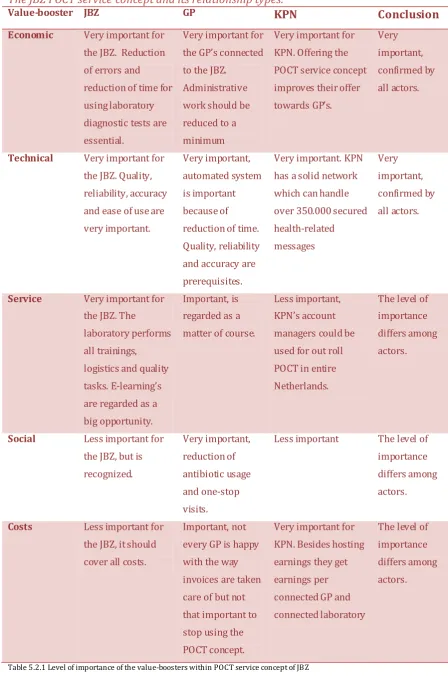
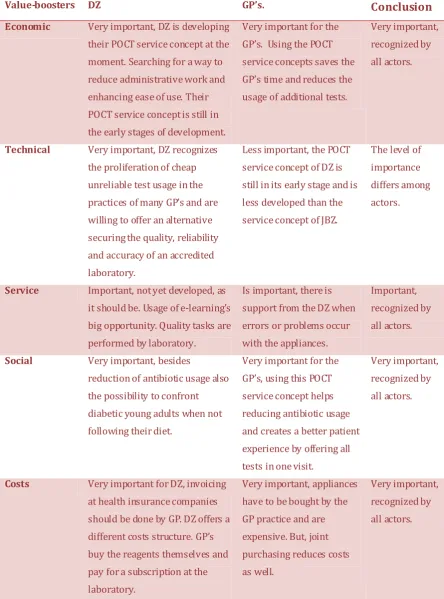
This research examined the different views on value-in-use for the different actors concerning the POCT service concepts. The way the value-boosters interact among the actors within the POCT service concept is examined using face-to-face interviews and electronic interview. These POCT service concepts are treated as single-case studies, which are cross case examined afterwards. Using the method of MacDonald as an example for the analysis and draw conclusions on the hand of illustrative quotations. 74 The following overview per POCT service concepts shows the number of “matches” in level of importance between the different actors. In other words, what value-boosters are recognized among actors within the different POCT service
concepts.
Value-boosters JBZ DZ DVU
Economic Match. Match. No match.
Technical Match. No match. Match.
Service No match. Match. No match.
Social No match. Match. Match.
Costs No match. Match. Match.
Total: 2 matches. 4 matches. 3 matches.
Table 6.2.1 Overview of matches in level of importance of value-boosters among actors within the POCT service concepts. When there is a match between the actors of a POCT service concept, it implies that all actors within that POCT service concept show the same level of importance regarding that specific value-booster. It is possible that GP’s show a high level of
importance for the social value-booster while the laboratories show a medium level of importance.
DZ is best in recognizing the value-in-use of its actors and outline them with their own value-in-use, partly because their POCT service concept is still under
construction and is being designed by both actors. The JBZ has most problems with recognizing the use of its actors and outline them with their own value-in-use. DVU has 3 matches on the value-booster and is therefore in the middle.
Relationship type within value-creating networks.
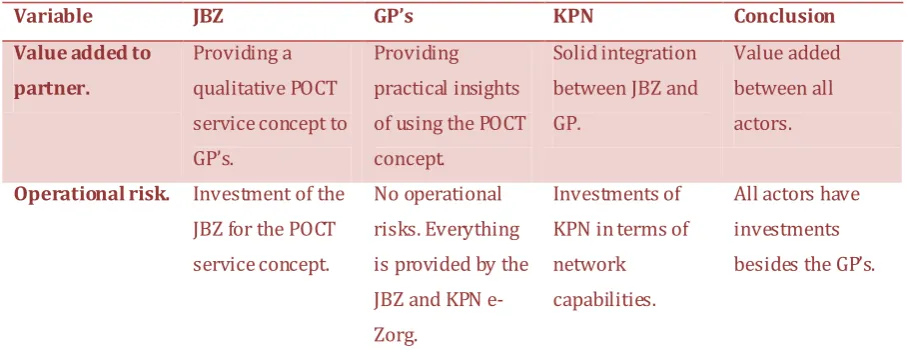
An important factor for value-creating networks is the relationship type within a network. In this research the model of Kothadaroman et al. (2001)75 in which the relationship type is dependent on two variables; operating risks and value added to partner.
The POCT service concept of the JBZ shows an integrative relationship type between the laboratory and the GP’s. The relationship type between the laboratory and KPN e-Zorg is a facilitative relationship.
The relationship type within the POCT service concept of DZ can be considered as facilitative between the laboratory and GP’s.
The POCT service concept shows an integrative relationship type between the laboratory and the GP’s.
The optimal relationship type for value-creating networks is a facilitative relationship type in which all actors add value to their partners but also share the operational risk.
Cross-case examination learning’s.
This part covers the learning’s from the cross case examination done after the single case studies were completed.
- All three POCT service concept providers recognize the importance of an automatized system in which no manual input is entered at all. Most errors occur when input is entered manually and therefore quality and reliability is raised when this can be done automatically. There is one POCT service concept provider, which is already able to work like that, the JBZ.
- All three POCT service concept providers are searching for a way to implement E-learning’s in their service concept in order to update the knowledge of the users of their POCT service concept as fast as possible.
- Providing in logistic needs is seen as a matter of course by all GP’s throughout all POCT service concepts. GP’s agree that they have an identifying role in the quality tasks and that laboratories are responsible for maintaining the
appliances.
- Customer retention and preventing double diagnostics are both important factors for GP’s and laboratories in all three POCT service concepts.
- Within the POCT service concept of JBZ and DVU GP’s feel that there is room for more analyzers, which could be useful in their practices.
- Ensuring quality, reliability and accuracy is essential for the actors of the POCT service concept.
- Reduction of antibiotic usage and one-stop-visits are the main reasons for all GP’s in all three POCT service concepts to engage in POCT activities.
- There is room for improvement in the way the POCT service concepts are financed. Only the POCT service concept of DZ shows a fit in the costs value-booster while the JBZ and DVU POCT service concepts show dissatisfaction in the way the diagnostic tests are invoiced.
6.3 Managerial and practical consequences and advices.
After examining what value means, what value-in-use means, what the value-boosters are and what value-creating networks are, a qualitative research has been done to examine three POCT service concepts and the value-in-use of its actors. Besides, the relationship types have been examined between the actors in those POCT service concepts. The gathered knowledge needs to be translated into managerial
consequences and advices and in practical consequences and advices.
Managerial consequences and advices.
Market offerings, and the solutions these market offerings offer, emerge through interactions between users and producers.76 Because of this co-creation it makes it hard to predict77 and therefore organizations should see actors as co-creators. Getting
clear insights of the bottlenecks for actors within a network is crucial according to Håkansson, et al. (2009).78 For organizations there is a need to understand that:
- It is necessary for organizations to understand they are part of a larger value-creating network.
- The actors within value-creating networks have a different view on value-in-use.
- The value-boosters in this research can be used to get a clear understanding of the different value-in-use of actors within an organization’s value-creating network.
- When comparing market offerings within the same industry the
value-boosters can be used to see whether there is a match between actors in level of importance.
- The relationship type is crucial to sustain current market offerings but also future market offerings. The facilitative relationship type enables more co-creation than the other relationship types within a value-creating network. Practical consequences and advices.
Besides the managerial consequences given in the previous paragraph, there are some practical consequences related to the POCT service concepts as well. There are some trends, which are likely to grow in the future. The growing aging society, the shifts in the Dutch health care system and the focus on reducing antibiotic usage are the main trends influencing the POCT service concepts. Considering the theoretical concepts used in this research the following consequences or advice can be given to the POCT service concepts:
- Be aware of the trends in your market. Continuously follow up on these trends and see how other laboratories in other countries are engaging similar
problems.
- Stay close on developments of actors and co-create. In this research
laboratories, GP’s and intermediaries are used but developers of appliances are actors too. For instance a finger scan could improve identification of POCT user and improves speed.
- The technical value-booster is most important in the POCT service concepts. All actors recognize that this is a prerequisite. Make sure that it keeps the high-level of reliability, accuracy and quality but in perspective of the GP that also the right analyzers are implemented. For instance the HBA1C analyzer is valued by the GP’s but not all laboratories recognize the importance of this tool.
- All POCT service concepts are searching for a way to make use of E-learning’s. E-learning’s are implemented in other industries as well. Therefore many organizations might have suffered the same problems as the laboratories are facing so make use of best practices.
- When considering the most effective relationship type for co-creation all actors within the POCT service concepts add value to their partners but there is a lack of shared operational risks in two of the three POCT service concepts. 6.4 Limitations and directions for future research.
A common problem of qualitative researches is the level of generalizability. The methods used however can be used in different settings as well. The value definition of Anderson & Narus is made in general and therefore using the derived value-boosters in different settings is possible. But further research is necessary to gather insights and proof for general value-boosters, which can be used in every setting. Using longitudinal design raises internal validity. The POCT service concept providers are selected based on their dominance in media. There could be better examples of POCT service concepts in the Netherlands or even Europe. When considering a broader scope different value-in-use are possible and different levels of importance could be shown by the actors within these value-creating networks. Besides, using a broader scope increases the generalizability.
relate this to health insurance companies because insights of the value-in-use of health insurance companies could help in a clear cost structure satisfying GP’s and laboratories.
The POCT service concepts are now examined in perspective of laboratories, GP’s and one intermediary but this POCT service concept can be used in multiple settings as well for instance rehabilitation centres or senior housing. In this perspective
particular value-boosters may be more or less important in perspective of the actors examined in this research.
The least developed POCT service concept showed the most matches in level of importance considering the value-boosters while the most developed POCT service concept showed the least matches in level of importance considering the value-boosters. Perhaps GP’s within the POCT service concept of the JBZ did not mention the value-booster “service” because they consider it as a matter of course. But what happens if this is not on the same level as it currently is? Besides, the POCT service concept of JBZ includes three actors instead of two actors within the other two POCT service concepts, which could explain the number of matches.
8.
Appendices
Appendix A, questions laboratories
1. Waarom denk jij dat POCT waarde toevoegt in de dagelijkse werkzaamheden in het lab? En voor de huisarts denk je?
- niet alleen gericht op deze methode maar ook POCT in het algemeen. - Doorvragen. Waarom bepaalde dingen bijdragen. Wat draagt niet bij in
daily operations? Wat juist wel? Wat zijn de grootste ergernissen? Etc. - Uit welke trends is POCT geboren?
2. Hoe is deze POCT methode georganiseerd en ontworpen? M.a.w. hoe werkt het en op welke vereisten is het gebouwd? Wat waren de achterliggende
concepten?
- inzichten krijgen hoe verschillende POCT methoden werken. - Trainingen, accuracy and reliability hoe zijn deze gewaarborgd, - Logistieke gedeelte gedekt?, hoe zit het met administratief werk?
3. What kind of impacts did implementing this POCT method have in your daily operations?
4. Wat maakt deze POCT methode de beste methode? Wat zou er nog verbetert kunnen worden aan deze methode, m.a.w. wat ontbreekt er nog?
- Stuur op value-boosters (economical, technical, service, social & price), achterhaal wat hij/zij belangrijk vindt aan de POCT methode.
- Doorvragen, what aspects are good, what aspects are bad and why are those aspects good or bad etc.
5. Is implementatie van deze POCT methode soepel verlopen? Wat waren zaken waar het lab of de huisarts tegen aan liepen? Is aansluiting op deze POCT methode eenvoudig voor andere labs? En huisartsen??
- Waarom wel of niet? - Doorvragen.
6. Hoe is het netwerk georganiseerd om deze POCT methode heen? Hoe is de relatie met de verschillende actoren?