DOI : https://doi.org/10.32628/CSEIT195527
An IoT Enabled Worker Safety System Using Gas and Temperature System
Divyesh Patel1, Arpita Shah2, Hetal Shah3
1,2,3U & P U. Patel Department of Computer Engineering, Chandubhai S Patel Institute of Technology,
CHARUSAT, Changa, Anand, Gujarat, India ABSTRACT
This paper aims to build up a model for an online remote gas and temperature checking device for worker’s safety
in sewage pipelines. The device is WSN based microcontroller equipped with analog and digital sensor. The design included several units mainly: Arduino Microcontroller MQ-135, DHT11, Gas and Temperature Sensors, and the current regulator circuit. The sensors are connected with a microcontroller through an ADC for advanced flag change and information logging. An LCD show is likewise associated with the microcontroller to show the estimations. For examination and filing purposes, the information can be exchanged to a PC with a graphical UI program through a USB interface. The device displays toxic gas and workers real-time position, transmit information remotely via a graphical user interface to IBM bluemix provide adjacent help. By keeps observing, this model will prone to diminish mishaps and slowly spares an existence. The model has numerous points of interest when contrasted with other checking frameworks as far as its littler size, gigantic memory limits, on-gadget show, bring down cost and more noteworthy versatility.
Keywords : Gas, Temperature, Sensor, Microcontroller, Web-Based, Wireless Sensor Network (WSN)
I. INTRODUCTION
IOT is the system interfacing objects in the physical world to the Internet. Tomorrow's Smart System will be remote. The framework procedure of observing and computerization applications are both "going remote" and "going IP" to decrease establishment cost and
simplify internet integration. Worker’s wellbeing is a
worry and obligation regarding all organizations, particularly when discussing work environment security. [7] It is an imperative duty with respect to wellbeing to check and affirm whether the worksite is appropriate and ok for the representatives to go ahead with their day by day assignments. Worker faces issues like lack of oxygen, liquids that can fill the confined spaces, a high concentration of dust, hot conditions, poisonous sewer gases, fire, and explosions.[6] Working environment wellbeing ends up essential
the module. To overcome this situation made an embedded system using a microcontroller [12].
In this paper, we show a minimal effort remote sensor organize (WSN) framework created utilizing Arduino, temperature-mugginess sensor and small-scale gas sensors give those data to the cloud. The framework that we have created is fit for gathering four air quality parameters and temperature stickiness parameter from various areas all the while [12].
II. METHODS AND MATERIAL
SYSTEM DESIGN 2.1 Block diagram
Figure 2.1-Block diagram of proposed system
In the above piece chart, there are following primary parts
• Back End which incorporates MQ2 sensor, MQ7 sensor, DHT11 sensor, and so on.
• Arduino mega (ATMEGA Atmel328PU)+Ethernet shield(W5100)
• IBM bluemix cloud server
In this framework, sensor, light ward resistor and temperature sensor is interfaced with Arduino mega board (AT mega Atmel 328PU). This Arduino super board is associated with MQTT server by means of Ethernet link. This will give availability to the server
to transmit the information on to the web. This information at that point observed self-assertively utilizing cell.
2.2 Flow chart
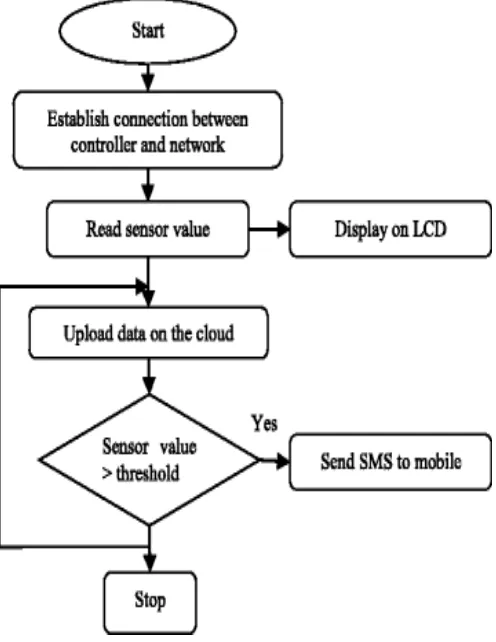
The proposed system is detecting sewer gases and sending the sensor information on an LCD monitor. The objective is to design and implement the system to notify the worker when there are a danger and logging all the data into dashboard monitor for further adjacent help. The device that we have created is equipped for gathering four air quality parameters from various areas at the same time. The device has the sensors on a front side. As shown in flow diagram sensor read value displays on the monitor. If the value of sensor very high then device sounds a buzzer and send a notification through Email or an SMS to a nearer cell to provide adjacent help.
Figure 1.2.Flow chart of proposed system
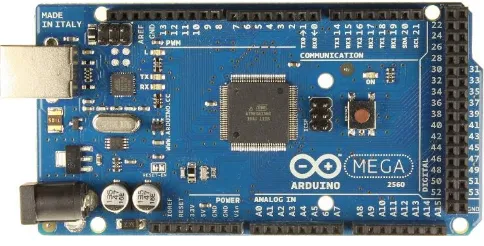
Figure 2.2 Arduino Mega
The Arduino Mega 2560 is a microcontroller board in light of the ATmega2560 (datasheet). It has 54 computerized input/yield pins (of which 14 can be utilized as PWM yields), 16 simple data sources, 4 UARTs (equipment serial ports), a 16 MHz gem oscillator, a USB association, a power jack, an ICSP header, and a reset catch[12]
Microcontroller ATmega2560 Operating Voltage 5V
Digital I/O Pins 54 (of which 15
provide PWM
output) Analog Input Pins 16 DC Current per I/O Pin
20 mA
DC Current for 3.3V Pin
50 mA
Flash Memory 256 KB of which 8 KB used by the boot -
loader
SRAM 8 KB
EEPROM 4 KB
Clock Speed 16 MHz
Length 101.52 mm
Width 53.3 mm
Table
• CO2 Sensor (MQ135)
It is a synthetic sensor. The scope of CO2 focus it can distinguish is 350-10000 ppm (parts per million When the sensor is presented to the CO2 gas, substance responses happen in the cell creating an electromotive power. The surface temperature of the sensor should be sufficiently high for these responses to occur. As the yield voltage of the sensor is low (100mV - 600mV), it should be enhanced with a specific end goal to enhance the precision of estimations.[15] It likewise requires an outside warming supply as its energy prerequisites can't be fulfilled by the microcontroller. Subsequently, it winds up fundamental to build up a flag molding and warming circuit for this sensor. [12].
• Humidity sensor (DHT11)
• MQTT
In this system use of MQTT protocol has been used as a light wait protocol While HTTP is the de-facto protocol for the human web, communication between machines at scale requires a paradigm shift— steering away from request/response and leading towards publish/subscribe. It works profitably wander level applications because of its ultra-lightweight, massively scalable, and easy-to-implement protocol MQTT. It ensures data transmission and profitable allotment. It is sensible for obliged condition than http. [15]
III. EXPERIMENT
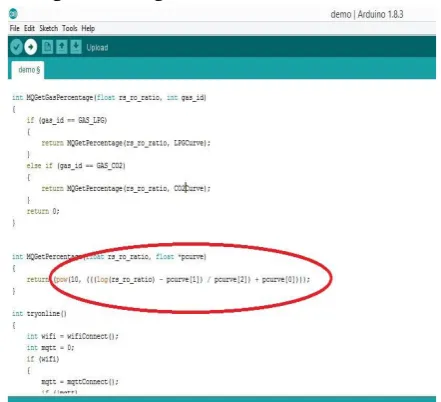
This examination done utilizing the Arduino Mega associated with Ethernet shield as a miniaturized scale web server. This experiment executed utilizing the Arduino Mega associated with Ethernet shield as a smaller scale web server, which can be associated with the equipment module design. Upload the below on board and open Serial Terminal. Then, wait until obtaining something as shown in LCD monitor.
Figure 3. Arduino code for CO2 gas sensing
You will get all the sensor reading on LCD monitor as given below which shows temperature, humidity, Liquefied Petroleum Gas (LPG), Methane (CH4),
Carbon Monoxide (CO) and Carbon Dioxide (CO2) on monitor as shown.
Figure 4. Led Monitor
Graph of gases has been taken using IBM bluemix cloud service, which provides a graph in range of 10-10000 ppm scale and gauge meter that indicates weather the situation is safe or in danger.
Figure 5. Graph of reading
Below table shows different sensor reading in different situation.
Table 1. Reading Table
Temperature Humidity LPG Methane
33 60% 94 14
33 60% 6 94
33 61% 2 10
32 60% 3 5
30 59% 30 114
IV.CONCLUSION AND FUTURE USE
temperature monitor. With the addition of GPS module can locate from anywhere.HR monitor, body temperature monitor system is the future improvement of proposed system which notifies intrusion by an SMS or Gmail. This project is a prototype for various safety applications based on Arduino mega and internet of things.
V. REFERENCES
[1]. http://www.safework.nsw.gov.au [2]. http://what-is-a-sensor.com
[3]. “Mobile collocated interactions with wearables:
past, present, and future” Andrés LuceroEmail
author, James Clawson, Joel Fischer and Simon Robinson
[4]. “Social Sencing” integrating sensors and social
networks. C.C. Aggarwal (ed.), Managing and Mining Sensor Data, IBM T. J. Watson Research Center Hawthorne, Tarek Abdelzaher University of Illinois at Urbana Champaign Urbana, IL
[5]. “CloudFit: A Cloud-Based Mobile Wellness
Platform Supported by Wearable Computing”.
Angel Ruiz-ZafraEmail author Manuel Noguera, Kawtar Benghazi, José María, Heredia Jiménez [6]. “Activity recognition using cell phone
accelerometers” Kwapisz, J.R., Weiss, G.M.,
Moore, S.A.: ACM SIGKDD Explorations Newsletter 12(2), 74–82 (2011)
[7]. “Smartphones: Feasibility for real-time sports
monitoring.” McCarthy, M.W., James, D.A.,
Rowlands, D.D.: Procedia Engineering (2013) [8]. “Multi-sensor system with Bluetooth
connectivity for non-invasive measurements of human body physical parameters. Sensors and
Actuators.” Depari, A., Flammini, A., Rinaldi, S.,
Vezzoli, A.: (2013)
[9]. Hand book of AD Hoc wireless networks, by Mohammad Ilyas
[10]. “Pervasive Healthcare and Wireless Health Monitoring” U. Varshney (*) Department of
Computer Information Systems, Georgia State University, Atlanta (2007)
[11]. “Social Sencing” Managing and Mining Sensor
Data, C.C. Aggarwal (ed.), IBM T. J. Watson Research Center Hawthorne, Tarek Abdelzaher [12]. University of Illinois at Urbana Champaign
Urbana, IL CONTROL ENGINEERING, Vol. 4.
[18]. Kanchan Mahajan, Prof. J. S.Chitode, "Waste Bin Monitoring
Cite this article as :
Divyesh Patel, Arpita Shah, Hetal Shah, "An IoT Enabled Worker Safety System Using Gas and Temperature System", International Journal of Scientific Research in Computer Science, Engineering and Information Technology (IJSRCSEIT), ISSN : 2456-3307, Volume 5 Issue 5, pp. 139-143,
September-October 2019. Available at doi :
https://doi.org/10.32628/CSEIT195527