Developing a TT-MCTAG for German with an RCG-based Parser
Laura Kallmeyer, Timm Lichte, Wolfgang Maier, Yannick Parmentier
†, Johannes Dellert
SFB 441,†SfS-CL, University of T¨ubingen Nauklerstr. 35, 72074 T¨ubingen, Germany
[email protected], [email protected],{wmaier,parmenti,jdellert}@sfs.uni-tuebingen.de
Abstract
Developing linguistic resources, in particular grammars, is known to be a complex task in itself, because of (amongst others) redundancy and consistency issues. Furthermore some languages can reveal themselves hard to describe because of specific characteristics, e.g. the free word order in German. In this context, we present (i) a framework allowing to describe tree-based grammars, and (ii) an actual fragment of a core multicomponent tree-adjoining grammar with tree tuples (TT-MCTAG) for German developed using this framework. This framework combines a metagrammar compiler and a parser based on range concatenation grammar (RCG) to respectively check the consistency and the correction of the grammar. The German grammar being developed within this framework already deals with a wide range of scrambling and extraction phenomena.
1.
Introduction
Among existing grammatical formalisms, tree-adjoining grammar (TAG) (Joshi and Schabes, 1997) distinguishes itself by its expressivity, which lies beyond context-free grammar, and its nice computational properties (e.g. poly-nomial parsing time complexity). It has been used for im-plementing a large-scale grammar of English (XTAG Re-search Group, 2001), as well as grammars for French, Chi-nese and Korean. However, the creation of a grammar re-source for German within a TAG framework poses a chal-lenge, mainly due to frequently occurring scrambling phe-nomena in German.
The purpose of this paper is to present an architecture for the development of a German TAG-based grammar, specif-ically taking care of the difficulties introduced by that lan-guage. The architecture relies on a TAG-based grammar formalism and includes a metagrammar compiler and a parsing system to respectively ensure the grammar consis-tency, and the grammar correctness.
The TAG-based formalism chosen for describing German is multicomponent tree-adjoining grammar with tree tuples (TT-MCTAG) (Lichte, 2007). The metagrammar environ-ment used is XMG (Duchier et al., 2004), and the parser for TT-MCTAG the TuLiPA system1, whose core component is a parser for range concatenation grammar (RCG) (Boullier, 2000).
The paper is structured as follows. In section 2., we intro-duce the TT-MCTAG formalism highlighting its adequacy for describing German. Then, in section 3. we briefly intro-duce the XMG metagrammar environment and its use for developing electronic tree-based grammars. In section 4., we present the ideas underlying the TuLiPA parsing en-vironment, namely the use of RCG as a pivot formalism, opening the way to parsing mildly context-sensitive for-malisms in general and TT-MCTAG in particular. Then, in section 5., we present the German grammar under devel-opment and give some prospects. Finally (section 6.), we compare our approach with existing work.
1See http://www.sfb441.uni-tuebingen.de/
emmy/tulipa.
2.
TT-MCTAG: A Grammar Formalism for
German
As underlying grammar formalism for our German mar, we make use of an extension of tree-adjoining gram-mar (TAG) (Joshi and Schabes, 1997), a tree-rewriting for-malism. Roughly put, a TAG consists of a set of elementary trees that can be combined using two operations: substi-tution (replacement of frontier nodes) and adjunction (re-placement of inner nodes). Besides the derived tree, TAG generates a second structure, the derivation tree, that en-codes the way the derived tree was obtained. More specif-ically, the derivation tree contains one node for each ele-mentary tree used during the derivation and one edge for each adjunction/substitution.
While a rather pure TAG could be used within the XTAG system for English, German, due to its rather free word or-der, is known to resist a satisfying analysis based on the expressive power of TAG alone. To overcome this, exten-sions of TAG with multiple components (MCTAG) have been proposed, among which multicomponent TAG with tree tuples (TT-MCTAG) (Lichte, 2007) has been chosen for TuLiPA.
In TT-MCTAG, elementary structures are made of tuples of the formhα,{β1, ..., βn}i, whereα, β1, ..., βnare
elemen-tary trees in terms of TAG. During derivation, theβ-trees have to attach to theα-tree, either directly or indirectly via node sharing. Roughly speaking, node sharing terms an ex-tended locality that allowsβ-trees to also adjoin to the root of trees that either adjoin toαthemselves, or that are again in a node sharing relation toα. In other words, an argument must be linked to a tree adjoining to its head by a chain of root adjunctions.
We further restrict TT-MCTAG, such that at each point of the derivation the number of pendingβ-trees is at mostk. This subclass is also calledk-TT-MCTAG. TT-MCTAG in general are NP-complete (Søgaard et al., 2007) while k-TT-MCTAG are mildly context-sensitive (Kallmeyer and Par-mentier, 2008).
scrambling and coherent constructions. The linguistic un-derstanding of a tuple is that of a head (theα-tree) and its subcategorization frame (theβ-trees). As an example see the tuple for vergisst (‘forgets’) in Figure 1, which shows the derivation tree for the word order in (1)a.
(1) a. dass Peter ihn heute vergisst
b. dass ihn Peter heute vergisst
c. dass ihn heute Peter vergisst
d. dass heute ihn Peter vergisst
e. . . .
(’that Peter forgets him/it today’)
It indicates that, starting from the vergisst head tree, the adverbial heute (‘today’) first adjoins to the root address (Gorn address 0), then the accusative argument tree adjoins to the root of the adverbial, and then the nominative argu-ment tree to the root of the accusative tree. Each arguargu-ment is linked by a chain of root adjunctions to heute which ad-joins to the head.
While TT-MCTAG provides satisfying descriptive means to cope with free word order phenomena in German, it is not obvious how to implement a TT-MCTAG of a wide lexical coverage. We use the means of factorization provided by the metagrammar environment XMG, presented in the next section.
3.
Using a Metagrammar Formalism for
Grammar Implementation
The development of large linguistic resources, especially grammars, is known to be a complex task (Erbach and Uszkoreit, 1990). On top of being time-consuming, gram-mar engineering has to deal with consistency and mainte-nance issues. Indeed, when the grammar reaches a certain size in terms of number of rules, it is hard (if not impossi-ble) to guarantee the consistency between these. Further-more, a modification of some information included in the rules may lead to the modification of a substantial part of the grammar. To avoid these problems, several techniques have been proposed, including the metagrammar approach. The idea underlying metagrammars is that the rules com-posing a grammar follow some linguistic invariants2, and that one should be able to automatically produce the gram-mar from a linguistic description of these invariants. For our grammar implementation, we are using the
eX-tensible MetaGrammar (XMG) environment, which offers
an expressive language for describing tree-based gram-mars (namely TAG, MCTAG and Interaction Gramgram-mars), along with a Warren Abstract Machine-based implementa-tion (Duchier et al., 2004). XMG allows to factorize the description of single trees in the grammar into different pieces, each describing a tree fragment that can be used in different contexts to combine with other fragments to form actual elementary trees. This compact way to de-scribe a tree-based grammar allows to avoid redundancies and thereby helps to guarantee consistency.
The XMG language provides the metagrammar designer
2
E.g. a transitive verb uses a subject and an object in an active form.
with two levels of description3:
• a tree description language allowing one to define tree fragments using the logic described in Rogers and Shanker (1992),
• a combination language allowing to combine tree frag-ments either conjunctively or disjunctively (the latter making it possible to define alternative syntactic struc-tures, e.g. active / passive).
As an illustration of a metagrammatical description, con-sider the tree fragments associated respectively with a canonical subject, a relativized subject, an active verbal morphology and a canonical subject, as depicted in Fig-ure 2. These fragments are combined via the following rule:
T ransitive →(SubjectCan∨ SubjectRel) ∧ Active∧ ObjectCan
The result of this combination is the production of two trees of a TAG, namely the tree associated with transitive verbs having a canonical object and either a canonical or a rela-tivized subject.
From this example, it is worth noticing that the metagram-mar does not actually describe lexicalized trees, but tree
schemata as introduced in the XTAG grammar (XTAG
Re-search Group, 2001). A tree schema is a tree where one leaf node is marked with⋄and referred to as the anchor node, i.e. the node that will receive the lexical item. Thus, tree schemata are abstractions over lexicalized trees. They cor-respond to tree structures that are common to words shar-ing specific properties such as valency and syntactic cate-gory. Furthermore, the trees are gathered into families (for verbs, a family corresponds to a subcategorization frame). This tree gathering makes it easier to define the associations between words and tree schemata. These associations are defined within a 2-layer lexicon. First, one defines a phological lexicon mapping words with lemmas and mor-phological features (e.g. gender). Secondly, one defines a syntactic lexicon mapping lemmas with tree families and syntactic features (e.g. reflexivity of a verb).
The parser is thus given a grammar made of tree schemata, plus this 2-layer lexicon as an input, and realizes the tree anchoring prior to parsing. The conceptual interest of han-dling tree schemata instead of lexicalized trees lies in the abstraction theses schemata provide, and its practical in-terest lies in the reduction of redundancy. An example of entries of morphological and syntactic lexica are given in section 5.
In the context of the implementation of an MCTAG for Ger-man, XMG has been extended to describe not only trees but also sets of trees (Parmentier et al., 2007). This extension lies in the interpretation of node variables that do not have any ancestor (the so-called local roots). When dealing with descriptions of trees, one has to make sure that the mod-els are actual trees, i.e. that there is a unique root. Thus, if the description contains several local roots, all possible node identifications are computed in order to obtain a tree
3
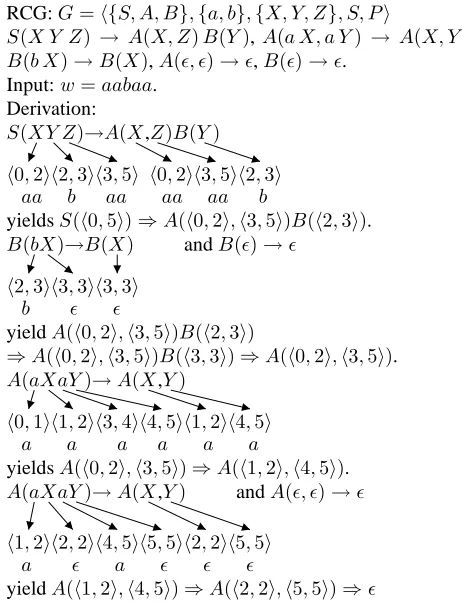
RCG:G=h{S, A, B},{a, b},{X, Y, Z}, S, Pi
S(X Y Z) → A(X, Z)B(Y),A(a X, a Y) → A(X, Y), B(b X)→B(X),A(ǫ, ǫ)→ǫ,B(ǫ)→ǫ.
Input:w=aabaa. Derivation:
S(XY Z)→A(X,Z)B(Y)
h0,2ih2,3ih3,5i h0,2ih3,5ih2,3i aa b aa aa aa b
yieldsS(h0,5i)⇒A(h0,2i,h3,5i)B(h2,3i). B(bX)→B(X) andB(ǫ)→ǫ
h2,3ih3,3ih3,3i
b ǫ ǫ
yieldA(h0,2i,h3,5i)B(h2,3i)
⇒A(h0,2i,h3,5i)B(h3,3i)⇒A(h0,2i,h3,5i). A(aXaY)→A(X,Y)
h0,1ih1,2ih3,4ih4,5ih1,2ih4,5i
a a a a a a
yieldsA(h0,2i,h3,5i)⇒A(h1,2i,h4,5i). A(aXaY)→A(X,Y) andA(ǫ, ǫ)→ǫ
h1,2ih2,2ih4,5ih5,5ih2,2ih5,5i
a ǫ a ǫ ǫ ǫ
yieldA(h1,2i,h4,5i)⇒A(h2,2i,h5,5i)⇒ǫ
Figure 3: Sample RCG
tains predicateshαi(X)andhβi(L, R)for initial and auxil-iary trees respectively.Xcovers the yield ofαand all trees added to α, while LandRcover those parts of the yield ofβ(including all trees added toβ) that are to the left and the right of the foot node of β. The clauses in the RCG reduce the argument(s) of these predicates by identifying those parts that come from the elementary treeα/β itself and those parts that come from one of the elementary trees added by substitution or adjunction.
Each TT-MCTAG derivation is a TAG derivation since it composes elementary trees using adjunction and substitu-tion. In the RCG we construct for a TT-MCTAG, there are predicateshγifor the elementary trees (not the tree sets). The yield ofhγicontains not onlyγand its arguments but also arguments of predicates that are higher in the deriva-tion tree and that are adjoined belowγvia node sharing. In order to keep track of the higher arguments still waiting for adjunction, we enrich the predicate names with the “list of pending arguments” (LPA).
This leads to an RCG of arity 2 with complex predicate names. In order to keep the number of necessary predicates finite, the limitk is crucial, sincekgives us the maximal LPA length.
In addition to the hγ . . .ipredicates we also use branch-ing predicateshadj . . .iandhsub . . .ithat take care of the adjunctions/substitutions possible at a given node.
As an example see the TT-MCTAG tuples for (2) and some of the equivalent RCG clauses in Figure 4.
(2) ... ...
dass that
es it
der the
Mechaniker mechanic
zu to
reparieren repair
verspricht promises ‘... that the mechanic promises to repair it’
The first clause states that, starting from the initial tree αrep for reparieren, we can decompose its yield into the
left part of a root-adjoining tree, followed by zu reparieren, followed by the right part of a root adjoining tree. The pred-icatehadj, αrep,0,{βacc}iis reponsable for computing the
possible root (position0) adjunctions inαrep.βaccis added
to the set representing the LPA since we have to keep track of the fact that it needs to be adjoined at some point. The clauses for thehadj, αrep,0,{βacc}ipredicate tell us that
we can either adjoinβacc(while removing it from the LPA)
or we can adjoin a new head tree, βv of verspricht while
keepingβaccon the LPA.
Note that with this construction, the grouping into sets gets lost. However, in our parser, the transformation is done only for the small set of tree sets selected for the input sentence. Additionally, whenever an input symbol occurs twice, we use two different occurrences of the same set having different identifiers. This way, we can identify trees belonging to the same set by searching for the same tree set identifier.
The conversion process is described in detail in Kallmeyer and Parmentier (2008).
4.2. TuLiPA: An RCG-based parser
The TuLiPA system includes the following components:
• a TT-MCTAG-to-RCG converter (as introduced in the previous section),
• an RCG parser producing an RCG derivation forest,
• an RCG derivation forest interpreter producing a TT-MCTAG derivation forest,
• a TT-MCTAG derivation forest processor building derivation and derived trees, extracting dependency views and computing semantic representations.
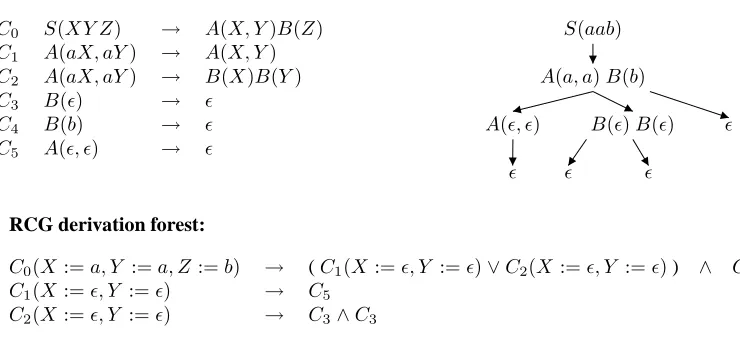
RCG parsing The RCG parsing is done using an algo-rithm derived from that of Boullier (2000). The recognizer corresponds to the original algorithm, while for parsing, several additions have been made to ensure the correctness of the output7. In TuLiPA’s RCG parser, the clause instanti-ations occurring during parsing are tabulated so that onceǫ is derived (i.e. successful parse), an RCG derivation forest can be straightforwardly extracted from the table of clause instantiations (see Figure 5).
RCG derivation forest interpreter After the completion of RCG parsing, the TT-MCTAG derivation forest is ex-tracted from the successfully instantiated clauses. Remem-ber that the RCG clauses represent the adjunctions and sub-stitutions that may occur on a node during the TAG deriva-tion. To extract the forest, we look at the left and right-hand-sides of each clause. These give respectively the site and inserted tree, see Figure 6 for an example of clause in-terpretation.
Note that both the RCG and TT-MCTAG derivation forests correspond to AND-OR graphs. This follows the results of Billot and Lang (1989).
7
*
VP
VP∗ verspricht ,
(
VP NPnom VP∗
) + *
NPnom
der Mech. ,{} +
*
VP
zu reparieren , (
VP
NPacc VP∗
) + *
NPacc
es ,{} +
derivation tree: reparieren
0
verspricht
0
NPnom ←argument of verspricht
1 0
Mechaniker NPacc ←argument of reparieren
1 es Some clauses of the equivalent RCG:
hαrep,∅i(L zu reparieren R)→ hadj, αrep,0,{βacc}i(L, R)
hadj, αrep,0,{βacc}i(L, R)→ hβacc,∅i(L, R)| hβv,{βacc}i(L, R)
hβacc,∅i(L X, R)→ hadj, βacc,0,∅i(L, R)hsub, βacc,1i(X)
hsub, βacc,1i(X)→ hαes,∅i(X) hαes,∅i(es)→ǫ
hβv,{βacc}i(L, verspricht R)→ hadj, βv,0,{βnom, βacc}i(L, R)
. . .
Figure 4: TT-MCTAG analysis of (2) and parts of the equivalent RCG
RCG Grammar: RCG Derivation wrtaab:
C0 S(XY Z) → A(X, Y)B(Z) S(aab)
C1 A(aX, aY) → A(X, Y)
C2 A(aX, aY) → B(X)B(Y) A(a, a)B(b)
C3 B(ǫ) → ǫ
C4 B(b) → ǫ A(ǫ, ǫ) B(ǫ)B(ǫ) ǫ
C5 A(ǫ, ǫ) → ǫ
ǫ ǫ ǫ
RCG derivation forest:
C0(X :=a, Y :=a, Z:=b) → (C1(X:=ǫ, Y :=ǫ)∨C2(X :=ǫ, Y :=ǫ)) ∧ C4
C1(X :=ǫ, Y :=ǫ) → C5
C2(X :=ǫ, Y :=ǫ) → C3∧C3
Figure 5: RCG derivation and corresponding derivation forest.
hαrep,∅i(es der M ech zu rep versp)→
hadj, αrep,0,{βacc}i(es der M ech, versp)
hadj, αrep,0,{βacc}i(es der M ech, versp)→
hβversp.,{βacc}i(es der M ech, versp)
αrep
βversp
hadj,0i
;
Figure 6: Interpretation of a clause instantiation in terms of TT-MCTAG derivation (using the TT-MCTAG in Fig. 4).
TT-MCTAG derivation forest processor Eventually, several post-processing steps are applied to the TT-MCTAG derivation forest. The first of these expands the forest in or-der to compute the or-derivation and or-derived trees. Recall that the forest contains all derivation steps (that is, the forest corresponds to a directed acyclic graph). It is thus possible
to extract all derivation trees it encodes by traversing the graph. For each extracted derivation tree, we can compute the corresponding derived tree.
The other post-processing steps of the derivation forest8 correspond to (i) the extraction of dependency views, and (ii) the computation of semantic representations.
Concerning (i), the idea is to interpret the relation between the head and the arguments of each tuple used within a parse in terms of dependencies9.
Concerning (ii), TuLiPA has been extended to support se-mantically annotated TT-MCTAG. The syntax / semantics interface adopted is the one of Gardent and Kallmeyer (2003). In this interface, each syntactic tree is associated with a predicative semantic formula, whose arguments are unification variables. These variables are co-indexed with features labelling specific nodes of the syntactic tree. The unifications occurring during derivation bind the seman-tic arguments referring to the same entities together, thus
8More precisely of each extracted derivation tree. 9
realizing the semantic composition. To integrate this se-mantic processing within TuLiPA, the only modifications needed were (a) the extension of the internal representation of tree sets to include semantic formulas and (b) the update of these formulas while the derived tree are computed.
Availability of the system TuLiPA is written in Java and released at http://www.sfb441. uni-tuebingen.de/emmy/tulipa under a GNU General Public License. TuLiPA’s main features include:
• a relatively easy installation procedure (the only re-quirement is the GecodeJ10library),
• two interfaces, an intuitive graphical one, and a text-based one,
• an output graphical interface displaying the result of parsing (namely derivation tree, derived tree and flat semantic representations),
• an XML export of the parsing result, allowing for the integration of TuLiPA within an NLP processing chain,
• the possibility to use an external Part-Of-Speech tag-ger (namely the TreeTagtag-ger developed at the Univer-sity of Stuttgart),
• the possibility to parse either tree-based grammars, or RCGs directly.
5.
The German TT-MCTAG: Current State
and Prospects
After having sketched both the grammar formalism and the implementation framework, i.e. rather formal aspects, in this section, we are turning to a presentation of the lin-guistic ressources we are aiming at. This includes two di-mensions, namely (1) the extend of the syntactic coverage of the grammar and (2) the strategies to expand the lexi-con. As this subpart contains still ongoing work, many de-tails inevitably are of a prospective and preliminary nature. Concerning semantic coverage, the addition of the syn-tax/semantics interface of Gardent and Kallmeyer (2003) to the tree schemata has just started.
Syntactic coverage In our implementation framework, covering syntactic phenomena means specifying appropri-ate tree (tuple) families lacking an anchor, i.e. a lexical terminal. The respective specification is carried out using the XMG description language and the XMG compiler (see section 3.).
So far, we have implemented (amongst others) free word order phenomena such as scrambling, coherent construc-tions and verbal clustering. Furthermore, so-called extrac-tion phenomena found in relative clauses, wh-quesextrac-tions and bridging constructions are accounted for. Thanks to TT-MCTAG, factorization from the many possible word orders in German syntax is already supported by the grammar for-malism, such that one tree tuple can license several derived structures. To give an example, one tree tuple for each finite
10http://www.gecode.org/gecodej
Morphological specification:
vergisst vergessen [pos=v,num=sg,per=3]
Lemma specification: *ENTRY: vergessen *CAT: v
*SEM: BinaryRel[pred=vergessen] *ACC: 1
*FAM: Vnp2 *FILTERS: [] *EX:
*EQUATIONS: NParg1→cas = nom NParg2→cas = acc *COANCHORS:
Figure 7: Morphological and lemma specification of
ver-gisst.
verb is sufficient to license most of the extraction phenom-ena, and scrambling therein. Having this highly factorized description due to the metagrammar and the grammar for-malism is not an end in itself, however. Eventually, the concise, but surface-abstracted account for complementa-tion relieves the lexicon.
While the above mentioned phenomena are satisfactorily covered, there turned out to be (well-known) hard nuts such as partial fronting, extraposition, and ellipsis. We hope to include them as well in the future, at least to a certain de-gree.
For evaluation of the syntactic coverage of the grammar, we will make use of the TSNLP-testsuite for German (Lehmann et al., 1996). Therefore, a handcrafted lexicon is presently being set up.
Lexical coverage As mentioned in section 3., the lexicon is 2-layered: a morphological lexicon maps an (inflected) token to some lemma form, while preserving morphologi-cal information in a feature structure; a lemma lexicon basi-cally maps the lemmata onto tree tuple families, while also performing case assignment. Fig. 7 contains the respective entries for the finite verb vergisst (’forgets’). The morpho-logical entry consists of the following columns, separated by tabulation: token ×lemma×morphological features. The lemma specification is build up by a fixed set of fea-tures, of which the most important ones are*ENTRY(= the
lemma),*CAT(= the POS-tag), and*FAM(= the tree
fam-ily as predefined in XMG). Case assignment can be speci-fied in*EQUATIONS, where in this exampleNParg1is a
defined label of some node in the tree tuples of the specified tree tuple family.
Since German shows rich inflection, this approach helps to reduce redundancies in the lexicon. In sum the lexi-con incorporates at least the following information for each token-lemma combination: lemmatization, morphological features, valency information, and the POS-tag. We also started to feed the lexicon with semantic information (see
*SEM).
and prepositions for the sake of correctness and complete-ness. Since much of the inflectional information is con-tributed by these functional items in German, this is advis-able. However, in order to obtain a rich lexicon also with respect to lexically rather open classes such as nouns, ad-jectives and verbs, already existing resources need to be combined without much modification. The combination of several ressources is necessary, since no ressource is known to us, that offers all the mentioned lexical information:
• morphological information: NEGRA corpus11
• lemmatization and POS-tags: T¨uPP-D/Z12
• valency information: subcategorization frames from Schulte im Walde (2002)
6.
Comparable Work
The German TT-MCTAG for the TuLiPA system is cur-rently under development. However, the already existing fragment reveals interesting differences to other grammar projects from the TAG-realm.
XTAG The XTAG grammar for English (XTAG Research Group, 2001) uses plain TAG, enhanced with feature struc-tures. Covering a wide range of syntactic structures and bringing along a rich lexicon, it is a well developed exem-plar. Its implementation framework, however, is different from our one, not only because of the unlike grammar for-malisms. XTAG does not use a metagrammar such as XMG for the description of its tree families. It does, however, possess a 2-layered lexicon (Morph Database and
Syntac-tic Database), that divides the task similarly. Part of the
evaluation is also performed on the (English) TSNLP-data. Remains to say, that XTAG does not offer a semantic di-mension.
While we cannot compare performance and coverage yet, there are some differences with respect to linguistic design, that are worth mentioning.
1. In contrast to XTAG, we completely omit empty cate-gories (e.g. traces,PRO) in syntactic description. This follows from rejecting a base word order for German, as well as dealing with argument raising and control only in the semantics.
2. Prepositional complements are not encoded via co-anchoring as in XTAG. Instead, prepositions are seen as nouns that display a special case feature, that the verb subcategorizes for.
3. In XTAG, extraction phenomena such as relative clauses and wh-questions require separate elementary structures. This is not the case in TuLiPA thanks to a higher degree of factorization in our tree sets com-pared to standard TAG.
11http://www.coli.uni-saarland.de/
projects/sfb378/negra-corpus/negra-corpus. html
12
http://www.sfs.uni-tuebingen.de/ en tuepp.shtml
French TAG In his thesis, Benoit Crabb´e (Crabb´e, 2005b) designed a French TAG of considerable syntactic coverage using the XMG framwork. As in XTAG, a plain TAG with feature structures was used. The grammar was also successfully evaluated against the TSNLP-dataset for which a suitable lexicon was implemented. Other than in XTAG, there is also a semantic extension available (Gar-dent, 2006).
7.
Conclusion
In this paper, we have presented an architecture for imple-menting a TAG-based grammar fragment for German. Be-cause of the limitation of standard TAG, we had to choose a multicomponent TAG variant, TT-MCTAG, as grammar formalism. TT-MCTAG has been argued to be suitable for modelling free word order phenomena. With some addi-tional constraint, the formalism is mildly context-sensitive. For grammar development, we use a meta-formalism, XMG, that allows a compact grammar representation and enables us to avoid the redundancies that are one of the ma-jor problems of grammar implementation. We had to ex-tend XMG to allow for the description of multicomponent TAG.
In order to do parsing with our variant of TAG, we had to develop a new parser. Here we chose an RCG-based pars-ing architecture that is intended to cover different mildly context-sensitive formalisms (so far we can parse TAG, TT-MCTAG and of course RCG). The central idea of our parser is that RCG is used as a pivot formalism, i.e., some input grammar is transformed into a RCG which is then used for parsing. Søgaard (2007) has described transformations into RCG for a range of other formalisms. These might be in-cluded into the TuLiPA parsing system in the future. For TAG and TT-MCTAG, our parser computes both, syn-tax and semantics. Here we follow the approach of Gardent and Kallmeyer (2003) that links flat semantic representa-tions to the elementary trees while exploiting the TAG fea-ture unifications for semantic computation.
Finally, we presented a German TT-MCTAG-based gram-mar, that is currently being developed and lexically ex-panded using the described implementation framework. By now, it already covers a wide range of challenging syntactic phenomena such as free word order and extraction. In the near future, both the grammar and the lexicon are going to be published under GPL.
We want to emphasize that TuLiPA is not only a parsing architecture useful in the context of TT-MCTAG grammar implementation but it is also one of the first TAG parsers including syntax and semantics. Due to its graphical in-terface and the various output formats, it helps to increase the transparency and modularity of TAG grammar develop-ment. Thanks to these features, it is already at the current state a very useful tool for understanding fundamental TAG principles and therefore can in particularly be successfully used for teaching purposes.
8.
References
Meeting of the Association for Computational Linguis-tics, pages 143–151, Vancouver, Canada.
Pierre Boullier. 1999. On TAG and Multicomponent TAG parsing. Rapport de recherche, Institut National de Recherche en Informatique et en Automatique.
Pierre Boullier. 2000. Range concatenation grammars. In Proceedings of the Sixth International Workshop
on Parsing Technologies (IWPT 2000), pages 53–64,
Trento, Italy.
Benoit Crabb´e. 2005a. Grammatical development with XMG. In Proceedings of the 5th International
Confer-ence on the Logical Aspects of Computational Linguis-tics (LACL05), Bordeaux, France.
Benoit Crabb´e. 2005b. Repr´esentation informatique de
grammaires fortement lexicalis´ees : Application `a la grammaire d’arbres adjoints. Ph.D. thesis, Universit´e
Nancy 2, Nancy, France.
Denys Duchier, Joseph Le Roux, and Yannick Parmen-tier. 2004. The Metagrammar Compiler: An NLP Ap-plication with a Multi-paradigm Architecture. In
Sec-ond International Mozart/Oz Conference (MOZ’2004),
Charleroi, Belgium.
Gregor Erbach and Hans Uszkoreit. 1990. Grammar en-gineering: Problems and prospects – Report on the Saarbr¨ucken Grammar Engineering Workshop. Techni-cal Report 1, Saarbr¨ucken, Germany.
Claire Gardent and Laura Kallmeyer. 2003. Semantic con-struction in FTAG. In Proceedings of the European
chapter of the Association for Computational Linguistics (EACL’03), Budapest, Hungary.
Claire Gardent. 2006. Int´egration d’une dimension s´emantique dans les grammaires d’arbres adjoints. In
Actes de La 13`eme ´edition de la conf´erence sur le TALN (TALN 2006), Leuven, Belgique.
Aravind K. Joshi and Yves Schabes. 1997. Tree-adjoining grammars. In G. Rozenberg and A. Salomaa, editors,
Handbook of Formal Languages, volume 3, pages 69–
124. Springer, Berlin, New York.
Laura Kallmeyer and Yannick Parmentier. 2008. On the relation between Multicomponent Tree Adjoining Gram-mars with Tree Tuples (TT-MCTAG) and Range Con-catenation Grammars (RCG). In Proceedings of the 2nd
International Conference on Language and Automata Theory and Applications LATA, Tarragona, Spain.
Sabine Lehmann, Stephan Oepen, Sylvie Regnier-Prost, Klaus Netter, Veronika Lux, Judith Klein, Kirsten Falkedal, Frederik Fouvry, Dominique Estival, Eva Dauphin, Herv´e Compagnion, Judith Baur, Lorna Balkan, and Doug Arnold. 1996. TSNLP— Test Suites for Natural Language Processing. In 16th International
Conference on Computational Linguistics, Proceedings of the Conference, volume 2, Copenhagen, Denmark.
Timm Lichte. 2007. An MCTAG with tuples for coher-ent constructions in German. In Proceedings of the 12th
Conference on Formal Grammar, Dublin, Ireland.
Yannick Parmentier, Laura Kallmeyer, Timm Lichte, and Wolfgang Maier. 2007. XMG: eXtending Meta-Grammars to MCTAG. In Actes de l’atelier sur les
formalismes syntaxiques de haut niveau, Conference
sur le Traitement Automatique des Langues Naturelles (TALN’2007), Toulouse, France.
James Rogers and Vijay Shanker. 1992. Reasoning with descriptions of trees. In Proceedings of the 30th annual
meeting of the Association for Computational Linguistics (ACL 92), pages 72–80, Newark, DE.
Sabine Schulte im Walde. 2002. A Subcategorisation Lexicon for German Verbs induced from a Lexicalised PCFG. In Proceedings of the 3rd Conference on
Lan-guage Resources and Evaluation, volume IV, pages
1351–1357, Las Palmas de Gran Canaria, Spain. Anders Søgaard, Timm Lichte, and Wolfgang Maier. 2007.
The complexity of linguistically motivated extensions of tree-adjoining grammar. In Recent Advances in Natural
Language Processing 2007, Borovets, Bulgaria.
Anders Søgaard. 2007. Complexity, expressivity and logic
of linguistic theories. Ph.D. thesis, University of
Copen-hagen, CopenCopen-hagen, Denmark.