Annotating Event Mentions in Text with Modality, Focus, and Source
Information
Suguru Matsuyoshi
†, Megumi Eguchi
†, Chitose Sao
†, Koji Murakami
†, Kentaro Inui
‡,†,
Yuji Matsumoto
††Graduate School of Information Science, ‡Graduate School of Information Science,
Nara Institute of Science and Technology Tohoku University
8916-5 Takayama, Ikoma, Nara 630-0192, Japan 6-6-05, Aoba, Aramaki, Aoba-ku, Sendai, Miyagi, 980-8579, Japan {matuyosi, megumi-e, chitose-s, kmurakami, matsu}@is.naist.jp, [email protected]
Abstract
Many natural language processing tasks, including information extraction, question answering and recognizing textual entailment, require analysis of the polarity, focus of polarity, tense, aspect, mood and source of the event mentions in a text in addition to its predicate-argument structure analysis. We refer to modality, polarity and other associated information as extended modality. In this paper, we propose a new annotation scheme for representing the extended modality of event mentions in a sentence. Our extended modality consists of the following seven components: Source, Time, Conditional, Primary modality type, Actuality, Evaluation and Focus. We reviewed the literature about extended modality in Linguistics and Natural Language Processing (NLP) and defined appropriate labels of each component. In the proposed annotation scheme, information of extended modality of an event mention is summarized at the core predicate of the event mention for immediate use in NLP applications. We also report on the current progress of our manual annotation of a Japanese corpus of about 50,000 event mentions, showing a reasonably high ratio of inter-annotator agreement.
1.
Introduction
In Natural Language Processing (NLP), development of syntactic and semantic parsers is a major task, and recently we have seen the development of precise POS taggers, de-pendency parsers, and predicate-argument structure analyz-ers. Identifying predicate-argument structure in a sentence is important but insufficient for applications such as infor-mation extraction (IE), question answering (QA) and rec-ognizing textual entailment (RTE). These applications re-quire analyzing the polarity, focus of polarity, tense, as-pect, mood and source of the event mentions in a text in addition to predicate-argument structure analysis. For ex-ample, the verb “submitted” in sentence (1) has three ar-guments “Ann”, “the plan” and “the comittee”, which can be identified by predicate-argument structure analysis, and the verb and these arguments correspond to an event men-tion “Ann submitting the plan to the comittee” (underlined in sentence (1)). The modality toward the event mention shows John’s assertion that the event actually happened. The verb “cause” and its arguments “mercury-based vac-cines” and “autism in children” underlined in sentence (2) correspond to an event mention, toward which the modal-ity indicates the doctor’s inference that the underlined event does not happen.
(1) John claimed that Ann submittedthe plan to the committee.
(2) The doctor speculated that mercury-based vaccines did notcauseautism in children.
Distinguishing assertion and inference is essential for NLP applications such as IE and RTE, because information as-serted is obviously much more reliable than information in-ferred. We refer to the modality, polarity and other associ-ated information of an event mention in a given sentence asextended modality. Extended modality covers almost all
the components of modality in a broad sense, as described in detail in section 3, and is important for interpreting a writer’s attitude toward event mentions.
A sentence may have several event mentions, though it does not include any connectives such as “and” and “although”. For example, sentence (3) has three event mentions, where the core predicates are “decide(d)”, “stop” and “buy(ing)”.
(3) Jimdecidedtostop buyingthat weekly magazine.
Modality in a narrow sense (hereafter referred as restricted modality) and polarity can be assigned to each event men-tion, even if the event mention is not the main proposition in the sentence. For example, the restricted modality of an event “Jim buying that weekly magazine” can be regarded as volition due to indirect effect of “decided” and its polar-ity negative due to direct effect of “stop”. We would like to recognize extended modality of such event mentions as well as the main event mention. It is because they are dependent on the main event in the sentence but can be regarded as distinct events in applications such as IE and RTE. For in-terpreting a writer’s attitude toward such event mentions, their extended modality should be analyzed.
In this paper, as a first step toward constructing an analyzer of extended modality, we propose a new annotation scheme for representing extended modality of event mentions in a sentence, and report on the current progress of manual an-notation of a Japanese corpus of about 50,000 event men-tions.
2.
Related work
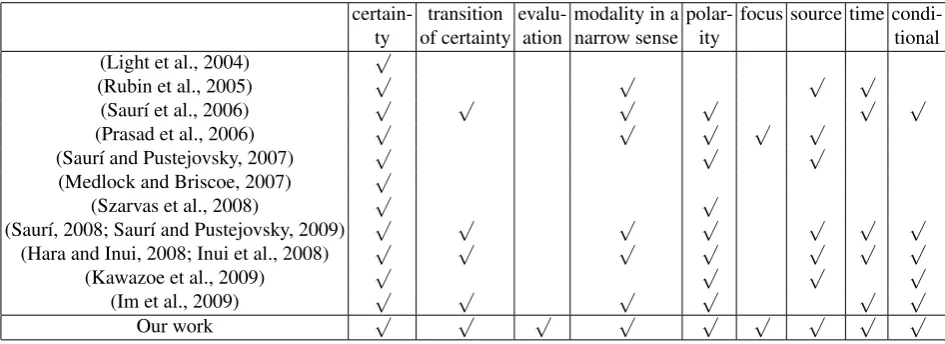
certain- transition evalu- modality in a polar- focus source time condi-ty of certainty ation narrow sense ity tional (Light et al., 2004) √
(Rubin et al., 2005) √ √ √ √
(Saur´ı et al., 2006) √ √ √ √ √ √
(Prasad et al., 2006) √ √ √ √ √
(Saur´ı and Pustejovsky, 2007) √ √ √
(Medlock and Briscoe, 2007) √
(Szarvas et al., 2008) √ √
(Saur´ı, 2008; Saur´ı and Pustejovsky, 2009) √ √ √ √ √ √ √ (Hara and Inui, 2008; Inui et al., 2008) √ √ √ √ √ √ √
(Kawazoe et al., 2009) √ √ √ √
(Im et al., 2009) √ √ √ √ √ √
Our work √ √ √ √ √ √ √ √ √
Table 1: Components of extended modality considered in our work and related works.
is divided into Deontic modality and Dynamic modality (Palmer, 2001). Other important categories of modality are Future, Negative, Interrogative, Imperative (Jussive), Pre-supposed, Conditional, Purposive, Resultative, Desidera-tive, and Fears. Modal logic with possible worlds has been studied to capture the logical properties of modal expres-sions strictly (Portner, 2009). By using well-defined acces-sibility relations or conversational backgrounds, the modal logic represents various modal expressions while differen-tiating between ones that have almost the same meaning. Classifications of restricted modality in Linguistics and sys-tems of modal logic are helpful for constructing a system of extended modality in our research, but they are unable to be adopted directly. We give three reasons for this. The first one is that these works mainly focus on classification of modal expressions while we focus on classification of event mentions based on their extended modality. The second reason is that the main targets in these works are modality classes of the main proposition in a sentence, and we want to deal with the extended modality of both the main propo-sition in a sentence and the event mentions embedded in that proposition, as mentioned in Section 1. The third rea-son is that classifications in these works are too fine-grained to identify automatically. We will describe our annotation scheme of extended modality in Section 3.
In recent years, there has been increasing attention paid to annotating phrases and event mentions in text with ex-tended modality in the fields of bioinformatics and NLP. We show a list of related work with considered components of extended modality in Table 1.
Studies in bioinformatics (Light et al., 2004; Medlock and Briscoe, 2007; Szarvas et al., 2008) mainly focus on cer-tainty toward event mentions in text, because they want to distinguish between asserted propositions and proposi-tions with inferential expressions and hedges. For example, Szarvas et al. mark hedging expressions, such as “may” and “possible”, or negations, such as “not” and “neither”, and their scopes in text (Szarvas et al., 2008). They do not mark the focus of a negation, even if it is partial negation. Related studies in NLP are roughly divided into two groups: One is for an annotation scheme of extended modality (Saur´ı et al., 2006; Prasad et al., 2006; Saur´ı, 2008; Saur´ı
several XML tags in the same sentence, and analyzing the extended modality requires extra effort.
For automatically analyzing extended modality in text, Saur´ı et al. have proposed a rule-based method using in-formation of polarity particles, modality markers and epis-temic predicates (Saur´ı and Pustejovsky, 2007). In their al-gorithm, values of epistemic modality and polarity toward events in a sentence are determined by the upper factuality values and rules one by one from the top of a dependency tree to the lowest level. Inui et al. (2008) have proposed a method of analyzing restricted modality and polarity of event mentions in Japanese text with a conditional random fields model. Implemention of such an analyzer for ex-tended modality is an area of future work.
3.
Proposed scheme
In this section, we propose an annotation scheme of ex-tended modality of event mentions in a sentence. In this re-search, we work with English and Japanese, but we believe that our annotation scheme is applicable to other languages such as Spanish and Korean.
3.1. Definition of an event mention
We define an event mention in text as follows:
consisting of a core predicate and its arguments (complements and adjuncts) in the sentence.
A predicate is a verb, “be”+an adjective or “be”+a noun. For example, the verb “ate” in sentence (4) is the core pred-icate of an event mention “Mary eating a cake with her fa-vorite fork yesterday”. In sentence (5), “is effective” is the core predicate of an event mention “xylitol being effective at preventing tooth decay”.
(4) Maryatea cake with her favorite fork yesterday.
(5) Xylitolis effectiveatpreventingtooth decay.
Because nominalized verb phrases and adjective phrases should be extracted as expressions consisting of predicate argument structures in applications such as IE and RTE, we regard these phrases (with their arguments) as event men-tions. For example, we regard “xylitol preventing tooth de-cay” as an event mention in sentence (5), where a nominal-ized verb “prevention” is the core predicate.
3.2. Our extended modality
For constructing a system of our extended modality of event mentions in a sentence in consideration of NLP applica-tions, we have the following four desiderata:
1. Information of the extended modality of an event men-tion should be gathered into one piece, specifically at the core predicate.
2. A system of extended modality should be language-independent.
3. The polarity of event mentions should be divided into two distinct classes: polarity on actuality and polarity from the view of the source’s evaluation.
4. Labels in each component of extended modality should not be too fine-grained.
Desideratum 1. facilitates use in NLP applications, be-cause spreading of pieces of information about the extended modality toward an event mention over several points re-quires taking extra effort in working out the summarized extended modality by considering labels or surface forms of several modality expressions related to the event men-tion. Desideratum 2. means that we aim for a language-independent scheme of extended modality, such as the scheme of semantic role labeling in The CoNLL-2009 Shared Task (Hajiˇc et al., 2009). We determine Desider-atum 3. because we believe that division of polarity into the above two classes is important for explicitly capturing the factuality of an event in text. A good example for de-scription of this is a subjunctive mood. There are two event mentions “I studying mathematics harder” and “I passing the examination” in sentence (6).
(6) If I had studied mathematics harder, I could have passedthe examination.
We can see that both of the events did not occur, so polarity values on actuality of them are negative. In the meantime, it appears that the writer of sentence (6) wanted the latter event “I passing the examination” to occur and therefore he/she evaluated occurence of the event as “positive”. We refer to such polarity from the view of the source’s evalu-ation as subjective polarity. Polarity on actuality and sub-jective polarity should not be grouped into a single “po-larity” attribute in a system of extended modality, because they should be treated in a different way in NLP applica-tions. Desideratum 4. indicates that a scheme of extended modality should be abstract to the extent of application-independence. We take the position that each application may subdivide our fundamental classification if necessary. This desideratum also comes from the fact that classifica-tions of restricted modality in Linguistics, e.g., (Palmer, 2001) and systems of modal logic (Portner, 2009) are too sophisticated, and it is very difficult to implement analyz-ers of extended modality based on them with the current level of technology in NLP.
As important components of extended modality of an event mention, we take Sourceand Focus information because they are deeply associated with modality and useful for ap-plications such as IE and RTE.
We reviewed the literature about extended modality in Lin-guistics, such as (Palmer, 2001;Nihongo kizyutsu bumpou kenkyukai, 2003; Nihongo kizyutsu bumpou kenkyukai, 2007; Masuoka, 2007) and NLP, such as (Wiebe et al., 2005; Prasad et al., 2006; Saur´ı, 2008; Inui et al., 2008), and made an annotation scheme of extended modality for event mentions in a sentence. Our extended modality con-sists of the following seven components:
Resource (A) (B) (C) (D) Number of event mentions 19,237(100%) 4,401(100%) 13,527(100%) 12,943(100%)
Component Label
Source wr 19,154(100%) 4,371(100%) 13,288(98%) 12,796(99%) wr ot 72( 0%) 9( 0%) 18( 0%) 33( 0%) wr arb 4( 0%) 3( 0%) 121( 1%) 68( 1%) wr STRING 7( 0%) 18( 0%) 100( 1%) 46( 0%) Time future 1,500( 8%) 349( 8%) 2,051(15%) 1,849(14%) notFuture 17,737(92%) 4,052(92%) 11,476(85%) 11,094(86%) Conditional condition 667( 3%) 142( 3%) 600( 5%) 986( 8%) hasCondition 56( 0%) 2( 0%) 172( 1%) 279( 2%) notConditional 18,514(97%) 4,257(97%) 12,755(94%) 11,678(90%) Primary assertion 18,194(94%) 4,110(93%) 12,735(94%) 10,462(81%) modality volition 408( 2%) 111( 3%) 322( 2%) 265( 2%) type wish 269( 1%) 25( 1%) 55( 1%) 288( 2%) imperative-direct 96( 1%) 20( 0%) 29( 0%) 436( 3%) imperative-indirect 143( 1%) 58( 1%) 269( 2%) 380( 3%) imperative-together 29( 0%) 17( 0%) 17( 0%) 10( 0%) permission 4( 0%) 0( 0%) 14( 0%) 10( 0%) interrogative 94( 1%) 60( 2%) 86( 1%) 1,092( 9%) Actuality certain+ 16,498(86%) 3,879(88%) 11,578(85%) 8,838(68%) certain− 1,036( 5%) 126( 3%) 637( 5%) 894( 7%) certain− →+ 0( 0%) 0( 0%) 20( 0%) 48( 0%) certain+→ − 2( 0%) 0( 0%) 11( 0%) 21( 0%) probable+ 951( 5%) 187( 4%) 669( 5%) 722( 6%) probable− 95( 1%) 29( 1%) 94( 1%) 125( 1%) probable− →+ 1( 0%) 0( 0%) 13( 0%) 6( 0%) probable+→ − 1( 0%) 0( 0%) 12( 0%) 2( 0%) unknown 653( 3%) 180( 4%) 493( 4%) 2,287(18%) Evaluation positive 903( 5%) 192( 4%) 677( 5%) 1,249(10%) negative 78( 0%) 34( 1%) 101( 1%) 233( 2%) neutral 18,256(95%) 4,175(95%) 12,749(94%) 11,461(88%) Focus negation(P1) 0( 0%) 2( 0%) 7( 0%) 8( 0%)
negation(P1;P2) 1( 0%) 0( 0%) 3( 0%) 0( 0%)
inference(P1) 19( 0%) 9( 0%) 10( 0%) 31( 0%)
inference(P1;P2) 0( 0%) 0( 0%) 12( 0%) 0( 0%)
interrogative(P1) 20( 0%) 27( 1%) 44( 0%) 263( 2%)
interrogative(P1;P2) 1( 0%) 0( 0%) 1( 0%) 0( 0%)
no 19,196(100%) 4,363(99%) 13,450(100%) 12,641(98%)
Table 2: Distribution of labels of each component of extended modality in our corpus. [(A) Blog posts, (B) Web documents, (C) The corpus from Murakami et al. (2009), (D) Posts from Q&A sites]
Source Time Conditional Primary modality type Actuality Evaluation Focus 0.69 0.76 0.68 0.66 0.70 0.72 0.75
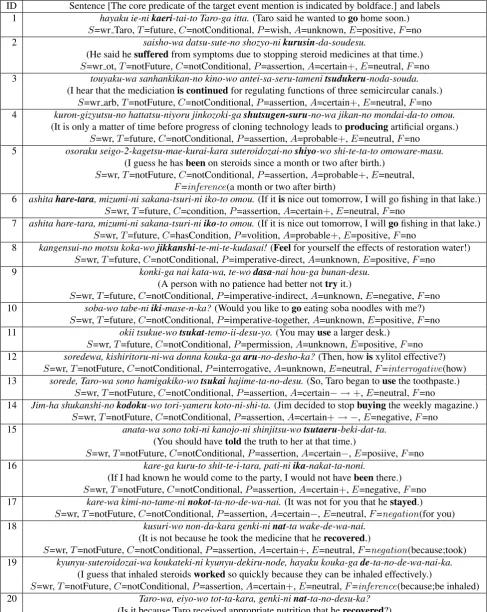
ID Sentence [The core predicate of the target event mention is indicated by boldface.] and labels 1 hayaku ie-nikaeri-tai-to Taro-ga itta. (Taro said he wanted togohome soon.)
S=wr Taro,T=future,C=notConditional,P=wish,A=unknown,E=positive,F=no 2 saisho-wa datsu-sute-no shozyo-nikurusin-da-soudesu.
(He said hesufferedfrom symptoms due to stopping steroid medicines at that time.) S=wr ot,T=notFuture,C=notConditional,P=assertion,A=certain+,E=neutral,F=no 3 touyaku-wa sanhankikan-no kino-wo antei-sa-seru-tamenitsudukeru-noda-souda.
(I hear that the mediciationis continuedfor regulating functions of three semicircular canals.) S=wr arb,T=notFuture,C=notConditional,P=assertion,A=certain+,E=neutral,F=no 4 kuron-gizyutsu-no hattatsu-niyoru jinkozoki-gashutsugen-suru-no-wa jikan-no mondai-da-to omou.
(It is only a matter of time before progress of cloning technology leads toproducingartificial organs.) S=wr,T=future,C=notConditional,P=assertion,A=probable+,E=neutral,F=no
5 osoraku seigo-2-kagetsu-mae-kurai-kara suteroidozai-noshiyo-wo shi-te-ta-to omoware-masu. (I guess he hasbeenon steroids since a month or two after birth.)
S=wr,T=notFuture,C=notConditional,P=assertion,A=probable+,E=neutral, F=inference(a month or two after birth)
6 ashitahare-tara, mizumi-ni sakana-tsuri-ni iko-to omou.(If itisnice out tomorrow, I will go fishing in that lake.) S=wr,T=future,C=condition,P=assertion,A=certain+,E=neutral,F=no
7 ashita hare-tara, mizumi-ni sakana-tsuri-niiko-to omou.(If it is nice out tomorrow, I willgofishing in that lake.) S=wr,T=future,C=hasCondition,P=volition,A=probable+,E=positive,F=no
8 kangensui-no motsu koka-wojikkanshi-te-mi-te-kudasai!(Feelfor yourself the effects of restoration water!) S=wr,T=future,C=notConditional,P=imperative-direct,A=unknown,E=positive,F=no
9 konki-ga nai kata-wa, te-wodasa-nai hou-ga bunan-desu. (A person with no patience had better nottryit.)
S=wr,T=future,C=notConditional,P=imperative-indirect,A=unknown,E=negative,F=no 10 soba-wo tabe-niiki-mase-n-ka?(Would you like togoeating soba noodles with me?)
S=wr,T=future,C=notConditional,P=imperative-together,A=unknown,E=positive,F=no 11 okii tsukue-wotsukat-temo-ii-desu-yo.(You mayusea larger desk.)
S=wr,T=future,C=notConditional,P=permission,A=unknown,E=positive,F=no 12 soredewa, kishiritoru-ni-wa donna kouka-gaaru-no-desho-ka?(Then, howisxylitol effective?)
S=wr,T=notFuture,C=notConditional,P=interrogative,A=unknown,E=neutral,F=interrogative(how) 13 sorede, Taro-wa sono hamigakiko-wotsukaihajime-ta-no-desu.(So, Taro began tousethe toothpaste.)
S=wr,T=notFuture,C=notConditional,P=assertion,A=certain− →+,E=neutral,F=no
14 Jim-ha shukanshi-nokodoku-wo tori-yameru koto-ni-shi-ta.(Jim decided to stopbuyingthe weekly magazine.) S=wr,T=notFuture,C=notConditional,P=assertion,A=certain+→ −,E=negative,F=no
15 anata-wa sono toki-ni kanojo-ni shinjitsu-wotsutaeru-beki-dat-ta. (You should havetoldthe truth to her at that time.)
S=wr,T=notFuture,C=notConditional,P=assertion,A=certain−,E=posiive,F=no 16 kare-ga kuru-to shit-te-i-tara, pati-niika-nakat-ta-noni.
(If I had known he would come to the party, I would not havebeenthere.) S=wr,T=notFuture,C=notConditional,P=assertion,A=certain+,E=negative,F=no 17 kare-wa kimi-no-tame-ninokot-ta-no-de-wa-nai.(It was not for you that hestayed.)
S=wr,T=notFuture,C=notConditional,P=assertion,A=certain−,E=neutral,F=negation(for you) 18 kusuri-wo non-da-kara genki-ninat-ta wake-de-wa-nai.
(It is not because he took the medicine that herecovered.)
S=wr,T=notFuture,C=notConditional,P=assertion,A=certain+,E=neutral,F=negation(because;took) 19 kyunyu-suteroidozai-wa koukateki-ni kyunyu-dekiru-node, hayaku kouka-gade-ta-no-de-wa-nai-ka.
(I guess that inhaled steroidsworkedso quickly because they can be inhaled effectively.)
S=wr,T=notFuture,C=notConditional,P=assertion,A=certain+,E=neutral,F=inference(because;be inhaled) 20 Taro-wa, eiyo-wo tot-ta-kara, genki-ninat-ta-no-desu-ka?
(Is it because Taro received appropriate nutrition that herecovered?) S=wr,T=notFuture,C=notConditional,P=assertion,A=certain+,E=neutral,
F=interrogative(because;received)