Evaluation of several Maximum Likelihood Linear Regression variants for
language adaptation
M´ıriam Luj´an, Carlos D. Mart´ınez, Vicente Alabau
Departament de Sistemes Inform`atics i Computaci´o Institut Tecnol`ogic d’Inform`atica
Universitat Polit`ecnica de Val`encia Cam´ı de Vera, s/n. 46071 Val`encia, Spain
{mlujan, cmartine,valabau}@dsic.upv.es
Abstract
Multilingual Automatic Speech Recognition (ASR) systems are of great interest in multilingual environments. We studied the case of the
Comunitat Valencianawhere the two official languages areSpanishandValencian. These two languages share most of their phonemes, and their syntax and vocabulary are also quite similar since they have influenced each other for many years. We constructed a system, and trained its acoustic models with a small corpus of Spanish and Valencian, which has produced poor results due to the lack of data. Adaptation techniques can be used to adapt acoustic models that are trained with a large corpus of a language inr order to obtain acoustic models for a phonetically similar language. This process is known as language adaptation. The Maximum Likelihood Linear Regression (MLLR) technique has commonly been used in speaker adaptation; however we have used MLLR in language adaptation. We compared several MLLR variants (mean square, diagonal matrix and full matrix) for language adaptation in order to choose the best alternative for our system.
1.
Introduction
Multilingual Automatic Speech Recognition (ASR) sys-tems are of great interest in multilingual environments (Ue-bler, 2001). In a multilingual environment, where each po-tential user has a different native language, a Multilingual Automatic Speech Recognition System must deal with dif-ferent languages and with the inappropriate pronunciation of a language by non-native speakers. Multilingual envi-ronments are common in contexts where there are different languages due to politics, tourism, inmigration, and so on. To build an ASR system, language and acoustic models must be trained. Language models are both task-dependent and language-dependent. For this reason, a multilingual ASR system must include several language models (one for each language that the system must deal with). Acous-tic models are also language-dependent because each guage defines its own phonemes differently from other lan-guages. In multilingual environments, the influence of the speaker’s mother tongue can produce an inappropriate pro-nunciation of the other languages that are present in these environments. This fact adds a new source of variabil-ity and makes accurate speech recognition difficult. An-other important problem is that languages are usually in-fluenced by other languages. In addition, the articulation of the same phoneme in different languages may differ in each language. All these facts demonstrate the difficulty of building multilingual speech recognition systems.
We studied theComunitat Valenciana, a multilingual envi-ronment that has two official languages: Spanish and Va-lencian. Spanish and Valencian have similar phonetic fea-tures. They both have a similar set of phonemes, and most acoustic models could be shared by both languages. In this
Work partially supported by VIDI-UPV under PAID06-20070315 program and by the EC (FEDER) and the Spanish MEC under grant TIN2006-15694-CO2-01.
multilingual environment, it is useful to have a multilingual ASR system. In a previous work, we constructed an ASR for this environment (Lujan et al, 2007).
Valencian is a dialect ofCatalanthat is spoken in the Co-munitat Valenciana. The Valencian dialect has special pho-netic features with respect to standard Catalan. This is due to its dialectal variance and the great influence that Span-ish has had on it. This influence has been much greater on Valencian than on other Catalan dialects. According to (Vi-lajoana and Pons, 2001), the total number of people who speak Catalan is 7,200,000, and the number of people who understand it is over 9,800,000. The Valencian dialect is spoken by 27% of all Catalan speakers. The great influence of the Spanish language on the Valencian dialect has mod-ified Valencian phonetics in the average speaker. We con-structed an ASR system for this environment even though the training corpora were quite small. However, it is well-know that a large corpus is necessary to build a good ASR and to obtain reliable acoustic models.
One way to obtain better acoustic models would be to use adaptation techniques to adapt acoustic models of a phonet-ically similar language (Schultz and Waibel, 2001). These models are usually trained with a large acoustic corpus. The resulting adapted models are commonly better than those trained with a small corpus of the real language.
a large Valencian corpus available. However, since Valen-cian is phonetically very similar to Spanish, we were able to use the small amount of the original training material avail-able in Valencian to adapt the Spanish acoustic models. Our objective is to compare the different MLLR variants in order to choose the best alternative for this pair of lan-guages.
This work is organized as follows. In Section 2., we de-scribe the MLLR adaptation technique. In Section 3., we describe the corpus that was used for the experiments. In Section 4., we explain the design of the language models and the acoustic models. In Section 5., we detail the differ-ent experimdiffer-ents carried out. In Section 6., we presdiffer-ent our conclusions and future work.
2.
The MLLR adaptation technique
The aim of speaker adaptation techniques is to obtain a speaker-dependent recognition system by using a combi-nation of general speech knowledge from well-trained hid-den Markov models and speaker-specific information from a new speaker’s data. Speaker adaptation is applied to a speech recognition system in order to obtain a speaker-dependent system with a better performance than the origi-nal system for a specific speaker.
MLLR is a technique to adapt a set of speaker-independent acoustic models to a speaker by using small amounts of adaptation material. This technique can also be used in guage adaptation by using adaptation material in the lan-guage being adapted to.
The MLLR approach requires an initial independent contin-uous density HMM system. MLLR takes some adaptation data from a speaker to adapt the acoustic models. MLLR updates the model mean parameters to maximize the likeli-hood of the adaptation data. The means are updated using a transformation matrix, which is estimated from the adapta-tion data. We applied the formulaadapta-tion presented in (Legget-ter and Woodland, 1995) to language adaptation: we take some adaptation data from a language to adapt the acoustic models using MLLR in the same way as in speaker adapta-tion.
The theory is based on the concept of regression classes. A regression class is a set of mixture components that share the same transformation matrix, which is estimated from the adaptation data. When all the models are in the same regression class, we have a global regression class. How-ever, any set of regression classes can be manually or au-tomatically defined over the gaussians of the HMM. There is no method to analytically determine the optimal num-ber and composition of regression classes (Leggetter and Woodland, 1995).
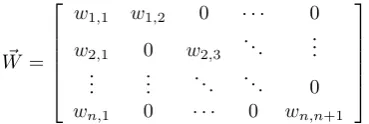
To perform the adaptation of the means, we computed a transformation matrixW~ for each regression class. This matrix is applied to the extended mean vector of all the mix-tures pertaining to the regression class to obtain an adapted mean vector. Given a stateqin a HMM, for theith gaussian of the output distribution, we denote its mean vector as~µqi.
The adapted mean vector~µbqiis obtained by:
~ b
µqi=W~ ·~ξqi
where~µbqiis the adapted mean and~ξqiis the extended mean
vector defined as:
~
ξqi= [w, µ0qi, . . . , µnqi]0= [w:~µqi]
wherenis the number of features,µ~qiis the original mean
vector andwis an offset term.
If we have a set of adaptation data denoted by the sequence of acoustic feature vectorsX~ =~x1~x2...~xT, ~xt ∈RD, t= 1, ..., T, we can estimate the adaptation matrixWc~ using the maximum likelihood approach as:
~ c W = max
~ W
pθ~(X~)
where~θdefines the parameters of the adapted model. To compute the transformation matrix, we can use several variants: without the same covariances of the distributions (with a full or a diagonal matrix) or with the same co-variances of the distributions. Details on the estimation of these variants can be consulted in (Leggetter and Wood-land, 1995). The following formulation assumes only one adaptation sample, but it can be easily extended forn adap-tation samples.
2.1. Full matrix
Given a stateqin a HMM, for theith gaussian of the out-put distribution, we denote its mean vector as ~µqi and its
covariance matrix asΣ~qi.
To compute a full matrix, it is necessary to compute an
aux-iliary tridimensional matrixG. In this case,~ cW~ must be cal-culated by rows becauseG~ is a tridimensional matrix. We calculate the rowkofWc~ as:
~ b
w0k =G~(k)−1~zk0
where
~ z=X
t
X
q
X
i
(γqi(t))~Σqi−1~xtξ~qi0
γqi(t)is defined as the posteriori probability of occupying
state qat timetgiven that the observation sequenceX~ is generated by theith gaussian.
The rowkofG~ is defined as:
~
G(k)jq =X
q,i
~v(qi)ii d~(qi)jq
where
~
D(qi)=~ξqi~ξqi0
and
~
V(qi)=X
t
γqi(t)Σ~ (−1) qi
2.2. Diagonal matrix
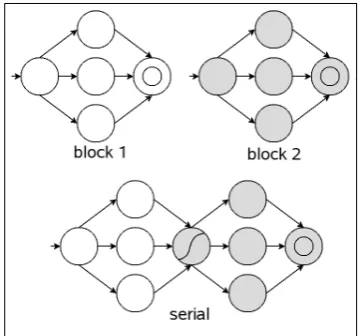
We developed two separate language models: an ton was built for each language using the acceptor automa-ton (in the corresponding language) of each block. The au-tomaton was made by joining the acceptor automata in a series. For every two consecutive automata, we merged the final states of the first acceptor automaton with the initial states of the second one. Figure 2 shows an example of the serialization process.
Figure 2: Illustration of the serialization process.
We computed the perplexity of these language models with the following results: Spanish 5.98 and Valencian 6.46. Note that the perplexity of the models is very low. This is in accordance with the size of the speech corpus, which is also small.
4.2. Acoustic models
Each acoustic model is associated to a phoneme (i.e., monophones) in order to make a comparison of the fea-tures of an acoustic sequence with the acoustic models. The acoustic models were hidden Markov models (HMM) that were trained using the HTK toolkit (Young et al., 2004). The HMMs followed a three-state, left-to-right topology without skips. We tested models with 32 Gaussians per state. Each gaussian modeled a 33-component feature vec-tor (10 cepstrals coefficients plus energy with the first and second derivatives).
To obtain reliable acoustic models, they must be trained with huge amounts of training data. It was easy to find large Spanish corpora, but we did not have a large Valencian cor-pus available for this study. However, since Valencian is phonetically very similar to Spanish, we were able to use the small amount of training material available in Valen-cian to adapt acoustic models that were trained from a large Spanish corpus. We used theSenglarcorpus as the initial training corpus. This corpus has been successfully used in other tasks (Casacuberta et al., 2004). The recording con-ditions for theSenglarcorpus were different from those of our corpus. For this reason, we obtained adapted acoustic models from theSenglaracoustic models for both Spanish and Valencian so that they could be used in our task. Adapted acoustic models were obtained with the MLLR technique by estimating a global adaptation matrix for each language (i.e., only one regression class). We used our
training corpus as adaptation material to obtain the adapted acoustic models. This technique has been used before to obtain acoustic models for multilingual speech recognition. The quantity of signal that we used to adapt the models was similar to the quantity of signal used in previous works (Schultz and Waibel, 2001) and (Zhao and O’Shaughnessy, 2007).
5.
Experiments and Results
To analyze the results, we used the Word Error Rate (WER) as the evaluation measure. This measure computes the edit distance between a reference sentence and the recognized sentence.
To perform the experiments, we used two language mod-els: a Spanish language model and a Valencian language model. We used adapted acoustic models for Spanish and Valencian. These acoustic models were adapted with the adaptation data in Spanish and Valencian from the acoustic models trained with the Senglar corpus (Casacuberta et al., 2004).
The adaptation data was small, so we adapted the acosutic models with only one regression class and, therefore, we only computed one transformation matrix.
We implemented the three variants of MLLR presented above: full matrix, diagonal matrix and mean square. Full matrix and diagonal matrix were calculated with one iteration of Expectation-Maximization because more itera-tions provided worse results. In general, when the initial models provide good Gaussian frame alignments, only a single iterarion of EM is required to estimate the transfor-mation matrix (Woodland, 2001).
To obtain baseline results, we performed experiments for Spanish and Valencian with the Senglar acoustic models without adaptation. The Senglar Valencian models were built by cloning the most similar Spanish model for each Valencian phoneme.
Spanish Valencian
Baseline 11.0% 16.5%
Full Matrix 6.4% 11.5% Diagonal Matrix 7.6% 11.7% Mean Square 5.6% 10.4%
Table 2: Results of experiments. (The best results are in boldface)
Table 2 shows the best results of experiments. In the same conditions, another standard MLLR tool (HTK) provided similar results for the full matrix case (6.0% in Spanish, 11.0% in Valencian) (Young et al., 2004). As the results show, in this case, it is best to use Mean Square because the WER improved 5 points in Spanish (from 11.0% to 5.6%) and 6 points in Valencian (from 16.5% to 10.4%). Mean Square obtains the best results because the difference be-tween the Senglar acoustic models and the adaptation data is large enough to make the different covariances a source of errors when computing the state occupancy (γqi(t)). The
6.
Conclusions and Future Work
We have implemented three variants of MLLR for language adaptation in order to choose the best alternative for our system, which deals with two languages: Spanish and Va-lencian. Our proposal is to employ language adaptation in these languages. We used acoustic models (trained with a large corpus in Spanish) and our training corpus as adapta-tion material to obtain the adapted acoustic models. The re-sults show that, in this case it is better to use Mean Square. The results with language adaptation are better than without language adaptation. In conclusion, we think that MLLR is a good option for language adaptation.
Nevertheless, these conclusions should be confirmed with a larger corpus and a more realistic task. In future work, we plan to adapt our acoustic models with more appropriate initial acoustic models, i.e., a set of Spanish acoustic mod-els that is closer to our conditions. It would be interesting to obtain the adapted Valencian acoustic models from a set of standard Catalan acoustic models (Moreno et al., 2006). Moreover, we plan to test different quantities of regression classes and other adaptation techniques such as MAP (Gau-vain and Lee, 1992).
7.
References
Alabau, V. and C.D. Mart´ınez, 2006. Bilingual speech cor-pus in two phonetically similar languages. In Proc. of LREC’06,pp. 1624–1627.
Casacuberta, F., H. Ney, F. J. Och, E. Vidal, J. M. Vilar, S. Barrachina, I. Garcia-Varea, C. Martinez D. Llorens, S. Molau, F. Nevado, M. Pastor, D. Pico, and A. San-chis., 2004. Some approaches to statistical and finite-state speech-to-speech translation. Computer Speech and Language, 18:25–47.
Leggetter, C.J. and P.C. Woodland, 1995. Maximum likeli-hood linear regression for speaker adaptation of contin-uous density hidden markov models. Computer Speech and Language, 9:171–185.
Moreno, A., A. Febrer, and L. M´arquez, 2006. Genera-tion of language resources for the development of speech tecnologies in Catalan. InProc. of LREC’06,pp. 1632– 1635.
Schultz, T. and A. Waibel, 2001. Language-independent and language-adaptive acoustic modeling for speech recognition.Speech Communication, 35(Issues 1-2):31– 51.
Uebler, U., 2001. Multilingual speech recognition in seven languages. Speech Communication, 35:53–69.
Vilajoana, Jordi and Dami`a Pons, 2001. Catalan, language of Europe. Generalitat de Catalunya.
Woodland, P.C., 2001. Speaker Adaptation for Continuous Density HMMs: A Review. ITRW on Adaptation Meth-ods for Speech Recognitionn, 11–19.
Luj´an, M. and C. D. Mart´ınez and V. Alabau, 2007. A study on bilingual speech recognition involving a minor-ity language. 33rd Language & Technology Conference: Human Language Technologies as a Challenge for Com-puter Science and Linguistics, 138–42.
Young, S., G. Evermann, T. Hain, D. Kershaw, G. Moore, J. Odell, D. Ollason, D. Povey, V. Valtchev, and P.
Wood-land, July, 2004. The HTK Book. CUED, UK, v3.2 edi-tion.