CSEIT1725119 | Received : 15 Sep 2017 | Accepted : 30 Sep 2017 | September-October-2017 [(2)5: 630-635 ]
International Journal of Scientific Research in Computer Science, Engineering and Information Technology © 2017 IJSRCSEIT | Volume 2 | Issue 5 | ISSN : 2456-3307
630
DoS Attack Detection System Using Multivariate Correlation
Analysis(MCA) and Classification Techniques
M. Ramya Tanaya
*1, K. Eswar
2*1Computer Science and Engineering, V.R Siddhartha Engineering College ,Student, Vijayawada, Andhra Pradesh, India 2
Computer Science and Engineering, V.R Siddhartha Engineering College, Assistant Professor, Vijayawada, Andhra Pradesh, India
ABSTRACT
Denial-of-Service (DoS) attacks cause serious impact on these computing systems. For detecting common specific operations of the denial of service attacks with proceedings of detection in distributed service attacks in networks. Recently use Multivariate Correlation Analysis (MCA) for accurate network traffic characterization by extracting the geometrical correlations between network traffic features. Our MCA-based DoS attack detection system employs the principle of anomaly-based detection in attack recognition. This makes our solution capable of detecting known and unknown DoS attacks effectively by learning the patterns of legitimate network traffic only. The sudden increase in traffic can cause the server to offer degraded performance. My Doom devastation on Microsoft, wiki leaks encounter with DoS barrages are some examples to highlight the impact. And other major Internet players like Amazon, CNN, and Yahoo are no exception. Early discovery of these attacks, although challenging, is necessary to protect victim server's network infrastructure resources. Previous intrusion prevention systems like MCA although efficient in thwarting DoS, its architecture is based on ISP collaboration and virtual protection rings. We propose to use an IPS rules (Classification rules) driven DoS detection approach that checks various parts of a data packet and not just the header. This enables the detection system to eliminate other forms DoS attacks such as Slow Read DoS attack. Its effectiveness and low overhead, as well as its support for incremental deployment in real networks are demonstrated.
Keywords: Denial of Service Attacks, Multivariate Correlation, Classification Rules, Intrusion Prevention Systems, Internet Service Provider.
I.
INTRODUCTION
DoS assaults are predominantly utilized for flooding a specific casualty with gigantic movement and incapacitating its administrations [4]. Late works go for countering DoS assaults by battling the fundamental vector, which is generally the utilization of botnet. A botnet is an extensive system of bargained machines (bots) controlled by one element (the ace). The ace can dispatch synchronized assaults, for example, DoS, by sending requests to the bots by means of a Command and Control channel [2][3] . Shockingly, recognizing a botnet is hard, and proficient arrangements require examining elements to take part effectively in the
To conquer such issues, another synergistic framework called Multivariate Correlation was recommended that identifies flooding DoS assaults beyond what many would consider possible from the casualty have and as close as conceivable to the assault source(s) at the Internet specialist co-op (ISP) level. [3][6] Multivariate Correlation depends on a disseminated engineering made out of different ISPs framing overlay systems of insurance rings around subscribed clients. The virtual rings utilize flat correspondence when the level of a potential assault is high. [2] along these lines, the risk is measured in light of the general activity transmission capacity coordinated to the client contrasted with the most extreme data transfer capacity it underpins. Multivariate Correlation Components
Packet Processor
Metrics Manager
Selection Manager
Score Manager
Collaboration Manager
Multivariant Connection structure uses the following algorithms: Bundle rate calculations using concept frequencies(collaboration manager) and Minimization Protects Execution. In addition to discovering surging DoS strikes, Multi-variant Connection also helps in discovering other surging scenarios, such as flash crowd, and other botnet-based DoS strikes thus offering a better performance. [14] But, Multivariate Correlation's security techniques requires different ISP's cooperation to form exclusive security which has real-time implementation issues involving total update of the structure. Multivariate Correlation's security techniques (virtual security notion) is not centered on IPS concept components (Classification & Relational Rules). Procedure of the multivariate correlation analysis to detect DoS attack detection will shown in figure 1.
Figure1: Multivariate Correlation data for individual feature generation to detect DoS attacks.
So, in this paper, the proposed system extending Multivariate Correlation to support different IPS rule structures will help Multivariate Correlation thwart other forms of DoS attacks especially the latest entrant Slow Read DoS attack. Proposed system was Classification & Relational’s detection system which is based on rules. Like viruses, most intruder activity has some sort of signature. Information about these signatures is used to create Classification & Relational rules. These rules in turn are based on intruder signatures. Classification & Relational rules can be used to check various parts of a data packet not just the header scanning adapted by prior approaches. A rule may be used to generate an alert message, log a message, or, in terms of Classification & Relational, pass the data packet, i.e., drop it silently. Thus enabling a detection system eliminating other forms DoS attacks such as Slow Read DoS attack. Classification & Relational Based DoS detection system can be a real time efficient and feasible implementation that can counter varying DoS attack forms.
II.
METHODS AND MATERIAL
Trials indicated great execution and power of Multivariate Correlation and featured great practices for its design. However, Multivariate Correlation was planned in single IPS Rule structure. In this paper we present the CLASSIFICATION and RELATIONAL run structure for unique source code is accessible to anybody at no change. Order and Relational Based DoS location framework can be an ongoing productive and achievable execution that can counter shifting DoS assault shapes.
MCA ANALYSIS
stored in separate files. Classification & Relational reads these rules at the start-up time and builds internal data structures or chains to apply these rules to captured data. [4] Finding signatures and using them in rules is a tricky job, since the more rules use, the more processing power is required to process captured data in real time. [2] It is important to implement as many signatures as it can using as few rules as possible. Classification & Relational comes with a rich set of pre-defined rules to detect intrusion activity and it is free to add own rules at will. To avoid false alarms, built-in rules can also remove.
SYSTEM DESIGN
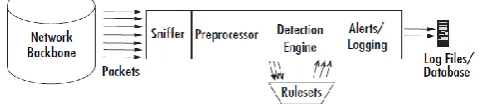
CLASSIFICATION & RELATIONAL is one of the most well-known NIDS. CLASSIFICATION & RELATIONAL is Start Resource, which indicates that the very first system source system code is available to anyone free, and this indicates many people to play a role to and evaluate the applications development. CLASSIFICATION & RELATIONAL uses the most popular open-source certificate known as the GNU Typical Community License. Category & Relational is rationally split into several elements. These elements work together to identify particular strikes and to obtain outcome in a needed structure from the recognition system. Category & Relational’s structure comprises of four primary components:
The sniffer
The preprocessor
The recognition engine
The output
Packet Sniffer
A bundle sniffer is a system (either components or software) used to tap into systems. It performs likewise to a mobile phone wiretap, but it’s used for information systems instead of speech systems. A system sniffer allows a application or a components system to eavesdrop on information system visitors. When it comes to the Internet, this usually comprises of IP visitors, but in regional LANs and heritage systems, it can be other method packages, such as IPX and AppleTalk visitors. Packet sniffers have various uses:
Network research and troubleshooting
Efficiency research and benchmarking
Eavesdropping for clear-text security
passwords and other exciting information of data.
Figure 2: Classification & Relational Architecture for DoS detection
Preprocessor
A preprocessor requires the raw packages and assessments them against certain plug-ins (like an RPC plug-in, an HTTP plug-in, and a slot checking device plug-in). These plug-ins check for a certain kind of actions from the bundle. Once the bundle is going to have a particular kind of “behaviour,” it is then sent to the recognition motor. Classification & Relational facilitates many types of preprocessors and their worker plug-ins, protecting many generally used methods as well as larger-view method problems such as IP fragmentation managing, slot checking and circulation management, and strong examination of highly presented methods.
Detection Engine
Once packages have been managed by all allowed preprocessors, they are passed off to the recognition motor. The recognition motor is the various meats of the signature-based IDS in Classification & Relational. The recognition motor requires the information that comes from the preprocessor and its plug-ins, and that information is examined through a set of guidelines. If the guidelines coordinate the information in the bundle, they are sent to the aware processer. The signature-based IDS operate is achieved by using various rulesets. The rulesets are arranged by category (Trojan horse, shield flows over, accessibility to various applications) and are modified consistently.
The guidelines themselves include of two parts:
forth), resource and location IP details, and ports
The concept choice The choice is the material in the bundle that should make the bundle coordinate the concept.
The recognition motor and its guidelines are the biggest section (and steepest studying curve) of new information to understand and comprehend with Classification & Relational. Classification & Relational has a particular format that it uses with its guidelines. Rule format can include the kind of method, the material, the duration, the headlines, and other various components, such as rubbish figures for interpreting butter flood guidelines. If we want to produce new guidelines from current guidelines it is known as generalizing CLASSIFICATION & RELATIONAL guidelines.
Alerting/Logging Component
After the Classification & Relational information goes through the recognition motor, it needs to go out somewhere. If the information suits a concept in the recognition motor, advice is activated. Based on what the recognition motor discovers within a bundle, the bundle may be used to log the activity or produce advice. Records are kept in simple written text data files, tcp-dump- design data files or some other type. Signals can be sent to a log data file, through a system relationship, through UNIX electrical sockets or Ms Windows Pop-up (SMB), or SNMP blocks. The alerts can also be held in an SQL data resource such as MySQL and Postgress .
III.
RESULTS AND DISCUSSION
Consider an Internet packet that contains a variation of a known attack, there should be some automated way to identify the packet as nearly matching a NIDS attack signature. If a particular statement has a set of conditions against it, an item may match some of the conditions. Whereas Boolean logic would give the value false to the query ’does this item match the conditions’, our logic could allow the item to match to a lesser extent rather than not at all. This principle can be applied when comparing an Internet packet against a set of conditions in a CLASSIFICATION & RELATIONAL rule. Our hypothesis is that if all but
one of the conditions are met, an alert with a lower priority can be issued against the Internet packet, as the packet may contain a variation of a known attack. While implementation, generalization in the case of matching network packets against rules, involves allowing a packet to generate an alert if:
The conditions in the rule do not all match, yet most of them do;
The only conditions that do not match exactly nearly match.
When implementing generalized rules, the execution time was 1 second to process and convert the original 1,325 rules into a total of 6,975 rules. The generalized Content execution time was 2 seconds to process and convert the same 1,325 original rules, into a total of 18,265 rules. These execution times would easily be acceptable for most potential uses, such as each time the CLASSIFICATION & RELATIONAL rules were downloaded for signature updates. The increase in the number of rules affected the time spent processing network traffic data as follows:
Using the original rules, Classification & Relational took approx 100 seconds to process 1,635,267 packets;
Using the generalized (inverted) rules, Classification & Relational took approx 400 seconds to process the same packets;
Using the generalized content rules,
Classification & Relational took approx 1,000 seconds to process the packets.
The change in CLASSIFICATION &
Figure3: Time comparison results between two techniques.
As shown in the above figure, it differentiates the comparison results between both current and suggested techniques designed in our application. In our current approach, we have to develop Multivariate Connection strategy for recognition of Denial-of-Service strikes in system interaction. In this method, we are not providing any concept framework process for recognition of those strikes found in the system interaction. In this method, we were designed Attack recognition system rules framework for developing system performance with equivalent concern principles of each node found in the network
As Comparison of Multivariate Correlation with CLASSIFICATION & RELATIONAL rule structure in the network formation. There is only one comparison i.e. time (Comparison results). In Multivariate Correlation detection virtual protection rings are formed with in low time when compare to original results in CLASSIFICATION & RELATIONAL rule structure. Because we taking different ISP rule structure formation for providing virtual protection rings in CLASSIFICATION & RELATIONAL rule enhanced technique.
IV.
CONCLUSION
In this paper, the proposed framework stretching out Multivariate Correlation to help distinctive IPS administer structures will enable Multivariate Correlation to ruin different types of DoS assaults particularly the most recent contestant Slow Read DoS assault. As further future work of Multivariate Correlation, We Propose Classification and Relational's identification framework which depends on rules. Like infections, most gate crasher action has some kind of mark. Data about these marks is utilized to make Classification and Relational standards. These guidelines thus depend on interloper marks. Arrangement and Relational based identification framework comprises of a few segments: Sniffer, preprocessor, the recognition motor, the yield/ready part. The discovery motor makes utilization of Classification and Relational tenets. Grouping and Relational standards can be utilized to check different parts of information parcel not only the header filtering adjusted by earlier methodologies. A control might be
utilized to produce a ready message, log a message, or, as far as Classification and Relational, pass the information bundle, i.e., drop it quietly. Accordingly empowering a location framework taking out different structures DoS assaults, for example, Slow Read DoS assault. Characterization and Relational Based DoS recognition framework can be a continuous proficient and doable execution that can counter changing DoS assault shapes.
V.
REFERENCES
[1]. Zhiyuan Tan, Aruna Jamdagni, Xiangjian He, "A System for Denial-of-Service Attack Detection Based on Multivariate Correlation Analysis", IEEE TRANSACTIONS ON PARALLEL AND DISTRIBUTED SYSTEMS VOL:25 NO:2 YEAR 2014.
[2]. P. Garca-Teodoro, J. Daz-Verdejo, G. Maci-Fernndez, and E. Vzquez, "Anomaly-based Network Intrusion Detection: Techniques, Systems and Challenges," Computers & Security, vol. 28, pp. 18-28, 2009.
[3]. D. E. Denning, "An Intrusion-detection Model," IEEE Transactions on Software Engineering, pp. 222-232, 1987.
[4]. K. Lee, J. Kim, K. H. Kwon, Y. Han, and S. Kim, "DoS attack detection method using cluster analysis," Expert Systems with Applications, vol. 34, no. 3, pp. 1659-1665, 2008.
[5]. A. Tajbakhsh, M. Rahmati, and A. Mirzaei, "Intrusion detection using fuzzy association rules," Applied Soft Computing, vol. 9, no. 2, pp. 462-469, 2009.
[6]. J. Yu, H. Lee, M.-S. Kim, and D. Park, "Traffic flooding attack detection with SNMP MIB using SVM," Computer Communications, vol. 31, no. 17, pp. 4212-4219, 2008.
[7]. W. Hu, W. Hu, and S. Maybank,
"AdaBoost-Based Algorithm for Network Intrusion
Detection," Trans. Sys. Man Cyber. Part B, vol. 38, no. 2, pp. 577-583, 2008.
[8]. C. Yu, H. Kai, and K. Wei-Shinn, "Collaborative Detection of DoS Attacks over Multiple Network Domains," Parallel and Distributed Systems, IEEE Transactions on, vol. 18, pp. 1649-1662, 2007.
[9]. G. Thatte, U. Mitra, and J. Heidemann, "Parametric Methods for Anomaly Detection in Aggregate Traffic," Networking, IEEE/ACM Transactions on, vol. 19, no. 2, pp. 512-525, 2011.
and Cybernetics, Part B: Cybernetics, IEEE Transactions on, vol. 35, pp. 302-312, 2005. [11]. S. Yu, W. Zhou, W. Jia, S. Guo, Y. Xiang, and F.
Tang, "Discriminating DoS Attacks from Flash Crowds Using Flow Correlation Coefficient," Parallel and Distributed Systems, IEEE Transactions on, vol. 23, pp. 1073-1080, 2012. [12]. S. Jin, D. S. Yeung, and X. Wang, "Network
Intrusion Detection in Covariance Feature Space," Pattern Recognition, vol. 40, pp. 2185- 2197, 2007.
[13]. C. F. Tsai and C. Y. Lin, "A Triangle Area Based Nearest Neighbors Approach to Intrusion Detection," Pattern Recognition, vol. 43, pp. 222-229, 2010.
[14]. A. Jamdagni, Z. Tan, X. He, P. Nanda, and R. P. Liu, "RePIDS: A multi tier Real-time Payload-based Intrusion Detection System," Computer Networks, vol. 57, pp. 811-824, 2013.
[15]. Z. Tan, A. Jamdagni, X. He, P. Nanda, and R. P. Liu, "Denial-of- Service Attack Detection Based on Multivariate Correlation Analysis," Neural Information Processing, 2011, pp. 756-765. [16]. Z. Tan, A. Jamdagni, X. He, P. Nanda, and R. P.