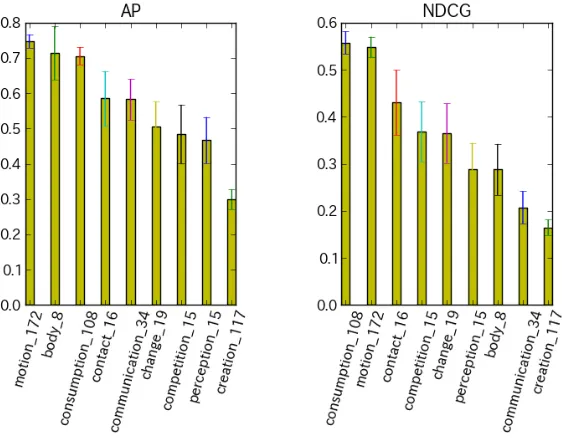
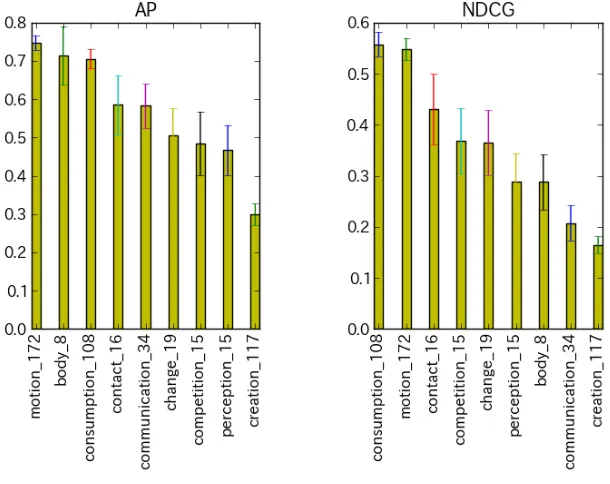
Figure 4: Comparison of query performances by sense group of concept noun.
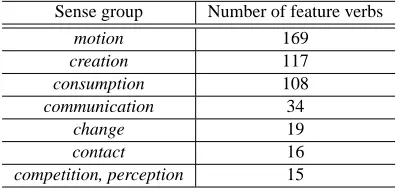
Figure 5: Comparison of query performances by sense group of feature verbs.
linguistic annotations for some of the acquired Web images, and analyzed the correlation between the imageability rat-ings and the semantic similarities calculated between the original semantic feature expressions and the acquired lin-guistic annotations.
5.1.
Linguistic Annotations
We have recruited two annotators who are fluent in English, and had them independently annotate 3,653 of the images already described in the previous section. In the annotation work, we have directed them to employ the original sen-tence patterns (e.g. Subj+Verb or Subj+Verb+Obj) as far as possible, but we have not forced them to observe any other restrictions.
Figure 7 displays two example images, both assessed as highly relevant (relevance rating:4) for the given semantic features. The annotations given by the two annotators were:
• (a) “cheetah hunts”:
– Annotator 1: “cheetah chases prey” (remark: the direction for sentence pattern was not observed in this case)
– Annotator 2: “cheetah runs”
• (b) “faucet leaks”:
– Annotator 1: “water drips”
– Annotator 2: “The faucet frips”
5.2.
Correlation Analysis
Figure 6: Comparison of query performances by combinations of concept noun and feature verbs.
A1:sim-subj A1:sim-verb A1:sim-obj A2:sim-subj A2:sim-verb A2:sim-obj
Lasso -0.273 1.011 0.060 0.193 0.685 0.0
SVR -3.446 0.258 -0.346 3.360 1.638 -3.387
Table 7: Weights for componential semantic similarities (A1: Annotator-1, A2: Annotator-2).
(a) cheetah hunts (b) faucet leaks
Figure 7: Examples of linguistic annotations.
of componential semantic similarities. More precisely, the sentential semantic similarity was calculated by balancing similarities between subjects, verbs, and objects (if any): each of the componential similarities was calculated by ap-plying Wu-Palmer’s and Lin’s methods (Bundanitsky and Hirst, 2006), and the optimized weight for each compo-nent was adjusted by applying a linear regression method (Lasso) (Tibshirani, 1996) and support vector regression (SVR) (Drucker et al., 1997).
By applying the regression processes, we obtained the fol-lowing correlation ratios (in Pearson) between the series of image ratings and the componential similarities: 0.472 for Lasso and 0.556 for SVR respectively (for both methods,
p < 0.001). These results show that there existed modest-level correlations between them, insisting that the linguistic annotations independently given to an “easier” image could be more similar to the original semantic feature expression
than those given to an “harder” image.
Table 7 summarizes the obtained weights for the compo-nential semantic similarities. As shown in the table, the similarities between verbs played a more prominent role in correlating the two modalities: image and language.
6.
Concluding Remarks
This paper investigated into the Web-imageabilities of the behavioral features (e.g. “beaver builds dams”) of a basic-level concept (beaver).
The primary contributions made in this paper are twofold: (1) ”beaver building dams”-type queries can better yield relevant Web images, suggesting that the present partici-ple form of a verb (”building”), as a query component, is more effective than the base form; (2) the behaviors taken by animate beings are likely to be more depicted on the Web, particularly if the behaviors are, in a sense, inherent to animate beings (e.g., motion, consumption), while the creation-type behaviors of inanimate beings are not. Although these findings are limited to the concepts and the concept-feature pairs investigated in the presented work, the resulting resource can be utilized as part of training data for learning the imageability of Web-images relative to a given concept. Moreover, the presented work could initiate a new research direction that deals with the image-ability of complex concepts, rather than atomic concepts, as a concept-feature pair in this paper can be seen as a kind of complex concept.
section revealed that the semantic gap could be relatively narrower for some of the Web images. Our future issues thus include the understanding the nature of such “easier” images and the “harder” images such as shown in Fig. 7. To advance this direction, we would incoporate established image features (such as SIFT), and consider linguistic the-ories of actions.
7.
Acknowledgments
This work was supported by JSPS KAKENHI Grant Num-ber 24650123.
8.
References
Alm, C.O. et al. (2006). Challenges for annotating im-ages for sense disambiguation. Proc. of the Workshop on
Frontiers in Linguistically Annotated Corpora, pp.1–4.
Barsalou, L.W. (2008). Grounded cognition. Annual
Re-view of Psychology, 59:617–645.
Bundanitsky, A., and Hirst, G. (2006). Evaluating WordNet-based measures of semantic distance.
Compu-tational Linguistics, Vol.32, No.1, pp.13–47.
Cree, G.S., and McRae, K. (2003). Analyzing the factors underlying the structure and computation of the mean-ing of chipmunk, cherry, chisel, cheese, and cello (and many other such concrete nouns). Journal of
Experimen-tal Psychology, 132:163–201.
Drucker, H., Burges, C.J.C., Kaufman, L., Smola, A., and Vapnik, V. (2004). Support vector regression machines. In M. C. Mozer, et al. (eds.), Advances in Neural
Infor-mation Processing Systems 9, pp.155–161.
Hayashi, Y., Savas, B., and Nagata, M. (2009). Utiliz-ing images for assistUtiliz-ing cross-Language information re-trieval on the Web. Proc. of Web Intelligence/IAT
Work-shops (WIRSS 2009), pp. 100–103.
Kwong, O.Y. (2012). New Perspectives on Computational
and Cognitive Strategies for Word Sense Disambigua-tion, Springer.
Manning, C.D, Raghavan, P., and Sch¨utze, H. (2008).
In-troduction to Information Retrieval, Cambridge
Univer-sity Press.
McRae, K., Cree, G.S., and Seidenberg, M.S. (2005). Se-mantic feature production norms for a large set of living and nonliving things. Behavior Research Methods,
In-struments, and Computers, 37(4):547–559.
Miller, G. (1998). Nouns in WordNet. In: Fellbaum, C. (ed), WordNet, An Electronic Lexical Database, pp. 23– 46, The MIT Press.
Silberer, C., Ferrari, V., and Lapata, M. (2013). Models of semantic representation with visual attributes. Proc. of
ACL 2013, pp. 572–582.
Tibshirani, R. (1996). Regression shrinkage and selection via the lasso. J. Royal. Statist. Soc B., Vol. 58, No. 1, pp.267–288.
Wang, H-C. (2010). Using language-retrieved pictures to support intercultural group brainstorming. Proc. of ACM