
The Weltmodell: A Data-Driven Commonsense Knowledge Base
Alan Akbik and Thilo Michael
Database Systems and Information Management Group (DIMA) Technische Universit¨at Berlin
Einsteinufer 17, 10587 Berlin, Germany [email protected], [email protected]
Abstract
We present the WELTMODELL, a commonsense knowledge base that was automatically generated from aggregated dependency parse fragments gathered from over 3.5 million English language books. We leverage the magnitude and diversity of this dataset to arrive at close to ten million distinct N-ary commonsense facts using techniques from open-domain Information Extraction (IE). Furthermore, we compute a range of measures of association and distributional similarity on this data. We present the results of our efforts using a browsable web demonstrator and publicly release all generated data for use and discussion by the research community. In this paper, we give an overview of our knowledge acquisition method and representation model, and present our web demonstrator.
Keywords:Knowledge Acquisition, Open Information Extraction, Commonsense Reasoning
1.
Introduction
Acquiring and representing structured, machine-readable general world knowledge has been a longstanding chal-lenge in AI and NLP. Early approaches for the creation of commonsense knowledge were based on hand-coded knowledge by groups of expert logicians (Lenat, 1995). To overcome the inherent complexities in scaling up hand-built rule-systems, more recent approaches have investigated the use of crowd-sourcing (Singh et al., 2002) and the integra-tion of numerous hand-built structured data sources (Speer and Havasi, 2012). A prominent example of this line of work is CONCEPTNET (Liu and Singh, 2004), a graph-based knowledge representation project in which nodes are concepts and edges relations that hold between these con-cepts.
We follow a different recent line of work which investigates the use of automated, data-driven methods to create com-monsense knowledge bases (Schubert, 2002; Gordon et al., 2010; Gordon, 2010). We are motivated by ever-growing amounts of readily available natural language text (Halevy et al., 2009), an increasing maturity of Information Extrac-tion (IE) technologies and the availability of scalable com-puting architectures (Dean and Ghemawat, 2008).
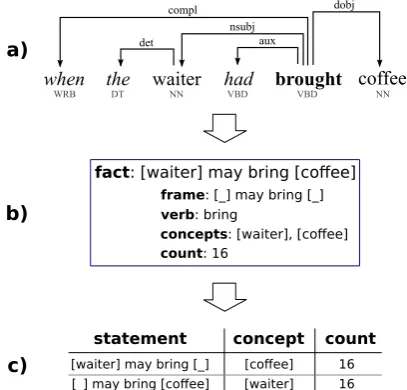
In particular, we are motivated by the availability of a dataset of aggregated dependency parse fragments gath-ered from over 3.5 million English language books (Gold-berg and Orwant, 2013). By applying techniques from open-domain IE (Akbik and L¨oser, 2012) and distributional semantics (Akbik et al., 2012) to this large and diverse dataset, we investigate the potential of large scale data-driven approaches for automatically acquiring common-sense knowledge. We distinguish our work from related efforts (Speer and Havasi, 2012; Schubert, 2002) in that we model relations that hold between an arbitrary number of concepts (e.g. N-ary relations) and determine several no-tions of similarity and association which we include in our model. We make the results of our efforts publicly available for use and discussion by the research community.
We present the WELTMODELL, the commonsense knowl-edge base created with our data-driven approach, using a
browsable web interface. Typical commonsense informa-tion that users may query in the WELTMODELLincludes:
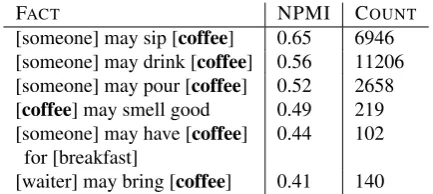
• Facts that pertain to a given concept, along with co-occurrence counts and mutual information values. For instance, a user might query for the concept “coffee” (see Table 1). Example facts include unary facts (“ cof-fee may smell good”), binary facts (“someone may drinkcoffee”) and ternary facts (“someonemay have coffeeforbreakfast”).
• Concepts that may fill a slot in a given statement. For example, given the facts found for “coffee” in Table 1, users may ask: “What are other things that some-one may have for breakfast?”, “What other things may smell good?”, or “What things may a waiter bring?”. See Table 2 for example results for such queries.
• Statements with highapplicative similarityfor a given statement. For instance, a user might ask “What state-ments hold for things that a waiter may bring?” (they may be put or placed on a table). We discuss such notions of similarity in section 2.4.
In the following, we give an overview of our knowl-edge acquisition methodology and knowlknowl-edge representa-tion model. We also give a brief overview of our web UI.
FACT NPMI COUNT
[someone] may sip [coffee] 0.65 6946 [someone] may drink [coffee] 0.56 11206 [someone] may pour [coffee] 0.52 2658 [coffee] may smell good 0.49 219 [someone] may have [coffee] 0.44 102
for [breakfast]
[waiter] may bring [coffee] 0.41 140
Figure 2: Information on the concept “planet”. On the left side, some associated statements are listed. On the right side, concepts with high functional similarity are listed, such as “star”, “earth” and “moon”.
Figure 3: Statement view for “[waiter] may bring [ ]”, i.e. all things that a waiter may bring. Concepts are grouped according to functional similarity, so one functionally similar group of concepts a waiter may bring is “check”, “bill” and “note”. Applicatively similar statements are listed on the right. The statement “[someone] may place [ ] on [table]” is similar. This reads as “things that a waiter may bring may also often be placed on a table”.
information. We will also investigate in how far we can en-courage and automatically integrate user feedback into our knowledge base.
Disambiguation. One principal problem that we are ad-dressing is the widespread ambiguity of concepts (as well as statements to a lesser extend). Examples for ambiguous concepts are “plane” (airplane vs. field) and “change” (coin vs. modification). Our hope is to separate the meanings either using unsupervised methods, for example through clustering the statements for each concept, or by disam-biguating concepts to WordNet. Initial investigations of both supervised and unsupervised approaches point to po-tential, however no results of sufficient quality for inclusion into the publicly browsable dataset have yet been produced.
Incompleteness. Another challenge that we are investi-gating concerns incompleteness; even with the very large dataset used in our experiments, not all possible facts are
observed. An example of this is the statement “[ ] may have [wing]”, which is observed for many different birds, but not the concept “owl”. However, the WELTMODELLcontains enough information to infer such statements, e.g. we know that an owl is a bird and that it can fly. We also observe that birds that can fly often have wings. Currently we are inves-tigating matrix completion methods as a general means to infer new information (Riedel et al., 2013).
5.
Acknowledgements
We would like to thank our colleague Larysa Visengeriyeva for her help and ideas in working with the syntactic n-grams. Alan Akbik and Thilo Michael received funding from the European Union’s Seventh Framework Programme (FP7/2007-2013) under grant agreement no ICT-2009-4-1 270137 ’Scalable Preservation Environments’ (SCAPE).
6.
References
Akbik, A. and L¨oser, A. (2012). Kraken: N-ary facts in open information extraction. InAKBC-WEKEX, pages 52–56. Asso-ciation for Computational Linguistics.
Akbik, A., Visengeriyeva, L., Herger, P., Hemsen, H., and L¨oser, A. (2012). Unsupervised discovery of relations and discrimi-native extraction patterns. InProceedings of the 24th Interna-tional Conference on ComputaInterna-tional Linguistics.
Bullinaria, J. and Levy, J. (2007). Extracting semantic represen-tations from word co-occurrence statistics: A computational study.Behavior Research Methods, 39(3):510–526.
Dean, J. and Ghemawat, S. (2008). Mapreduce: simplified data processing on large clusters. Communications of the ACM, 51(1):107–113.
Goldberg, Y. and Orwant, J. (2013). A dataset of syntactic-ngrams over time from a very large corpus of english books. Gordon, J., Van Durme, B., and Schubert, L. K. (2010). Learning
from the web: Extracting general world knowledge from noisy text. InCollaboratively-Built Knowledge Sources and AI. Gordon, A. S., Bejan, C. A., and Sagae, K. (2011).
Common-sense causal reasoning using millions of personal stories. In
AAAI.
Gordon, A. S. (2010). Mining commonsense knowledge from personal stories in internet weblogs. Automated Knowledge Base Construction, page 8.
Halevy, A., Norvig, P., and Pereira, F. (2009). The unreasonable effectiveness of data.Intelligent Systems, IEEE, 24(2):8–12. Lenat, D. B. (1995). Cyc: A large-scale investment in knowledge
infrastructure.Communications of the ACM, 38(11):33–38. Liu, H. and Singh, P. (2004). Conceptnet - a practical
common-sense reasoning tool-kit. BT technology journal, 22(4):211– 226.
Michel, J.-B., Shen, Y. K., Aiden, A. P., Veres, A., Gray, M. K., Pickett, J. P., Hoiberg, D., Clancy, D., Norvig, P., Orwant, J., et al. (2011). Quantitative analysis of culture using millions of digitized books.science, 331(6014):176–182.
Miller, G. A. (1995). Wordnet: a lexical database for english.
Communications of the ACM, 38(11):39–41.
Riedel, S., Yao, L., McCallum, A., and Marlin, B. M. (2013). Relation extraction with matrix factorization and universal schemas.
Rink, B., Bejan, C. A., and Harabagiu, S. M. (2010). Learn-ing textual graph patterns to detect causal event relations. In
FLAIRS Conference.
Roemmele, M., Bejan, C. A., and Gordon, A. S. (2011). Choice of plausible alternatives: An evaluation of commonsense causal reasoning. InAAAI Spring Symposium: Logical Formaliza-tions of Commonsense Reasoning.
Schubert, L. K. (2002). Can we derive general world knowledge from texts? InProceedings of the second international confer-ence on Human Language Technology Research, pages 94–97. Morgan Kaufmann Publishers Inc.
Singh, P., Lin, T., Mueller, E. T., Lim, G., Perkins, T., and Zhu, W. L. (2002). Open mind common sense: Knowledge acqui-sition from the general public. InOn the Move to
Meaning-ful Internet Systems 2002: CoopIS, DOA, and ODBASE, pages 1223–1237. Springer.
Speer, R. and Havasi, C. (2012). Representing general relational knowledge in conceptnet 5. InLREC, pages 3679–3686. Turney, P. D. (2012). Domain and function: A dual-space
![Table 3: Examples for functional and applicative similarities. The concepts “coffee” and “tea” (highlighted bold) sharea high functional similarity, because statements that hold for “coffee” often also hold for “tea” (such as “[someone] maydrink [ ]”)](https://thumb-us.123doks.com/thumbv2/123dok_us/1059428.1132338/3.595.67.531.74.154/examples-functional-applicative-similarities-highlighted-functional-similarity-statements.webp)
![Figure 3: Statement view for “[waiter] may bring [ ]”, i.e. all things that a waiter may bring](https://thumb-us.123doks.com/thumbv2/123dok_us/1059428.1132338/4.595.58.537.70.275/figure-statement-view-waiter-bring-things-waiter-bring.webp)