CSEIT1722288 | Received : 16 April 2017 | Accepted : 24 April 2017 | March-April-2017 [(2)2: 983-988]
International Journal of Scientific Research in Computer Science, Engineering and Information Technology © 2017 IJSRCSEIT | Volume 2 | Issue 2 | ISSN : 2456-3307
983
Secure File Storage in Cloud and Easy Access using Android -
MyCloud
Agasya Gulekar, Kunal Rawat, Manoj Selvin, Mujtaba Shaikh, Prof. Mahavir Devmane
Department of Information Technology, Mumbai University, Mumbai, Maharashtra, India
ABSTRACT
MyCloud is a cloud based application service comprised of a Public cloud which can be accessed over a Desktop computer or an Android running device. In today’s world where everyone has so much information to consume, remember and recall, it is possible to forget something or another, but what if it’s an important Document required at an even more important place then it may lead to some serious problem. MyCloud project will assist the clients to access personal Documents from anywhere at any time.
Keywords: Mycloud, Secure Cloud File Storage, QR Code File Access, MyCloud Encrypted Communication.
I.
INTRODUCTION
Cloud computing is a model for enabling ubiquitous network access to a shared pool of configurable computing resources [1]. Cloud computing is one of the hottest buzzwords in technology. It appears 48 million times on the Internet [2]. The fundamental concept of cloud computing originated in the 1950s, when corporations and learning institutes prioritized the efficiency of their large-scale mainframe computers, allowing multiple users both physical access to the computer from multiple terminals as well as shared central processing unit time [3].
MyCloud eradicates this issue by making use of the Internet and every common man’s weapon a Smart phone. With the help of a reliable Internet connection clients will be able to use the cloud services anytime from any place around the Globe and also as the stakes here are highly classified and important Documents we assure you that „Security‟ is our first priority.
Before submitting your final paper, check that the format conforms to this template. Specifically, check the appearance of the title and author block, the appearance of section headings, document margins, column width, column spacing and other features.
II.
METHODS AND MATERIALS USED
A. Public Cloud
B. QR Code :
QR code (abbreviated from Quick Response Code) is the trademark for a type of matrix barcode (or two-dimensional barcode) first designed for the automotive industry in Japan. A barcode is a machine-readable optical label that contains information about the item to which it is attached. A QR code uses four standardized encoding modes (numeric, alphanumeric, byte/binary, and kanji) to efficiently store data; extensions may also be used.[1]
A QR code consists of black squares arranged in a square grid on a white background, which can be read by an imaging device such as a camera, and processed using Reed–Solomon error correction until the image can be appropriately interpreted. The required data is then extracted from patterns that are present in both horizontal and vertical components of the image.[2].
C. OpenStack
OpenStack is a set of software tools for building and managing cloud computing platforms for public and private clouds. Backed by some of the biggest companies in software development and hosting, as well as thousands of individual community members, many think that OpenStack is the future of cloud computing. OpenStack is managed by the OpenStack Foundation, a non-profit which oversees both development and community-building around the project. The seven openstack‟s projects along with their respective code name are listed in table 1.
Components of OpenStack:
1. Nova is the primary computing engine behind OpenStack. It is used for deploying and managing large numbers of virtual machines and other instances to handle computing tasks [8].
2. Swift is a storage system for objects and files. Rather than the traditional idea of referring the files by their location on a disk drive, developers can instead use a unique identifier referring to the file or piece of information and let OpenStack decide where to store this information. This makes scaling easy, and developers need not to worry about the capacity of a system, everything will be handled by OpenStack [8].
3. Cinder is a block storage component, provides the software to create and centrally manage a service that provisions storage in the form of block devices known as Cinder volumes. Cinder provides storage with high availability, faulttolerance and its APIs compatibility with other like Amazon EC2 APIs [11].
IP addresses. It helps to ensure that each of the components of an OpenStack deployment can communicate with one another quickly and efficiently.
5. Horizon (Dashboard) provides administrators and users a graphical interface to access, provision, and automate cloudbased resources [8].
6. Keystone provides identity services for OpenStack. It is essentially a central list of all of the users of the OpenStack cloud, mapped against all of the services provided by the cloud which they have permission to use [8].
7. Glance provides image services to OpenStack. In this case, "images" refers to images (or virtual copies) of hard disks. Glance is the only module that can add, delete, share, or duplicate images [9].
8. Ceilometer provides telemetry services, which allow the cloud to provide billing services to individual users of the cloud. It also keeps a verifiable count of each user‟s system usage of each of the various components of an OpenStack cloud [8].
9. Heat is the orchestration component of OpenStack, which allows developers to store the requirements of a cloud application in a file that defines what resources are necessary for that application. In this way, it helps to manage the infrastructure needed for a cloud service to run [8].
D. OTP (One Time Password)
One-time password is a password that is only valid for a single login session or transaction. Hence for each session the user wants to login or to access some file the new OTP is generated which is unique and Time based, means it will expire after some duration which helps peventing replay attacks, phishing attacks and other attacks on basic static passwords [9].
III.
PROPOSED SYSTEM
The QR technology plays an important role in our project. At a certain point in the authentication process of our project the user will be required to scan a server-generated QR code from their Smartphone if user is using a Smartphone. OTP is a password that is valid for only one login session or transaction. This OTP allow the user to get login into the system by entering their password with OTP. OTP is an encrypted format, so users can‟t read it. Instead of that, user needs to forward that OTP with system logging password to the system. It avoids the unauthorized logging. In our proposed approach is, after user entering the username and password web server generates the Encrypted OTP using AES algorithm and converted into QR image and it is available in that page. The user can make use of any normal QR Decoder/Scanner available for their mobile. After scanning the user will get new URL, which prompts user to enter OTP which will be available on the user message box of MyCloud or it will be sent to the registered mobile number. After successfull authentication the user can add/remove files easily.
1. Registration: In MyCloud, the user will be asked to provide a username and unique password set to register to MYCLOUD database. After the registration process the user can create an account on MYCLOUD cloud services and can upload and store the files (.JPG/.PNG/.PDF/.BMP/and other formats).
2.1. Authentication: Phase-I If the user choses, a desktop computer as his device of operation then the user will be directly redirected to the account‟s homepage. Where a user will have the highest access to documents, user can create/delete/view or even close an account (temporarily or permanently).
2.2. Authentication: Phase-II If a user wants to view the documents on a Mobile phone, i.e. the user has selected the Mobile option from the desktop then the Cloud server will start the phase-2 authentication process. In this authentication phase, a QR code will be generated on user‟s desktop screen for a certain period of time. If the user is not able to perform further process in that amount of time the QR code will expire. If the user scans the QR code from a smartphone in that given time-period, then an URL in the QR code will redirect to an OTP page on user‟s phone‟s browser. Also the required OTP will appear on user‟s desktop screen which user will be required to enter in user‟s Mobile phone‟s browser window. Now the user will be redirected to user‟s account page. If the user is only using the Smartphone to login in the system, the server will recognize the device using his screen size (media query). Then there will be only one phase authentication process i.e. username and password.
3. Encryption Algorithm
3.1 AES Algorithm:
AES encryption uses a single key as a part of the encryption process. The key can be 128 bits (16 bytes), 192 bits (24 bytes), or 256 bits (32 bytes) in length [12].
Figure 3. AES Encryption
The term bit encryption refers to the use of a 128-bit encryption key. With AES both the encryption and the decryption are performed using the same key. This is called a symmetric encryption algorithm. When both the encryption and the decryption are performed using
the different key, ie. Public and Private key is A symmetric encryption algorithm [12].
IV.
RESULTS AND DISCUSSION
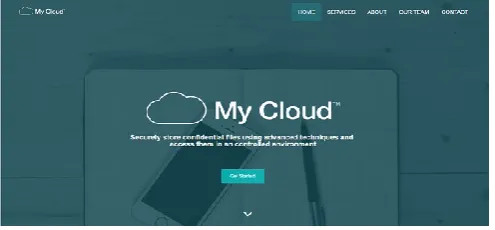
Figure 4. MyCloud Home Page
Figure 5. User Dashboard
Figure 6. User Profile Settings
Figure 8. MyCloud Android App – Quick File Access on your Smartphone Without Login
Figure 9. Scanning File URL QR Code.
V.
CONCLUSION
The Cloud computing is very popular and prevelant technology today which can be used to solve many day-to-day problems. MyCloud is one example of that. Unlike other software applications for storing and accessing data online the users won’t have to install the application on their device it can be accessed using any Web browser on their smartphones or a usual desktop. MyCloud also uses many encryption algorithms to provide satisfactory security to the users with two phase authentication process. We have proposed a secure and reliable authentication scheme for accessing documents on mobile through QR code based OTPs. The system is very user-friendly as user’s does not require any technical pre-requisite.The MyCloud
application will be designed in HTML5 using CSS3 as a front-end and PHP and MySQL as a back-end. The project mainly uses open source technologies which are free of cost. OpenStack will be used to create the Public Cloud. The MyCloud application will be much easier than other cloud based applications and all the important documents will be at the tip of the fingers which will save users a lot of time and will be more secure than any other traditional methods.
VI.
REFERENCES
[1]. P. Mell and, T. Grance., “The NIST Definition of Cloud Computing,” NIST (National Institute of Standard and Technology)., Sept, 2011.
[2]. Who Coined 'Cloud Computing?. Online].
Available at:
”www.technologyreview.com/news/425970/who -coined-cloudcomputing/”. Accessed 6th Aug 2015].
[3]. The history of cloud computing and what's coming next: A CIO guide. Online]. Available at: ”http://searchcio.techtarget.com/essentialguide/T
he-history-ofcloud-computing-and-whats-coming-next-A-CIO-guide”. Accessed 7th Aug 2015].
[4]. Software Reuse in the Emerging Cloud Computing. Online]. Available at: ”http://www.igi-global.com/chapter/software-public-cloudcomputing/”. Accessed 11th Sep 2015]. 6A. S. Narayanan, “QR Codes and Security Solutions,” International Journal of Computer Science and Telecommunications., Vol. 3, No. 7, 2012.
[6]. What are the components of OpenStack?.
Online]. Available at:
”https://opensource.com/resources/what-is-Openstack”. Accessed 18th Jan 2016].
[7]. Chapter 9. Image service. Online]. Available at: “http://docs.openstack.org/liberty/configreferenc e/content/ch_configuring-openstack-image-service.html”. Accessed 19th Jan 2016].
distribution scheme for Authentication in NetBanking,” International Journal of Engineering and Technology., Vol. 5, No. 3, 2013.
[9]. K. C. Liao, W. H. Lee, “A Novel User Authentication Scheme Based on QR-Code,” Journal of Networks, Vol. 5, No. 8, 2010. [10]. R. Kamboj, A. Arya, “Openstack: Open Source
Cloud Computing IaaS Platform,” International Journal of Advanced Research in Computer Science and Software Engineering. Vol. 4, No. 5, 2014.