Heuristic word alignment with parallel phrases
Maria Holmqvist
Department of Computer and Information Science Link¨oping University, Sweden
Abstract
This paper presents a method for word alignment that uses parallel phrases from manually word aligned sentence pairs to align words in new texts. Experiments on an English–Swedish parallel corpus showed that the heuristic phrase-based method produced word alignments with high precision. Furthermore, alignment recall was improved by generalizing phrases with part-of-speech categories. We also compared the phrase-based method to statistical word alignment and found that a combination of phrase-based and statistical word alignments outperformed pure statistical alignment in terms of Alignment Error Rate (AER).
1.
Introduction
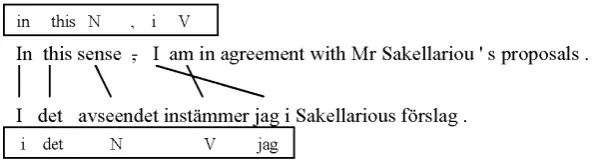
This paper presents a new method for identifying corre-sponding words in parallel texts, a task known as word alignment. The method uses parallel phrases from a set of manually word aligned sentence pairs to find word align-ments in new parallel text. Parallel phrases are defined as pairs of aligned sentence segments of arbitrary length which are consistent with the word alignment1. Figure 1
shows an example of aligned parallel phrases.
Parallel phrases are also the fundamental building blocks of phrase-based statistical machine translation systems (PBSMT). In phrase-based MT the translation model con-sists of phrase translations rather than word translations and phrase-based systems have been shown to clearly outper-form word-based systems (Koehn et al., 2003). The advan-tage of phrase-based MT is that phrases capture the trans-lation of words in context and can accommodate local re-ordering as well as deletions and additions of words. Word alignment should also benefit from using phrase informa-tion as phrases will provide context to the word links.
In this paper, word alignment is performed by match-ing parallel phrases to new sentence pairs and addmatch-ing the word links suggested by matching phrase pairs. Longer matching phrases are preferred over shorter phrases since the context provided by longer phrases makes them more reliable in suggesting correct word links. In addition, we make the phrases more general by replacing some words with part-of-speech (POS) categories. This generalization of phrases increases the number of matching phrases and improves word alignment recall.
We have also compared word alignment based on parallel phrases to state-of-the-art statistical word alignment with Giza++ (Och and Ney, 2003). In the statistical approach to word alignment, word correspondences are estimated di-rectly from parallel text in an unsupervised manner that does not require any manual annotations. As a rule, statis-tical word alignment improves with the amount of parallel text. The method we present here produces alignments with
1Note that the termphraserefers to a number of consecutive
words that do not have to constitute a syntactic phrase. This def-inition of phrase is also used in phrase-based statistical machine translation.
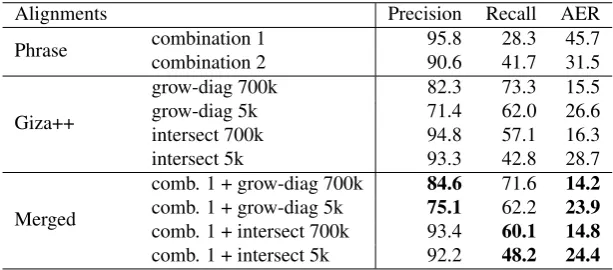
higher precision but lower recall than Giza++. For most ap-plications of word alignment, such as machine translation, recall is just as important as precision. We show that by combining the phrase-based word alignments with Giza++ we achieve a better overall alignment.
Although phrases have been used to improve word align-ment in different ways, they have not previously been used in the way proposed in this paper. Work on linguistically motivated phrases for word alignment includes Lin and Cherry (2003) and Talbot (2005) who identified phrases and phrase boundaries to put linguistic constraints on statistical word alignment.
The alignment algorithm in described in Section 2. Sec-tion 3 presents the result of applying the method to align a Swedish–English parallel corpus, and compares these re-sults to statistical word alignment. Section 4 contains con-clusions and directions for further research.
2.
Word alignment with parallel phrases
Phrase-based word alignment requires a set of manually word aligned sentence pairs from which we can extract par-allel segments, or phrases, of different lengths. The follow-ing experiments are based on a set of 1200 manually word aligned sentence pairs from the English–Swedish part of the Europarl corpus (Koehn, 2005). The sentence pairs were POS-tagged with Swedish and English versions of Con-nexor Machinese Syntax2(Tapanainen and J¨arvinen, 1997)and annotated with word alignments by two bilingual na-tive Swedish speakers. From this data, 1000 sentence pairs were used as the training set and the remaining 200 pairs were kept as a test set for the final evaluation.
2.1. Phrase extraction
A set of parallel phrases was created by extracting all pos-sible phrase pairs with a maximum length of 7 words from the word aligned training data. A parallel phrase consists of a source segment, a target segment and links between words in the segments, as shown in Figure 1. The ex-tracted phrases were consistent with the word alignment so that aligned multi-word units are included as a whole in a phrase. In Figure 1, for example, the wordsthe portare
Figure 2: Matching a parallel phrase to a new sentence pair.
in the union i unionen 0-0 1-1 2-1
P the union PREP unionen 0-0 1-1 2-1
P DET N PREP NN 0-0 1-1 2-1
Figure 3: Example of generalized parallel phrases.
of the precision estimates increase if the phrase is frequent in the training data.
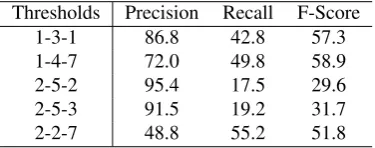
The generalized set of phrases with thresholds P=1, L=3 and G=1 was chosen for this experiment. All phrases in this set were matched to sentences in the training data and link precision and frequency were recorded for each phrase. Table 3 shows the result of word alignment with different sets of parallel phrases created by varying the thresholds for training data precision (TP) and frequency. The best precision on the devtest set (99.6%) was achieved by ap-plying the set of phrases that occurred at least 5 times and produced at least 95% correct links in training data.
Settings TP Frequency Precision Recall
1-3-1 0.95 5 99.6 12.2
1-3-1 0.95 3 99.4 15.1
1-3-1 0.95 2 99.1 18.4
1-3-1 0.90 3 98.5 17.9
1-3-1 0.90 2 98.3 20.8
1-3-1 0.85 2 98.1 23.2
1-3-1 0.80 2 97.5 25.3
1-3-1 0.95 1 97.2 24.9
1-3-1 0.90 1 96.5 27.0
1-3-1 0.85 1 96.3 28.9
1-3-1 0.80 1 95.8 30.6
Table 3: Settings with high precision on training data sorted according to link precision on devtest data.
Alignments Precision Recall
Phrase combination 1 96.8 31.1 Phrase combination 2 87.3 57.2 Original phrases (1-7 words) 70.3 41.3 Original phrases (2-7 words) 92.2 16.8 Generalized phrases (2-2-7) 48.8 55.2
Table 4: Results of phrase combinations on the devtest set. Results for the original phrases and fully generalized phrases are included in the table for comparison.
2.5. Combining reliable phrases
Based on experiments with generalization thresholds and training data precision we were able to identify reliable sub-sets of phrases and rank them according to their alignment precision on the devtest set. When aligning a new sentence pair, the links suggested by each of these sets of phrases were combined into a larger set of links, starting with the links produced by the highest ranked phrases and adding links which connect previously unaligned words from the lower ranked link sets in sequence. This way of combining link sets gave high precision whereas the simple method of taking the union of all link sets gave slightly higher recall.
The settings in Table 3 were combined to get a word alignment with high precision (Combination 1). Another set of ranked settings with higher recall was combined to get a word alignment with a different precision/recall trade-off (Combination 2). The precision and recall for these two combinations on the devtest set are presented in Table 4.
3.
Evaluation
The phrase-based word alignment method was evaluated using the full training set and a test set of 200 sentences. The test set was annotated with word links by two annota-tors. Their annotations were combined into a gold standard where each link was given a confidence label, either sure (S) or possible (P). The confidence labels reflect the fact that word alignment is a difficult task and while some align-ments are very clear others depend on personal judgment or on different alignment strategies. The confidence labels play a role during evaluation so that a missing P link is not punished as severely as a missing S link. Annotators used guidelines similar to Lambert et al. (2005) to distinguish between sure and possible links. Interannotator agreement was calculated as AGR = 2 *I/(A1 + A2) where A1 and A2 is the set of links created by the first and second annotator andIis the intersection of both annotators word links. The agreement was relatively high, with 85.8% labeled agree-ment and 91.3% unlabeled agreeagree-ment. The final alignagree-ment contained 73% S links and 27% P links (not counting null links)(Holmqvist, 2008).
. . . (4)through (5)spinelessness (6)or (7)ideology (8), (9)support (10)you . . . . . . (3)st¨oder (4)er (5)av (6)slapphet (7)eller (8)av (9)ideologiska (10)sk¨al . . . Giza++ grow-diag 4-6 5-3* 5-4* 5-5* 5-6 6-7 7-6* 7-8* 7-9 7-10 Phrase-based 4-5 5-6 6-7 9-3
Merged 4-5 5-6 6-7 7-6* 7-8* 7-9 7-10 9-3 Reference 4-5 5-6 6-7 7-9 7-10 9-3 10-4
Figure 4: Example of merging phrase-based word alignments with Giza grow-diag alignments. Incorrect links are marked with *.
phrase DET A economy - DET A ekonominin a sentence pair seems more reliable than matching the function word inthe A N - det A N.
We showed that a combination of phrase-based and sta-tistical alignment outperformed both approaches. The way we combined the two alignments were rather simplistic and it seems likely that more advanced methods for combi-nation could produce improved results. For example, the phrase-based alignments could be added to the statistical alignments already during the symmetrization process.
It also remains to be investigated whether phrase-based alignment will improve machine translation or other appli-cations of word alignment.
5.
References
Maria Holmqvist. 2008. Word alignment by re-using par-allel phrases. Licentiate thesis. Department of computer and information science, Link¨opings Universitet. Philipp Koehn, Franz Josef Och, and Daniel Marcu. 2003.
Statistical phrase-based translation. In Proceedings of the 2003 Conference of the North American Chapter of the Association for Computational Linguistics on Human Language Technology (NAACL 2003), pages 48–54, Ed-monton, Alberta, Canada.
Philipp Koehn. 2005. Europarl: A parallel corpus for sta-tistical machine translation. InProceedings of the tenth Machine Translation Summit (MT Summit X), Phuket, Thailand.
Patrik Lambert, Adri`a de Gispert, Rafael Banchs, and Jos´e B. Mari˜no. 2005. Guidelines for word alignment evaluation and manual alignment. Language Resources and Evaluation, 39:267–285.
Dekang Lin and Colin Cherry. 2003. Word alignment with cohesion constraint. In Proceedings of the 2003 Con-ference of the North American Chapter of the Associa-tion for ComputaAssocia-tional Linguistics on Human Language Technology (NAACL 2003), pages 49–51, Edmonton, Al-berta, Canada.
Franz Josef Och and Hermann Ney. 2003. A system-atic comparison of various statistical alignment models. Computational Linguistics, 29(1):19–51.
David Talbot. 2005. Constrained EM for parallel text alignment. Natural Language Engineering, 11(3):263– 277.