
A Snack Implementation and Tcl/Tk Interface to the
Fundamental Frequency Variation Spectrum Algorithm
Kornel Laskowski
1, Jens Edlund
21Language Technologies Institute, Carnegie Mellon University, Pittsburgh PA, USA 2KTH Speech, Music and Hearing, Stockholm, Sweden
[email protected],[email protected]
Abstract
Intonation is an important aspect of vocal production, used for a variety of communicative needs. Its modeling is therefore crucial in many speech understanding systems, particularly those requiring inference of speaker intent in real-time. However, the estimation of pitch, traditionally the first step in intonation modeling, is computationally inconvenient in such scenarios. This is because it is often, and most optimally, achieved only after speech segmentation and recognition. A consequence is that earlier speech processing components, in today’s state-of-the-art systems, lack intonation awareness by fiat; it is not known to what extent this circumscribes their performance. In the current work, we present a freely available implementation of an alternative to pitch estimation, namely the computation of the fundamental frequency variation (FFV) spectrum, which can be easily employed at any level within a speech processing system. It is our hope that the implementation we describe aid in the understanding of this novel acoustic feature space, and that it facilitate its inclusion, as desired, in the front-end routines of speech recognition, dialog act recognition, and speaker recognition systems.
1.
Introduction
Intonation is an important aspect of vocal production, used for a variety of communicative needs. Its estimation and modeling is therefore crucial to speech classification and understanding systems. This is particularly true of those systems operating in real-time, in which inference of speaker intent should be achieved with low latency. At the present time, the overwhelming majority of such systems reconstruct intonation contours from frame-level estimates of pitch (F0), computed by a pitch-tracking component; these estimates are then normalized to eliminate absolute, speaker-dependent values.
Due to its sensitivity to noise and voicing occlusions, pitch is computed and modeled only after speech is segmented and, often, also recognized. The resulting system flow makes intonation contours unavailable to early processing components, where they are likely to be at least as useful as in downstream processing. It is therefore of some im-port that an instantaneous, frame-level characterization of intonation in speech, available as early as speech detection itself, be developed. Although pitch is visually appealing, the long-observation-time requirements for accurate pitch estimation do not recommend it as a basis for frame-level modeling.
The fundamental frequency variation (FFV) spectrum, de-signed to address these concerns (Laskowski et al., 2008a), offers a computationally tractable alternative to character-izing intonation which obviates the need to first estimate absolute pitch, and then to normalize it out its average. It is based on a simple observation, namely that the rate of change in F0, across two temporally adjacent frames of speech produced by the same speaker, can be inferred by finding the dilation factor required to optimally align the harmonic spacing in their magnitude frequency spectra. This can be achieved without knowledge of the frequency scale (provided it is the same in both frames). Unfortu-nately, FFV processing entails a significant deviation from traditional, pitch-centered conceptualizations of intonation,
presenting a steep learning curve for researchers who may wish to use it in their work.
This paper addresses the latter problem by presenting our current implementation of the FFV algorithm (briefly de-scribed in Section 3.) within a free, publicly available and commonly used speech processing toolkit. The implemen-tation exposes, via a Tcl/Tk interface, the critical parame-ters driving the FFV spectrum computation. We describe these parameters, some of their effects, and their defaults in Section 4.; Section 5. discusses several possibilities for modeling the spectrum. In Section 6., we present a graph-ical comparison between the spectrum and the output of a popular pitch tracker (Talkin, 1995), for singing voice. Before concluding, we enumerate in Section 7. several ap-plications in which FFV processing has been shown to be useful. We expect that this evidence, collectively, may fa-cilitate the inclusion of FFV feature computation in general speech analysis software, such as WaveSurfer (Sj¨olander and Beskow, 2000) and Praat (van Heuven, 2001), as well as in the front-ends of dedicated speech understanding sys-tems.
2.
The Snack Sound Toolkit
in-terface and visualizations for the functionality in Snack; it also can be extended with new custom plug-ins, and be em-bedded in other applications.
3.
The FFV Spectrum
The fundamental frequency variation spectrum is a recently introduced representation (Laskowski et al., 2008a) which captures instantaneous, per-frame variation in fundamen-tal frequency. The algorithm relies on the comparison of the frequency magnitude spectraFLandFRof the left and
right halves of an analysis frame, respectively. The compar-ison is implemented as a dot product following frequency dilation by a factorρof one ofFL orFR. The dot
prod-uct, expressed asg(ρ), yields a continuous spectrum when computed over a range ofρ; an example is shown in Fig-ure 1.
−2 −1 0 +1 +2
0 0.5 1
Figure 1: The FFV spectrum for a randomly chosen voiced speech frame; the magnitude ofg(ρ), shown along they -axis, is a function of the dilation factorρshown along thex -axis in octaves per 0.008 s (the temporal separation between the maxima of the two window functions used in computing FLandFR).
FFV processing offers several advantages over other repre-sentations of variation in fundamental frequency; most no-tably, it is a local estimate, independent of the absolute fun-damental frequency, and it does not require dynamic pro-gramming as employed in most pitch tracking applications. This makes the representation directly amenable to hidden Markov modeling (HMMing). Examples of successful us-age in this way (cf. Section 7.) include speaker change pre-diction in dialogue systems, speaker recognition, and dialog act classification in meeting data.
4.
The Snack FFV Interface
4.1. Synopsis
Given the path name$fileof a file containing a snippet of audio, the following Tcl code frames and prints out the FFV spectrum for each frame:
snack::sound s s read $file
foreach line [s ffv
-tFra tf ra -tSep tsep
-tInt tint -tExt text
-winShapeInt <string-literal> -winShapeExt <string-literal> -Ng Ng -tSepRef trefsep
-filterbank <string-literal> ] {
puts $line }
The positive real-valued parameterstFra,tSep,tInt, tExt, tSepRef, the positive integer-valued parameter Ng, and the string-valued parameters winShapeInt, winShapeExt, and filterbank in the above com-mand are described individually in the following subsec-tions.
4.2. Framing Parameters
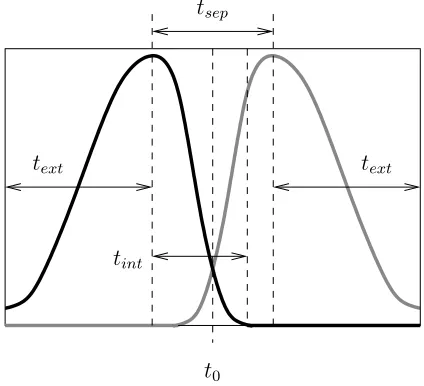
As mentioned in Section 3., the FFV algorithm relies on an estimate of the frequency magnitude spectra of the left and right halves of each analysis frame. These spectra are com-puted using two asymmetrical analysis windows, placed symmetrically about the frame’s center, as shown in Fig-ure 2. Parameters governing window shape can be modi-fied from their default values using arguments to the Snack ffvfunction:
t
0t
intt
extt
extt
sepFigure 2: Relative placement of the left and right window functions, hL andhR, in a single analysis frame of
dura-tion 2text+tsep centered on instantt0. The parameters
tint,text, andtsep, all in seconds, are as described in the
text. Successive frames are placed such that their respec-tive instantst0aretf raseconds apart, not shown.
-tFra The frame step between successive analysis frames, in seconds; the default value is 0.008.
0 1 2 3 4 200
250 300 350 400 450 500 550
0 1 2 3 4
−1 −0.5 0 0.5 1
(a) (b)
0 1 2 3 4
−1 −0.5 0 0.5 1
(c)
Figure 3: Glissando. Clockwise from the upper left: (a)p[t], the output of a pitch tracker, in absolute frequency along the y-axis, as a function of time in seconds along thex-axis. (b)p˙[t], computed fromp[t]using Equation 10, in octaves per second along they-axis, as a function of time in seconds along thex-axis. (c) Bird’s eye view of consecutive FFV spectra gt(ρ), with timetin seconds along thex-axis, and rate ofF0variation in octaves per second along they-axis; darker shades of gray indicate larger magnitudes ofgt(ρ).
The modulation spectrum in Figure 5(d) indicates that rates ofF0change in the range(+0.5,+1.0)octaves per second appear at a frequency of just over 1 Hz, as observed also in Figure 4(d). However, in addition, there is a dark patch at ρvalues of approximately±0.5octaves per second, which appears at the much higher modulation frequency of 3.5 Hz. This up and down change, symmetric aboutρ= 0and dis-tinct from the mostly positive rates of change at approxi-mately 1 Hz, is due to vibrato.
7.
Applications in Automatic Speech
Processing
FFV processing has been applied to a number of tasks in speech understanding, and in a limited few cases a com-parison has been made with information available from a standard pitch trajectory. It is important to note, how-ever, that the computational flexibility afforded by adopt-ing FFV features cannot be duplicated when usadopt-ing their
pitch-trajectory-derived counterparts. This section enumer-ates several applications in which FFV processing has been shown to be beneficial and/or enabling in that regard.
7.1. Text-Independent Speaker Change Prediction
Speaker change prediction is the task of deciding whether a currently vocalizing speaker is signaling the intent to con-tinue, following an incipient pause. It is an important func-tionality in dialogue systems which aim to exhibit human-like response times, avoiding long hold-over waits before initiating a turn (Edlund and Heldner, 2005). From a sys-tem design perspective, real-time speaker change prediction would ideally be incorporated into speech activity detec-tion; this calls for frame-level acoustic features characteriz-ing instantaneous intonation sub-phrases.
Graph-0 1 2 3 4 5 6 250
300 350 400 450 500 550 600
0 1 2 3 4 5 6
−1 −0.5 0 0.5 1
(a) (b)
5 10 15 20
−1 −0.5 0 0.5 1
0 1 2 3 4 5 6
−1 −0.5 0 0.5 1
(d) (c)
Figure 4: A scale. Clockwise from the upper left: (a)p[t], the output of a pitch tracker; (b)p˙[t], change in pitch computed fromp[t]; (c) consecutive FFV spectragt(ρ); axes as in Figure 3. (d) Modulation spectrum ofgt(ρ)for specific values of
ratesρofF0variation, shown along they-axis as for panel (c); modulation frequency shown alongx-axis in Hertz; darker shades of gray indicate larger magnitudes.
ical depiction of what HMMs learn for this task, namely that speakers employ predominantly flat intonation con-tours to signal a desire to continue speaking, was shown in (Laskowski et al., 2008b). In (Heldner et al., 2008), it was additionally shown that intonation contours prior to speaker change differ as a function of speaker role; instruc-tion givers employ more falls than rises, while followers use the opposite strategy. Finally, (Laskowski et al., 2008c) considered several refinements to the FFV representation for the speaker change prediction task.
7.2. Text-Independent Dialogue Act Recognition
The FFV representation has also been applied in multi-party conversational settings (Laskowski et al., 2009a), ini-tially to detect floor mechanism dialog acts in the ICSI Meeting Corpus (Janin et al., 2003). We reported that floor holders and holds, signaling floor reservation (and there-fore quite similar to the phenomena in Section 7.1.), can be separated from all other dialog act types with a
dis-crimination of 70.6 to 72.2%. FFV model analysis re-vealed that talkspurts implementing these dialog acts are initiated with flat intonation contours, and terminated with slower speech. Several modifications, and augmentation with other prosodic features, are presented in (Laskowski et al., 2009b).
0 2 4 6 8 200
250 300 350 400 450 500 550 600
0 2 4 6 8
−1 −0.5 0 0.5 1
(a) (b)
5 10 15 20
−1 −0.5 0 0.5 1
0 2 4 6 8
−1 −0.5 0 0.5 1
(d) (c)
Figure 5: A scale with vibrato. Clockwise from the upper left: (a)p[t], the output of a pitch tracker; (b)p˙[t], change in pitch computed fromp[t]; (c) consecutive FFV spectragt(ρ); (d) modulation spectrum ofgt(ρ); axes as in Figure 4.
7.3. Pitch Detection
An approach which appears conceptually identical to FFV processing and which may be computationally quite similar was proposed for the purposes of improving pitch estima-tion in (Martin, 2008). Harmonic similarity between adja-cent spectra was shown to benefit pitch tracking in several examples of utterances with low signal-to-noise ratios.
7.4. Text-Independent Speaker Recognition
Finally, the FFV representation has also been shown to aid in the task of speaker recognition, in both nearfield (Laskowski and Jin, 2009) and farfield (Jin et al., 2010) scenarios. The temporal locality of the FFV features makes possible the construction of single-state Gaussian mixture model systems, such as those used with standard Mel-frequency cepstral coefficient systems. Because these sys-tems do not model trajectories, the observed improvements in baseline speaker recognition system performance sug-gest that speakers differ in their preferences of rate ofF0 change, in addition to differences in absolute F0 (which FFV features, and therefore the systems in (Laskowski and
Jin, 2009; Jin et al., 2010), do not model).
8.
Conclusions
We have implemented and presented an interface to the computation of a novel representation of macro- and micro-intonation, the fundamental frequency variation (FFV) spectrum, within the popular and publicly available Snack Sound Toolkit. The interface exposes the majority of parameters governing FFV behavior, and our description makes it possible for speech researchers, practitioners and voice pathologists to explore its potential use in their work without needing to understand and to re-implement the sig-nal processing intersig-nals.
making FFV suitable for deployment in HMM decoding scenarios, such as speech recognition for tonal languages.
9.
Acknowledgments
We would like to thank Marietta Fischesser and Florian Metze for contributing their voices and recording expertise, as well as Timo Baumann who implemented the first stage of the FFV port to Snack.
10.
References
J. Edlund and M. Heldner. 2005. Exploring prosody in in-teraction control. Phonetica, 62:215–226.
M. Heldner, J. Edlund, K. Laskowski, and A. Pelc´e. 2008. Prosodic features in the vicinity of silences and overlaps. In Proc. Nordic Prosody, pages 95–105, Helsinki, Fin-land.
P. Helgason. 2006. SMTC — A Swedish Map Task Cor-pus. In Proc. Fonetik, pages 57–60, Lund, Sweden. A. Janin, D. Baron, J. Edwards, D. Ellis, D. Gelbard,
N. Morgan, B. Peskin, T. Pfau, E. Shriberg, A. Stol-cke, and C. Wooters. 2003. The ICSI Meeting Corpus. In Proc. ICASSP, pages 364–367, Hong Kong, China. IEEE.
Q. Jin, R. Li, Q. Yang, K. Laskowski, and T. Schultz. 2010. Speaker identification with distant microphone speech. In Proc. ICASSP, pages 4518–4521, Dallas TX, USA. IEEE.
K. Laskowski and Q. Jin. 2009. Modeling instantaneous intonation for speaker identification using the funda-mental frequency variation spectrum. In Proc. ICASSP, pages 4541–4544, Taipei, Taiwan. IEEE.
K. Laskowski and E. Shriberg. 2010. Comparing the con-tributions of context and prosody in text-independent di-alog act recognition. In Proc. INTERSPEECH, pages 5374–5377, Dallas TX, USA. IEEE.
K. Laskowski, J. Edlund, and M. Heldner. 2008a. An instantaneous vector representation of delta pitch for speaker-change prediction in conversational dialogue systems. In Proc. ICASSP, pages 5041–5044, Las Vegas NV, USA. IEEE.
K. Laskowski, J. Edlund, and M. Heldner. 2008b. Learn-ing prosodic sequences usLearn-ing the fundamental frequency variation spectrum. In Proc. Speech Prosody, pages 151–154, Campinas, Brazil. ISCA.
K. Laskowski, M. W¨olfel, M. Helnder, and J. Edlund. 2008c. Computing the fundamental frequency variation spectrum in conversational spoken dialogue systems. In Proc. Acoustics, pages 3305–3310, Paris, France. ASA. K. Laskowski, M. Heldner, and J. Edlund. 2009a.
Explor-ing the prosody of floor mechanisms in English usExplor-ing the fundamental frequency variation spectrum. In Proc. EU-SIPCO, pages 2539–2543, Glasgow, UK. EURASIP. K. Laskowski, M. Heldner, and J. Edlund. 2009b. A
general-purpose 32 ms prosodic vector for hidden Markov modeling. In Proc. INTERSPEECH, pages 724– 727, Brighton, UK. ISCA.
B. Lindblom and J. Sundberg. 2005. The Human Voice in Speech and Singing. Springer.
P. Martin. 2008. A fundamental frequency estimator by crosscorrelation of adjacent spectra. In Proc. Speech Prosody, pages 147–150, Campinas, Brazil. ISCA. Y. Matsumoto. 2008. Ruby Programming Language
1.8.7. http://www.ruby-lang.org/en/. (last accessed 24 March 2010).
J. Ousterhout. 2008. Tcl Programming Language and Tk Graphical User Interface Toolkit 8.4. http://www.tcl.tk. (last accessed 24 March 2010).
K. Sj¨olander and J. Beskow. 2000. WaveSurfer — An open source speech tool. In Proc. ICSLP, pages 464–467, Bei-jing, China. ISCA.
K. Sj¨olander. 2001. Snack Sound Toolkit 2.2.10. http://www.speech.kth.se/snack/. (last ac-cessed 24 Marchi 2010).
D. Talkin, 1995. Speech Coding and Synthesis (Kleijn & Paliwal, eds.), chapter A Robust Algorithm for Pitch Tracking (RAPT), pages 495–518. Elsevier.
V. van Heuven. 2001. Praat, A system for doing phonetics by computer. Glot International, 5(9–10):341–345. G. van Rossum. 2008. Python Programming Language
![Figure 3: Glissando. Clockwise from the upper left: (a) pof gray indicate larger magnitudes ofsecond along theyg [t], the output of a pitch tracker, in absolute frequency along the-axis, as a function of time in seconds along the x-axis](https://thumb-us.123doks.com/thumbv2/123dok_us/1067864.1133869/5.595.116.522.69.477/glissando-clockwise-indicate-magnitudes-ofsecond-absolute-frequency-function.webp)
![Figure 4: A scale. Clockwise from the upper left: (a) p [t], the output of a pitch tracker; (b) ˙p [t], change in pitch computedfrom p [t]; (c) consecutive FFV spectra gt (ρ); axes as in Figure 3](https://thumb-us.123doks.com/thumbv2/123dok_us/1067864.1133869/6.595.67.529.73.475/figure-clockwise-tracker-change-computedfrom-consecutive-spectra-figure.webp)
![Figure 5: A scale with vibrato. Clockwise from the upper left: (a) p [t], the output of a pitch tracker; (b) ˙p [t], change inpitch computed from p [t]; (c) consecutive FFV spectra gt (ρ); (d) modulation spectrum of gt (ρ); axes as in Figure 4.](https://thumb-us.123doks.com/thumbv2/123dok_us/1067864.1133869/7.595.63.531.75.474/clockwise-tracker-computed-consecutive-spectra-modulation-spectrum-figure.webp)