Data Collection and IPR in Multilingual Parallel Corpora
Dutch Parallel Corpus
Orphée De Clercq
1,2and Maribel Montero Perez
3 LT3, Language and Translation Technology Team, University College Ghent1Groot-Brittanniëlaan 45, 9000 Gent Belgium [email protected]
Dept. of Applied Mathematics and Computer Science, Ghent University2 Krijgslaan 281 (S9), 9000 Gent Belgium
K.U. Leuven - Campus Kortrijk3 Etienne Sabbelaan 53, 8500 Kortrijk Belgium
Abstract
After three years of work the Dutch Parallel Corpus (DPC) project has reached an end. The finalized corpus is a ten-million-word high-quality sentence-aligned bidirectional parallel corpus of Dutch, English and French, with Dutch as central language. In this paper we present the corpus and try to formulate some basic data collection principles, based on the work that was carried out for the project. Building a corpus is a difficult and time-consuming task, especially when every text sample included has to be cleared from copyrights. The DPC is balanced according to five text types (literature, journalistic texts, instructive texts, administrative texts and texts treating external communication) and four translation directions (Dutch-English, English-Dutch, Dutch-French and French-Dutch). All the text material was cleared from copyrights. The data collection process necessitated the involvement of different text providers, which resulted in drawing up four different licence agreements. Problems such as an unknown source language, copyright issues and changes to the corpus design are discussed in close detail and illustrated with examples so as to be of help to future corpus compilers.
1.
Introduction
The creation of a corpus consists of two crucial steps: besides the effort put in data processing, a considerable amount of time has to be devoted to acquiring text material and clearing copyrights. Although data collection is the crucial starting point in every project of corpus compiling, there is currently no universal approach of dealing with this task (Xiao, 2010:152).
This paper is an attempt to formulate some basic data collection principles, based on the experience gained during the creation of the Dutch Parallel Corpus (DPC). Many textbooks have already been published on corpus linguistics as a discipline. Kennedy (1998), Wynne (2005) and McEnery et al. (2006), to name only a few, all devote one or more chapters to corpus compilation and design principles. Issues of data collection and more specifically copyright clearance, however, are only touched on very briefly.
When examining existing parallel corpora, we notice that some are freely available but lack text type balance such as Europarl (Koehn, 2005), and that others include several text types but are not freely accessible to the research community due to copyright restrictions, e.g. the English-Norwegian corpus (Johansson, 1999/2002). New corpus compiling methods, such as the web as corpus initiative WacKy, do not deal with copyrights at all to the best of our knowledge, instead the project websites are usually provided with a notice that anyone offended can file a request for removing specific documents from the corpora (Baroni et al, 2009).
The Dutch Parallel Corpus does exhibit text type balance and is available for the entire research community. These two objectives were actually the prerequisites of the data
collection process, which consisted of two crucial steps:
Finding potential providers of high-quality text material, i.e. published and/or revised by professional translation services, which fits in the corpus design, and convincing them to participate in the project;
Obtaining copyright clearance for all texts included in the corpus for both commercial and non-commercial purposes.
Since these two challenges can be transferred to any other corpus project, we attempt to formulate in this paper some general principles about data acquisition and permission clearance that might be re-used in other projects involving data acquisition.
The remainder of this paper is structured as follows: Section 2 presents the Dutch Parallel Corpus project and describes its balanced design. Section 3 gives an overview of the entire data collection process, copyright clearance and focuses on problems that arise during Intellectual Property Rights (IPR) negotiations. Section 4 concludes the paper.
2.
Dutch Parallel Corpus
Language Technology Agency (HLT-agency) 1 is responsible for the distribution of the DPC.
The finalized Dutch Parallel Corpus is an annotated ten-million-words parallel corpus of Dutch, English and French. All the text material included in DPC has been standardized, sentence aligned, tokenized and annotated with linguistic information (lemmata and part-of-speech tags).
2.1 Balanced Design
The corpus is balanced in two ways. It contains an equal amount of text material in all four translation directions, with a minimum of 2,000,000 words per translation direction. A small part of the corpus is trilingual. This is represented in Figure 1.
Figure 1: Translation directions
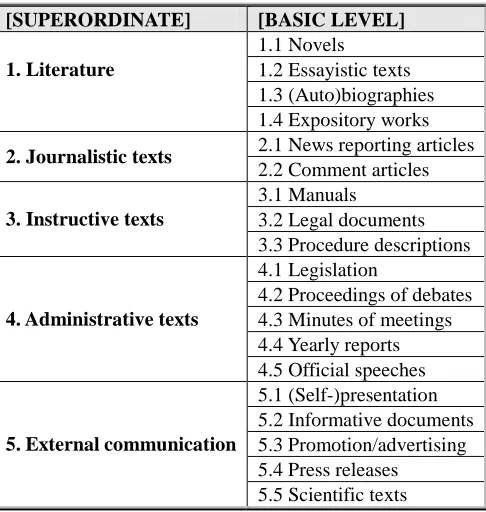
Secondly, the corpus offers a great variety of text material coming from different domains divided into five major text types.
[SUPERORDINATE] [BASIC LEVEL]
1.1 Novels 1.2 Essayistic texts 1.3 (Auto)biographies
1. Literature
1.4 Expository works 2.1 News reporting articles
2. Journalistic texts
2.2 Comment articles 3.1 Manuals
3.2 Legal documents
3. Instructive texts
3.3 Procedure descriptions 4.1 Legislation
4.2 Proceedings of debates 4.3 Minutes of meetings 4.4 Yearly reports
4. Administrative texts
4.5 Official speeches 5.1 (Self-)presentation 5.2 Informative documents 5.3 Promotion/advertising 5.4 Press releases
5. External communication
5.5 Scientific texts
Table 1: DPC’s two-level typology
1 The Dutch-Flemish agency for management,
maintenance and distribution of Dutch digital language resources. Seehttp://www.tst.inl.nl
The typology and structure of the initial design were based on the prototype approach by David Lee. In order to prevent having overbroad categories containing heterogeneous material, Lee (2001) advocates using a prototype approach based on the basic-level category and thus creating a multi-level typology. This means introducing subcategories and adding this information to the metadata which allows the user to fine-tune his/her search. This approach led the DPC team to opt for a two-level typology as presented in Table 1.
All this information is stored in the metadata, where it is further complemented with text and translation-related details such as the intended audience, type of text provider, translation direction and so forth. For a more detailed description of the corpus design, the project goals, applications and functionality we refer to (Macken et al.,2007 and Rura et al.,2008).
2.2 Final Corpus
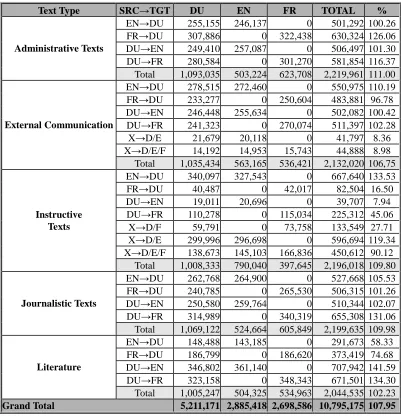
The corpus as it was eventually composed is presented in Table 2. The word counts are based on cleaned data (i.e. text of which all figures, tables and graphs are removed). As can be deducted from this table the finalized corpus contains five text types represented with around 2,000,000 words each: administrative texts, texts used for external communication, literature (both fiction and non-fiction), journalistic texts and instructive texts. Within each text type, each translation direction (Dutch-English, English-Dutch, Dutch-French and French-Dutch) is represented by 500,000 words. This brings the total number of words to 10,795,175 words, exceeding our prime objective of ten million words. A closer look at Table 2 reveals that, although a balanced composition was achieved, there is one text type -literature - that is not completely balanced over the translation directions. Some translation directions are underrepresented - such as Dutch-English within the Instructive texts - because of source language problems. These are changes to the original design that can all be attributed to problems with data collection and copyright clearance. All of this is discussed in closer detail in the following sections.
3.
Data Collection and IPR Clearance
One could expect a data collection process to consist of four steps: (i) a researcher finds adequate text material to be included in the corpus, (ii) he/she contacts the legitimate author and asks his/her permission (iii), the author agrees and (iv) both parties sign an agreement. In reality there is considerably more to it, especially in the case of parallel corpus compilation, since more parties are involved (author, translator, publisher, foreign publisher). Negotiations on IPR matters may drag on for months and exceptionally even years.
3.1 Data Collection
Text Type SRC→TGT DU EN FR TOTAL %
EN→DU 255,155 246,137 0 501,292 100.26 FR→DU 307,886 0 322,438 630,324 126.06 DU→EN 249,410 257,087 0 506,497 101.30 DU→FR 280,584 0 301,270 581,854 116.37
Administrative Texts
Total 1,093,035 503,224 623,708 2,219,961 111.00 EN→DU 278,515 272,460 0 550,975 110.19 FR→DU 233,277 0 250,604 483,881 96.78 DU→EN 246,448 255,634 0 502,082 100.42 DU→FR 241,323 0 270,074 511,397 102.28
X→D/E 21,679 20,118 0 41,797 8.36
X→D/E/F 14,192 14,953 15,743 44,888 8.98
External Communication
Total 1,035,434 563,165 536,421 2,132,020 106,75 EN→DU 340,097 327,543 0 667,640 133.53
FR→DU 40,487 0 42,017 82,504 16.50
DU→EN 19,011 20,696 0 39,707 7.94
DU→FR 110,278 0 115,034 225,312 45.06
X→D/F 59,791 0 73,758 133,549 27.71
X→D/E 299,996 296,698 0 596,694 119.34 X→D/E/F 138,673 145,103 166,836 450,612 90.12
Instructive Texts
Total 1,008,333 790,040 397,645 2,196,018 109.80 EN→DU 262,768 264,900 0 527,668 105.53 FR→DU 240,785 0 265,530 506,315 101.26 DU→EN 250,580 259,764 0 510,344 102.07 DU→FR 314,989 0 340,319 655,308 131.06
Journalistic Texts
Total 1,069,122 524,664 605,849 2,199,635 109.98 EN→DU 148,488 143,185 0 291,673 58.33 FR→DU 186,799 0 186,620 373,419 74.68 DU→EN 346,802 361,140 0 707,942 141.59 DU→FR 323,158 0 348,343 671,501 134.30
Literature
Total 1,005,247 504,325 534,963 2,044,535 102.23
Grand Total 5,211,171 2,885,418 2,698,586 10,795,175 107.95
Table 2: Number of words included in DPC according to text type and translation direction
both commercial and non-commercial purposes, data collection started in the first project term and continued throughout the whole project period.
The first step in the acquisition process consists in deciding where to find adequate text material and whom to contact. Since obtaining high quality translations was important we first contacted translation divisions and professional translators. Another objective we formulated was to collect at least three different text providers per text type . Following the design we could make a division between two main data sources, institutionsfor finding the first three text types: administrative texts, texts treating external communication and instructive texts, and commercial publishers for finding journalistic texts and (fictional as well as non-fictional) literature.
The same division is relevant when describing the difficulties encountered during data collection. While institutions produce texts to inform and help their customers, commercial publishers publish text material as a core business. Institutions were thus more easily persuaded to hand over text material than commercial publishers, who are on the alert for undesired competition.
A different approach was thus necessary to be able to persuade both parties to participate.
3.1.1. Institutions
In a bilingual country like Belgium, many official texts need to be available in both Dutch and French. As most multinationals also have a local branch in Flanders or the Netherlands, a lot of English text material gets translated into Dutch. Due to this high level of multilingualism, we were able to collect sufficient translated text material for the first three text types with Dutch both as a source and target language.
after signing a user agreement.
After signing this agreement the corpus will be accessible either as a full text resource in XML-encoded format or by means of a password protected web interface that was specially developed for the Dutch Parallel Corpus by the Leuven Language Institute4of the K.U. Leuven.
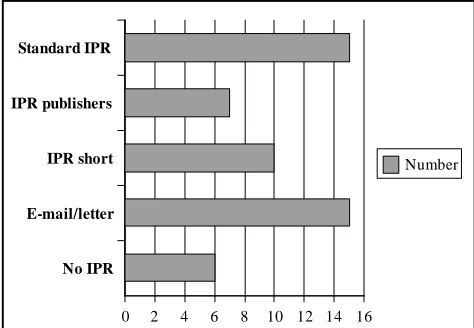
Graph 1 presents the number of signed contracts for text material falling under one or other sort of agreement or under no agreement at all.
Graph 1: Quantitative proportions of agreement status
The short IPR agreement and the one for publishers were adopted in other corpus projects of the STEVIN programme, such as SoNaR. SoNaR aims at collecting a 500-million-word Dutch reference corpus, completely cleared from copyrights. For more information on this project we refer to (Oostdijk et al., 2008) and (Reynaert et al., 2010).
3.3 General Principles
There is no such thing as a universal recipe for the acquisition of text material and for obtaining permission clearance. As stated above, many textbooks exist that deal with corpus compilation and design, but when it comes to data collection and copyright clearance much is left to the inspiration of the individual corpus builders.
We did find some guidelines (Kilgariff, 2002), but these only confirm that copyright law is still in its infancy when it comes to corpus building and that there is very little which is obviously legal or illegal. A widely accepted word of advice is that, whenever in doubt, seek permission (Xiao, 2010:153).
We believe that, thanks to the experience gained during the DPC project, some more practical guidelines for the optimisation of data collection and some useful advice can be formulated, this is done in Table 3.
This is not an exhaustive list and during corpus compilation many different situations arise, but we hope that this paper will help colleagues with some issues and difficulties they experience when building corpora and clearing text samples from copyrights.
4http://ilt.kuleuven.be/english/
Practical Guidelines
Start data collection from day one, some negotiations might take years;
Give sufficient information about the project and try to find examples that illustrate the need for data; Stress the importance of available data for all kinds of
purposes;
Use a different approach on IPR agreement for publishers and for institutions;
Contact multinationals, they often have a local branch and thus translate text into foreign languages; If possible, try to win high-level influential partners to
facilitate negotiations.
Be sure there is a budget for cases in which licences have to be paid for.
Advice
Be patient, repeating the same thing over and over again might be frustrating but is necessary;
Use the argument that the final product may also be useful for the text provider;
Anticipate possible questions ranging from What is a corpus? to How much money is my diary worth?; Remain polite, you are asking a favour for which (in most
cases) no compensation is given.
Table 3: Practical guidelines and advice for data collection
4.
Conclusion
Collecting text material and clearing copyrights is a difficult and time-consuming step in every corpus project for which there are no universal or clear-cut rules. Thanks to the experience that was gained during the DPC project, we were able to solve most copyright problems we were confronted with, and managed to collect a ten-million word parallel corpus Dutch-English-French that is available for research and commercial purposes.
Although changes and concessions had to be made in the design because of data collection problems, in the end we did manage to create a balanced corpus. Successful negotiation of copyright issues depends largely on using different agreements for different text providers.
It is our hope that the experience and the principles described above may be useful for future corpus projects.
5.
Acknowledgements
The DPC project was carried out within the STEVIN programme, which is funded by the Dutch and Flemish governments, under grant number STE-05-26. Its main collaborators were Piet Desmet (coordinator), Hans Paulussen, Maribel Montero Perez (K.U.Leuven Campus Kortrijk), Willy Vandeweghe (co-coordinator), Lieve Macken and Orphée De Clercq (School of Translation Studies, University College Ghent).
6.
References
P. Baker, A. Hardie, and T. McEnery. 2006.A Glossary of No IPR
E-mail/letter IPR short IPR publishers Standard IPR
0 2 4 6 8 10 12 14 16
Corpus Linguistics. Edinburgh University Press, Edinburgh.
M. Baroni, S. Bernardini, and E. Zanchetta. 2009. The WaCky Wide Web: A Collection of Very Large Linguistically Processed Web-Crawled Corpora. Language Resources and Evaluation, 43(3): 209-226. A. Geyken. 2007. The DWDS corpus: A reference corpus
for the German language of the 20th century. In C. Felbaum, editor, Idioms and Collocations: Corpus-based Linguistic and Lexicographic Studies, pages 23-40. Continuum International Publishing Group, London.
S. Johansson, J. Ebeling, and S. Oksefjell. 1999/2002. English-Norwegian Parallel Corpus: Manual. URL: http://www.hf.uio.no/iba/prosjekt/ENPCmanual.html G. Kennedy. 1998.An Introduction to Corpus Linguistics.
Longman, London, New York.
A. Kilgariff. 2002. Legal aspects of corpora compiling in
Corpora List Archive. URL:
http://helmer.hit.uib.no/corpora/2002-3/0253.html. P. Koehn. 2005. Europarl: a parallel corpus for statistical
machine translation. InProceedings of the Tenth Machine Translation Summit, Phuket, Thailand, pages 79-86.
D.Y.W. Lee. 2001. Genres, Registers, Text Types, Domains and Styles: Clarifying the Concepts and Navigating a Path through the BNC Jungle. In Language Learning and Technology,5(3): 37-72. L. Macken, J. Truskina, H. Paulussen, L. Rura, P. Desmet,
and W. Vandeweghe. 2007. Dutch Parallel Corpus: A multilingual annotated corpus. InOn-line Proceedings of Corpus Linguistics, July 2007, Birmingham, United Kingdom.
T. McEnery, R. Xiao, and Y. Tono. 2006.Corpus-Based Language Studies: an advanced resource book. Routledge, Oxon, New York.
J. Odijk, J-P Martens, F. van Eyde, W. Daelemans, D. Kenyon-Jackson, P. Vossen, A. van Hesse, L. Boves, and J. Beeken. 2004. Vlaams-Nederlands meerjarenprogramma voor Nederlandstalige taal- en spraaktechnologie. STEVIN. Spraak- en Taaltechnologische Essentiële Voorzieningen in het Nederlands.The Hague: Nederlandse Taalunie. N. Oostdijk, M. Reynaert, P. Monachesi, G Van Noord, R.
Ordelman, I. Schuurman, and V. Vandeghinste. 2008. From DCoi to SoNaR: a reference corpus for Dutch. In Proceedings of the Sixth International Conference on Language Resources and Evaluation, May, Marrakech, Morocco. European Language Resources Association http://www.lrefconf.org/proceedings/lrec2008.
M. Reynaert, N. Oostdijk, O. De Clercq, H. Van den Heuvel, and F. de Jong. 2010. Balancing SoNaR: IPR versus Processing Issues in a 500-Million-Word Written Dutch Reference Corpus. InProceedings of the Seventh International Conference on Linguistic Resources and Evaluation (LREC-2010), Valletta, Malta.
L. Rura, W. Vandeweghe, and M. Montero Perez. 2008. Designing a parallel corpus as a multifunctional
translator's aid. In Proceedings of XVIII FIT World Congress, August 2008, Shanghai, pages 4-7.
I. Schuurman, W. Goedertier, H. Hoekstra, N. Oostdijk, R. Piepenbrock, and M. Schouppe. 2004. Linguistic annotation of the Spoken Dutch Corpus: If we had to do it all over again… In Proceedings of the Fourth International Conference on Language Resources and Evaluation, Lisbon, Portugal, Volume I pages 57-60. R. Xiao. 2010. Corpus Creation. In N. Indurkhya, F.