International Journal of Scientific Research in Computer Science, Engineering and Information Technology © 2018 IJSRCSEIT | Volume 3 | Issue 4 | ISSN : 2456-3307
Face Recognition Technique for Processing Library
Transactions
Aishwarya Tagade1, Ashlesha Orke1, Dipti Thool1, Priyanka Mandhalkar1, Prof. Amita Meshram2 1BE Scholars, Department of Computer Technology, Rajiv Gandhi College of Engineering and Research,
Nagpur, Maharashtra, India
2Assistant Professor, Department of Computer Technology, Rajiv Gandhi College of Engineering and Research,
Nagpur, Maharashtra, India
ABSTRACT
Biometrics is a term used to characterize a person's DNA, hand geometry, face, and so on or behavioral qualities, for example, hand signature, voice tone, keystrokes et cetera. Consequently, these natural attributes are novel for each person. As a rule, face recognition related advancements are ending up more prominent among biometric-based innovations that measure a person's common information. Hereditary biometrics has for the most part used to verify and recognize people by examining their physical attributes, for example, unique finger impression, eye iris, vein and so forth. The reason for this work is to show a Windows based continuous application framework utilizing face recognition calculations for performing Library Transaction. Rather than utilizing a Library card, a camera would catch pictures of faces of understudy, playing out the library transaction and contrast them and the photographs of the understudy in the database of Library to confirm the understudy's personality. Nearby Binary Patterns, face calculations will used to lessen the effect of light presentation that will influence the exactness of the framework.
Keywords: Biometrics, Library Transaction, Library card, Face Recognition
I.
INTRODUCTION
Face recognition called biometric frameworks that consequently distinguishes or checks a man's character utilizing his/her facial highlights and looks. It is broadly used to distinguish travel papers and driver's licenses conveying people regardless of whether they don't know that a face recognition framework is independently checking their character [1, 2]. Face recognition programming has numerous application in the cutting edge world, for example, signing in on to a PC utilizing facial confirmation as a secret key, gaming, individuals labeling, security et cetera [3] . The present Face Recognition Systems and applications in the market have insufficiencies that range from dependability issues, lessened recognition correctnesses in certain condition,
muddled element extraction, high setup expenses and execution issues. Be that as it may, the interest for a hearty Face Recognition System (FRS) pertinent crosswise over different mechanical uses, associations and the general population is expanding significantly.
lighting conditions that influence the recognition procedure [4]. Thus, it is just sound to utilize LBP calculation to give prevalent outcomes.
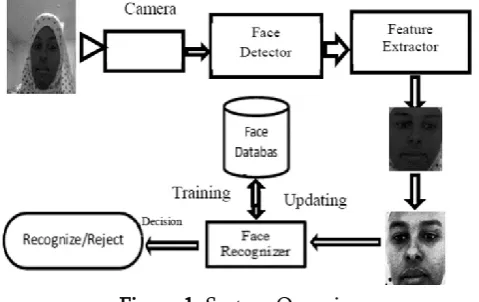
Preparing of Library information is an undertaking which alludes to library frameworks which are for the most part little or medium in estimate. It is utilized to deal with the library utilizing a modernized framework where he/she can record different transactions like issue of books, return of books, expansion of new books, and expansion of new understudies and so on. The ID Cards chiefly do the approvals for client issuing the books comprising of Barcodes. Being the Physical Token it has the likelihood of being lost or abused. We Propose the Integration of Face Recognition system for the Validation of the client playing out the transaction. Figure 1 demonstrates the design for Recognition of facial pictures.
Figure 1. System Overview
Normally ID-cards comprising of Barcodes are utilized to approve the validness of the client/understudy performing transaction from the library. Because of some reason, the ID-Card harmed or it can be lost and even it can be abused. To make it more dependable and effective we propose to actualize the face Recognition technique for approval of the client. Natural qualities are one of a kind for each person. Much of the time, face recognition related advancements are ending up more prevalent among biometric-based advances that measure a person's regular information. The motivation behind this work is to show a Windows based ongoing
application framework utilizing face recognition calculations for performing Library Transaction.
The application exhibited in this investigation catches pictures of individuals' faces utilizing cameras and recoveries the pictures as preparing set into a database. At that point, it utilizes the spared pictures as the preparation set to prepare the framework to perceive a specific individual progressively at whatever point he/she comes before the camera. This new framework has extra focal points that incorporates, simple to setup and introduce high transportability and low start-up costs.
II.
REVIEW OF LITERATURE
There is a quick progression in the zone of recognition and biometric security frameworks throughout the years and the examination improvement development isn't backing off by any stretch of the imagination. In 1964-1965, Bledsoe, alongside Helen Chan and Charles Bisson, influenced a noteworthy achievement when they to utilize PCs to perceive human faces [5]. Presently, there are a few works and undertakings in the field of manmade brainpower or biometrics specifically, for example, the face recognition security framework utilized by the German Federal Police Department in Frankfurt Rhein-Main global airplane terminal [6]. In any case, there are as yet numerous waiting issues that should be settled.
Binary Patterns (LBP) for facial component extraction. The LBP administrator consolidates a locale in the picture and doles out an incentive as a focal pixel. These focal pixels are marked either 0 or 1. On the off chance that the esteem is lower or higher than the esteem doled out to the focal pixel, a histogram of the marks is registered and utilized as a descriptor. The LBP descriptor will be built and gathered in each area and the outcomes are consolidated together to make one vector speaking to the whole face picture. For each given pixel, a paired number is gotten by blending all these parallel esteems in a clockwise way, beginning from the upper left neighbor pixel.
In spite of the way that as of now effectively various of business face recognition frameworks are being used, along these lines of distinguishing proof keeps on being a fascinating point for specialists. This is because of the way that the present frameworks perform well under moderately straightforward and controlled conditions, however perform much more awful when varieties in various variables are available, for example, posture, perspective, outward appearances, time (when the photos are made) and enlightenment (helping changes)[8]. The objective in this exploration region is to limit the impact of these elements and make hearty face recognition framework. A model for face recognition is appeared in Figure 2.
Figure 2. Model of Face Recognition
The procedure of individual ID by utilizing face recognition can be part into three fundamental stages (Figure 2). These are face portrayal, highlight extraction and arrangement [6]. Face portrayal is the
main assignment, that is, the means by which to demonstrate a face. The best approach to speak to a face decides the progressive calculations of recognition and recognizable proof. For the passage level recognition (that is, to decide if the given picture speaks to a face), the picture is changed (scaled and pivoted) till it has the same 'position' as the pictures from the database. In the component extraction stage, the most valuable and exceptional highlights (properties) of the face picture are extricated.
With these acquired highlights, the face picture is contrasted and the pictures from the database. This is done in the characterization stage [7, 9]. The yield of the grouping part is the personality of a face picture from the database with the most elevated coordinating score, along these lines with the littlest contrasts contrasted with the information face picture. Likewise, an edge esteem can be utilized to decide whether the distinctions are sufficiently little. Overall, it may be the case that a specific face is not in the database by any stretch of the imagination.
III.
IMPLEMENTATION
Face Recognition as it is regularly alluded to as, investigations attributes of a man's face picture contribution through a camera. Facial recognition or face recognition as it is regularly alluded to as; examinations qualities of a man's face picture contribution through a camera.
The proposed framework is an independent application that uses a brought together database to perceive human faces. In this application, human faces will be caught by the webcam or camera and the distinguished face is put away into the database. The proposed framework has been set up with the assistance of three fundamental advances:
Recognize and concentrate facial pictures and spares the facial data into database for future references.
Prepare and figuring Eigen Value and Eigen Vector
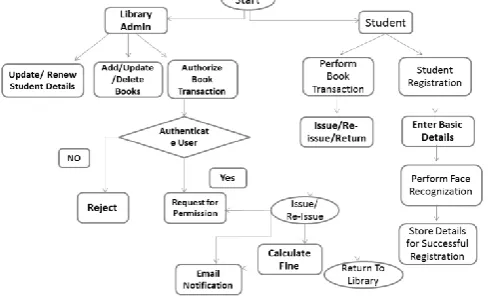
Perceive and match face pictures with existing put away face picture database. Customarily Library frameworks utilizes understudy's ID card for issuing books. The Current strategies are repetitive and tedious. The proposed framework comprises of a Face Recognition utilizing Local Binary Pattern Algorithm. The detail stream of the framework is shown in figure 3.
IV.
LOCAL BINARY PATTERN
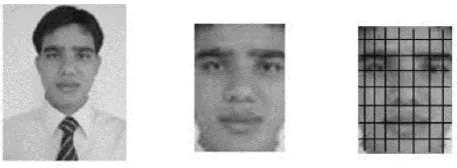
There exist a few techniques for separating the most helpful highlights from (preprocessed) confront pictures to perform confront acknowledgment. One of these element extraction techniques is the Local Binary Pattern (LBP) strategy. Ojala et al. [5] presented this relative new approach in 1996. With LBP, it is conceivable to depict the surface and state of a computerized picture. This is finished by separating a picture into a few little areas from which the highlights are removed (figure 4).
Figure 4. A preprocessed picture separated into 64 areas
These highlights comprise of double examples that depict the surroundings of pixels in the districts. The got highlights from the locales are linked into a solitary component histogram, which shapes a portrayal of the picture. Pictures would then be able to be looked at by estimating the likeness (separate) between their histograms. As indicated by a few investigations [2, 3, and 4] confront acknowledgment utilizing the LBP strategy gives great outcomes, both as far as speed and segregation execution. Because of the way the surface and state of pictures is depicted, the technique is by all accounts very strong against confront pictures with various outward appearances, changed helping conditions, picture pivot and maturing of people.
The Algorithm of the proposed implementation is as follows:
Input: Training Image set.
Output: Feature extracted from face image and
compared with centre pixel and recognition with unknown face image.
1. Initialize temp = 0
2. FOR each image I in the training image set 3. Initialize the pattern histogram, H = 0 4. FOR each center pixel tc belongs to I 5. Compute the pattern label of tc, LBP (1) 6. Increase the corresponding bin by 1. 7. END FOR
8. Find the highest LBP feature for each face image and combined into single vector.
9. Compare with test face image.
V.
CONCLUSION
with the library work. The all in all achievement is a push to see how face Recognition is utilized as a type of biometric to perceive characters of people. It incorporates every one of the phases from particulars extraction from face to details coordinating which produces a match pick up. Different standard strategies are utilized as a part of the moderate phases of preparing. The unwavering quality of any consistent Face Recognition framework emphatically depends on the accuracy got in the minutia extraction process. Various elements are adverse to the right area of minutia. Among them, poor picture quality is the most genuine one. In Future we can ad lib the calculation for numerous face coordinating all the while. Besides the framework can be enhanced and actualized as an android application for making it less demanding to get to.
VI.
REFERENCES
[1]. Prof. Zhao, R. Chellappa, P.J. Phillips, et al., Face recognition: a literature survey,ACM Comput. Surv. 35 (4) (2003) 399–458.
[2]. S.G. Kong, J. Heo, B.R. Abidi, et al., Recent advances in visual and infrared face recognition—a review, Comput. Vis. Image Underst. 97 (1) (2005) 103–135.
[3]. FACIAL RECOGNITION TECHNOLOGY Commercial Uses, Privacy Issues, and Applicable Federal Law.
[4]. T. Ahonen, A. Hadid, and M. Pietikainen, "Face description with local binary patterns: Application to face recognition," IEEE Trans. Pattern Anal. Mach. Intell., vol. 28, pp. 2037-2041, Dec. 2006
[5]. Dr.S.B.Thorat, S.K.Nayak , Miss.Jyoti P Dandale "Facial Recognition Technology: An analysis with scope in India"
[6]. Wang Yuan, Yao Lixiu, Zhou Fuqiang, "A Real Time Fingerprint Recognition System Based On Novel Fingerprint Matching Strategy", ICEMI 2007, The Eighth International Conference on Electronic Measurement and Instruments.
[7]. Sangram Bana and Davinder Kaur,"Fingerprint Recognition using Image Segmentation", (IJAEST) International Journal Of Advanced Engineering Sciences And Technologies Vol No. 5, Issue No. 1, 012 – 023.
[8]. Zhang Jinhai, "Research on Fingerprint image preprocessing and Thinning", IEEE 2011. [9]. Mar Mar Min, Yadana Thein, "Intelligent
Fingerprint Recognition System by Using Geometry Approach", 978-1- 4244-5757 IEEE 2009.
[10]. RAVI. J, K. B. RAJA, VENUGOPAL. K. R,"Fingerprint Recognition Using Minutia Score Matching", International Journal of Engineering Science and Technology Vol.1. [11]. Mary Lourde R, Dushyant Khosala,