© 2018 IJSRCSEIT | Volume 3 | Issue 3 | ISSN : 2456-3307
Smart Irrigation Using IOT
Arif Gori1, Manglesh Singh1, Ojas Thanawala1, Anupam Vishwakarma1, Mohd.Ashfaque Shaikh2
1Student, Department of Computer Engineering, RCOE, Mumbai, Maharashtra, India
2Professor, Department of Computer Engineering, RCOE, Mumbai, Maharashtra, India
ABSTRACT
Adopting smart ways of irrigation has become imperative due to the acute scarcity in the supply of water, which further results in the degradation of the soil quality. This project shows how we implement smart irrigation using IOT. This project achieves complete non-vigilance of humans and automatic irrigation facilities using specific hardware and software implementation. This system can also prove to be helpful in agriculture, parks and lawns. The project’s objective is to automatically detect the moisture levels in soil and sprinkle water accordingly, activate an LDR, when needed, which acts as a form of light needed for photosynthesis. All the information and data statistics would be uploaded on the website regularly.
Keywords: IOT, LDR, Arduino.
I.
INTRODUCTION
Agriculture is considered as the basis of life for us as it is the main source of food and other raw materials. It plays vital role in the growth of country’s economy. The use of technology in agriculture is on the rise, but a large portion of agriculture, especially irrigation remains a manual exercise. It is known that the output of a plant depends on various factors. The availability of optimum quantity of water is highly imperative in this regard. With the advent of open source Arduino boards along with cheap moisture sensors, it is viable to create devices that can monitor the soil moisture content and accordingly irrigating
the fields or the landscape as when needed [1]. The
project makes use of a microcontroller Arduino UNO R3 platform and IOT, which helps farmers to remotely monitor the status of the sprinkler installed on the farm by knowing the sensor values. The project also uses a LDR unit, which acts as a light needed for photosynthesis, thereby making the farmers' work much easier. A website is created which includes real time data analysis of the moisture levels in the soil and the threshold levels
needed for a particular type of soil. It also shows data regarding the activation of the LDR sensor when needed. Farmers can easily monitor the data displayed in the website and function accordingly. In addition to employing technologies in monitoring the agriculture for automating the irrigation system, there is need for some intelligence, which allows machines to apply some intelligence in interpreting agricultural data captured and accordingly analyse data towards predicting the output, rather than
following traditional rule based algorithm [2].
II.
SIGNIFICANCE OF THE SYSTEM
The main focus of this paper is to detect the moisture level of the soil and the light intensity of the surrounding soil.
It includes different Chapters that are used to give a brief knowledge about what the system does.
III.
LITERATURE SURVEY
directly in the land, plants under go high stress from
variation in soil moisture [3]; therefore the appearance
of the plant is reduced. Various researches have been proposed in which the humidity and soil moisture sensors are placed in the root zone of the plant. Based on the sensed values the microcontroller is used to control the supply of water to the field. This system doesn’t intimate the farmer about the field status. This System Supports excess Amount of water in the land and uses Wi-Fi Module to send notifications and website is being used to overcome under irrigation, over irrigation that causes leaching and loss of nutrient content of soil and they have also promised that Microcontroller used can increase System Life and lower the power Consumption. There system is
The soil moisture in each direction of field is sensed
by sensor node and the sensed data is sent to [5] server
through Arduino. On receiving the value the server checks it with required soil moisture value. When soil moisture in a particular field is not up to required level then controller node switch on the motor to irrigate associated field. Also a flowchart is developed with threshold values of LDR and soil moisture is
programmed [6].This system also detects the amount
of light that is required for the growth of crops and if the light is below the threshold then external light can be provided.
However, use of technology in the field of agriculture plays an important role in increasing the
production as well as in reducing the man power [7].
Some of the research attempts are done for betterment of farmers that provide systems which use technologies helpful for increasing the agricultural yield.
IV.
METHODOLOGY
4.1 PROPOSED SYSTEM:
Figure 2. Block Diagram
Arduino:
We have used Arduino as a main controller. Arduino controls all the components such as sensors, Wi-Fi module etc. It is in constant communication with the server via Wi-Fi module. All the analytical data is sent at an interval of 30 seconds to the server.
Soil moisture sensor:
This sensor is used to detect the volumetric water level of the soil. It is inserted into the soil and continuously sends the data to the server through Arduino and Wi-Fi module .If the soil is dry, the reading will be less whereas if the soil is wet then the reading will be more. If there is no sufficient moisture content in the soil, the controller will send an activation command to the DC motor which, in turn, will sprinkle water till the threshold value is crossed.
LDR sensor:
The LDR sensor is used to measure the amount of light present around the crops. Plants require light for photosynthesis. If the room has less amount of light then the reading will show a greater value, whereas if there is enough light, the reading will show a value less than the threshold value.
Wi-Fi Module:
We have used an ESP8266 Wi-Fi module. Wi-Fi module is used to send the data to server. It is connected to arduino. The sensor measures the readings and sends to the Arduino and Arduino in
turn sends this data to the server with the help of the Wi-Fi module.
The overall working of the system is illustrated in the flow chart:
Figure 3.Flowchart of the system
V.
RESULTS
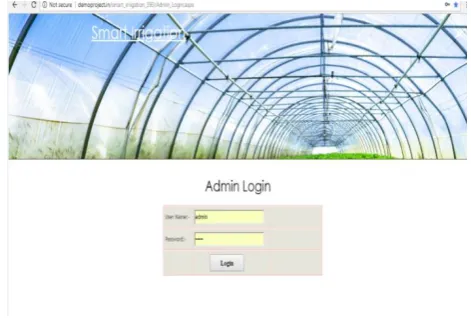
The following is the login page of the website .The user needs to enter a valid username and a password after which the user gets the access to the entire website and can track the progress.
Figure 4. Login
Figure 5. Home Page
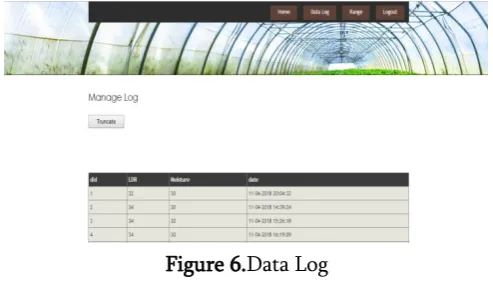
Once the website is started, initialize arduino web server and sensors. Then sensors collect the readings from their surrounding every 30 seconds and send the data to the arduino. The Arduino compares the value of moisture with the threshold value. If the vale is greater than the threshold value then the irrigation system will start sprinkling the water automatically. The DC motor will sprinkle water until the sensor shows a value beyond the threshold value. The LDR sensor reads the readings and sends to the arduino. If the surrounding has, less light then it will send a greater value whereas if surrounding has more light then it will send lesser value to the Arduino and the server. The database stores all these values until the system is shut. The log of the readings is shown in the figure given below:
Figure 6.Data Log
As every plant has a different requirement of moisture and the light in the surrounding. We can set the threshold values according to the need of the plant in our web application. As shown in the screenshot below there are two boxes viz. LDR and moisture where threshold values can be entered.
Figure 7. Set Rages
The result includes the successful operation of automatically irrigating the soil, sending all the values to the server log .This project tries to conserve the water resources by irrigating the appropriate amount of water as required by the plant.
VI.
CONCLUSION AND FUTURE WORK
The smart irrigation system implemented is cost effective for optimizing water resources for agricultural production. The system supply essential water and light through the water sprinkler and LDR sensor depending on the threshold levels thereby making the process simpler to use. Through this project it can be concluded that there can be considerable development in irrigation with those of IOT and automation. Thus this system is a solution to the problems faced in the existing process of irrigation.
In future this Project can be used to conserve water and also it can be used for the following:
Moisture within the root zone can be
maintained at field capacity.
Water distribution is highly uniform.
Labour cost is less than other irrigation
methods.
Fertilization can easily be included with
minimal waste of fertilizers.
Consumption of water as well as electricity is
VII.
ACKNOWLEDGEMENT
We would like to take this opportunity to express our profound gratitude and deep regard to (Prof. Mohd. Ashfaque Shaikh) for his exemplary guidance, valuable feedback and constant encouragement throughout the duration of the project. His valuable suggestions were of immense help throughout our project work. His perceptive criticism kept us working to make this project in a much better way.
Working under him was an extremely
knowledgeable experience for us.
VIII.
REFERENCES
[1].Srishti Rawal "IOT based Smart Irrigation
System", International Journal of Computer Applications (0975 – 8887) Volume 159 – No 8, February 2017.
[2].Yuthika Shekhar, Ekta Dagur, Sourabh Mishra,
Rijo Jackson Tom and Veeramanikandan, Suresh
Sankaranarayanan "Intelligent IoT Based
Automated Irrigation System" presented at International Journal of Applied Engineering Research ISSN 0973-4562 Volume 12, Number 18 (2017) pp. 7306-7320 © Research India Publications.
[3].Apurva Tyagi, Nina Gupta, Dr. J P Navani, Mr.
Raghvendra Tiwari, Mrs. Anamika Gupta "Smart Irrigation System" presented at International Journal for Innovative Research in Science & Technology| Volume 3 | Issue 10 | March 2017.
[4].Ankit Kumar Verma, Bhagavan. K, Vamaraju
Akhil, Amrita Singh "Wireless network based smart irrigation system using IOT", International Journal of Engineering & Technology, 7 (1.1) (2018) 342-345.
[5].Chandan kumar sahu, Pramitee Behera "Low
Cost Smart Irrigation Control System", IEE
SPONSORED 2nd INERNATIONAL
CONFERECE ON ELECTRONICS AND
COMMUNICATION SYSTEM (ICECS 2015).
[6].S.G.Manoj Guru, P.Naveen, R.Vinodh Raja,
V.SrirengaNachiyar "SMART IRRIGATION
SYSTEM USING ARDUINO", International Journal of Electronics and Communication Engineering - (ICRTECITA-2017) - Special Issue - March 2017.
[7].Karan Kansara, Vishal Zaveri, Shreyans Shah,
Sandip Delwadkar, Kaushal Jani "Sensor based Automated Irrigation System with IOT: A
Technical Review", (IJCSIT) International