the translation result, link information between Korean and English words, error candidates in Korean and English sentences. The system also offers information on what the information means exactly and how to handle error candidates effectively by providing examples.
To implement user-friendly interface, the system detects both user’s action and the environment and determines what the user wants in such environment. The information is represented as easy and instinctive as possible. The user can see the effect of correction by pressing the translation button right away.
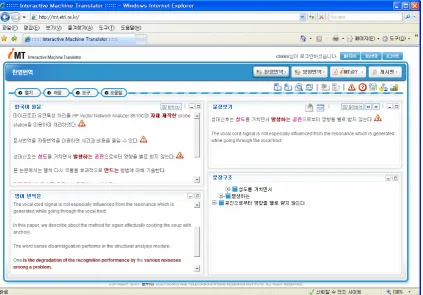
Figure 1 shows the main window of our system. It consists of four sub-windows, that is, Korean window, English window, working window, and sentence structure window. The Korean window on top left shows the Korean sentences to be translated. The English window on bottom left shows the translated English sentences. The modified English sentence by the user is also saved in English window. The working window on top right shows one Korean sentence and the corresponding English sentence which is the user’s current concern. The sentence structure window shows the syntactic structure of the Korean sentence on working window. Basically, one node of the tree is a simple sentence which is linked with the corresponding English translation. Link information on simple sentence level is more easy to grasp the structure and find errors than on word level. Word-level syntactic structure can be seen also if a user clicks the ‘+’ on the tree.
Figure 1: Main Window of Korean-English MT System
3.1 Korean Sentence Modification
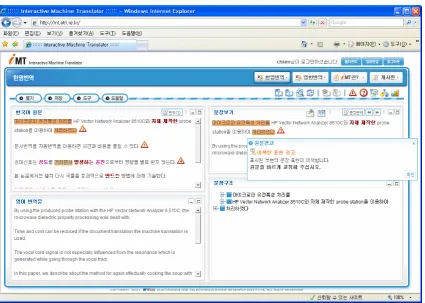
highlighted and at the same time an information box is popped up which describes the error type and how to handle it.
Figure 2: Reporting the Error Candidates of Korean sentences
Rewriting the Korean sentence needs to be done both for translatability and readability. But, sometimes they conflict with each other where we prefer translatability. For example, the appropriate use of auxiliary postpositions in Korean can enhance the readability for human in many cases, but it sometimes causes errors in translation. But, most of the time, improvement in readability leads to improvement in translatability. Ambiguous words or long sentences often make mistakes for human, much more for machine translation. Examples of ambiguous words are as follows.
(a) 기본적인 HMM 모델도 사용하는 경우 (b) 기본적인 HMM 모델에서 벗어나지 않고 (c) 얼굴 검출을 할 경우에는
(d) 지문의 방향영상을 구할 경우
Auxiliary-postpositions cause case ambiguities. In (a), ‘도’ has case ambiguities between
subject/object/adverb case, and a user is asked about whether ‘도’ can be replaced by
case-postpositions such as ‘이(subject)’,’를(object)’ or others. If it is better not to modify, then no
model’ is changed to ‘deviate from the basic HMM model’. ‘하다’(which means do) is one of
the most frequently used verb in Korean and the abuse of ‘하다’ often leads to deterioration in
translatability and even in readability. So, if ‘하다’ is considered to be better to modify, ‘하다’
is reported for modification as in (c). The modified sentence “얼굴을 검출할 경우에는” has the translation ‘if the face is detected’ instead of the original translation ‘if the face detection is
done’. Verbs acting like pro-verb also causes ambiguities as ‘구하다’ in (d). The user is asked
about whether to change ‘구하다’ into ‘계산하다(compute)’, ‘얻다(get)’, or ‘구하다(save)’. Modifications on the structure are as follows.
(e) … 형상을 … 여러 형상을 다단계 모델의 구조로 생성하는 기술을 말한다.
Unlike English, there exist double subject/object phenomena in Korean, the translation of which is various depending on their semantic characteristics. But, many double subject/object sentences are erroneous in reality. (e) is such an example. So, double subject/object sentences with the possibility of error are reported to the user.
In Korean, ellipses are frequently occurred in various ways as the following.
(f) 첫번째 프레임에서 얼굴 검출하는 경우 (g) 성능 개선을 수행하는 경우
(h) 오류를 검출, 수정하는 과정에서
The ellipsis of postposition and obligatory case as in (f) is easy to detect and the user needs to
change ‘얼굴’ into ‘얼굴을’ . Unlike English, subject ellipsis is common in Korean and if a Korean transitive verb has no subject in a sentence, the user is asked about whether to convert it into intransitive or not. The English translation of a Korean transitive verb requires a subject all
the time. The intransitive version of (g) is ‘성능 개선이 수행되는 경우’ and the translation doesn’t need subject. On the contrary, as in (h), the ellipsis of suffix part in a light verb is not easy to detect and the failure of the detection leads to the wrong syntactic analysis and wrong
translation. The unabridged form of ‘검출(detection, noun)’ is ‘검출하다’ (detect, verb) in (h),
where the verb ‘검출하다’ is mis-interpreted as noun ‘검출’(detection). For this kind of ellipsis we use lexical co-occurrence information and also syntactic patterns. Lexical co-occurrence
dictionary has entries like ‘오류-를-검출하다’.
In addition to the fore-mentioned, there are still other kinds of problems in translation as in the following :
(i) 증가를 가져오다
(j) 이렇게 하여 나오는 정보는
(k) 최대수는 3n 이며, 최소수는 n 이 된다
and come out’ where ‘하다’ is obsolete. The modified sentence ‘이렇게나오는정보들은’ get the , translation ‘information coming out in this way’. The application of agreement/concord can improve the translation quality also. The translation of sentence (k) is ‘The maximum number is 3n and the minimum number becomes n’ which is very faithful to the source sentence. With respect to the standpoint of agreement/concord, ‘이 된다’ can be modified into ‘이다’ in (k) and the translation is ‘The maximum number is 3n and the minimum number is n’. Generally, human doesn’t want to repeat the same vocabulary in writing. But, the application of agreement/concord and therefore the use of the same vocabulary is a very good way for machine translation.
The modifications described in this section are obtained automatically or semi-automatically through corpus analysis and they are still needed to be complemented.
3.2 Engine Error Correction
Engine errors are not easy for a user to understand and correct. So, items reported to users are needed to be understandable and manageable. We only report such errors like morphological, syntactic analysis errors and word translation errors to the user.
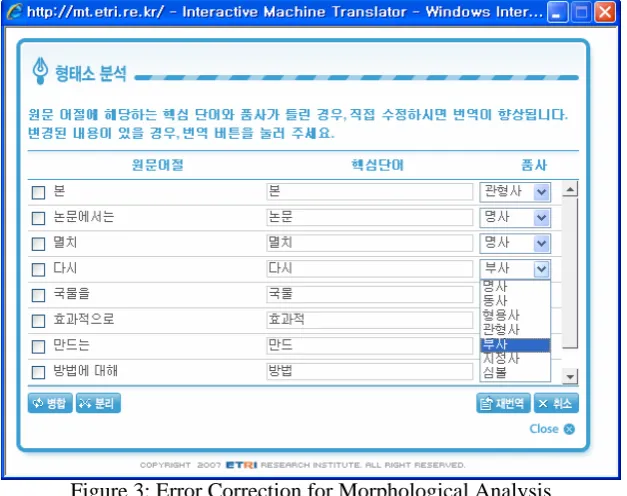
The morphological errors are part-of-speech tagging errors and segmentation errors which can be found indirectly through scanning the translation result. These errors can be modified by correcting the morphological analysis directly. If a user presses the morphological analysis button, the morphological analysis result is popped up. Figure 3 is the morphological analysis result of “본 논문에서는 멸치 다시 국물을 효과적으로 만드는 방법에 대해 기술한다.”.
Here, ‘다시’ is wrongly tagged as adverb, the user can fix it.
Figure 3: Error Correction for Morphological Analysis
Figure 4: Sentence Structure before and after the Correction
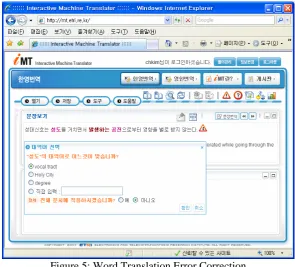
Word translation errors can be modified by pressing the suspicious word and selecting the right one among several candidates or by typing in the right one directly.
Figure 5: Word Translation Error Correction
3.3 Target Sentence Correction
Source sentence modification and engine error correction can improve the translation, however it still may not be satisfying. This is because our paper MT system is pattern-based system. Our MT system generates target sentences mainly based on pattern resources such as sentence patterns, verbal patterns, noun patterns and etc. When the wrong patterns are matched and used in generation, the translated English sentences may contain erroneous expressions. Even when the patterns are correctly matched, the English counterpart may contain somewhat unnatural translation. For this reason, we employed the language model for post-processing. For example,
translation for “필요성이대두되고있다” by consulting the dictionary for each Korean word
and combining the candidates. In this case, those Korean words ‘필요성’(necessity) and
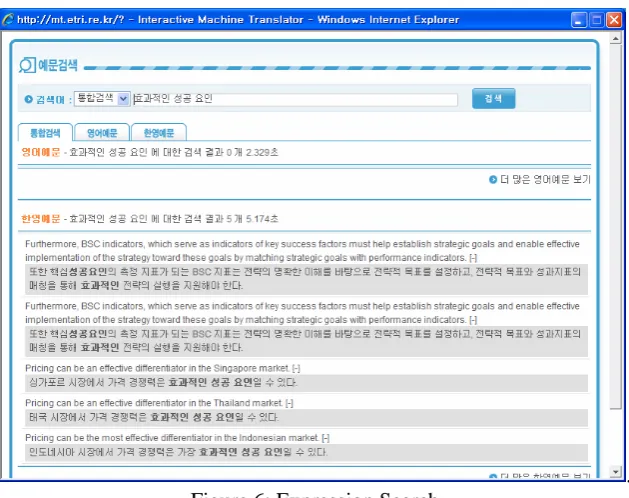
‘대두되다’(occur, come to the front, raise, show itself, be raised) are consulted and combined. Each combination expression is retrieved from the English paper database for its examples. From this information, the user gets a hint on how to correct the expression. Sometimes some expressions look unnatural to the user even though the system regards them as natural. For the user’s confidence, the system provides the function to retrieve the same expression as the one in the translation as in Figure 6.
. Figure 6: Expression Search
4.
Evaluation
We have implemented our system and opened it to users for 6 months. The main users are researchers and university students in the field of science and technology.
Total # of Users Total Length of Stay(day) Average(stay/user)
694 1,827 2.633
The total number of users and their length of stay are as the above. It is hard to say that our system is useful for paper writing according to the above statistics. Some few can write an English paper just in 2.6 days but most of people can’t.
Total # of Users Total # of Sentences Average (Sent./user)
694 39,506 56.925
The average sentence translated per user is as the above. It is still not so promising but a little bit more positive than the previous one. We can think that if a user thinks our system is useful, then the user is sure to use more complex function of the system in addition to the simple translation such as the source sentence modification, the engine error correction or the target sentence modification. These kind of functions entail the re-translation(RT).