Three English Learner Assistance Systems
Using Automatic Paraphrasing Techniques
Masaki Murata and Hitoshi Isahara
National Institute of Information and Communications Technology 3-5 Hikaridai, Seika-cho, Soraku-gun, Kyoto 619-0289, Japan
{murata,isahara}@nict.go.jp
Abstract
We developed three systems based on automatic paraphrasing techniques to help En-glish learners and EnEn-glish-language beginners. One system extracts personal error patterns in the user’s English usage. The second transforms English sentences contain-ing the letters “l” and “r” into sentences containcontain-ing fewer instances of these letters, which Japanese people have trouble pronouncing properly in English. This system could be used, for example, to transform a draft of a presentation that a Japanese speaker was to present to an audience. The third is an annotation system that pro-vides definition sentences of difficult English words, making them easier to understand. We believe that these systems will be useful both for learners of English and in studies on second-language acquisition.
1 Introduction
Studies on paraphrasing (IWPT, 2001; Murata and Isahara, 2001) are relevant to a range of research topics including sentence generation, summarization, and question-answering in natural language processing (Katoh and Uratani, 1999; Takahashi et al., 2003). Several techniques have been constructed for paraphrasing. We used automatic paraphrasing techniques based on natural language processing to develop three learner-assistance systems for English language learners and beginners. One system extracts an individual’s personal error patterns in using English. The second transforms English sentences containing the letters “l” and “r” into sentences with fewer instances of these letters, which Japanese people have trouble pronouncing properly in English. The third system transforms difficult English words into easier ones by providing definitions of the difficult words that clarify their meaning. These systems and studies using them may also have applications in studies on second language acquisition (Dulay et al., 1982; Larsen-Freeman and Long, 1991; Granger, 1998).
2 Extraction of personal error patterns in using English
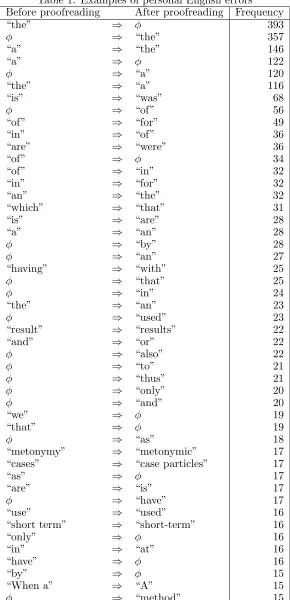
We investigated methods of automatically extracting differences from pairs of texts that cor-respond to each other within the domain of paraphrasing studies. One study examined the extraction of differences between spoken and written language and transformation rules for au-tomatic translation from written to spoken language by matching presentations at academic conferences and the papers corresponding to them (Murata and Isahara, 2002a). Another study focused on extracting rewriting rules and synonyms in patents by matching the patent claim and its embodiment, both of which have the same meaning (Murata and Isahara, 2002c). In this study, we extracted an individual’s personal English error patterns by matching a paper before proofreading with the corresponding paper after proofreading. (The proofreading was
We think a good approach way
is to construct it using “X noY”.
The criteria used to select determine
the most appropriate transformation
type must be predefined.
This figure shows the structure composition
of the thesaurus.
length d is the length size
of a document d.
Incorrect transformation
This is the title name
of the query.
P of d and t is the location determination
of the first occurrence of a termt
in the document d.
This term is for weighting terms which are followed used
by the
Japanese-language particle “nado”.
We think that this problem question
can be overcome by enlarging the corpus
a special type, on a special subject|a gland of an insect, called corpus
allatum|a total assemblage of law in a country|an extract of corpus
lu-teum of a pig or a cow|the glassy fluid from the eye|a set of material
or data for use during study, especially for linguistic analysis] is a very
large corpus [Above!] of modern English, containing over 100 million
words from both spoken and written English texts.
The project was carried out and is managed by an industrial/academic
consortium [Notes: an association of creditor nations] led by Oxford
University Press, ...
The spoken part (10%) includes a large amount of unscripted [Notes:
(of a speech or discussion that is broadcast) spoken naturally or
with-out previous arrangement] informal conversation, recordeded [Caution!]
by volunteers selected from different age, region and social classes in a
demographically [Notes: in a demographical way] balanced way, ...
... will be useful for a very wide variety of research purposes, in fields as
distinct as lexicography, [Notes: the creating and printing of dictionaries]
artificial intelligence, speech recognition and synthesis, literary studies,
and all varieties of linguistics.
The corpus [Above!] is encoded [Caution!] according to the Guidelines
...
..., the equivalent of more than a thousand high capacity floppy diskettes.
[Notes: a small plastic disk coated with magnetic material on which
computer data can be stored called a floppy disk]
To put these numbers into perspective, the thickness of the average
paperback [Notes: of the form of a publication enveloped by a slender
cardboard cover—a small book bound with a thin cardboard cover] book
when we used the method to extract difficult words but to avoid extracting words occurring in our papers, “corpus”, which we know very well, was not extracted.
“encoded” is given “[Caution!]”, so the user realizes that “encoded” is difficult. This helps English learners. “[Caution!]” has another interesting function. “recorededed”, which is a typo, is also given “[Caution!]”.
In future work, we would like to develop a system that stores all the sentences that a user has written and read and show him/her which word he/she first encountered when a new sentence is presented. (We have already investigated a system for highlighting expressions that appear first in documents (Murata and Isahara, 2002c).) We also consider that it may be interesting to highlight the words that appear first in English language school textbooks. Although there are systems that provide translations or meaning glosses to assist readers (Poznanski et al., 1998), the ideas of user-dependent processing and highlighting expressions that appear first are novel and in future, we would like to further examine these concepts.
5 Conclusion
We used automatic paraphrasing techniques based on natural language processing to develop three systems for helping English learners and beginners. They included a system for extracting personal error patterns in the user’s English usage; a system for transforming English sen-tences containing the letters “l” and “r”, which Japanese people have trouble pronouncing, into sentences containing fewer instances of these letters; and an annotation system that provides definition phrases for difficult words. We believe that these systems will be useful for English learners and in studies on second language acquisition (Dulay et al., 1982; Larsen-Freeman and Long, 1991; Granger, 1998).
Acknowledgments
We are grateful to Ms. Izumi and Dr. Kotani of the National Institute of Information and Communications Technology for their help and valuable comments on this study.
References
Dulay, Heidi, Marina Burt, and Stephen Krashen. 1982. Language Two. Oxford University Press.
EDR, 1993. EDR Electronic Dictionary Technical Guide. EDR (Japan Electronic Dictionary Research Institute, Ltd.).
Granger, Sylviane. 1998. Learner English on Computer. Longman.
IWPT. 2001. NLPRS’2001 Workshop on Automatic Paraphrasing: Theories and Applications.
Kaji, Nobuhiro and Sadao Kurohashi. 2004. Recognition and paraphrasing of periphrastic and overlap-ping verb phrases. In LERC 2004.
Katoh, Naoto and Noriyoshi Uratani. 1999. A new approach to acquiring linguistic knowledge for locally summarizing Japanese news sentences. Journal of Natural Language Processing, 6(7). (in Japanese).
Larsen-Freeman, Diane and Michael H. Long. 1991. An Introduction to second language acquisition research. Longman.
Murata, Masaki. 2002. NLP using DIFF — use of convenient tool for detecting differences, MDIFF —. Journal of Natural Language Processing, 9(2). (in Japanese).
Murata, Masaki and Hitoshi Isahara. 2001. Universal model for paraphrasing — using transformation based on a defined criteria —. In NLPRS’2001 Workshop on Automatic Paraphrasing: Theories and
http://arxiv.org/abs/cs.CL/0208020.
Murata, Masaki and Hitoshi Isahara. 2002c. Using the diff command in patent documents. Proceedings of the Third NTCIR Workshop (PATENT).
Murata, Masaki and Makoto Nagao. 1993. Determination of referential property and number of nouns in Japanese sentences for machine translation into English. InProceedings of the 5th TMI, pages 218–225.
Oxford University Computing Services. 1995. British national corpus.
Poznanski, Victor, Pete Whitelock, Jan IJdens, and Steffan Corley. 1998. Practical glossing by prioritised tiling. COLING-ACL ’98, pages 1060–1066.
Princeton University. 2003. Wordnet 2.0.