Cross-Language Plagiarism Detection Methods
Vera Danilova
Dept. of Romance Languages, Autonomous University of Barcelona, Spain [email protected]
Abstract
The present paper provides a summary on the existing approaches to plagiarism de-tection in multilingual context. Our aim is to organize the available data for the further research. Considering distant lan-guage pairs is of a particular interest for us. Cross-language plagiarism detection issue has acquired pronounced importance lately, since semantic contents of a docu-ment can be easily and discreetly plagia-rized through the use of translation (hu-man or machine-based). We attempt to show the development of detection ap-proaches from the first experiments based on machine translation pre-processing to the up-to-date knowledge-based systems that proved to obtain reliable results on various corpora.
1 Introduction
According to Barr´on-Cede˜noet al. (2008), cross-language plagiarism detection (CLPD) consists in discriminating semantically similar texts indepen-dent of the languages they are written in, when no reference to the original source is given. However, here similar means that the objects (texts) share only certain characteristics and are comparable, whereas plagiarism has to do with the cases when author’s original words and ideas are copied (with or without formal modifications). As follows from an updated version of the definition in Barr´on-Cede˜no (2012) a cross-language plagiarism case takes place when we deal with unacknowledged reuse of a text involving its translation from one language to another.
As indicated by Barr´on Cede˜no (2012) no tech-nologies were developed for CLPD purposes be-fore 2008. Since the establishment of the Inter-national Competition on Plagiarism Detection as
a part of the workshop PAN (Uncovering Plagia-rism, Authorship and Social Software Misuse) in 2009, cross-lingual issues started to draw atten-tion of the participants. In 2010 there were at-tempts of using machine translation (MT) at the document pre-processing step in order to deal with non-English documents as possible sources of pla-giarism. The detailed comparison of sections was implemented using traditional monolingual meth-ods. The main problems that manifested them-selves immediately were computational cost and quality of MT that is so far unable to permit reli-able comparison of suspicious texts and sources. Moreover, authors tend to modify translated texts using paraphrases, which makes the discrimina-tion process even more complicated. Also, one of the main challenges is the presence of salient dis-tinctions in syntactic structures of languages be-longing to different families.
It was already in 2008 that the researchers started to come up with new strategies for avoid-ing the MT step. Barr´on Cede˜no (2008) proposed a statistical approach based on parallel corpora for the CLPD. In Lee et al. (2008), a text catego-rization approach was posited. Domain-specific classification was performed using support vec-tor machine model and parallel corpora contain-ing Chinese-English text pairs. Similarity mea-surement was carried out by means of language-neutral clustering based on Self-Organizing Maps (SOM). Ceskaet al.(2008) proposed a tool named MLPlag based on the word location analysis. EuroWordNet thesaurus was used for language-independent text representation (synonym normal-ization). Detailed comparison was performed by computing both symmetric (VSM-based) and asymmetric similarity measures, which required a preliminary calculation of occurrence frequency of plagiarized words. Multilingual pre-processing involving lemmatization and inter-lingual index-ing anticipated the comparison.
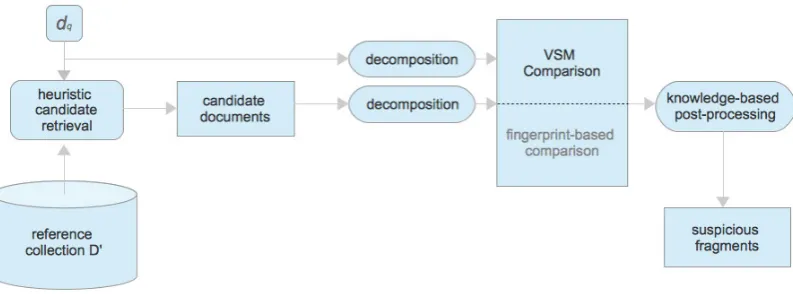
Figure 1: Plagiarism detection process (adapted from Potthastet al.(2011).
Despite of the disadvantages of MT-based ap-proach, it was not discarded by the researchers. As Meuschke and Gipp (2013) point out, it is suit-able for small document collections. In the subse-quent sections we describe the application of MT and other approaches more in detail.
2 Related Work
The surveys by Potthastet al. (2011) and Barr´on Cede˜noet al.(2013) were dedicated exclusively to the classification and evaluation of CLPD meth-ods. Also, a large description of CLPD technol-ogy is provided in the doctoral thesis by Barr´on Cede˜no (2012). Potthast et al. (2011) outline the steps of CLPD process, provide some strate-gies of heuristic retrieval and evaluate the perfor-mance of three models for the detailed analysis. Barr´on Cede˜no et al. (2013) enrich this survey by describing the whole architecture of plagiarism analysis. Also, a modification to the classification of detailed analysis methods is introduced and an evaluation of three other models is provided.
The rest of the article is organized as fol-lows: Section 3 introduces the main approaches to CLPD, explains the prototypical structure of analysis and outlines the performance evaluation, presented in the previous surveys; Section 4 con-cludes the paper.
3 Approaches to CLPD
3.1 Intrinsic VS External CLPD
Barr´on Cede˜no (2012) divides CLPD methods into intrinsic and external, because, as shown in the lit-erature, intrinsic plagiarism detection techniques
allow to discriminate the so calledeffects of trans-lation process inside the text. Some of the rel-evant indicators found by researchers are as fol-lows: function words, morphosyntactic categories, personal pronouns, adverbs (in 2006 by Baroni and Bernardini); animate pronouns, such asI, we, he, cohesive markers, such as therefore, thus (in 2011 by Koppel and Ordan); a high number of ha-pax legomena(in 2006 by Somers).
Some researchers, cited in Pataki (2012), ar-gue that no regularities indicating MT within texts were revealed as a result of a series of experiments with German-English translation, which is one of the best qualities. Thus, they regard this solution as infeasible due to the randomness and variable nature of features.
3.2 CLPD Process Structure
The majority of authors attribute CLPD to the ex-ternal PD approach, as in Meuschke and Gipp (2013), therefore, the same conventional detection steps, namely, candidate retrieval, detailed com-parison and knowledge-based post-processing are distinguished and remain unchanged, as shown in the surveys by Potthastet al. (2011) and Barr´on Cede˜noet al.(2013). The standard plagiarism de-tection workflow is presented in Fig. 1.
3.3 Retrieval and Comparison
from the suspicious document and translated into the corresponding language (a CLIR solu-tion); the next two approaches rely on the re-sults of machine translation and make use of ei-ther standard keyword retrieval (an IR solution) or hash coding. Detailed comparison step in-cludes measuring the similarity between suspi-cious text and the potential source documents re-sulting from the candidate retrieval step. The corresponding methods outlined in Potthastet al.
(2011) are as follows: syntax-based (CL-CNG), dictionary-based (Eurovoc thesaurus-based, CL-VSM), parallel corpora based (CL-ASA, CL-LSI, CL-KCCA) and comparable corpora-based (CL-ESA). Some of them rely on the use of tools, containing language- and topic-specific informa-tion, e.g. dictionary based, parallel corpora-based, comparable corpora-based and some of them do not, such as syntax-based. In what follows a de-tailed explanation is provided for each one of the comparison models.
Syntax-Based Models
CL-CNG or Cross-Language Character N-Gram model uses overlapping character 4-gram tokenization on the basis of the Hopkins Auto-mated Information Retriever for Combing Un-structured Text (HAIRCUT) system and was cre-ated by McNamee and Mayfield (2004). The key distinction of this approach lies in the possibil-ity of comparing multilingual documents without translation. The best results were achieved for the languages sharing similar syntactic structure and international lexicon (e.g., related European lan-guage pairs).
The rest of the methods depends on the use of lexico-conceptual knowledge bases, corpora and dictionaries.
Dictionary-Based Models
CL-VSM (Cross-Language Vector Space Model) approach consists in constructing vector space models of the documents using indexed thesauri, dictionaries and other concept spaces. Eurovoc and corpora developed in the JRC(Joint Research Centre), e.g. JRC-Acquis Multilin-gual Parallel Corpus, presented in Steinberger (2012) link texts through the so called ”language-independent anchors”, multilingual pairs of words that denote entity names, locations, dates, measurement units etc.. In Gupta (2012) CL-CTS, Cross-Language Conceptual Thesaurus-Based Similarity method, is proposed, which is an
algorithm that measures the similarity between texts written in different languages (English, German and Spanish in that particular case) on the basis of the domain-specific mapping presented in Eurovoc. Anad-hocfunction defines whether a document belongs to some thesaurus concept id, represented by vector dimension in multidimensional vector space. The main advan-tage of this method lies in robustness to topic variance. In Pataki (2012) a dictionary-based language-independent approach is presented that consists of three main stages, namely, search space reduction, similarity estimation and filtering of results. Retrieval space is reduced by means of document pre-processing (fragmentation, stemming, elimination of stop-words), key words extraction and translation of their lemmas. It was estimated that the optimum number of translations equals to five. The main distinction of the present method lies in the use of anad-hoc metric based on the minimum function, which allows to discard word number variance. Its purpose is to verify whether the compared documents are likely to be translations of one another. Post-processing step is rule-based and considers two thresholds for the obtained similarities. In order to reduce the computational cost of candidate retrieval and similarity analysis it was proposed in Pataki and Marosi (2012) to use SZTAKI desktop grid. It dynamically uploads and preprocesses information from the Wikipedia database and stores it to the KOPI system. Torrej´on and Ramos (2011) presented a combination of n-gram and dictionary-based approach as an extension to ”CoReMo” System developed earlier for external plagiarism detection purposes. Direct2stem
and stem2stem dictionaries are integrated into the system and are based on Wiktionary and Wikipedia interlanguage links dictionaries. Di-rect2stemtakes full words as entries and provides translations of the most frequent stems as output.
Pre-processing includes case folding, elimination of stopwords, Porter stemming and internal sorting. Referential monotony is an algorithm that selects the longest sequences of text splits that indicate possible plagiarism and compares them to the whole source text. CoReMo system algorithm’s advantages, as observed by the authors, are good runtime performance (obtaining of global results in 30 minutes), integrated dictionary and low computer requirements.
Comparable Corpora-Based Models
CL-ESA or Cross-Language Explicit Similar-ity Analysis, as reported in Potthastet al. (2011) represents approaches based on comparable cor-pora. According to Talvensaari (2008), as opposed to parallel corpora (LSI, KCCA and CL-ASA models), comparable corpora concept does not involve sentence-aligned translations. It is rep-resented by topic-related texts with common vo-cabulary. Wikipedia encyclopedia and similar re-sources can serve as an example. These corpora are noisier, but at the same time more flexible. CL-ESA approach implies automatic creation of word associations for bilingual document representation in order to perform comparison of vocabulary cor-relation. As explained in Cimianoet al. (2009), concept space Cis associated precisely to the ar-ticle space in Wikipedia, therefore the approach is called ”explicit”. The association strength be-tween the suspicious document and the concept space is evaluated by calculating the sum of the
tf-idfvalues of the article for all words of the anal-ysed text. Later, for cross-language retrieval pur-poses, the method was extended by the employ-ment of Wikipedia language links to index the document with respect to the corresponding arti-cles in any language.
Parallel Corpora-Based Models
CL-ASA or Cross-Language Alignment Simi-larity Analysis introduced by Barr´on Cede˜noet al.
(2008) implies creation of bilingual statistical dic-tionary (core of CLiPA (Cross-Lingual Plagiarism Analysis) system) on the basis of parallel corpus being aligned using the well-known IBM Model 1. As observed in Ceskaet al.(2008) word positions are taken into account. At the second step expecta-tion maximizaexpecta-tion algorithm is applied in order to calculate statistical dictionary probabilities. The model was modified, as presented in Potthast et al. (2011): translation model probabilityp(dq/d’)
was changed to weight measurew(dq/d’)and
lan-guage model probabilityp(d’)was substituted by a length model in order to apply it similarity anal-ysis of full-scale documents of variable length.
CL-LSI or Cross-Language Latent Semantic In-dexing also uses parallel corpora. It is a common strategy applied in IR systems for term-document association. It is ”latent” in the way that it ex-tracts topic-related lexemes from the data itself and not from the external sources as opposed to CL-ESA. In Potthastet al. (2011) it is observed that CL-LSI is characterized by poor runtime per-formance due to the use of linear algebra tech-nique, singular value decomposition of the origi-nal term-document matrix, as the core of the algo-rithm. According to Cimianoet al. (2009), con-cepts are latently contained in the columns of one of the orthogonal matrices (term-concept correla-tion weights) resulting from the main matrix de-composition.
CL-KCCA or Cross-Language Kernel Canon-ical Correlation Analysis performs much better than LSI on the same datasets, although it is based on SVD as well, according to Vinokourov et al.
(2002). However, Potthast et al. (2011) ob-serve that for the same reasons of runtime per-formance this approach cannot compete with CL-CNG and CL-ASA. As explained in Vinokourov
et al. (2002), CL-KCCA analyses the correspon-dence of points in two embedding spaces that rep-resent bilingual document pair and measures the correlation of the respective projection values. It provides detection of certain semantic similarities, represented by word sets with the same patterns of occurrence values for given bilingual document pairs.
knowl-edge base can be integrated into this system, as pointed out by the authors. Text fragmentation at the pre-processing step is performed using 5-sentence sliding window, grammatical categories are tagged with the TreeTagger tool. Similarity is measured basing on relation and concept weight values. CL-KGA, as observed by Franco-Salvador
et al. (2013), refines the results of the other state-of-the-art approaches, according to plagdet evalu-ation results.
Barr´on Cede˜no et al. (2013) update this clas-sification by adding the fifth model (MT-based) and attributing the whole set to the retrieval step, not the detailed comparison. Thus, as a result we have five families of retrieval models: lexicon-based, thesaurus-lexicon-based, comparable corpus-lexicon-based, parallel corpus-based and MT-based. Authors de-fine them assystems. Lexicon-based systems (an amplified version syntax-based model class, pre-sented in Potthastet al. (2011)) comprise the fol-lowing techniques:cognateness, based on prefixes and other tokens;dot-plotmodel, based on charac-tern-grams; CL-CNG (Cross-Language Character N-Grams). The rest of the models, except the MT-based one, are identical to those described in Pot-thastet al. (2011). MT-based model (or T+MA) involves determination of the suspicious document language with a language detector, translation and monolingual analysis. In Barr´on Cede˜no (2012) T+MA includesweb-based CL modelsand multi-ple translations. The approach by Kent and Salim (2009 and 2010) belongs to the first type. They use Google Translate API to obtain English ver-sions of texts that were originally written in Malay, with that the further pre-processing and compari-son using three least-frequent four-grams finger-print matching are performed. The approach by Muhret al.(2010) is attributed to the second type. Instead of a full-scale automatic translation, they make use only of the main component of the cor-responding systems: word alignment algorithm. German and Spanish texts form the corpus for the subsequent experiments. The words are aligned using BerkeleyAligner and 5 translation candi-dates are assigned on the basis of the Europarl cor-pus. As observed in Barr´on Cede˜noet al. (2013), T+MA proved its efficiency in PAN 2011, how-ever, the same translation system (Google Transla-tor) was used for generation and analysis. There-fore, an evaluation of T+MA performance using other translation systems was implemented.
3.4 Results of Performance Evaluation
In Potthast et al. (2011) the performance of C3G (based on 3-grams), ESA and CL-ASA was compared. Three experiments (cross-language ranking, bilingual rank correlation and cross-language similarity distribution) were car-ried out on the basis of two aligned corpora: comparable Wikipedia and parallel JRC-Acquis corpus (legal documents of the European Union aligned in 22 languages). Language pairs included English as the first language and Spanish, Ger-man, French, Dutch, or Polish as the second one. CL-C3G and CL-ESA show better results when suspicious and original documents share topic-specific information, whereas CL-ASA performs better with professional and automatic translations (due to the nature of the corpora used). CL-ASA and CL-ESA, as opposed to CL-CNG, can be ap-plied for distant language pairs with alphabet and syntax unrelated, as pointed out in Barr´on Cede˜no (2012). CL-ESA, as compared to CL-ASA and CL-C3G, proved to be more a general purpose re-trieval model, however, it depends much on the languages involved. CL-C3G outperformed the other approaches within the framework of these experiments.
In Barr´on Cede˜no (2012) the performance of CL-CNG, CL-ASA and CL-T+MA was com-pared. The author was interested in studying the behaviour of the models with respect to dis-tant language pairs (English and Basque-Spanish). T+MA outperformed the other mod-els, because it doesn’t depend neither on corpora nor on syntactic/lexical similarities between lan-guages. However, it is a computationally expen-sive method and there is still a lack of good auto-matic translators for most language pairs.
and the aim is to detect plagiarized fragments. In Experiment C plagiarized fragments shall be re-trieved from the noisy set of reference collection documents. According to the results of Experi-ment A, performance of the models depends on the document length: when considering an exact copy case, CL-CNG and T+MA work better with longer documents as opposed to CL-ASA (due to the use of length model). CL-CNG appears to outper-form the other models in paraphrase uncovering. As to the results of Experiment B, T+MA shows the best recall in fragment detection, whereas CL-ASA provides the highest precision values, partic-ularly in case of long texts (chunks have a fixed length of 5 sentences). Short plagiarism cases ap-pear to be the hardest to detect. Within the frame-work of the Experiment C, CL-ASA provided bet-ter values of F-measure on short texts than T+MA model. Those obtained using CL-CNG, despite of not being influenced by the length and nature of plagiarism, turned out to be the worst ones. On the basis of the experiments performed authors conclude that T+MA and CL-CNG can be consid-ered as recall-oriented systems and CL-ASA as a precision-oriented one.
4 Conclusions
The paper in hand outlines the existing approaches to translated plagiarism detection for the purposes of further research in the context of distant lan-guage pairs. The problem-oriented surveys by Potthast et al. (2011) and Barr´on Cede˜no et al.
(2013) are summarized. It can be seen that the pro-totypical detection process remains unchanged: it includes heuristic retrieval, detailed comparison and knowledge-based filtering. Retrieval and com-parison algorithms are being modified and knowl-edge bases are being expanded. CL-CNG was developed in 2004 and it is still one of the best-performing approaches that does not require the availability of any concept bases, such as dictio-naries, thesauri, semantic networks or corpora, however it performs well only for languages shar-ing syntactic and lexical similarities (Indoeuro-pean families). All of the other analysis ap-proaches depend on the availability of knowledge bases. In Torrej´on and Ramos (2011) and Pataki (2012) ad-hoc dictionaries are used; Steinberger (2012) and Gupta (2012) describe the application of Eurovoc thesaurus; CL-ESA makes use of com-parable corpora and such models as ASA,
CL-KCCA, CL-LSI require the availability of paral-lel corpora to properly perform the analysis; CL-KGA approach relies on the use of large semantic network BabelNet that combines WordNet synsets with Wikipedia articles, thus ensuring a more pre-cise concept mapping. MT+A, according to the comparison by Barr´on Cede˜noet al. (2013), pro-vides the best results, however, the translation of the whole reference collection is too costly and the corresponding translation services are far from be-ing perfect, particularly for the cases of distant lan-guage pairs. Within the framework of the consid-ered approaches, linguistic features are taken into account at the pre-processing step (lemmatization, case-folding, grammatical categories tagging etc.). Due to the variation in languages structures, their analysis is being avoided at the comparison step for the purposes of preserving runtime character-istics. The core analysis unit for the present meth-ods is either character (CL-CNG) or word with the underlying concepts and connections.
References
Alberto Barr´on-Cede˜no, Paolo Rosso, David Pinto, and Alfons Juan. 2008. On cross-lingual plagiarism analysis using a statistical model. Proceedings of the ECAI’08 PAN Workshop: Uncovering Plagia-rism, Authorship and Social Software Misuse, pp. 9-13. Patras, Greece.
Alberto Barr´on-Cede˜no. 2012. On the Mono- and Cross-Language Detection of Text Re-Use and Pla-giarism (Thesis). Departmento de Sistemas In-form´aticos y Computaci´on, Universidad Polit´ecnica de Valencia.
Alberto Barr´on-Cede˜no, Parth Gupta, and Paolo Rosso. 2013 Methods for cross-language plagiarism detec-tion. Knowledge-Based Systems 50, 211-217.
Zdenek Ceska, Michal Toman, and Karel Jezek. 2008.
Multilingual Plagiarism Detection. AIMSA 2008, LNAI 5253, pp. 83-92, 2008.
Philipp Cimiano, Antje Schultz, Sergey Sizov, Philipp Sorg, and Steffen Staab 2009. Explicit Versus Latent Concept Models for Cross-Language Infor-mation Retrieval. Proceedings of the Twenty-First International Joint Conference on Artificial Intelli-gence (IJCAI-09).
Marc Franco-Salvador, Parth Gupta, and Paolo Rosso. 2013. Cross-Language Plagiarism Detection Us-ing a MultilUs-ingual Semantic Network. IECIR 2013, LNCS 7814, pp. 710-713.
Us-ing a Conceptual Thesaurus. ACLEF 2012, LNCS 7488, pp. 67-75, 2012.
Chow Kok Kent, and Naomie Salim. 2009.Web Based Cross Language Plagiarism Detection. Journal of Computing, Volume 1, Issue 1.
Chow Kok Kent, and Naomie Salim. 2010. Web Based Cross Language Plagiarism Detection. Sec-ond International Conference on Computational In-telligence, Modelling and Simulation, pages 199-204, IEEE.
Chung-Hong Lee, Chih-Hong Wu, and Hsin-Chang Yang. 2008. A Platform Framework for Cross-lingual Text Relatedness Evaluation and Plagiarism Detection. The 3rd International Conference on In-novative Computing Information and Control (ICI-CIC’08).
Paul McNamee, and James Mayfield. 2004.Character N-Gram Tokenization for European Language Text Retrieval. Information Retrieval,7,773-97.
Norman Meuschke, and Bela Gipp 2013. State-of-the-art in detecting academic plagiarism. International Journal for Educational Integrity Vol. 9 No.1, pp. 50-71 .
Markus Muhr, Roman Kern, Mario Zechner, and Michael Granitzer. 2010. External and Intrinsic Plagiarism Detection Using a Cross-Lingual Re-trieval and Segmentation System. Lab report for PAN at CLEF 2010.
Roberto Navigli 2012. Babelplagiarism: What can BabelNet do for cross-language plagiarism detec-tion?. Keynotes for PAN 2012: Uncovering, Au-thorship, ad Social Software Misuse.
M´at´e Pataki. 2012. A new approach for searching translated plagiarism. Proceedings of the 5th Inter-national Plagiarism Conference. Newcastle, UK.
M´at´e Pataki, and Attila Csaba Marosi 2012. Searching for Translated Plagiarism with the Help of Desktop Grids. Journal of Grid Computing, 1-18.
Martin Potthast, Alberto Barr´on-Cede˜no, Benno Stein, and Paolo Rosso. 2011. Cross-language plagia-rism detection. Language Resources and Evaluation 45:45-62.
Ralf Steinberger 2012. Cross-lingual similarity cal-culation for plagiarism detection and more - Tools and resources. Keynotes for PAN 2012: Uncover-ing, Authorship, ad Social Software Misuse.
Tuomas Talvensaari. 2008. Comparable Corpora in Cross-Language Information Retrieval (Academic Dissertation). Acta Electronica Universitatis Tam-perensis 779.
Diego Antonio Rodr´ıguez Torrej´on, and Jos´e Manuel Mart´ı Ramos. 2011. Crosslingual CoReMo System. Notebook for PAN at CLEF 2011.