Text content and task performance in the evaluation of a Natural
Language Generation system
Albert Gatt
Department of Computing Science
University of Aberdeen
[email protected]
Franc¸ois Portet
Laboratoire d’Informatique de Grenoble
Grenoble Institute of Technology
[email protected]
Abstract
An important question in the evaluation of Natu-ral Language Generation systems concerns the re-lationship between textual characteristics and task performance. If the results of task-based evalua-tion can be correlated to properties of the text, there are better prospects for improving the system. The present paper investigates this relationship by fo-cusing on the outcomes of a task-based evaluation of a system that generates summaries of patient data, attempting to correlate these with the results of an analysis of the system’s texts, compared to a set of gold standard human-authored summaries.
Keywords
Natural Language Generation, evaluation, decision support, domain on-tology
1 Introduction
In the evaluation ofNLPsystems, an important distinction is that betweenintrinsiccriteria, which typically measure aspects of output quality, andextrinsicones, which assess a system in terms of its adequacy in its target setting [9]. The relationship between the two is important. A systematic relationship between the outcomes of extrinsic evaluation and properties of a system’s output can indicate directions for improvement in output, leading to improvements in the system’s utility in its target setting.
This paper focusses on the evaluation of a a Natural Language Generation (NLG) system, BT-45 [13], which generates summaries of clinical patient data in a Neona-tal Intensive Care Unit (NICU). It was been evaluated in an experiment comparing decision making by clinicians based on the system output and other ways of presenting the same information, including human-authored summaries [17]. The aims of this paper are twofold. First, we investigate the relationship between intrinsic properties of generated text – particularly its informativeness and relevance – and its utility for decision-making. Second, we propose a novel intrinsic evaluation method. Rather than comparingBT-45 texts to a gold standard based on surface characteristics, such as matchingn−grams, we make explicit use of do-main knowledge in the form of an ontology and attempt to quantify the differences in the content selection strategies underlying theBT-45 and the gold standard texts.
2 Background
Intrinsic evaluation inNLGhas often relied on human in-put, typically in the form of ratings of or responses to ques-tionnaires [12, 4, 7]. Automatic intrinsic methods exploit-ing corpora have mostly been used in evaluations of mor-phosyntactic realisers [11, 3]. Extrinsic, task-based meth-ods are also widespread [14, 10, 15]. While such studies tend to be more expensive and labour-intensive, extrinsic evaluation criteria give a reliable assessment of the sys-tem’s utility in doing what it was designed to do.
The relationship between these different classes of evaluation methods is not straightforward. Recent work has shown that corpus-based intrinsic methods do not corre-late with the results of intrinsic evaluation based on human judgements, suggesting that they are measuring different aspects of output quality [2]. Cautionary notes have also been sounded in Machine Translation [5] and summarisa-tion [6], with some recent work inNLG showing that in-trinsic measures also correlate poorly with task-based mea-suresNLG[1]. On the other hand, the relationship between task-based measures and textual characteristics bears on several important questions. Task-based evaluations tend to yield global scores from which it is often hard to extract specific indicators of a system’s weaknesses. While judge-ment elicitation studies may be better suited to this purpose, these do not necessarily reflect a system’s utility in a task, while corpus-based studies necessarily depend on a finite number of reference outputs against which to compare a system, which do not exhaust the space of possibilities.
3 The
BT
-45
system and evaluation
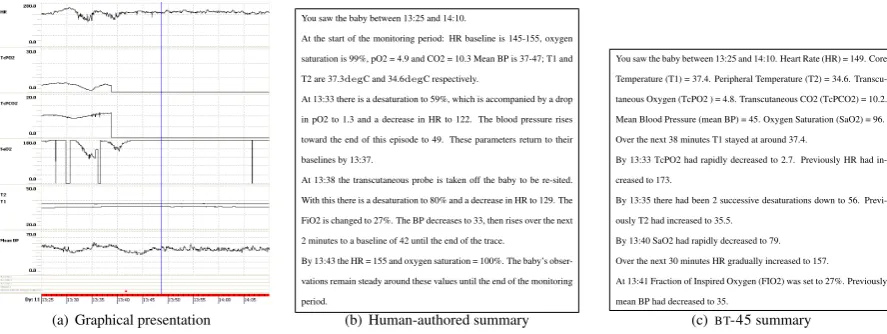
In this section, we briefly summarise the main aspects of theBT-45 architecture and the task-based evaluation (see [13] and [17] for a complete description).BT-45 produces a textual summary of 45 minutes ofNICUdata, in the form of physiological signals measured from a patient using sen-sors, and data relating to discrete events, which are logged by clinicians in a database in the course of a shift. A snap-shot of the input data is displayed in Figure 1(a). Figure 1(b) shows a summary of this data written by two expert neonatologists, while Figure 1(c) presents theBT-45 output for the same period. As the summary shows,BT-45 texts kept interpretation and diagnosis to a minimum, generating a descriptive summary of the salient events related to a pa-tient. This involved a four-stage process, each making use of a domain-specific ontology. First, the main features of the signal data are identified, and the discrete data are ex-tracted. Both form the input to adata interpretationstage,
(a) Graphical presentation
You saw the baby between 13:25 and 14:10.
At the start of the monitoring period: HR baseline is 145-155, oxygen saturation is 99%, pO2 = 4.9 and CO2 = 10.3 Mean BP is 37-47; T1 and T2 are 37.3degC and 34.6degC respectively.
At 13:33 there is a desaturation to 59%, which is accompanied by a drop in pO2 to 1.3 and a decrease in HR to 122. The blood pressure rises toward the end of this episode to 49. These parameters return to their baselines by 13:37.
At 13:38 the transcutaneous probe is taken off the baby to be re-sited. With this there is a desaturation to 80% and a decrease in HR to 129. The FiO2 is changed to 27%. The BP decreases to 33, then rises over the next 2 minutes to a baseline of 42 until the end of the trace.
By 13:43 the HR = 155 and oxygen saturation = 100%. The baby’s obser-vations remain steady around these values until the end of the monitoring period.
(b) Human-authored summary
You saw the baby between 13:25 and 14:10. Heart Rate (HR) = 149. Core Temperature (T1) = 37.4. Peripheral Temperature (T2) = 34.6. Transcu-taneous Oxygen (TcPO2 ) = 4.8. TranscuTranscu-taneous CO2 (TcPCO2) = 10.2. Mean Blood Pressure (mean BP) = 45. Oxygen Saturation (SaO2) = 96. Over the next 38 minutes T1 stayed at around 37.4.
By 13:33 TcPO2 had rapidly decreased to 2.7. Previously HR had in-creased to 173.
By 13:35 there had been 2 successive desaturations down to 56. Previ-ously T2 had increased to 35.5.
By 13:40 SaO2 had rapidly decreased to 79. Over the next 30 minutes HR gradually increased to 157. At 13:41 Fraction of Inspired Oxygen (FIO2) was set to 27%. Previously mean BP had decreased to 35.
(c) BT-45 summary
Fig. 1:NICUdata presented in different formats
which creates abstractions from the raw data and relates events to eachother via causal and other links. Document planningselects important events and structures them into a document plan, whilemicroplanningfleshes out their se-mantic content and realises the text.
The system was evaluated during an off-ward experi-ment during which 35 clinicians in 4 groups (junior and senior doctors and junior and senior nurses) were asked to select the most appropriate clinical actions to take in rela-tion to a patient, based on around 45 minutes of data. 24 scenarios were presented to each participant in one of the three conditions shown in Figure 1: (G)Graphically;(H) textual summary written by human experts; and(C) tex-tual summary generated byBT-45. Participants were asked to select the appropriate clinical actions to take at the end of the period from a predefined set of 18 actions. Prior to the experiment, a senior neonatal nurse and consultant neonatologist identified, for each scenario, the subsets of appropriate, inappropriate (potentially harmful) and neu-tral actions from this set. Moreover, for each scenario there was onetarget actionwhich was deemed to be the most important out of all the appropriate ones. For each partic-ipantpand scenarios, a performance scoreSp
s was
com-puted based on the proportionPAPsof actions selected out
of the set of appropriate actions for the scenario,APs, and
the proportionPINAPsselected out of the set of
inappropri-ate actionsINAPs:
Sp
s =PAPs−PINAPs∈[−1,1] (1)
Overall, the human expert texts (H) led to the best decision making (.45SD=.10) followed by the Computer texts (C) (.41SD=.13) and the Graphical (G) condition (.40SD=.15). A 3 (Condition) x 4 (Group) by-subjectsANOVA showed no main effect of participant Group, but an effect of Condi-tion that approached significance (F(2,31) = 2.939, p = 0.06). There was no interaction. SeparateANOVAs showed a difference between the G and H conditions (F(1,31) = 4.975, p <0.05) and the C and H conditions (F(1,31) = 5.266, p < 0.05), but none between G and C. Thus, hu-man texts proved most useful to decision-making, but gen-erated texts were found to be no worse than presentation in the graphical condition, which is the modality used in cur-rent clinical practice. A follow-up analysis comparing the scenarios based on their main target action showed a
sig-Fig. 2: Excerpt from the ontology showing relations to functional concepts (in bold)
nificant difference in performance between H and C texts (F(1,7) = 8.002;p <001).
Although this evaluation tells us that textual presenta-tion can be very effective, it does not give direct informa-tion about which aspects of the experimental texts played a role in decision-making. On the other hand, the significant effect of main target action does suggest that some of the burden is carried by the content selection strategies in the H and C texts, with the human-authored summaries incorpo-rating more information that was relevant to the appropriate actions. This was the focus of our follow-up evaluation.
4 The role of the ontology
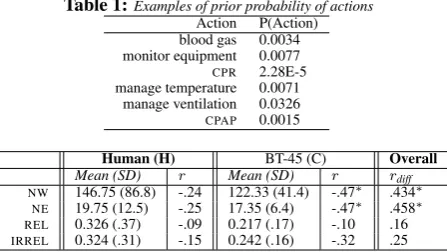
-Table 1:Examples of prior probability of actions
Action P(Action) blood gas 0.0034 monitor equipment 0.0077
CPR 2.28E-5 manage temperature 0.0071
manage ventilation 0.0326
CPAP 0.0015
Human (H) BT-45 (C) Overall
Mean (SD) r Mean (SD) r rdiff
NW 146.75 (86.8) -.24 122.33 (41.4) -.47∗ .434∗ NE 19.75 (12.5) -.25 17.35 (6.4) -.47∗ .458∗ REL 0.326 (.37) -.09 0.217 (.17) -.10 .16 IRREL 0.324 (.31) -.15 0.242 (.16) -.32 .25
Table 2:Mean scores across groups on informativeness and relevance, with correlations.r= Pearson’s correlation between intrinsic and extrin-sic performance score. rdiff= correlation between difference in perfor-mance and difference in score between H and C. Asterisk (∗) indicates significance atp≤.05
resuscitating a patient, are only taken in exceptional cir-cumstances. To account for the potential effects of this on decision making, we computed the prior probability of each clinical action used in the experiment, as a maximum like-lihood estimate based on a large database of 43,889 clinical actions recorded by an on-site research nurse over a period of 4 months in aNICU[8]. Some example probabilities for each action are displayed in Table 1. These were used to weight the relevance scores, which are now defined as follows:
RELs,t=
X
a∈APs
P(a).N(a)t (2)
IRRELs,t=
X
a∈INAPs
P(a).N(a)t (3)
whereais any action andN(a)tstands for the number of
times actionawas referenced by the events in textt.
6 Evaluation results
In this section, we present the results of our comparison of the 24 pairs of human and computer-generated texts. All results are reported using scenarios (N = 24) as source of variance. For each measure, we report (a) the correla-tion (r) between the performance score and the measure in a given condition (H or C); (b) differences between H and C on the measure; (c) the correlation between the abso-lutedifferences in the scores obtained by H and C texts and those in decision-making performance (rdiff). Table 2
dis-plays all descriptives and correlation coefficients. In what follows, we summarise the main observations, discussing their implications in Section 7.
6.1 Effect of informativeness
The means for NEand NW in Table 2 indicates that hu-man texts tend to mention more events and are slightly longer than theBT-45 texts, but with much higher variabil-ity (higherSD) between scenarios. No significant corre-lations (r) were observed betweenNEorNW and perfor-mance in the H condition; in the C condition, both corre-lations are significant. However, in all cases, therscores
are negative, suggesting that more information tended to be linked tolowerdecision-making performance. Paired t-tests showed that there was no significant difference be-tween the two sets of texts onNE(t(23) = 1.24, p > .2), though the difference on theNWscore approached signifi-cance (t(23) = 1.90, p=.07).
There was a significant positive correlation between the absolute differences in informativeness scores and decision-making (rdiff). We also investigated the
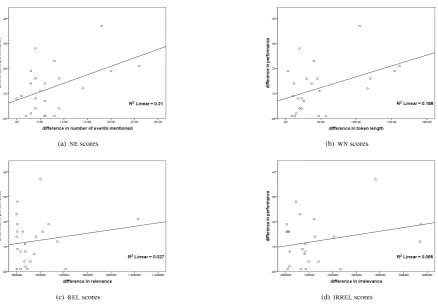
correla-tion within user groups, finding a significant correlacorrela-tion only in the case of Senior Doctors for both measures (NW: r= 45;NE:r=.53;p≤.05). The differences in scores are plotted against differences in performance in Figures 3(a) and 3(b). In both cases, a linear relationship accounts for approximately 20% of the variance, as reflected by the R2value associated with the regression line. Omitting the ‘outliers’ where the differences between H and C in NW andNEseems highest (4 points in Figure 3(a), 5 in Figure 3(a)) does not improve the models.
In summary, human expert texts shown more variability thanBT-45 texts on our informativeness measures. Sepa-rate correlations for H and C show a surprising negative covariation between the measures and decision-making, while a weak positive relationship can be observed between the difference in the scores and decision-making differ-ences in the two conditions.
6.2 Effect of relevance
Table 2 shows that the H texts achieved higher scores on both REL and IRREL, that is, the events mentioned by human experts referenced more appropriate actions, but also more ‘inappropriate’ ones. Once again, the varia-tion is higher in the H texts. There were significant dif-ferences on both measures between H and C texts (REL: t(23) = 2.23, p < .05;IRREL:t(23) = 2.11, p < .05). As for the correlations within each condition (r), they are once again negative, and never reach significance.
On the other hand, we do observe a significant positive correlation between difference in performance and both RELand IRREL. Once again, this seems to be primarily due to the Senior Doctor group, where differences inREL and difference in performance were significantly correlated (r =.54;p < .05). The correlations were not significant for any other user group, and never significant for differ-ences inIRREL.
These trends are further reflected in Figures 3(c) and 3(d), which again plot the difference in performance be-tween H and C against difference in theRELandIRREL. Once again, both figures show that the linear relationship accounts for a very low proportion of the variance (<2%); removing the outliers in either case again results in no im-provement.
7 Discussion
(a)NEscores (b)WNscores
(c) RELscores (d)IRRELscores
Fig. 3:Difference in task performance against differences inNW,NE,RELandIRRELscores
measures, taking the present conclusions as final would seem to be premature, for a number of reasons which we outline in this section.
Content vs. structure In focussing exclusively on a def-inition of content based on the events referenced by a text, our evaluation scores ignore aspects of discourse and in-formation structure, such as the extent to which the texts link the events mentioned via discourse or temporal con-nectives, as in the human-authored excerpt below: Example 1 (Human text) The pCO2 continues to rise to 10.1. The baby is pale and unresponsive. ET suction is given, baby is turned and at 17:02 the ETT is removed; the baby is again given Neopuff ventilation.
BT-45 texts often lacked the kind of linking exemplified above. Hence, the relationship between intrinsic and ex-trinsic evaluation measures may need to account for both content and discourse structure.
Differences among users It is likely that some of the statistically weak results reported in the previous section are due to differences between participants in our evalua-tion. These differences are in part individual, as reflected by the comparatively high variance in performance scores (cf. Section 3). Perhaps more importantly, differences are also likely to arise between user groups. Although no main effect of Group was found on performance, it seems likely that different users will focus on different aspects of a text when reading summaries. For instance, whether a user is
a doctor or a nurse will have an impact on how likely they are to consider taking a particular action, given their dif-ferent aims, and the fact that some actions fall within their remit and others tend not to. Some support for this con-clusion comes from the observation that the correlation be-tween differences in performance and differences in infor-mativeness and relevance were primarily due to one group of users, namely, Senior Doctors. If this interpretation is correct, then it reflects the necessity of tailoring theNLG system output to different users, particularly in a medical context, where roles tend to be fixed and a single ‘one size fits all’ solution is unlikely to be adequate [16].
Granularity Another limitation is related to the informa-tion captured by our annotainforma-tions, which do not make suffi-ciently fine-grained distinctions and do not use the full ex-pressivity available in the ontology. For example,SaO2 de-creases to 60%andSaO2 stays stableare both represented by the same event, with TYPE = TRENDand SOURCE = OXYGEN SATURATION; however, their relative importance is clearly different, since only the former suggests that something must be done. We are seeking to make finer-grained distinctions of this kind in our current work.
con-tent selection strategy which selected events based on their clinical importance, computed using rules obtained from clinicians. By contrast, our expert authors may have been selecting content using much more sophisticated heuristics, in part based on the salient patterns in the data and possi-bly also their knowledge of the most important observa-tions given a patient’s current and previous state. As an example,BT-45 seldom mentioned noise or artifacts in the input signals, deeming these to be unimportant; in contrast, these were mentioned in some cases by the human texts because they drew a clinician’s attention to the need for managing the sensors which were sampling the physiolog-ical parameters. In short, humans probably do a better job at taking context into account. Modulo differences in the probability of actions, our measures of informativeness and relevance gave equal weight to the different events men-tioned, without reference to context, whereby an event can become relevant not through its association with a potential target action, but because it can shed light on the nature and provenance of the rest of the events described in the text. Thus, when we focus on those events which are indirectly linked to possible actions, BT-45 does not seem to differ very much from the H texts, but this should be interpreted in light of the fact that the two texts did differ on overall informativeness, as reflected by theNEmeasure.
8 Conclusions
This paper began by arguing that extrinsic evaluation methodologies, though useful and necessary, often leave open the question of which aspects of a system are con-tributing to the results, and why. The present paper at-tempted to identify some of these aspects, focusing primar-ily on the content selection strategy of a system to gener-ate patient summaries in a Neonatal Intensive Care con-text. Our results showed that the relationship between our measures of textual content, and performance on a task is somewhat weak. Our interpretation of these results is that content-based intrinsic measures need to be more granu-lar, and take into account other textual characteristics, such as discourse structure, as well as the role of different user groups. We have also proposed an intrinsic evaluation methodology which relies on domain knowledge to quan-tify informativeness and relevance. In our ongoing work, we are extending this methodology to address the short-comings identified in our results.
Acknowledgments
Thanks to Professor Neil McIntosh, senior consultant at the Royal Infirmary of Edinburgh, who helped with the devel-opment of the ontology. Thanks also to Jim Hunter and Ehud Reiter. The BabyTalk project is supported by UK Engineering and Physical Sciences Research Council (EP-SRC), under grants EP/D049520/1 and EP/D05057X/1.
References
[1] A. Belz and A. Gatt. Intrinsic vs. extrinsic evaluation measures for referring expression generation. InProc. ACL-08, 2008.
[2] A. Belz and E. Reiter. Comparing automatic and hu-man evaluation ofNLG systems. InProc. EACL-06, 2006.
[3] C. B. Callaway. Evaluating coverage for large sym-bolicNLGgrammars. InProc. IJCAI-03, 2003. [4] C. B. Callaway and J. C. Lester. Narrative prose
generation. Artificial Intelligence, 139(2):213–252, 2002.
[5] C. Calliston-Burch, M. Osborne, and P. Koehn. Re-evaluating the role ofBLEUin machine translation re-search. InProc. EACL-06, 2006.
[6] B. J. Dorr, C. Monz, S. President, R. Schwartz, and D. Zajic. A methodology for extrinsic evaluation of text summarization: DoesROUGEcorrelate? InProc. Workshop on Intrinsic and Extrinsic Evaluation Mea-sures, 2005.
[7] M. Foster. Automated metrics that agree with human judgements on generated output for an embodied con-versational agent. InProc. INLG-08, 2008.
[8] J. Hunter, G. Ewing, L. Ferguson, Y. Freer, R. Logie, P. McCue, and N. McIntosh. TheNEONATEdatabase. InProc. IDAMAP-03, 2003.
[9] K. S. Jones and J. Galliers. Evaluating natural lan-guage processing systems: An analysis and review. Springer, Berlin, 1996.
[10] A. Karasimos and A. Isard. Multilingual evaluation of a natural language generation system. InProc. LREC-04, 2004.
[11] I. Langkilde-Geary. An empirical verification of cov-erage and correctness for a general-purpose sentence generator. InProc. INLG-02, 2002.
[12] J. Lester and B. Porter. Developing and empiri-cally evaluating robust explanation generators: The KNIGHT experiments. Computational Linguistics, 23(1):65–101, 1997.
[13] F. Portet, E. Reiter, A. Gatt, J. Hunter, S. Sripada, Y. Freer, and C. Sykes. Automatic generation of tex-tual summaries from neonatal intensive care data. Ar-tificial Intelligence, 173(7–8):789–816, 2009. [14] E. Reiter, R. Robertson, and L. Osman. Lessons from
a failure: Generating tailored smoking cessation let-ters.Artificial Intelligence, 144:41–58, 2003. [15] O. Stock, M. Zancanaro, P. Busetta, C. Callaway,
A. Krueger, M. Kruppa, T. Kuflik, E. Not, and C. Roc-chi. Adaptive, intelligent presentation of information for the museum visitor inPEACH.User Modeling and User-Adapted Interaction, 17(3):257–304, 2007. [16] B. Strople and P. Ottani. Can technology improve
intershift report? what the research reveals. Journal of Professional Nursing, 22(3):197–204, 2006. [17] M. van der Meulen, R. H. Logie, Y. Freer, C. Sykes,