Acronym Recognition and Processing in 22 Languages
Maud Ehrmann
Department of Computer Science
Sapienza University of Rome
[email protected]
Ralf Steinberger
European Commission
Joint Research Centre
IPSC-GlobeSec
[email protected]
Leonida Della Rocca
European Commission
Joint Research Centre
IPSC-GlobeSec
[email protected]
Hristo Tannev
European Commission
Joint Research Centre
IPSC-GlobeSec
hristo.tannev
@jrc.ec.europa.eu
Abstract
We are presenting work on recognising acro-nyms of the form Long-Form (Short-Form) such as “International Monetary Fund (IMF)” in millions of news articles in twenty-two lan-guages, as part of our more general effort to recognise entities and their variants in news text and to use them for the automatic analysis of the news, including the linking of related news across languages. We show how the ac-ronym recognition patterns, initially developed for medical terms, needed to be adapted to the more general news domain and we present evaluation results. We describe our effort to automatically merge the numerous long-form variants referring to the same short-form, while keeping non-related long-forms sepa-rate. Finally, we provide extensive statistics on the frequency and the distribution of short-form/long-form pairs across languages.
1
Introduction and Motivation
An acronym is an abbreviation formed from the initial letters of the various word elements and read as a single word.1 Acronyms are formed to speed up and ease communication, mainly to create words for concepts frequently used or
1 See http://dictionary.reference.com/help/faq/ language/t08.html to distinguish acronyms from relat-ed concepts such as initials and contractions.
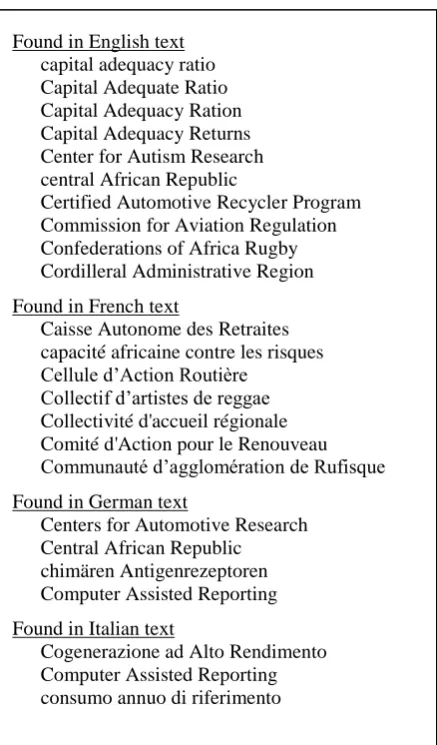
ficult to describe. Like entities, acronyms have a high reference value, in the sense that they most of the time act as reference anchors of textual content. However, they are not always explicitly defined, which can cause comprehension prob-lems, both for humans and machines. In addition, due to the large number of acronyms – we found over one million when analysing our news data set – the same short-form (SF) can have several conceptually different long-forms (LF) (see Ta-ble 1). Even for the same SF-LF pair, many LF variants may exist. In addition to simple wording differences, there can be grammatical inflection forms and cross-lingual variants.
Acronyms are productive words, i.e. new ac-ronyms are created every day, requiring frequent updating of any acronym database. In the first month of applying the tool to our large through-put of multilingual news articles, we identified 66,000 acronyms (before merging variants, i.e. unique SF-LF pairs). After only five months of analysis, the monthly number of newly identified acronym pairs has halved and the number of newly found acronyms seems to be stabilising around this value. We are adding these new ac-ronyms to our multilingual dataset every day and we plan to publicly release the more frequently occurring ones in regular intervals as part of the multilingual name variant resource JRC-Names (Steinberger et al. 2011), which currently pre-dominantly contains person names. This dataset
can be used for named entity recognition and other natural language processing tasks, includ-ing information retrieval, question answerinclud-ing, summarisation and machine translation.
For acronym recognition, we use the simple and efficient algorithm which was initially de-veloped by Schwartz & Hearst (2003) for the recognition of biomedical abbreviations in Eng-lish text, but we adapted it for our purposes.
Our contributions are (a) the adaptation of the method to another text type (news); (b) the appli-cation to over twenty languages; (c) the genera-tion of highly multilingual statistics on acronym use and on (d) acronym SF ambiguity; and (e) the automatic grouping of LF variant forms.
We first present related work (Section 2), then present our adaptation of the original algorithm, together with recognition statistics and evalua-tion results (3). We then describe our method to group LF variants (4). We finish by summarising and by pointing to future work (5).
2
Related Work
Since the pioneering achievement of Taghva and Gilbreth (1999), a significant amount of work has been completed in the domain of abbrevia-tion processing. Focusing almost exclusively on the bio-medical domain and on the English lan-guage, research has developed into three main directions: acronym extraction and mapping to their full forms; acronym variant clustering; and, more recently, acronym disambiguation. We re-port here on the first two.
With regard to acronym extraction, existing approaches can be divided into four main catego-ries, as suggested by Torii et al. (2007) in their comparative study: alignment-based approaches, which exploit the fact that SF and LF show letter or string ordered similarities; collocation-based
approaches, which exploit the fact that SF and LF frequently occur together and can be consid-ered as collocations; pattern/rule-based ap-proaches, which explore regularities of abbrevia-tion convenabbrevia-tions; and, finally, machine-learning
approaches, most of which supervised. Major representatives of these approaches are, respec-tively: Schwartz and Hearst (2003), whose letter matching algorithm proved to be, despite its sim-plicity, very efficient; Okazaki and Ananiadou (2006), who address the problem as a term recognition task and perform acronym extraction using statistical co-occurrence evidence in large text collections; Pustejovsky et al. (2001), Wren and Garber (2002) and Adar (2004), who look at regular patterns in occurrences of acronyms and manually design templates for their extraction; and Chang et al. (2002) and Nadeau and Turney (2005) who apply supervised machine learning algorithms after pre-selection of acronym candi-dates through the use of Longest Common Sub-sequence for the former, the use of heuristics for the latter. Although not comparable because fo-cusing on different acronym sub-types (showing different levels of difficulty), these methods per-form overall quite well and one can consider the extraction-recognition step a mature technology in the domain of English biomedical literature.
However, not much work exists for languages other than English. Kompara (2010) describes some preliminary work on Slovene, English, French and Italian, while Kokkinakis and Dan-nélls (2006) investigate the specificity of Swe-dish – a compounding language – with regard to acronym extraction and present good results ob-tained thanks to an approach similar to that of Nadeau and Turney (2005). The work showing
Found in English text capital adequacy ratio Capital Adequate Ratio Capital Adequacy Ration Capital Adequacy Returns Center for Autism Research central African Republic
Certified Automotive Recycler Program Commission for Aviation Regulation Confederations of Africa Rugby Cordilleral Administrative Region
Found in French text
Caisse Autonome des Retraites capacité africaine contre les risques Cellule d‟Action Routière
Collectif d‟artistes de reggae Collectivité d'accueil régionale Comité d'Action pour le Renouveau Communauté d‟agglomération de Rufisque
Found in German text
Centers for Automotive Research Central African Republic chimären Antigenrezeptoren Computer Assisted Reporting
Found in Italian text
Cogenerazione ad Alto Rendimento Computer Assisted Reporting consumo annuo di riferimento
most similarity with ours is that by Hanh et al.
(2005). Applying Schwartz and Hearst‟s algo-rithm on textual data retrieved from the web in English, German, Portuguese and Spanish, they present a method to align acronyms and their definitions across languages, thanks to an lingual representation layer. They explore inter-lingua phenomena and report statistics on the four languages they consider. As opposed to this work, we consider a wider range of languages and we do not intend to use any interlingua.
Finally, it is worth mentioning work on acro-nym variant clustering: Okazaki et al. (2010) present a method to gather similar English acro-nym expansions based on hierarchical clustering applied over a pseudo distance metric. This dis-tance corresponds to a conditional probability, itself computed through binary classification based on various string similarity metric features. Combining all features, they obtain an F-measure of 0.89, noticing that the n-gram similarity was contributing most to the efficiency of the condi-tional probability. Looking at the same problem, Adar (2004) applies a variant of k-means cluster-ing uscluster-ing the cosine similarity measure over ac-ronym expansion trigrams, and then refined the obtained results taking into account the MeSH category available for each initial n-gram cluster, eventually reaching very good results.
3
Multilingual Acronym Extraction
3.1 Recognition Algorithm
We use the algorithm presented by Schwartz & Hearst (2003), with minor modifications, mostly consisting of post-processing and filtering the results. In simple words, the algorithm rec-ognises short uppercase expressions between brackets (the SF) and searches in the left-hand-side con-text for the letters used in the SF. At least the first letter must be word-initial. Unlike Schwartz & Hearst, we do not currently recog-nise acronym pairs of the format SF (LF) as the-se are much rarer (in our datathe-set, less than 10% of all occurrences) and we achieve high recall due to the sheer size of our dataset.
Here are some more details about the algo-rithm proposed by Ariel & Schwartz: SFs are valid candidates only if they consist of at most two words and if they are between 2 and 10 characters long. If the expression in parentheses is longer, they assume the pattern SF (LF). LF candidates must appear in the same sentence and they must be adjacent to the SF. Regarding their length (the search window), they must not be
longer than (a) twice as many words as there are characters in the SF, or (b) the number of charac-ters in the SF plus five words, whichever is the smaller (i.e. min(|A|+5,|A|*2) words, with |A| being the number of characters of the SF).
After applying this pattern to text, we filter the resulting acronym pairs to reduce noise and to avoid unwanted acronym pairs, eliminating cases where either the SF or the LF satisfies any of the following conditions:
a) SFs with currency symbols;
b) SFs with punctuation marks other than hy-phens, with quotation marks and word-final apostrophes;
c) SFs starting with a single letter followed by a space;
d) SFs having no uppercase letters.
We additionally eliminate acronyms with LFs satisfying any of the following conditions: e) LFs excluding white spaces (one-word LFs). Furthermore, SFs must not:
f) be part of a multilingual stop word list con-sisting of closed class words (mostly deter-miners), days of the week or the month and individual words like north. Our mixed lan-guage stop word list contains about 300 words.
These rules are being applied continuously to large numbers of news texts in the 22 languages of the Europe Media Monitor (EMM) which use the Latin alphabet. EMM processes a current av-erage of 175,000 news articles per day in 70 lan-guages (Steinberger et al. 2009). All acronym pairs are stored, together with meta-information such as date, language, news source and news category, allowing the preparation of detailed statistics.
3.2 Multilingual Evaluation
pre-sumably for all languages using an alphabetic writing system distinguishing lower and upper-case letters.
ISO Language No Prec. Rec. F1
Cs De En Es Fr
Czech German English Spanish French
267 274 404 339 371
.96 .94 .97 .93 .87
.90 .92 .91 .88 .83
.93 .93 .93 .90 .85 Hu Hungarian 318 .98 .96 .92 Ro Romanian 277 .93 .91 .92
Table 2: Acronym recognition performance results for seven languages (Language ISO code; Number of
acronyms evaluated; Precision; Recall; F1 measure).
The major reason for non-recognition (lowering Recall) are cases where the acronym‟s SF is in a different language from the LF, such as in the German Vereinigte Nationen (UNO), where the German LF is followed by the English SF. How-ever, there is a non-negligible number of cases where such cases get coincidentally recognised correctly. Such a lucky case is Namibische Rund-funkanstalt (NBC), where NBC stands for the English equivalent Namibian Broadcasting Cor-poration.
The major source of wrongly recognised acro-nym pairs, across all languages, are generic SFs
such as the title CEO (Chief Executive Officer) or party acronyms such as PS (Parti Socialiste) following person names, leading to the erroneous recognition of the acronym pairs like the follow-ing: Stephan Dorgerloh (SPD); Charles Otieno (CEO); consists of Pieter van Oord (CEO). Some of these cases are hard to avoid. It might there-fore be useful to produce lists of such SFs and to filter them additionally, e.g. by combining the recognition patterns with a named entity recogni-tion tool or by training classifiers to get rid of unwanted LFs. It might also be possible to ex-ploit the fact that these SFs occur with unusually high numbers of different LFs, but care must be taken not to also exclude the good LFs. In our evaluation, we came across small numbers of such SFs, leading however to many wrongly rec-ognised acronym pairs.
3.3 Multilingual Recognition Statistics
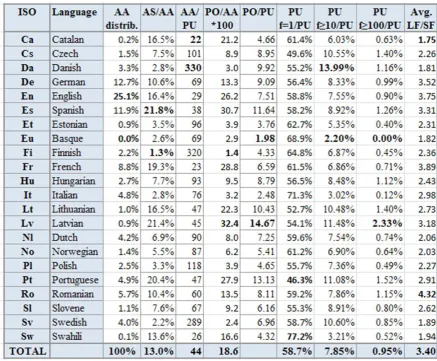
We applied the method described in Section 3.1 to many million news articles in 22 languages and produced various types of statistics. These are shown in Table 3. When looking at statistics on, for instance, how many acronyms are used in the different languages, we have to bear in mind that these statistics are biased to some extent by the choices we have made. For instance, we only identify acronym pairs of the form LF (SF), while some languages may more frequently use the inverse order SF (LF) or other alternatives such as LF, SF (i.e. the short form is shown in-side the text, separated by a comma) or SF, ac-ronym for LF (i.e. explicitly mentioning in the text that SF is the acronym for LF). All the num-bers in Table 3 refer to successfully recognised acronyms, i.e. after the filtering process de-scribed in Section 3.1. When counting unique acronym pairs (PU – pairs unique) or unique SFs, we strictly distinguish case and we consider space and punctuation. For instance, UNO, Uno
and U.N.O. are three different SFs. Acronym pair
occurrences without distinguishing uniqueness are referred to as PO (pairs occurrences). We furthermore use the abbreviations AA for all ar-ticles analysed and AS for selected articles, i.e. only those in which we found acronyms. The highest and the lowest value in each of the col-umns in Table 3 is written in boldface to give an idea of the range of values.
The first column with numerical contents gives an indication on the relative amount of news text we have analysed. The next column shows that the ratio of news articles AS in which good acronyms (acronyms passing the filtering
process) were found, compared to all news arti-cles analysed (AA), is 13%. However, there are enormous differences from one language to the other, with Spanish, Latvian and Portuguese hav-ing the highest density of acronyms and Finnish, Swedish and Basque having the lowest.
The third column summarises how many news articles need to be analysed to find a new (i.e. unique) acronym. The fourth column shows how many acronym pair occurrences (i.e. non-unique) there are per 100 articles analysed. The fifth column depicts the ratio between unique acronyms PU compared to all acronyms found (PO), thus giving an indication of the number of repetitions of acronyms in the corpus. The sixth column presents the ratio of acronym pairs that have been found exactly once in the corpus (al-most 60%), while the next two columns give an indication of how many acronyms have been found at least 10 times or at least 100 times in the corpus. Note that the numbers in Table 3 re-fer to acronym pairs before the merging of acro-nym variants (described in Section 4). The last column provides the ratio between the number of LFs for the same SF, considering all SFs. We thus see that there is an average of 3.4 LFs for each SF. When considering only those SFs that are ambiguous at all (i.e. ignoring SFs that are found with only one LF), the ratio is 6.87.
The statistics on the average number of differ-ent SFs for the same unique LF (i.e. the inverse ratio) is less interesting as there are only 1.08 different SFs for the same LF. When considering only the ambiguous LFs, the ratio is 2.23, i.e. there are just over two SFs for the same LF. The two different SFs are typically due to varying case, due to plural formation (ROV and ROVs for
Remotely Operated Vehicles) or due to punctua-tion (e.g. UP and U.P. for Uttar Pradesh). How-ever, occasionally, there are also more funda-mental differences in the LFs. For instance, in Italian texts, we found the following three acro-nyms AUSTRADE, Austrade and ATC, all repre-senting the same LF Australian Trade Commis-sion.
4
Merging related acronym variants
4.1 Clustering of acronym variants
Given that there are many SFs for which a varie-ty of (relevant and conceptually related) LFs ex-ist, we cluster – separately for each language – all LFs having the same SF. By setting an empir-ically determined threshold for intra-cluster simi-larity (or cluster homogeneity), we can group related LFs while keeping unrelated ones sepa-rate. We apply binary (hierarchical) group-average clustering. The clustering is based on a pair-wise string similarity for each LF pair in the set. This string similarity is a normalised Le-venshtein edit distance where the number of re-quired insertions, deletions and substitutions is divided by the number of characters of the longer LF, yielding a distance value D between 0 and 1. The string similarity S is then the inverse value 1/D. The intra-cluster similarity threshold is set empirically, separately for each language, by op-timising it on a development set. For each acro-nym pair cluster, we choose the most frequently found LF as the representative acronym name.
4.2 Evaluation of the clustering
For the evaluation, we manually selected a small number of widely known acronym SFs, for which we could expect that they would be pre-sent in each of the languages. Examples are IAEA (International Atomic Energy Agency), IMF (International Monetary Fund), CAR (Cen-tral African Republic), ECB (European Cen(Cen-tral Bank) and FIFA (Fédération Internationale de Football Association), and their respective trans-lations in the four languages (e.g. German EZB and IAEO). This was to make the results compa-rable across languages. For the rest (the majori-ty), we selected SFs that existed in each of the languages, without knowing whether they would be related across languages and whether the LFs would be similar. This selection was made in preparation of our future work on clustering LF
variants across languages if they have the same SF.
Table 4 summarises the evaluation results for the acronym LF clustering step for English, French, German and Italian (languages for which we had evaluation volunteers). The first three columns show the number of SF clusters evalu-ated (unique SF), the number of LFs that had been found and evaluated for these SFs (unique LFs), as well as the number of distinct clusters
Table 4: Evaluation results for the clustering (separately for each language) of all LFs having the same SF.
identified by the clustering algorithm and evalu-ated (LF clusters). Comparing the third column with the fourth column (clusters ≥ 2) shows that about two thirds of the acronym pairs were not clustered at all and remained single acronyms.
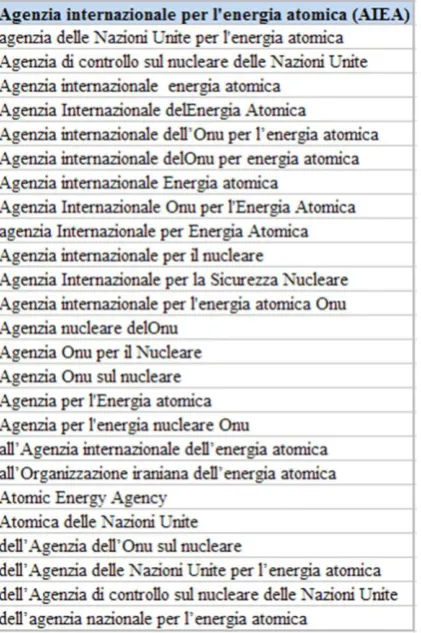
The precision was evaluated keeping an appli-cation-centred approach in mind. Within the framework of ENM, the purpose of the acronym recognition and of the long-form clustering is (a) to display to the users name-like entities as meta-information to news articles and (b) to use these extracted „entities‟ as anchors to establish links between related documents (eventually also across languages). For that purpose, we evaluat-ed the precision generously, accepting acronym pairs as rightfully belonging to the same cluster if the intention of the journalist seems to have been to refer to the same entity, even if the acro-nym LF was not perfectly captured. For that rea-son, we show recognition error rates separately in Table 4: The column Recognition Error de-scribes cases where the system captured non-acronyms or the LFs did not belong to the SF. The column Border Error reflects cases where the acronym was detected, but the border of the LF was identified wrongly (e.g. recognising the string assisted by the International Energy Atom-ic Agency for the SF IAEA. In such a case, if the erroneous LF was placed in the correct cluster, it was annotated as being correct for clustering, but it was also marked as a border error. Journalists are sometimes very lax in their usage of names (see Table 5). It is our intention to capture these references even if the naming may in itself be wrong.
In summary, we find that the clustering pro-cess works surprisingly well and that it manages to group LF variants with the same SF, while only rarely excluding LFs that should also be grouped with the cluster. The cases where LFs that refer to the same real-world entity are ex-cluded from a cluster are usually those where the LF differs substantially from those of the entries in the cluster, making it almost impossible to automatically merge the variants. For instance, the German equivalences for Common Agricul-tural Policy (CAP): gemeinsame Land-wirtschaftspolitik and Gemeinsamen Eu-ropäischen Agrarpolitik (GAP) are so different that we do not expect these variants to be recog-nised automatically without making use of the context of the acronym.
5
Conclusion and future work
Acronyms are important referential text elements with high information content that are useful for a whole range of text processing applications. We have shown that an existing English lan-guage acronym recognition pattern from the bi-omedical domain can be adapted successfully to the news domain and to 22 languages from dif-ferent language families, yielding over one mil-lion acronym short-form/long-form pairs. The method works well, for all languages using an alphabetic writing system and distinguishing case. Case is important (a) to select the more promising acronym pairs, thus excluding possi-ble false positives, and also (b) to detect the be-ginning of the LF string. While we suspect that the method will work well with languages using for instance the Cyrillic or Greek alphabets, it will probably not work well for languages using the Arabic or Hebrew scripts because these do not distinguish case. Clustering turned out to be an efficient method to group acronym spelling variants and separating non-related acronym long-forms coincidentally having the same short-form.
We are interested in categorising the multilin-gual acronym collection into acronym subtypes such as organisations, programmes (e.g. FP7), stock exchange terminology (e.g. DOW), etc. As our biggest interest are organisation names, we have built a rule-based categoriser using diction-aries with organisation name parts (e.g. bank, organisation, international, club, etc.). We be-lieve that, in order to categorise strings in 22 dif-ferent languages, it is faster to establish and ap-ply such dictionaries than it would be to annotate data in each of the languages and to train a ma-chine learning classifier, but future experiments will show.
The acronym dataset we have created opens up further research avenues. The most interesting challenge probably is how to automatically link acronym long forms across languages. We have several fundamentally different solutions in mind on how to achieve this and we will tackle this task next.
Finally, we are interested in recognising and disambiguating acronym SFs that are not accom-panied by their LFs, using the local context.
Acknowledgments
The authors gratefully acknowledge the support of the ERC Starting Grant MultiJEDI No. 259234.
References
Adar Eytan. 2004. SaRAD: a Simple and Robust Ab-breviation Dictionary. BioInformatics 20:527-533.
Chang Jeffrey T., Hinrich Schütze & Russ B. Altman. 2002. Creating an Online Dictionary of Abbrevia-tions from MEDLINE. Journal of the American Medical Informatics Associations 9:262-272.
Hahn Udo, Philipp Daumke, Stefan Schulz & Kornél Markó. 2005. Cross-language mining for acronyms and their completions from the web. Discovery Science, Springer Berlin Heidelberg. 113-123.
Hiroko Ao & Toshihisa Takagi. 2005. ALICE: an algorithm to extract abbreviations from MED-LINE. Journal of the American Medical Informat-ics Association 12(.5):576-586.
Karipis George. 2005. Cluto: Software for clustering high dimensional datasets. Internet website (last accessed, June 2008), http://glaros.dtc.umn. edu/gkhome/cluto/cluto/overview (2005).
Kompara Mojca. 2010. Automatic recognition of ab-breviations and abab-breviations' expansions in multi-lingual electronic texts. Proceedings of CAMLing. 82-91.
Kokkinakis Dimitrios & Dana Dannélls. 2006. Rec-ognizing acronyms and their definitions in Swedish medical texts. Proceedings of the 5th Conference on Language Resources and Evaluation (LREC). Genoa, Italy.
Okazaki Naoaki & Sophia Ananiadou. 2006. Building an abbreviation dictionary using a term recognition approach. Bioinformatics 22(24):3089-3095.
Okazaki Naoaki, Sophia Ananiadou & Jun'ichi Tsujii. 2010. Building a high-quality sense inventory for improved abbreviation disambiguation. Bioinfor-matics 26(9):1246-1253.
Park Youngja and Roy J. Byrd. 2001. Hybrid text mining for finding abbreviations and their defini-tions. Proceedings of the 2001 conference on em-pirical methods in natural language processing, 126-133.
Pustejovsky James, José Castano, Brent Cochran, Maciej Kotecki & Michael Morrell. 2001. Auto-matic extraction of acronym-meaning pairs from
MEDLINE databases. Studies in health technology and informatics 1:371-375.
Nadeau David & Peter Turney. 2005. A supervised learning approach to acronym identification. Pro-ceedings of the Canadian Conference on Artificial Intelligence. 319-329.
Schwartz Ariel S. & Marti A. Hearst. 2003. A simple algorithm for identifying abbreviation definitions in biomedical text. Proceedings of the PAC on Bi-ocomputing, 451-462.
Steinberger Ralf, Bruno Pouliquen & Erik van der Goot (2009). An Introduction to the Europe Media Monitor Family of Applications. In: Fredric Gey, Noriko Kando & Jussi Karlgren (eds.): Information Access in a Multilingual World - Proceedings of the SIGIR 2009 Workshop (SIGIR-CLIR'2009), pp. 1-8. Boston, USA. 23 July 2009.
Steinberger Ralf, Bruno Pouliquen, Mijail Kabadjov & Erik van der Goot (2011). JRC-Names: A freely available, highly multilingual named entity re-source. Proceedings of the 8th International Con-ference Recent Advances in Natural Language Processing (RANLP'2011), pp. 104-110. Hissar, Bulgaria, 12-14 September 2011.Taghva Kazem & Jeff Gilbreth. 1999. Recognizing acronyms and their definitions. International Journal on Docu-ment Analysis and Recognition, 1(4):191-198.
Torii Manabu, Zhang-zhi Hu, Min Song, Cathy H Wu & Hongfang Liu. 2007. A comparison study on al-gorithms of detecting long forms for short forms in biomedical text. BMC Bioinformatics, 8 (suppl. 9):S5.
Wren J. D. & H. R. Garner. 2002. Heuristics for Iden-tification of Acronym-Definition Patterns within Text: Towards an Automated Construction of Comprehensive Acronym-Definition Dictionaries. Methods of Information in Medicine 41(5):426-434.