A Semi-Automatic, Iterative Method for Creating a Domain-Specific
Treebank
Corina Dima Erhard Hinrichs Department of Linguistics
University of T¨ubingen
corina.dima, [email protected]
Abstract
In this paper we present the development process of NLP-QT, a question treebank that will be used for data-driven parsing in the context of a domain-specific QA sys-tem for querying NLP resource metadata. We motivate the need to build NLP-QT as a resource in its own right, by com-paring the Penn Treebank-style annotation scheme used for QuestionBank (Judge et al., 2006) with the modified NP annota-tion for the Penn Treebank introduced by Vadas and Curran (2007). We argue that this modified annotation scheme provides a better interface representation for seman-tic interpretation and show how it can be incorporated into the NLP-QT resource, without significant loss in parser perfor-mance.
The parsing experiments reported in the paper confirm the feasibility of an iter-ative, semi-automatic construction of the NLP-QT resource similar to the approach taken for QuestionBank. At the same time, we propose to improve the iterative re-finement technique used for QuestionBank by adopting Hwa (2001)’s heuristics for selecting additional material to be hand-corrected and added to the data set at each iteration.
1 Introduction
Question-Answering (QA) systems have a long history in the field of natural language process-ing. In the 1970s and 1980s QA systems fo-cused on natural language interfaces to domain-specific data bases or expert systems. Such
sys-tems typically used hand-crafted, rule-based front ends for parsing and semantic interpretation. With the increased availability of large-scale textual re-sources, QA systems more recently have focused on domain-independent broad-coverage informa-tion retrieval applicainforma-tions that typically employ more shallow processing techniques for question analysis and answer matching.
The intended application for the research re-ported in the present paper is more in the tradi-tion of the earlier, domain-specific QA systems in that it aims to provide a natural language front-end to large repositories of metadata about language tools and resources that are made available by the CLARIN1project. However, instead of relying on
a parser with hand-crafted grammar rules, it em-ploys a robust data-driven parser that requires an-notated training data in the form of a treebank.
Since the natural language front end for the in-tended QA system is English, the simplest solu-tion would be to use a statistical parser such as the Berkeley (Petrov and Klein, 2007) or Stanford (Klein and Manning, 2003) parser with an existing language model obtained from the Penn Treebank (Marcus et al., 1993). However, it is well known that parser performance drops when analyzing text from domains other than that represented in the training data (Sekine, 1997; Gildea, 2001). In par-ticular, Judge et al. (2006) have shown that lan-guage models obtained from the Penn Treebank perform far worse on questions than on their orig-inal test data. The Bikel (2004) parser they employ has an F-Score of 82.97 when tested on Section 23 of the Penn-II Treebank and an F-Score of 78.77 when tested on the 4000 questions in Question-Bank. Judge et al. (2006) attribute this loss of
per-1
CLARIN project - http://www.clarin.eu
news-NP
second language acquisition materials
NP
NML
NML
second language acquisition
materials
Figure 1: Comparing annotations for the compound noun second language acquisition materials: Penn-style annotation on the left, Vadas and Curran (2007) Penn-style annotation on the right
Question Word % in QB % in NLP-QT
Are there 0 5.45
At what 0.075 0
For what 0.025 0
How 3.75 0.5
How * 8.2 0
In what 0.825 0
In which 0.15 0
Is there 0 16.81
On what 0.075 0
On which 0.075 0
What 57.35 0.98
When 5 0.05
Where 6.075 75.07
Which 1.925 0.09
Who 11.375 0.1
Why 1.2 0
Other 3.822 0.93
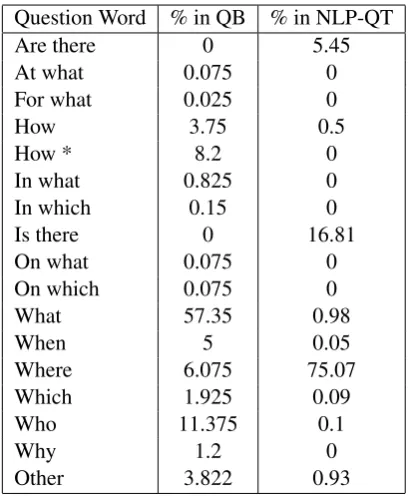
Table 1: Distribution of question types in the two datasources;How *stands for questions likehow many, how much, how far, how longetc.
querying NLP resource metadata, the empha-sis is to a large extent onwhere andis there
questions; the percentage for each type of question in the two datasources is showed in Table 1.
3 Comparing the Annotation of Base NPs
There is yet another property of both Question-Bank and the Penn Treebank that limits its use-fulness for the QA application considered here. This concerns the flat-structure annotation style for noun phrases adopted in both resources. For example, in the questionWhere can I find a Ger-man corpus containing second language
acquisi-tion materials? the compound noun second lan-guage acquisition materialswould be annotated in these resources as a single flat NP, as shown in the left column of Figure 1. Such a flat annotation does not provide sufficient information about the scope of each member of the compound. It is pre-cisely this type of shortcoming that led Vadas and Curran (2007) to revise the Penn Treebank anno-tation style for NPs along the following lines:
• If the intended scope of a base NP leads to a strictly right-branching structure, then the Penn Treebank annotation remains un-changed.
• If the intended scope is partially or com-pletely left-branching, then an extra node is introduced into the tree for each left-branching structure. The label of this node is either NML or JJP, depending on the lexi-cal head of the lolexi-cal tree (noun or adjective, respectively).
The resulting annotation for the compound noun second language acquisition materials is shown in the right column of Figure 1.
From the point of view of semantic interpreta-tion, the more contoured Vadas and Curran (2007) annotation style is to be preferred since it reflects the type of answer that is required, namely materi-als for second language acquisition, but not for ex-ampleacquisition materials for second language, orthe second (batch) of language acquisition ma-terials.
4 Experimental Results
This section summarizes the set of experiments that we have conducted with the Vadas and Curran (2007) annotation style for NPs and in particular with the NLP-QT data set. We discuss two types of experiments:
• comparing the performance of the parser us-ing different annotation styles for base NPs,
• experiments for optimizing the language model of a statistical parser in order to as-sist with the semi-automatic creation of the treebank.
All the experiments were performed with the Berkeley parser. The results are summarized in Table 2 and Table 3.
4.1 Parsing Results for Different Annotation Styles
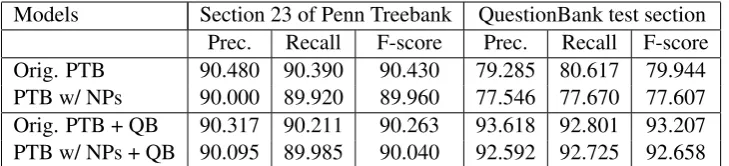
Using Bikel (2004)’s parser, Vadas and Curran (2007) report that the parsing results slightly de-crease when the parser is trained on the Penn Tree-bank with the modified annotation style for NPs. As Table 2 shows, we obtain a similar result when testing on section 23 of the Penn Treebank, using the Berkeley parser trained on sections 02-21 of the same treebank: there is minor drop in F-score from 90.43 to 89.96. We also confirm Gildea’s finding that testing a parser on test sets from a dif-ferent domain than the training sets results in a sig-nificant loss of performance: when using the same models that we used for the Penn Treebank exper-iments, the average F-score for test data from the Question Bank in a 10-fold cross-validation ex-periment is 79.944 for the model trained on the original Penn Treebank and 77.607 for the model trained on the modified Penn Treebank.
The above experiments were designed as a base-line for comparing the performance of the parser trained only on Penn Treebank data. But since our primary interest is in parsing questions as accu-rately as possible, we conducted a second set of experiments, summarized in the lower half of Ta-ble 2. Here additional training data from the Ques-tion Bank was added to both the original and the modified Penn Treebank training data. The de-crease in performance caused by adding the Ques-tionBank training data together with the modified NP annotation on section 23 is comparable to the one caused by adding the modified NP annotation
alone (a decrease from 90.263 to 90.04, whereas for the original Penn Treebank data the F-score decreased from 90.43 to 89.96), but this slight de-crease is more than offset by the inde-crease in se-mantic information obtained from the Vadas and Curran (2007) annotation for complex base NPs. Even more noteworthy is the big jump in F-score from 77.607 to 92.658 when adding the Question-Bank data to the training data.
4.2 Semi-automatic Creation of NLP-QT
The creation of a treebank is a time-consuming and expensive task if all the annotation has to be performed manually. It is therefore useful to in-vestigate whether at least parts of the annotation can be performed automatically or by a combina-tion of automatic analysis and manual post edit-ing. To this end, we performed a set of parsing ex-periments, again using the Berkeley parser, where the test data are taken both from the QuestionBank and a seed set of 500 manually annotated ques-tions from the NLP-QT. The results are shown in Table 3.
As in the experiments shown in the previous subsection, the performance with a model trained purely on Penn Treebank data (with NPs annotated in the Vadas and Curran (2007) style) serves as a baseline (the model is callednp-wsjin the table). This model is then enriched by first adding anno-tated data from Question Bank and then by adding the manually annotated questions from the NLP-QT. We refer to these models asnp-wsjqband np-wsjqblq 500, respectively. The results are very en-couraging on several dimensions:
1. overall parsing performance on the test data for both thenp-wsjqband thenp-wsjqblq 500
models is very good
2. adding questions from the NLP-QT yields a desired increase in performance
3. almost two-thirds of all questions from the test data yield a completely correct parse.
Models Section 23 of Penn Treebank QuestionBank test section Prec. Recall F-score Prec. Recall F-score Orig. PTB 90.480 90.390 90.430 79.285 80.617 79.944 PTB w/ NPs 90.000 89.920 89.960 77.546 77.670 77.607 Orig. PTB + QB 90.317 90.211 90.263 93.618 92.801 93.207 PTB w/ NPs + QB 90.095 89.985 90.040 92.592 92.725 92.658
Table 2: Comparison of parser performance when trained on different data sources with different anno-tation styles
Models Questions test set
Prec. Recall F-score Exact match np-wsj 78.525 78.780 78.651 30.231 np-wsjqb 91.256 91.499 91.375 63.111 np-wsjqblq 500 92.128 92.186 92.157 64.801
Table 3: Parser performance increases when adding hand-corrected question data to the training set
% of total Avg. char. length Avg. word length Avg. const. no
Correct 48.59 61.55 11.41 20.94
Incorrect 51.41 100.96 17.85 31.96
Table 4: Average length and constituent count for the correctly/incorrectly parsed questions
parses, adding this post-corrected data set to the previously used training material and then retrain-ing the parser with the enlarged data set.
One question that was not addressed in the ap-proach by Judge et al. concerns the selection of the additional trees that will be manually corrected and then added to the training and test material in the next iteration. As Hwa (2001) has pointed out, this selection process can be critical in minimizing the amount of data that needs to be hand-corrected during grammar induction. She suggests several simple heuristics for ranking the candidate trees, two of which will be considered here. One heuris-tic is based on the often observed fact that, on aver-age, longer sentences are harder to parse correctly than shorter ones. A second, related and some-what more fine-grained variant of the first heuris-tic is based on the number of constituents obtained by the automatic parse of a sentence. Since the automatic parse is often at least partially incor-rect, the constituent count of the parser will typ-ically be just an estimate of the actual constituent count and related complexity of the sentence. Hwa suggests that when trees are added, the selected trees should match the average constituent count and length profile of the trees that were incorrectly parsed in the previous iteration.
We adopt Hwa’s approach in the construction
of the NLP-QT treebank. In order to use it effec-tively, it is necessary to inspect the results of the parser and in particular create an automatic profile of the completely correct versus partially incorrect parses. This type of error analysis is the subject of the next section.
4.3 Error Analysis
Table 4 summarizes the profiling of the 500 ques-tions from the NLP-QT used in the 10-fold val-idation experiment. On average, 48.59 % of all sentences received an entirely correct parse. The average length in characters and in words as well as the average number of constituents of the cor-rectly parsed sentences differ significantly from the questions where the parse is only partially cor-rect.
NP
NP
NP NP
NP
PP PP
SQ
ADJP ADJP
ADJP
Is there any freely available text corpus for Croatian , no smaller than 20k words ? VBZ EX DT RB JJ NN NN IN JJ , RB JJR IN JJ NNS .
(a) Incorrect parse
NP
NP
NP NP
PP SQ
JJP
Is there any freely available text corpus for Croatian , no smaller than 20k words ?
VBZ EX DT RB JJ NN NN IN JJ , RB JJR IN JJ NNS .
QP NP
NP
(b) Correct parse
Figure 2: Incorrect (top) and correct (bottom) parse for example 6
Where can I find information on chunking French and German texts ?
WRB MD PRP VB NN IN NN NNS CC JJ NNS .
WHADVP NP NP NP NP NP
NP SQ
VP
SBARQ
PP
(a) Incorrect parse
Where can I find information on chunking French and German texts ?
WRB MD PRP VB NN IN NN NNS CC JJ NNS .
WHADVP NP NP
NP SQ
VP
SBARQ
PP
NP VP
JJP S
(b) Correct parse
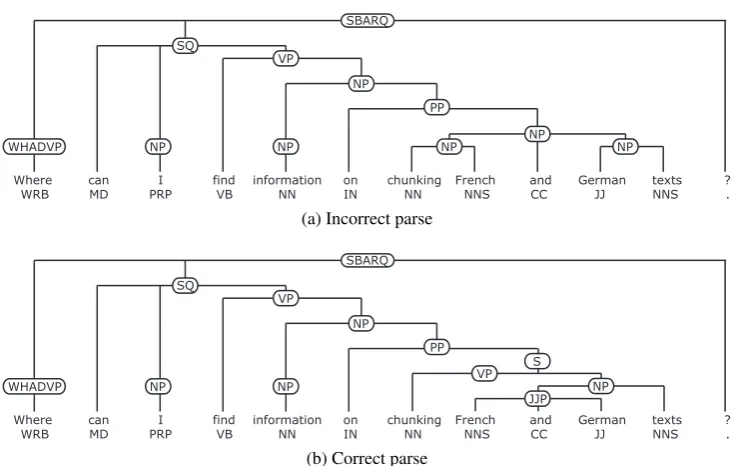
Figure 3: Incorrect (top) and correct (bottom) parse for example 7
Dan Klein and Christopher D. Manning. 2003. Accu-rate Unlexicalized Parsing. Proceedings of the 41st Annual Meeting on Association for Computational Linguistics - Volume 1 (ACL 2003), 423–430.
Mitchell P. Marcus, Beatrice Santorini, and Mary Ann Marcinkiewicz. 1993. Building a Large Annotated Corpus of English: The Penn Treebank. Computa-tional Linguistics 19, 313–330.
Slav Petrov and Dan Klein. 2007. Improved Inference for Unlexicalized Parsing. Proceedings of NAACL HLT 2007.
Satoshi Sekine. 1997. The Domain Dependence of
Parsing. Proceedings of the Fifth Conference on Applied Natural Language Processing, 96–102.