Automatic Text Simplification for Spanish:
Comparative Evaluation of Various Simplification Strategies
Sanja ˇStajner1 and Iacer Calixto2 and Horacio Saggion3
1Research Group in Computational Linguistics, University of Wolverhampton, UK [email protected]
2ADAPT Centre, Dublin City University, School of Computing, Ireland [email protected]
3TALN Research Group, Universitat Pompeu Fabra, Spain [email protected]
Abstract
In this paper, we explore statistical ma-chine translation (SMT) approaches to au-tomatic text simplification (ATS) for Span-ish. First, we compare the performances of the standard phrase-based (PB) and hi-erarchical (HIERO) SMT models in this specific task. In both cases, we build two models, one using the TS corpus with “light” simplifications and the other us-ing the TS corpus with “heavy” simplifi-cations. Next, we compare the two best systems with the state-of-the-art text sim-plification system for Spanish (Simplext). Our results, based on an extensive human evaluation, show that the SMT-based sys-tems perform equally as well as, or bet-ter than, Simplext, despite the very small datasets used for training and tuning.
1 Introduction
The goal of automatic text simplification (ATS) is to transform lexically and syntactically com-plex texts or sentences into their simpler vari-ants which can be more easily understood by non-native speakers, children, and people with vari-ous language or learning impairments (e.g. people with autism, dyslexia, or intellectual disabilities). Due to the scarcity and limited sizes of parallel corpora of original and manually simplified sen-tences, the state-of-the-art ATS systems are still predominantly rule-based for many languages, e.g. Spanish (Drndarevi´c et al., 2013), Basque (Aranzabe et al., 2013), and French (Brouwers et al., 2014).
Recently, several studies proposed applying the
standard PB-SMT model to the text simplifica-tion task for Brazilian Portuguese (Specia, 2010), English (Coster and Kauchak, 2011), and Span-ish (ˇStajner, 2014). None of those studies, how-ever, performed a thorough human evaluation of the systems or directly compared their systems to the existing rule-based ATS systems for those lan-guages. The reported automatic evaluation (using BLEU score) gives us no insights on the correct-ness and usefulcorrect-ness of those systems and how well they perform in comparison to the state-of-the-art rule-based ATS systems.
In this paper, we address the problem of ATS for Spanish, investigating the possibility of ap-plying the standard phrase-based (PB) and hier-archical (HIERO) SMT models to the only two currently-known text simplification (TS) parallel corpora for Spanish. We perform an extensive hu-man evaluation of the generated output which al-lows us to compare the systems directly. Addition-ally, we compare our two best systems with Sim-plext, the state-of-the-art text simplification sys-tem for Spanish (Saggion et al., 2015).
Our experiments make several contributions to the field of automatic text simplification by explor-ing the followexplor-ing important questions:
1. How well can PB-SMT and HIERO models perform if built using very small parallel TS corpora?
2. Do the results obtained using standard PB-SMT models differ significantly from the ones obtained using the HIERO models?
3. How do the SMT-based models for ATS per-form in comparison with the state-of-the-art ATS system for Spanish?
Version Example
Original Los expertos presentar´an un informe de esta misi´on en la pr´oxima reuni´on del Comit´e del Patrimonio Mundial, que tendr´a lugar en Bahrein en junio de 2011.
Light Los expertos presentar´an un informe del estudio del estado de conservaci´on de Pompeyaen la pr´oxima reuni´on del Comit´e del Patrimonio Mundial, queser´aen Bahrein en junio de 2011.
Heavy Los expertos presentar´an un informesobre Pompeyaen la pr´oxima reuni´onsobre la cultura del mundo. Esta reuni´on ser´aen junio de 2011.
Table 1: Different levels of simplification (deviations from the original sentence are shown in italics)
in the next three subsections.
3.1 Corpora
In order to test the influence of the level of sim-plification in TS datasets (“heavy” or “light”) on the system performance, we trained the standard PB-SMT (Koehn et al., 2003) and HIERO (Chi-ang, 2007) models in the Moses toolkit (Koehn et al., 2007) on two TS corpora:
1. Heavy– The TS corpus built under the Sim-plext project (Saggion et al., 2011), aimed at simplifying texts for people with intellec-tual disabilities. The original news stories were simplified manually by trained human editors, following detailed guidelines (Anula, 2007).
2. Light – The TS corpus consisting of var-ious texts (some of which present in the Heavy corpus) and their manual simplifica-tions obtained using only six main simplifi-cation rules (Mitkov and ˇStajner, 2014).
In both corpora, the sentence-alignment was man-ually checked and corrected where necessary. An example of an original sentence and its corre-sponding manual simplifications in the two cor-pora is given in Table 1.
3.2 SMT Models
In order to compare the impact of different SMT models (PB vs. HIERO) on the system perfor-mance, the language model (LM) and the test set (consisting of 47 sentence pairs from each of the two corpora) were kept the same for all systems. Ideally, the LM should be trained on a large cor-pus of “simplified” Spanish. However, as such a corpus has not been compiled yet, we trained the LM on a subset of the Europarl v7 Spanish corpus (Koehn, 2005) using the SRILM toolkit (Stolcke, 2002). In order to reduce the complexity of the sentences used for the training of the LM, we fil-tered out all sentences that contain more than 15
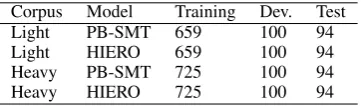
Corpus Model Training Dev. Test
Light PB-SMT 659 100 94
Light HIERO 659 100 94
Heavy PB-SMT 725 100 94
Heavy HIERO 725 100 94
Table 2: SMT experiments
tokens. The sizes of the datasets used in the four experiments are given in Table 2.
3.3 Evaluation
In order to obtain better insights into the poten-tial problems in the SMT-based ATS, where the models are trained on the small datasets, we opted for human evaluation of the output in addition to the automatic evaluation (using the BLEU scores). Following the standard procedure for human eval-uation of TS systems used in previous studies (Coster and Kauchak, 2011; Wubben et al., 2012; Drndarevi´c et al., 2013), we asked human evalu-ators to assess, on a 1–5 scale (where the higher mark always denotes better output), three aspects of the presented sentences: grammaticality (G), meaning preservation (M), and simplicity (S).
We first asked thirteen annotators (8 native and 5 non-native with advanced knowledge of Span-ish) to rate 20 original sentences and their corre-sponding simplifications (one manual and four au-tomatic SMT-based) in order to directly compare the performances of the PB and HIERO models on both corpora. Next, we asked the annotators to rate another 20 original sentences and their cor-responding simplifications (one manual and three automatic, out of which two were produced by the two best SMT systems and the third by the Sim-plext system) in order to directly compare the per-formances of the SMT systems with the state-of-the-art (rule-based) text simplification system for Spanish (Section 2.3).
corre-System Corpus S-BLEU BLEU PB LightHeavy 0.37420.3662 0.33740.3313 HIERO LightHeavy 0.37180.2959 0.33360.2718 Baseline 0.3645 0.3260
Table 3: Automatic evaluation
sponding simplified variants) were selected ran-domly from the test set under the criterion that they have been modified by at least two ATS sys-tems. Every annotator was asked to rate all sions of the same original sentence (different ver-sions of the same sentence were always shown in a random order). This allowed us to have a direct pairwise comparison of each pair of systems.
4 Results
The results of the automatic and human evalua-tions are presented in the next two subsecevalua-tions.
4.1 Automatic Evaluation
We compared the performances of the systems using two automatic MT evaluation metrics, the sentence-level BLEU score (S-BLEU)3 and the document-level BLEU score (Papineni et al., 2002). As the baseline, we used the system which makes no changes to the input (i.e. output of the system is the original sentence). This seems as a natural baseline for this specific task (ATS), as all previous studies (Specia, 2010; Coster and Kauchak, 2011; ˇStajner, 2014) reported that their systems are overcautious, usually making only a few or no changes to the input sentence, and only slightly outperform this baseline. For calculating the S-BLEU and BLEU scores, we used the man-ual simplification (‘gold standard’) as the refer-ence, and the original sentences and the outputs of the four systems as five corresponding hypotheses. The results are presented in Table 3.
The only two systems which significantly out-perform the baseline in terms of the S-BLEU scores (0.05 level of significance; Wilcoxon signed rank test for repeated measures) are the systems trained and tuned on the Light corpus. The performance of the PB and HIERO systems
3Sentence-level BLEU score (S-BLEU) differs from BLEU score only in the sense that S-BLEU will still posi-tively score segments that do not have higher n-gram match-ing (n=4 in our settmatch-ing) unless there is no unigram match; otherwise it is the same as BLEU.
Aspect PB HIERO PB HIEROHeavy Light Manual
G MeanMedian 11.74 1.771 4.035 3.914 4.615
Mode 1 1 5 5 5
M MeanMedian 11.98 1.931 4.575 4.405 3.624
Mode 1 1 5 5 4
S MeanMedian 22.31 2.292 2.993 2.933 4.405
Mode 1 1 2 2 5
Table 4: Phrase-based vs. hierarchical SMT
trained and tuned on theHeavycorpus was not sig-nificantly different from the baseline.
4.2 Human Evaluation
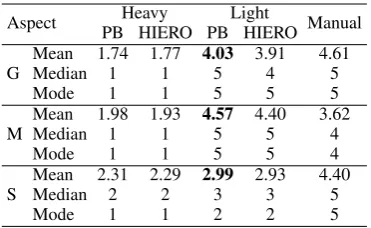
The results of the human evaluation of the PB and HIERO systems built using each of the two cor-pora (HeavyandLight) are given in Table 4. For each of the three aspects (G – grammaticality, M – meaning preservation, and S – simplicity), we present the mean, median and mode calculated on the 260 entries for each system-corpus combina-tion.
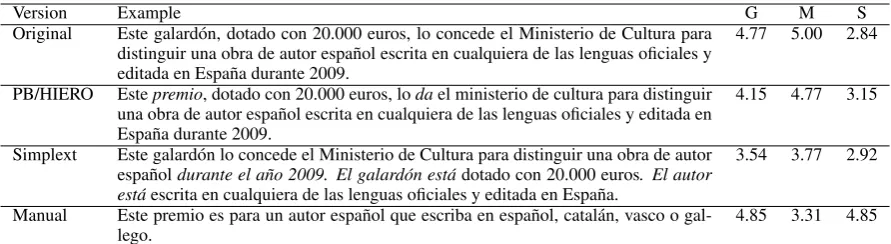
As can be seen (Table 4), the systems built using theLightcorpus were rated higher than those built using theHeavycorpus on all three aspects (espe-cially pronounced for grammaticality and mean-ing preservation). The performances of the PB and HIERO models built using theHeavycorpus achieved almost the same scores, while the PB model was rated as slightly better than HIERO in the case when the models were built using the Light corpus (the differences in G and M scores were statistically significant at a 0.01 level of sig-nificance4). It is interesting to note that the mean-ing preservation (M) score was higher for both SMT-models built using theLightcorpus than for the manual simplifications. This reflects the fact that manual simplification often relies on heavy paraphrasing and sometimes does not retain all in-formation present in the original sentence (see the example in Table 9, Section 5).
Additionally, we calculated how many times: (1) the output of the systems built using theLight corpus was rated better than the output of the sys-tems built using theHeavycorpus on the same test sentence (Table 5), and (2) the output of the HI-ERO models was rated better than the output of
Version Example G M S Original Este galard´on, dotado con 20.000 euros, lo concede el Ministerio de Cultura para
distinguir una obra de autor espa˜nol escrita en cualquiera de las lenguas oficiales y editada en Espa˜na durante 2009.
4.77 5.00 2.84
PB/HIERO Estepremio, dotado con 20.000 euros, lodael ministerio de cultura para distinguir una obra de autor espa˜nol escrita en cualquiera de las lenguas oficiales y editada en Espa˜na durante 2009.
4.15 4.77 3.15
Simplext Este galard´on lo concede el Ministerio de Cultura para distinguir una obra de autor espa˜noldurante el a˜no 2009. El galard´on est´adotado con 20.000 euros. El autor est´aescrita en cualquiera de las lenguas oficiales y editada en Espa˜na.
3.54 3.77 2.92
Manual Este premio es para un autor espa˜nol que escriba en espa˜nol, catal´an, vasco o
gal-lego. 4.85 3.31 4.85
Table 9: An example of an original sentence, its manual simplification, and its automatic simplifications generated by three different ATS systems (deviations from the original sentences are shown in italics; columns ‘G’, ‘M’, and ‘S’ contain mean value of the scores for grammaticality, meaning preservation, and simplicity obtained from all thirteen annotators)
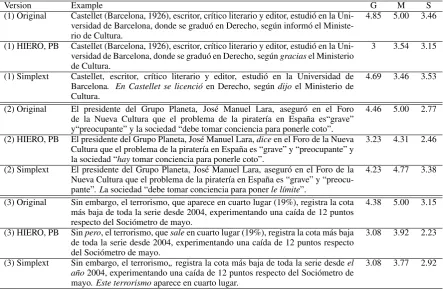
average). In all of those cases when the SMT-based systems scored lower than the Simplext sys-tem the reason was one (or both) of the follow-ing: the system performed one wrong lexical sub-stitution which led to a low grammaticality score; and/or the system did not perform sentence split-ting and the Simplext system did. Table 10 con-tains three such examples.
In the first example (1), the SMT-based systems applied an incorrect lexical substitution, replac-ing the word “inform´o” (informed) with “gracias” (thanks). That led to an ungrammatical output of the system and the lower total score. The same word was correctly simplified by the Simplext sys-tem using the word “dijo” (said) instead. The Simplext system additionally performed a sen-tence splitting. During that process, the name of the university at which the writer graduated has been replaced with the name of the writer, which changed the original meaning of the sen-tence. However, this did not lead to an ungram-matical output (as opposed to the wrong lexical substitution performed by the SMT-based mod-els), and the Simplext system thus obtained better scores for grammaticality (G) and simplicity (S), and a lower score for meaning preservation (M) than the SMT-based systems.
In the second example (2), the SMT-based sys-tems performed one good lexical simplification (which was not performed by the Simplext sys-tem) by replacing the word “asegur´o” (assured) with the word “dice” (says). However, our sys-tems also applied one incorrect lexical simplifica-tion which, although it did not change the origi-nal meaning of the sentence, led to the ungram-matical output. In the same example, the
Sim-plext system correctly split the original sentence into two shorter sentences and performed one cor-rect lexical simplification. The changes made by the Simplext system led to a small grammatical issue (“poner le” should be written together), but this did not significantly influence grammaticality score (G).
The third example (3) illustrates the case in which the Simplext system was rated better than the SMT-based systems because it performed a sentence splitting when the SMT-based systems did not. At the same time, the SMT-based systems applied one correct lexical simplification. The same word was left unchanged by the Simplext system. However, it appears that human evalua-tors tend to give a higher simplicity score to the system which performs sentence splitting than to the system which performs lexical simplification (in the case that each of the systems performs only one of the two possible modifications).
7 Conclusions and Future Work
Version Example G M S (1) Original Castellet (Barcelona, 1926), escritor, cr´ıtico literario y editor, estudi´o en la
Uni-versidad de Barcelona, donde se gradu´o en Derecho, seg´un inform´o el Ministe-rio de Cultura.
4.85 5.00 3.46
(1) HIERO, PB Castellet (Barcelona, 1926), escritor, cr´ıtico literario y editor, estudi´o en la Uni-versidad de Barcelona, donde se gradu´o en Derecho, seg´ungraciasel Ministerio de Cultura.
3 3.54 3.15
(1) Simplext Castellet, escritor, cr´ıtico literario y editor, estudi´o en la Universidad de Barcelona. En Castellet se licenci´oen Derecho, seg´undijoel Ministerio de Cultura.
4.69 3.46 3.53
(2) Original El presidente del Grupo Planeta, Jos´e Manuel Lara, asegur´o en el Foro de la Nueva Cultura que el problema de la pirater´ıa en Espa˜na es“grave” y“preocupante” y la sociedad “debe tomar conciencia para ponerle coto”.
4.46 5.00 2.77
(2) HIERO, PB El presidente del Grupo Planeta, Jos´e Manuel Lara,diceen el Foro de la Nueva Cultura que el problema de la pirater´ıa en Espa˜na es “grave” y “preocupante” y la sociedad “haytomar conciencia para ponerle coto”.
3.23 4.31 2.46
(2) Simplext El presidente del Grupo Planeta, Jos´e Manuel Lara, asegur´o en el Foro de la Nueva Cultura que el problema de la pirater´ıa en Espa˜na es “grave” y “preocu-pante”. La sociedad “debe tomar conciencia para ponerle l´ımite”.
4.23 4.77 3.38
(3) Original Sin embargo, el terrorismo, que aparece en cuarto lugar (19%), registra la cota m´as baja de toda la serie desde 2004, experimentando una ca´ıda de 12 puntos respecto del Soci´ometro de mayo.
4.38 5.00 3.15
(3) HIERO, PB Sinpero, el terrorismo, quesaleen cuarto lugar (19%), registra la cota m´as baja de toda la serie desde 2004, experimentando una ca´ıda de 12 puntos respecto del Soci´ometro de mayo.
3.08 3.92 2.23
(3) Simplext Sin embargo, el terrorismo,,registra la cota m´as baja de toda la serie desdeel a˜no2004, experimentando una ca´ıda de 12 puntos respecto del Soci´ometro de mayo. Este terrorismoaparece en cuarto lugar.
3.08 3.77 2.92
Table 10: Three examples of the original sentences and their automatic simplifications generated by our systems and the Simplext system (deviations from the original sentences are shown in italics; the columns ‘G’, ‘M’, and ‘S’ contain mean value of the scores for grammaticality, meaning preservation, and simplicity obtained from all thirteen annotators)
by the Simplext system.
We acknowledge that the fact that we built the language models using the Europarl corpus which is not a good representative of “simplified” lan-guage (despite our efforts to filter out complex sentences) is probably one of the main reasons why the SMT-based systems are not able to gen-erate sentences as simple as those gengen-erated by Simplext. Our future work will thus focus on finding better strategies for filtering out complex sentences from the Europarl corpus (e.g. using just those sentences with certain simple syntactic structures, and those with simple and frequently used words).
Acknowledgements
The research described in this paper was par-tially funded by the project SKATER-UPF-TALN (TIN2012-38584-C06-03), Ministerio de Econom´ıa y Competitividad, Secretar´ıa de Es-tado de Investigaci´on, Desarrollo e Innovaci´on, Spain, the project ABLE-TO-INCLUDE (CIP-ICT-PSP-2013-7/621055), and by Science Foun-dation Ireland through the CNGL Programme
(Grant 12/CE/I2267) in the ADAPT Centre (www.adaptcentre.ie) at Dublin City University. We are also grateful to all the annotators for their evaluation efforts, and the anonymous reviewers for their constructive comments.
References
Sandra Maria Alu´ısio and Caroline Gasperin. 2010. Fostering Digital Inclusion and Accessibility: The PorSimples Project for Simplification of Portuguese
Texts. In Proceedings of the NAACL HLT 2010
Young Investigators Workshop on Computational Approaches to Languages of the Americas (YIW-CALA), pages 46–53. ACL.
M.A. Angrosh and A. Siddharthan. 2014. Text simpli-fication using synchronous dependency grammars: Generalising automatically harvested rules. In Pro-ceedings of the 8th International Natural Language Generation Conference (INGL), pages 16–25.
Alberto Anula. 2007. Tipos de textos, complejidad ling¨u´ıstica y facilicitaci´on lectora. InActas del Sexto Congreso de Hispanistas de Asia, pages 45–61.
Auto-Appendix A: Scoring Instructions Given to the Annotators
Grammaticality (G)
5 Grammatically correct sentence
4 One or two typos (not capitalised first letter of the sentence, ‘’s’ separated from the noun, missing comma, etc.)
3 One incorrect construction but the sentence still has a meaning (missing preposition in a phrasal verb, transitive instead of intransitive verb or vice versa, use of animate instead of inanimate object or vice versa, etc.)
2 A few incorrect constructions of the above type, or a combination of a typo and an incorrect construction, but the sentence is still meaningful
1 So many mistakes (or such a mistake) that the sentence is grammatically incorrect and completely meaningless
Meaning preservation (M)
5 The two sentences have exactly the same meaning
4 The meanings of the two sentences differ just in a nuance or some minimal addition of a world knowledge
3 The two sentences do not mean exactly the same, but the main point is the same 2 The meanings of the two sentences differ, but they are not opposite
1 The meanings of the two sentences are opposite
Simplicity (S)
5 Very simple (all words are short, frequent, and used with their most commonly used meaning) 4 Simple (a few longer words, but still frequent and used with their most commonly used meaning) 3 A few difficult words or phrases, but the overall meaning of the sentence is clear
2 Quite a few difficult words or phrases which makes it difficult to understand the main meaning of the sentence