168
Parallel Sentence Retrieval From Comparable Corpora for Biomedical
Text Simplification
R´emi Cardon UMR CNRS 8163 – STL
F-59000 Lille, France
Natalia Grabar UMR CNRS 8163 – STL
F-59000 Lille, France
Abstract
Parallel sentences provide semantically simi-lar information which can vary on a given di-mension, such as language or register. Parallel sentences with register variation (like expert and non-expert documents) can be exploited for the automatic text simplification. The aim of automatic text simplification is to better ac-cess and understand a given information. In the biomedical field, simplification may per-mit patients to understand medical and health texts. Yet, there is currently no such avail-able resources. We propose to exploit compa-rable corpora which are distinguished by their registers (specialized and simplified versions) to detect and align parallel sentences. These corpora are in French and are related to the biomedical area. Manually created reference data show 0.76 inter-annotator agreement. Our purpose is to state whether a given pair of specialized and simplified sentences is paral-lel and can be aligned or not. We treat this task as binary classification (alignment/non-alignment). We perform experiments with a controlled ratio of imbalance and on the highly unbalanced real data. Our results show that the method we present here can be used to au-tomatically generate a corpus of parallel sen-tences from our comparable corpus.
1 Introduction
Parallel sentences provide semantically similar in-formation which can vary on a given dimension. Typically, parallel sentences are collected in two languages and correspond to mutual translations. In the general language, the Europarl (Koehn,
2005) corpus provides such sentences in several pairs of languages. Yet, the dimension on which the parallelism is positioned can come from other levels, such as expert and non-expert register of language. The following pair of sentences (first in expert and second in non-expert languages) illus-trates this:
• Drugs that inhibit the peristalsis are con-traindicated in that situation
• In that case, do not take drugs intended for blocking or slowing down the intestinal tran-sit
Pairs of parallel sentences provide useful in-formation on lexicon used, syntactic structures, stylistic features, etc., as well as the correspon-dences between the languages or registers. Hence, pairs built from different languages are widely used in machine translation, while pairs differenti-ated by the register of language can be used for the text simplification. The purpose of text simplifica-tion is to provide simplified versions of texts, in order to remove or replace difficult words or infor-mation. Simplification can be concerned with dif-ferent linguistic aspects, such as lexicon, syntax, semantics, pragmatics and even document struc-ture.
Automatic text simplification can be used as a preprocessing step for NLP applications or for producing suitable versions of texts for humans. In this second case, simplified documents are typ-ically created for children (Vu et al., 2014), for people with low literacy or foreigners (Paetzold and Specia,2016), for people with mental or neu-rodegenerative disorders (Chen et al.,2016), or for laypeople who face specialized documents (Leroy et al.,2013). Our work is related to the creation of simplified medical documents for laypeople, such as patients and their relatives. It has indeed been noticed that medical and health documents con-tain information that is difficult to understand by patients and their relatives, mainly because of the presence of technical and specialized terms and notions. This situation has a negative effect on the healthcare process (AMA, 1999; Mcgray, 2005;
un-derstand medical and health information is an im-portant issue, which motivates our work.
In order to perform biomedical text simplifi-cation, we propose to collect parallel sentences, which align difficult and simple information, as they provide crucial and necessary indicators for automatic systems for text simplification. Indeed, such pairs of sentences contain cues on transfor-mations which are suitable for the simplification, such as lexical substitutes and syntactic modifica-tions. Yet, this kind of resources is seldom avail-able, especially in languages other than English. As a matter of fact, it is easier to access compa-rable corpora: they cover the same topics but are differentiated by their registers (documents ated for medical professionals and documents cre-ated for patients). More precisely, we can exploit an existing monolingual comparable corpus with medical documents in French (Grabar and Cardon,
2018). The purpose of our work is to detect and align parallel sentences from this comparable cor-pus. We also propose to test what is the impact of imbalance on categorization results: imbalance of categories is indeed the natural characteristics in textual data.
The existing work on searching parallel sen-tences in monolingual comparable corpora indi-cates that the main difficulty is that such sentences may show low lexical overlap but be neverthe-less parallel. Recently, this task gained in pop-ularity in general-language domain thanks to the semantic text similarity (STS) initiative. Dedi-cated SemEval competitions have been proposed for several years (Agirre et al.,2013,2015,2016). The objective, for a given pair of sentences, is to predict whether they are semantically similar and to assign a similarity score going from 0 (independent semantics) to 5 (semantic equiva-lence). This task is usually explored in general-language corpora (Coster and Kauchak, 2011;
Hwang et al.,2015;Kajiwara and Komachi,2016;
Brunato et al.,2016). Among the exploited meth-ods, we can notice:
• lexicon-based methods which rely on simi-larity of subwords or words from the pro-cessed texts or on machine translation ( Mad-nani et al.,2012). The features exploited can be: lexical overlap, sentence length, string edition distance, numbers, named entities, the longest common substring (Clough et al.,
2002; Zhang and Patrick, 2005; Qiu et al.,
2006;Nelken and Shieber,2006;Zhu et al.,
2010);
• knowledge-based methods which exploit ex-ternal resources, such as WordNet (Miller et al., 1993) or PPDB (Ganitkevitch et al.,
2013). The features exploited can be: over-lap with external resources, distance between the synsets, intersection of synsets, seman-tic similarity of resource graphs, presence of synonyms, hyperonyms or antonyms ( Mihal-cea et al., 2006; Fernando and Stevenson,
2008;Lai and Hockenmaier,2014);
• syntax-based methods which exploit the syn-tactic modelling of sentences. The fea-tures often exploited are: syntactic cate-gories, syntactic overlap, syntactic dependen-cies and constituents, predicat-argument rela-tions, edition distance between syntactic trees (Wan et al., 2006; Severyn et al., 2013; Tai et al.,2015;Tsubaki et al.,2016);
• corpus-based methods which exploit distri-butional methods, latent semantic analysis (LSA), topics modelling, word embeddings, etc. (Barzilay and Elhadad, 2003; Guo and Diab, 2012;Zhao et al., 2014;Kiros et al.,
2015;He et al.,2015;Mueller and Thyagara-jan,2016).
There has been work for detection of para-phrases in French comparable biomedical corpora (Del´eger and Zweigenbaum,2009), but there is no work on building a corpus for text simplification in the biomedical domain. Our work is positioned in this area.
In what follows, we first present the linguistic material used, and the methods proposed. We then present and discuss the results obtained, and con-clude with directions of future work.
2 Method
We use the CLEAR comparable medical cor-pus (Grabar and Cardon, 2018) available online1 which contains three comparable sub-corpora in French. Documents within these sub-corpora are contrasted by the degree of technicality of the in-formation they contain with typically specialized
1http://natalia.grabar.free.fr/
and simplified versions of a given text. These cor-pora cover three genres: drug information, sum-maries of scientific articles, and encyclopedia arti-cles. We also exploit a reference dataset with sen-tences manually aligned by two annotators.
2.1 Comparable Corpora
Table1 indicates the size of the comparable cor-pus in French: number of documents, number of words (occurrences and lemmas) in special-ized and simplified versions. This information is detailed for each sub-corpus: drug information (Drugs), summaries of scientific articles (Scient.), and encyclopedia articles (Encyc.).
The Drugs corpus contains drug information such as provided to health professionals and pa-tients. Indeed, two distinct sets of documents ex-ist, each of which contains common and specific information. This corpus is built from the public drug database2of the French Health ministry. Spe-cialized versions of documents provide more word occurrences than simplified versions.
The Scientific corpus contains summaries of meta-reviews of high evidence health-related ar-ticles, such as proposed by the Cochrane collabo-ration (Sackett et al.,1996). These reviews have been first intended for health professionals but re-cently the collaborators started to create simplified versions of the reviews (Plain language summary) so that they can be read and understood by the whole population. This corpus has been built from the online library of the Cochrane collaboration3. Here again, specialized version of summaries is larger than the simplified version, although the dif-ference is not very important.
The Encyclopedia corpus contains encyclo-pedia articles from Wikiencyclo-pedia4 and Vikidia5. Wikipedia articles are considered as technical texts while Vikidia articles are considered as their simplified versions (they are created for children from 8 to 13 year old). Similarly to the works done in English, we associate Vikidia with Simple Wikipedia6. Only articles indexed in the medical portal are exploited in this work. From Table1, we can see that specialized versions (from Wikipedia) are also longer than simplified versions.
2
http://base-donnees-publique. medicaments.gouv.fr/
3http://www.cochranelibrary.com/ 4https://fr.wikipedia.org
5
https://fr.vikidia.org 6http://simple.wikipedia.org
Those three corpora have different degrees of parallelism: Wikipedia and Vikidia articles are written independently from each other, drug infor-mation documents are related to the same drugs but the types of information presented for experts and laypeople vary, while simplified summaries from theScientificcorpus are created starting from the expert summaries.
2.2 Reference Data
The reference data with aligned sentence pairs, which associate technical and simplified contents, are created manually. We have randomly selected 2x14 Encyclopedia articles, 2x12 Drugs docu-ments, and 2x13Scientific summaries. The sen-tence alignment is done by two annotators follow-ing these guidelines:
1. exclude identical sentences or sentences with only punctuation and stopword difference ;
2. include sentence pairs with morphological variations (e.g. Ne pas d´epasser la posolo-gie recommand´ee. and Ne d´epassez pas la posologie recommand´ee. – both examples can be translated byDo not take more than the recommended dose.);
3. exclude sentence pairs with overlapping se-mantics, when each sentence brings own con-tent, in addition to the common semantics;
4. include sentence pairs in which one sentence is included in the other, which enables many-to-one matching (e.g.C’est un organe fait de tissus membraneux et musculaires, d’environ 10 `a 15 mm de long, qui pend `a la partie moyenne du voile du palais.andElle est con-stitu´ee d’ un tissu membraneux et musculaire.
– It is an organ made of membranous and muscular tissues, approximately 10 to 15 mm long, that hangs from the medium part of the soft palate. andIt is made of a membranous and muscular tissue.);
corpus # docs # occsp # occsimpl #lemmassp #lemmassimpl
Drugs 11,800x2 52,313,126 33,682,889 43,515 25,725
Scient. 3,815x2 2,840,003 1,515,051 11,558 7,567
Encyc. 575x2 2,293,078 197,672 19,287 3,117
Table 1: Size of the three source corpora. Column headers: number of documents, total number of occurrences (specialized and simple), total number of unique lemmas (specialized and simple)
Specialized Simplified Alignment
source aligned source aligned rate (%)
# doc. # sent. # occ. # pairs. # occ. # sent. # occ. # pairs. # occ. sp. simp. D 12x2 4,416 44,709 502 5,751 2,736 27,820 502 10,398 18 11
S 13x2 553 8,854 112 3,166 263 4,688 112 3,306 20 43
E 14x2 2,494 36,002 49 1,100 238 2,659 49 853 2 21
Table 2: Size of the reference data with consensual alignment of sentences. Column headers: number of docu-ments, sentences and word occurrences for each subset, alignment rate
that situation. andIn that case, do not take drugs intended for blocking or slowing down the intestinal transit.).
The judgement on semantic closeness may vary according to the annotators. For this reason, the alignments provided by each annotator undergo consensus discussions. This alignment process provides a set of 663 aligned sentence pairs. The inter-annotator agreement is 0.76 (Cohen, 1960). It is computed within the two sets of sentences proposed for alignment by the two annotators.
Table 2 shows the details of the manually aligned set of sentences. Because the three cor-pora vary in their capacity to provide parallel sen-tences, we compute their alignment rate. The alignment rate for a given corpus is the number of sentences that are part of an aligned pair relative to the total number of sentences. As expected, only a tiny fraction of all possible pairs corresponds to aligned sentences. We can observe that the Sci-entificcorpus is the most parallel with the highest alignment rate of sentences, while the two other corpora (DrugsandEncylopedia) contain propor-tionally less parallel sentences. Sentences from simplified documents in the Scientific and drugs
corpora are longer than sentences from special-ized documents because they often add explana-tions for technical noexplana-tions, like in this example:
We considered studies involving bulking agents (a fibre supplement), antispasmodics (smooth muscle relaxants) or antidepressants (drugs used to treat depression that can also change pain perceptions) that used outcome measures including
improve-ment of abdominal pain, global assessimprove-ment (over-all relief of IBS symptoms) or symptom score. In theEncylopediacorpus such notions are replaced by simpler words, or removed. Finally, in all cor-pora, we observe frequent substitutions by syn-onyms, like{nutrition,food},{enteral,directly in the stomach}, or {hypersensitivity, allergy}. No-tice that with such substitutions, lexical similarity between sentences is reduced.
The documents are pre-processed. They are segmented into sentences using strong punctuation (i.e. .?!;:). We removed, from each subcorpus, the sentences that are found in at least half of the doc-uments of a given corpus. Those sentences are typ-ically legal notices, section titles, and remainders from the conversion of the HTML versions of the documents. The lines that contain no alphabetic characters have also been removed. That reduces the total number of possible pairs for each docu-ment pair approximately from 940,000 to 590,000.
2.3 Automatic Detection and Alignment of Parallel Sentences
Automatic detection and alignment of parallel sen-tences is the main step of our work. The unity processed is a pair of sentences. The objective is to categorize the pairs of sentences in one of the two categories:
• alignment: the sentences are parallel and can be aligned;
The reference data provide 663 positive exam-ples (parallel sentence pairs). In order to perform the automatic categorization, we also need nega-tive examples, which are obtained by randomly pairing all sentences from all the document pairs except the sentence pairs that are already found to be parallel. Approximately 590,000 non-parallel sentences pairs are created in this way. That high degree of imbalance is the main challenge in our work and we address it in the experimental design (sec2.4).
For the automatic alignment of parallel sen-tences, we first use a binary classification model that relies on the random forests algorithm (Breiman, 2001). The implementation we use is the one that is available in scikit-learn (Pedregosa et al.,2011). Our goal is to propose features that can work on textual data in different languages and registers. We use several features which are mainly lexicon-based and corpus-based, so that they can be easily applied to textual data in other corpora, speacialized areas and languages or trans-posed on them. The features are computed on word forms (occurrences). The features are the following:
1. Number of common non-stopwords. This feature permits to compute the basic lexical overlap between specialized and simplified versions of sentences (Barzilay and Elhadad,
2003). It concentrates on non-lexical content of sentences;
2. Percentage of words from one sentence in-cluded in the other sentence, computed in both directions. This features represents pos-sible lexical and semantic inclusion relations between the sentences;
3. Sentence length difference between special-ized and simplified sentences. This feature assumes that simplification may imply stable association with the sentence length;
4. Average length difference in words between specialized and simplified sentences. This feature is similar to the previous one but takes into account average difference in sentence length;
5. Total number of common bigrams and tri-grams. This feature is computed on charac-ter ngrams. The assumption is that, at the
sub-word level, some sequences of characters may be meaningful for the alignment of sen-tences if they are shared by them;
6. Word-based similarity measure exploits three scores (cosine, Dice and Jaccard). This fea-ture provides a more sophisticated indica-tion on word overlap between two sentences. Weight assigned to each word is set to 1;
7. Character-based minimal edit distance( Lev-enshtein,1966). This is a classical acception of edit distance. It takes into account basic edit operations (insertion, deletion and sub-stitution) at the level of characters. The cost of each operation is set to 1;
8. Word-based minimal edit distance ( Leven-shtein,1966). This feature is computed with words as units within sentence. It takes into account the same three edit operations with the same cost set to 1. This feature permits to compute the cost of lexical transformation of one sentence into another;
9. WAVG. This features uses word embeddings. The word vectors of each sentence are aver-aged, and the similarity score is calculated by comparing the two resulting sentence vectors (Stajner et al.,2018);
10. CWASA. This feature is the continuous word alignment-based similarity analysis, as de-scribed in (Franco-Salvador et al.,2016).
For the last two features, we trained the em-beddings on the CLEAR corpus using word2vec (Mikolov et al., 2013), and the scores are com-puted using the CATS tool (Stajner et al.,2018).
2.4 Experimental Design
The set with manually aligned pairs is divided into three subsets:
• equivalence: 238 pairs with equivalent se-mantics,
• tech in simp: 237 pairs with inclusion where the content of technical sentence is fully in-cluded in simplified sentence, and simplified sentence provides additional content,
(a) equivalence, test subsets (b) inclusion, technical in simple, test subsets
(c) inclusion, simple in technical, test subsets
(d) equivalence, real data (e) inclusion, technical in simple, real data
(f) inclusion, simple in technical, real data
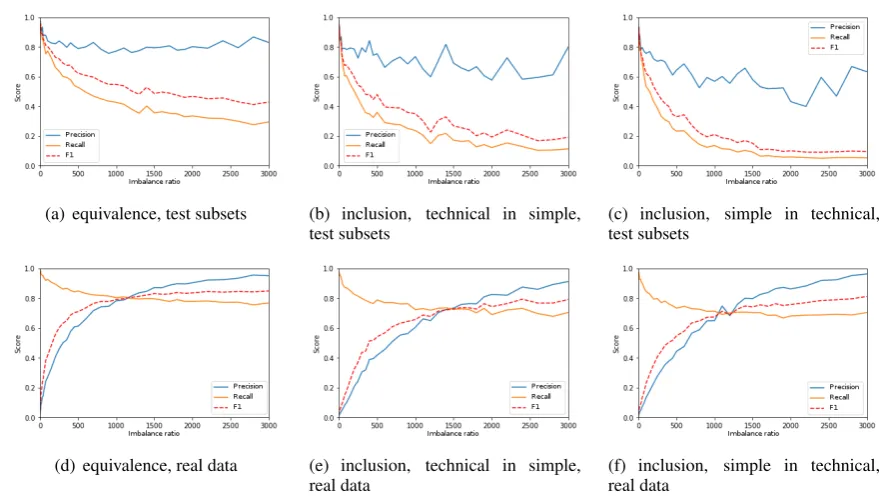
Figure 1: Precision, Recall and F-1 for the various experiments and subsets
For each subset, we perform two sets of experi-ments:
1. We train and test the model with balanced data (we randomly select as many non-aligned pairs as non-aligned pairs), and then we progressively increase the number of non-aligned pairs until we reach a ratio of 3000:1, which is close to the real data (∼4000:1).
2. Then, for each ratio, we apply the obtained model to the whole dataset and evaluate the results. Note that the training data is included in the whole dataset, we proceed this way be-cause of the low volume of available data.
As there is some degree of variability coming with the subset of non-aligned pairs that are ran-domly selected for the imbalance ratio, every sin-gle one of those experiments has been performed fifty times: the results that are presented corre-spond to the mean values over the fifty runs.
2.5 Evaluation
For evaluating the results, in each experiment we divide the indicated datasets in two parts: two thirds for training and one third for testing. The metrics we use are Recall, Precision and F1 scores. As we are primarily focused on detection of the aligned pairs, we only report scores for that class. Another reason to exclude the negative class and
the global score from the observations is that when the data are imbalanced (negative class is grow-ing progressively), misclassifygrow-ing the positive data has little influence over the global scores, which thus always appear to be high (metrics above 0.99).
Finally, we apply the best model for equivalent pairs on another 30 randomly selected documents and evaluate the output.
3 Presentation and Discussion of Results
We present the results in Figure1: Thexaxis rep-resents the growing of imbalance (the first posi-tion is1and corresponds to balanced data), while they axis represents the values of Precision, Re-call and F-measure. The results for the three sub-sets are presented: equivalence (Figures1(a) and
1(d)), inclusion of technical sentence in simple sentence (Figures 1(b) and 1(e)), and inclusion of simple sentence in technical sentence (Figures
1(c)and1(f)). Besides, Figures1(a),1(b)and1(c)
equivalence simp. in tech. tech. in simp. intersection false positives
nb. of pairs 56 10 4 9 1
ratio 70% 12.5% 5% 11.25% 1.25%
Table 3: Breakdown by pair types of the output of the model trained on equivalent pairs with an imbalance ratio of 1200:1 and applied to 30 randomly chosen pairs of documents
The most visible conclusion we can draw from those experiments is that equivalent pairs (Figures
1(a)and1(d)) are easier to classify than inclusion pairs (the rest of the Figures). Values of both, Pre-cision and Recall, are higher on the equivalence dataset at different imbalance points. For instance, with training on the equally balanced dataset (po-sition 1 on Figure 1(a)), the scores for Precision (0.98) and Recall (0.95) are higher than the scores obtained by the technical in simple dataset (0.96 Precision and 0.94 Recall) and the simple in tech-nical dataset (0.95 Precision and 0.93 Recall) at the same point. For the application to the real data, for ratio 1200:1 – the point where Precision and Recall meet for equivalent pairs, see Figure 1(d)
– we obtain 0.81 Precision and 0.81 Recall. At that same ratio, for the technical in simple pairs the scores are 0.65 Precision and 0.73 Recall, and for the simple in technical pairs Precision is 0.73 and Recall is 0.70. This result is positive because the equivalence dataset usually provides the main and the most complete information on transforma-tions required for the simplification. As for the inclusion relations, they cover a large variety of situations which do not necessarily correspond to the searched information. This is illustrated by the unstability of the curves in Figures1(b)and1(c), whereas they are smooth in Figure1(a). The neg-ative examples subset seems to have a quite high influence on the results, which indicates that it is more difficult to draw a clear separation between positive and negative examples. We need to design additional processing steps to be able to classify those pairs in a more efficient way.
We can also observe from Figures 1(a), 1(b)
and 1(c) that the use of balanced data provides very high results, both for Precision and Recall, which are very close to the reference data (>0.90 performance). This is true for the three subsets tested (equivalence and inclusions). These good results in an artifical setting cannot be applied to the real dataset, as is indicated by the starting point in Figures1(d),1(e)and1(f). Yet, the imbalance has greater effect on the inclusion datasets, while
again the equivalence dataset resists better. An in-teresting fact is that, when the model is learned on a substantial degree of imbalance, the Precision score is high when that model is applied to the real data, which has a ratio of about 4,000:1. This is interesting because it shows that the model is par-ticularly good at discriminating counter-examples. The recall value is also high, but since two thirds of the real data examples have been used for train-ing, that good score should be considered cau-tiously. We are planning to evaluate the models on a separate set of manually annotated documents. This is still a good result, as during the tests that we performed with other classification algorithms, the models did not successfully recognize the ex-amples they had seen during training.
For further evaluation, we randomly selected 30 pairs of documents to evaluate the performances of the models. We used the model that was trained at a ratio of 1200:1 on equivalent pairs. In terms of precision, the model shows 98.75% on all the sentence pairs aligned (80 sentence pairs), includ-ing equivalence, inclusions and intersection. Ta-ble3shows the breakdown of this output in terms of pair types: 70% (56 pairs) are equivalent pairs, 29% (23 pairs) are examples of inclusion (10 sim-ple in technical, 4 technical in simsim-ple) and inter-section (9), and one pair contains two unrelated sentences. Those results show that we have a model that can be used to automatically generate a parallel corpus with reduced noise, from highly imbalanced comparable corpus, for text simplifi-cation purposes.
4 Conclusion and Future Work
We addressed the task of detection and alignment of parallel sentences from a monolingual compa-rable French corpus. The compacompa-rable aspect is on the technicality axis, as the corpus contrasts tech-nical and simplified versions of information on the same subjects. We use the CLEAR corpus, that is related to the biomedical area.
Tu Thanh Vu, Giang Binh Tran, and Son Bao Pham. 2014. Learning to simplify children stories with limited data. In Intelligent Information and Database Systems, pages 31–41.
Stephen Wan, Mark Dras, Robert Dale, and Cecile Paris. 2006. Using dependency-based features to take the para-farce out of paraphrase. In Aus-tralasian Language Technology Workshop, pages 131–138.
Yitao Zhang and Jon Patrick. 2005. Paraphrase iden-tification by text canonicalization. In Australasian Language Technology Workshop, pages 160–166.
Jiang Zhao, Tian Tian Zhu, and Man Lan. 2014. ECNU: One stone two birds: Ensemble of heteroge-nous measures for semantic relatedness and textual entailment. In Workshop on Semantic Evaluation (SemEval 2014), pages 271–277.