An Evaluation Tool for Machine Translation: Fast Evaluation for MT Research
Sonja Nießen, Franz Josef Och, Gregor Leusch, Hermann Ney
Lehrstuhl f¨ur Informatik VI RWTH Aachen – University of Technology
D-52056 Aachen, Germany
fniessen,och,[email protected]
Abstract
In this paper we present a tool for the evaluation of translation quality. First, the typical requirements of such a tool in the framework of machine translation (MT) research are discussed. We define evaluation criteria which are more adequate than pure edit distance and we describe how the measurement along these quality criteria is performed semi-automatically in a fast, convenient and above all consistent way using our tool and the corresponding graphical user interface.
1.
Introduction
Research in machine translation suffers from the lack of suitable, consistent, and easy-to-use criteria for the evalu-ation of the experimental results. The question of how the performances of different translation systems on a certain corpus can be compared or how the effects of small changes in the system prototypes can be judged in a fast and cheap way is still open.
Efforts in the field of the evaluation of translation qual-ity have focussed on measuring the suitabilqual-ity of a certain translation program as part of a distinct natural language processing task (White and Taylor, 1998; Sparck Jones and Galliers, 1996). Evaluation methods, which are ‘ideal’ in this respect would be too time-consuming to help the daily work of machine translation research.
2.
Quality Criteria in MT Research
When researchers compare the performances of differ-ent translation systems or when they are interested in the effects of small changes in the system prototypes, they typ-ically measure one or both of the following criteria:Word Error Rate (WER): The edit distance d(t;r)
(number of insertions, deletions and substitutions) be-tween the produced translation tand one predefined
reference translation r is calculated. The edit
dis-tance has the great advantage to be automatically com-putable, and as a consequence, the results are inexpen-sive to get and reproducible, because the underlying data and the algorithm are always the same.
The great disadvantage of the WER is the fact that it depends fundamentally on the choice of the sam-ple translation. In machine translation this criterion is used e.g. in (Vidal, 1997), and (Tillmann et al., 1997).
Subjective Sentence Error Rate (SSER): The
transla-tions are scored by classification into a small number of quality classes, ranging from “perfect” to “abso-lutely wrong”. In comparison to the WER, this crite-rion is more liable and conveys more information, but to measure the SSER is expensive, as it is not com-puted automatically but is the result of labourous eval-uation by human experts. Besides, the results depend highly on the persons performing the evaluation and
hence, the comparability of results is not guaranteed. Another disadvantage is the fact that the length of the sentences is not taken into account: The score of the translation of a long sentence has the same impact on the overall result as the score of the translation of a one-word sentence. The SSER is used e.g. in (Nießen et al., 1998).
3.
Semi-Automatic Evaluation
One of the characteristics of MT research is the fact that different prototypes of translation systems are tested
many times on one distinct set of test sentences (for
exam-ple for adjusting parameter settings or examining the effects of slight changes in system design). Sometimes the result-ing translations differ only in a small number of words.
The idea now is to store an input sentences together
with all translations T(s) = t 1
;:::;t
K that have already
been manually evaluated together with their scores in a databaseDB.
In addition, a suitable graphical user interface per-mits convenient manipulation of the database and provides means for calculating several kinds of statistics on it.
This approach and the resulting evaluation tool give us the following opportunities:
automatically return the scores of translations that
have already occured at least once. Hence, consis-tency of quality judgements over time is guaranteed (see 3.1.1.).
facilitate the evaluation of new translations, that
dif-fer only slightly from previous ones (see 5.2.). This makes evaluation more efficient and helps mainte-nance of consistency.
extrapolate scores for new translations by comparison
with similar sentences inDB(see 3.1.1.).
define new types of quality criteria (see 3.2. and 3.3.).
3.1. Definition of SSER
In our evaluation scheme, each translationtfor an input
sentencesis assigned a scorev(s;t)ranging from 0 points
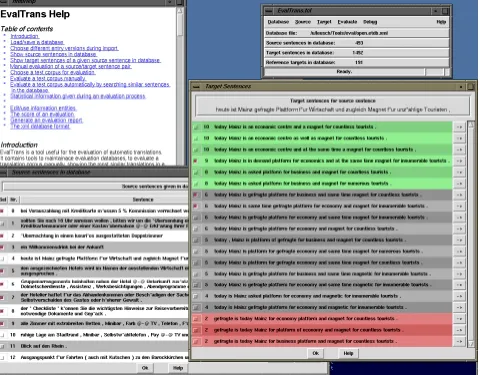
Figure 1: Overview of the GUI Layout.
The GUI offers the database manipulation operations import, export, selection, deletion and merging. The con-venient segmentation of source sentences into information items is also supported. The implementation of a search method is planned. The interface also contains a help sys-tem based on hypertext.
The most important purpose of the GUI is on the one hand to display statistics about the status of the database and about a distinct set of candidate translations and on the other hand to facilitate the manual evaluation of new trans-lations.
5.1. Displaying of Statistics
Three major kinds of statistics can be displayed:
1. For a selected source sentences, compute the average
number of correctly translated information items by sentences inT(s)(this conveys the “difficulty” ofs).
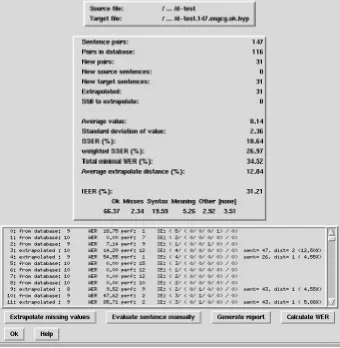
An example is shown in Figure 2.
2. For any subset of all scored and stored target sen-tences, display the average (absolute) estimation error (see section 6.2.1. and Figure 3).
3. For a given set ofnpairs(s 1
;t
1 ):::(s
n ;t
n
), the
fol-lowing operations are possible: Print the eSSER, the
Figure 2: Statistics on information item error rate.
Figure 3: The average (absolute) estimation error.
average normalized edit distance d(t
n
1
) and the
av-erage multi reference WER and for all pairs(s i
;t
i ),
print the estimated score v(s~ i
;t
i
Figure 4: Statistics for a sample set of candidate translations.
distance d(t i
;T(s
i
)), the multi reference WER, and
the number of information items translated correctly if(s
i ;t
i
)is already in the database. See Figure 4.
5.2. Manual Evaluation of new Translations
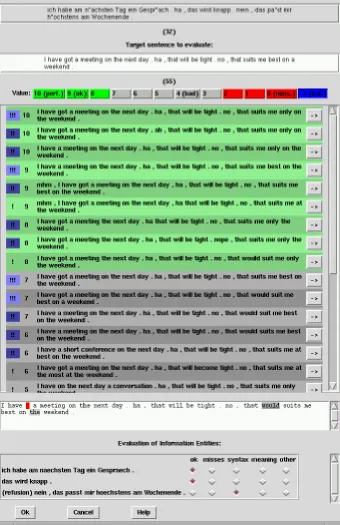
As can be seen in Figure 5, those candidate translations inDB, that are most similar to t
i are highlighted. When
moving the cursor over one of the candidates, all insertions, substitutions and deletions are marked in different colours. This facilitates the evaluation, as judgements can be made in comparison to other translations. The information items can be classified quickly by clicking on radio buttons for “ok” or one of the error classes.
6.
Evaluation of the Tool
The machine translation research group at the depart-ment for Language Processing and Pattern Recognition at the University of Technology in Aachen constantly per-forms experiments to control the progress of the develop-ment of their translation systems. The Evaluation tool has yet been used for the evaluation of results on three differ-ent test sets, the first from the Verbmobil corpus (Wahlster, 1993) with spontaneously spoken dialogs in the domain of appointment scheduling and the other two from the Eu-Trans 2 Zeres corpus with texts in the touristic domain (see
(Amengual et al., 1996) for a description of the first phase of this project). The corpus statistics and the range of the results on the test corpora for different translation methods in terms of SSER are briefly summarized in Table 1. The higher complexity of the EuTrans corpus (increased vocab-ulary size as well as smaller amount of training data and less constrained domain) results in higher SSER.
6.1. Efficiency of Manual Evaluation
The human evaluators who do the manual evaluation of the experimental results are students from the Department of English Language and Literature and the Department of Romance Languages.
They reported a substantial help for their work due to the graphical user interface. They also mentioned that the judgement of the information items not only caused an in-creased evaluation effort, but also helped getting a “feel-ing” for the quality of the translation under consideration. Highlighting of the most similar translation candidates and also marking the respective difference in terms of substitu-tions, insertions and deletions in different colours (see sec-tion 5.2. and Figure 5) helped speeding up the evaluasec-tion process substantially.
Figure 5: Manual evaluation of a new translation candidate.
Table 1: Example of SSER and corpus statistics for various tasks.
Verbmobil-147 EuTrans-closed EuTrans-open
Words in Vocabulary German 7 335 58 434
English 4 382 34 928
Number of Sentences Training 45 680 26 834
Test 147 100 100
of the sentence, provided that the evaluators were already familiar with the source sentence.
6.2. Quality of Estimation
The accuracy of the extrapolation of the SSER depends on many factors, like complexity of the translation task, variability of the evaluated translations, degree to which the database is filled, i.e. number of translations per source sentence, etc. The average normalized edit distance
d(t n
1 )
is a measure for the reliability of the eSSER for a certain set of new translations, whereas the methods described in subsection 6.2.1. allow for the computation of the expected estimation error on translations yet to be produced.
6.2.1. Leaving One Out validation (L1O)
As a measure for the reliability of the estimation of scores for new translation candidates, we compute the aver-age absolute extrapolation errorjEEj(DB)ranging from 0
to 10. In the following definition,T(DB)is the number of
target sentences contained inDB(normalization constant):
jEEj(DB)= 1
T(DB ) n
X
i=1 X
t2T(s
i )
jv(s
i
;t) v(s^
i
;t;T nt)j:
In words, the quantity conveys the following: For each tar-get sentencetfor a source sentences, try to estimate the
corresponding score from the other translation candidates (leaving one out scheme). The resulting estimate is com-pared to the real score of t. jEEj(DB)gives the overall
estimation error per sentence, i.e. a measurement for the reliability of the estimates for a distinct sentence. Note that the estimation process sometimes overestimates the quality of a translation, and sometimes the estimation is lower than the real score. It is for this reason that the eSSER on a set ofntranslation is more reliable than each estimated a score
of a distinct sentencet.
In Table 2, the results of the leaving one out validation on three different databases, representing different sets of test sentences, are summarized. The test sets are the same as summarized in Table 1. In Table 2, the column sym-bol “n” means “number of different source sentences” and
“T=n” stands for “average number of target sentences per
source sentence”. Note that for the Verbmobil corpusnist
smaller than the the number of sentences in the test corpus, because some sentences occur more than once.
Table 2: L1O Validation on different databases.
Database n T=n jEEj(DB)
Verbmobil-147 144 41.3 1.1
Eutrans open 100 42.9 1.0
Eutrans closed 100 12.8 1.4
Figure 6 shows the development of the average ab-solute extrapolation error as the database is gradually filled. On the x-axis, the respective database version of the Verbmobil-147 evaluation database is shown (old versions can easily be retrieved, as the databases are under revision control).
1.1 1.15 1.2 1.25 1.3 1.35 1.4 1.45 1.5
0 20 40 60 80 100 120
|EE|
DB revision
|EE|
Figure 6:jEEj(DB)versus revision number ofDB.
6.2.2. Example hypotheses files
For 26 sets of translations (11 from the Verbmobil-147 test set, 6 from EuTrans open, 15 from EuTrans closed), we stored the eSSER and the corresponding
d(t n
1
)just
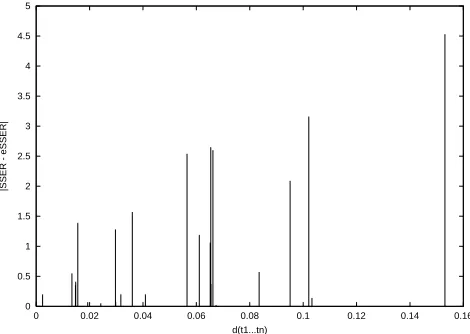
be-fore evaluating them and compared the estimate to the real SSER afterwards (i.e. we computed the absolute extra-polation errorjSSER - eSSERj). The resulting diagram is
shown in Figure 7. The average absolute extrapolation error on the 26 files was only 1.2 %.
On average 29.5 % of the sentences in the 26 sets de-scribed in this section had to be estimated, i.e. were not yet present in the database. This means that the tool saved at least 70 % of the evaluation effort for the evaluation of these 26 translation hypotheses files!
6.3. Consistency of Results
The following experiment would convey information about the sensibility of the evaluation results against the so called “human factor”, i.e. the question “how much would the SSER of a certain set of new candidates differ depend-ing on which evaluator performs the evaluation and on his or her current mental constitution?”: Randomly extract sen-tences with theirs scores from the database and make
eval-0 0.5 1 1.5 2 2.5 3 3.5 4 4.5 5
0 0.02 0.04 0.06 0.08 0.1 0.12 0.14 0.16
|SSER - eSSER|
d(t1...tn)
Figure 7: d(t
n
1
)versus absolute extrapolation error (jSSER
uators do the evaluation again. The resulting new score can be compared to the score formerly stored in the database. We have not performed this experiment so far.
6.4. Number of reference translations
In Table 3 the column symbolR =nmeans number of
reference translations (score 10) per source sentence. The EuTrans tests are more difficult than the test for Verbmo-bil. For this reason, and because less experiments have yet been run and thus less hypotheses have been evaluated for EuTrans-closed and especially for EuTrans-open, the num-ber of reference translations is small compared to an aver-age of 6 references for the Verbmobil test sentences.
Table 3: Number of reference translations.
Database R =n
Verbmobil-147 6.0
EuTrans closed 1.3
EuTrans open 2.0
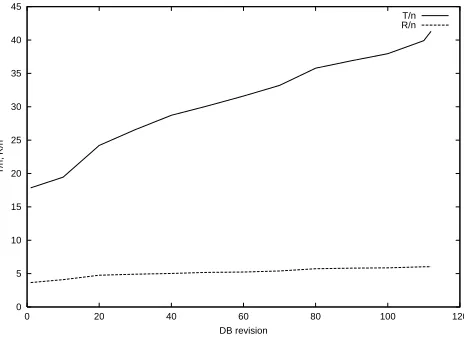
Figure 8 shows the development of the rateT=nof
tar-get sentences per source sentence and of the rate R =nof
reference sentences per source sentence on the Verbmobil-147 database. Again, the x-axis represents increasing revi-sion numbers.
0 5 10 15 20 25 30 35 40 45
0 20 40 60 80 100 120
T/n, R/n
DB revision
T/n R/n
Figure 8:jEEj(DB)versus revision number ofDB.
7.
Further Applications and planned
Improvements
We plan to facilitate the extraction of “difficult” source sentences in terms of average score and average rate of cor-rectly translated information items of all candidate transla-tions inDB.
Some improvements of the current implementation are planned to make the tool more comfortable for the evalu-ators and to support consistency: More “natural” similar-ity measures than the traditional edit distance would allow for crossings in the two compared sentences. As a conse-quence, a more balanced selection of database entries to be offered as similar to the current translation candidate is pos-sible. In future implementations, direct access to the infor-mation item evaluation of the most similar candidates will
be provided to help maintaining the consistency between new and previous judgements.
A revised guideline for evaluators, containing qualita-tive descriptions of the classification criteria, is currently created.
The software will be made available for non-commercial purposes. If the reader is interested in us-ing it, please feel free to send an email to one of the authors or to the MT research group (email adress: [email protected]).
Acknowledgement. This work was partly supported by the German Federal Ministry of Education, Science, Re-search and Technology under the Contract Number 01 IV 701 T4 (VERBMOBIL) and by the EUTRANSproject by the European Community (ESPRIT project number 30268).
8.
References
Alshawi, Hiyan, Srinivas Bangalore, and Shona Douglas, 1998. Automatic Acquisition of Hierarchical Transduc-tion Models for Machine TranslaTransduc-tion. In Proc. 36th
An-nual Conference of the Association for Computational Linguistics and the 17th International Conference on Computational Linguistics. Montr´eal, P.Q., Canada.
Amengual, J. C., J. M. Bened´ı, A. Casta˜no, A. Marzal, F. Prat, E. Vidal, J. M. Vilar, C. Delogu, A. di Carlo, H. Ney, and S. Vogel, 1996. Example-Based Under-standing and Translation Systems (EuTrans): Final Re-port, Part I. Deliverable of ESPRIT project No. 20268. Nießen, S., S. Vogel, H. Ney, and C. Tillmann, 1998. A DP
based Search Algorithm for Statistical Machine Trans-lation. In Proc. 36th Annual Conference of the
Asso-ciation for Computational Linguistics and the 17th In-ternational Conference on Computational Linguistics.
Montr´eal, P.Q., Canada.
Sparck Jones, Karen and Julia R. Galliers, 1996.
Evaluat-ing Natural Language ProcessEvaluat-ing Systems: An Analysis and Review. Lecture notes in computer science. Berlin:
Springer-Verlag.
Tillmann, C., S. Vogel, H. Ney, H. Sawaf, and A. Zu-biaga, 1997. Accelerated DP based Search for Statis-tical Translation. In Proceedings of the 5th European
Conference on Speech Communication and Technology, Rhodes, Greece.
Vidal, E., 1997. Finite-State Speech-to-Speech Transla-tion. In Proceedings of the International Conference on
Acoustics, Speech and Signal Processing, Munich, Ger-many.
Wahlster, W., 1993. Verbmobil: Translation of Face-to-Face Dialogs. In Proceedings of the MT Summit IV. Kobe, Japan.
White, John S. and Kathryn B. Taylor, 1998. A Task-Oriented Evaluation Metric for Machine Translation. In
Proc. First International Conference on Language Re-sources and Evaluation. Granada, Spain: European