CSEIT1831253 | Received : 01 Feb 2018 | Accepted : 11 Feb 2018 | January-February-2018 [(3) 1 : 1534-1539]
International Journal of Scientific Research in Computer Science, Engineering and Information Technology © 2018 IJSRCSEIT | Volume 3 | Issue 1 | ISSN : 2456-3307
1534
A Study on E-Learning and Cloud Computing
Dr. P. NeelakantanVNR Vignana Jyothi Institute of Engineering and Technology, Hyderabad, Telangana, India
ABSTRACT
PC based research facilities are an essential part of the e-learning condition. With the presentation of Cloud Computing innovations an ever increasing number of labs move into the cloud, known as virtual labs. While there are numerous advantages for utilizing virtual labs, there is likewise an expansion unpredictability in regards to the use of them. There are numerous cloud administration frameworks (Cloud MS) which include an additional layer of multifaceted nature to the e-taking in encounter both from the point of view of the educator and of the understudy. The reason for the investigation is to recognize approaches to enhance the learning procedure using distributed computing advances, while lessening the unpredictability related with these advances the principle center is about the asking for, creation, arrangement, observing and administration of virtual labs utilizing Cloud Computing. IBM Tivoli Service Automation Manager and VMware Hypervisor are utilized for building a private cloud. Moodle is utilized as the Course Management System (Course MS). The proposed Virtual LabCloud System (VLCS) offers one conceivable approach to enhance the learning procedure by utilizing Cloud Computing to offer Virtual Labs as a Service (VLaaS). The VLCS has the fundamental objective of offering virtual labs while expanding the cloud assets use. The proposed VLCS makes another connection between distributed computing and e-learning by giving virtual lab centers as a support of however many clients as could reasonably be expected while expanding the usage of private cloud assets. This approach offers the chance to upgrade the e-learning background with better approaches for educating.
Keywords :Cloud Computing, E-Learning, Virtual Labs, Vlab As A Service
I.
INTRODUCTION
The adoption of cloud technology within the instructional environment has the capacity of offering new opportunities for improvement and innovation of the gaining knowledge of process. This paper focuses on deployment, creation , requesting and virtual lab management using cloud computing.
Currently, maximum of those activities can be handled by the usage of a few kind of course management machine (course MS), like IBM Tivoli carrier Automation supervisor (TSAM) [1], Microsoft system center 2012 [2],VMware vCloud Suite [3], or Apache CloudStack [4]. All of those systems where designed to nice manipulate a Cloud Computing
platform on the infrastructure degree, in different words for presenting Infrastructure as a service (IaaS) [5]. IaaS represents the maximum primary cloud-provider model which generally approach the supplying of cloud resources as services, for instance, virtual machines. With using IaaS the extent of technical information required by means of the end consumer is the very best whilst comparing with the opposite fundamental cloud-provider fashions, Platform as a service(PaaS) [7] and software as a service (SaaS) [8].
might be represented by a virtual machine (hardware sources), the operating system (OS) and the required software and documents (software program sources).
The usage of virtual labs at some universities became implemented and tested at the IBM CloudBurst [9] platform which makes use of VMware as a hypervisor and IBM TSAM as a Cloud MS. Despite the fact that the simple capability of the virtual labs is working (introduction of virtual system templates, deployment of virtual machines based on templates), there are nevertheless functionalities that are lacking or tasks that want manual actions so as to be finished. The following section of the paper addresses the issues discussed above and the design of VLCS.
II.
VIRTUAL LABS CLOUD SYSTEM
The VLCS is a product framework configuration to fill the necessities of a scholarly domain by making a connection between a Cloud MS and a Course MS or E-Learning System, for instance Moodle [10]. VLCS will speak to another layer for making and overseeing virtual research facilities. While a Cloud Management System (either business or open-source) is compulsory, the presence of a Course Management System is profoundly prescribed yet a bit much for the use of the VLCS.
2.1. VLCS goals
The principle goal of the VLCS is to augment the use of private cloud assets keeping in mind the end goal to offer access to virtual research centers to however many clients as could be allowed. This should be possible by productively checking and booking the utilization of cloud assets.
The second target is to permit the instructing staff to center around the advancement of new, imaginative learning procedures and educational program without worrying about the many-sided quality behind the VLCS, specifically the cloud administration errands.
The third goal of the VLCS is the capacity to communicate with any (or the same number of) Cloud MS and Course MS as could be allowed. In the main phase of advancement, VLCS will offer help for the accompanying Cloud MS VMware vCenter, IBM TSAM and Microsoft System Center 2012. With respect to Course MS or e-Learning System, VLCS will offer help just for Moodle through a committed module.
2.2. Virtual Laboratory as a Service
VLCS centers around virtual research centers from the end-client or instructive point of view. Consequently VLCS presents the idea of Virtual Labs as a Service (VLaaS). VLaaS can be seen as another cloud benefit show which expands the IaaS by including e-learning usefulness. Utilizing VLaaS, end-clients still get cloud benefits as virtual machines and different assets, with the essential contrast that these administrations are designated to particular clients or client bunches just with regards to a course or research center.
2.3. Virtual labs administration
A virtual lab, center substance of the VLCS, is made out of equipment and programming assets which are facilitated in a cloud situation, private, open or half and half. The VLCS has bolster for the accompanying situations with respect to the administration of virtual research facilities: predefined virtual lab utilizing virtual machine formats or custom virtual lab utilizing on-request virtual machines and extra programming.
The making of preconfigured virtual machine layouts, the most tedious movement, requires the setup of the virtual machine (equipment arrangement), introducing the OS, the hypervisor apparatuses or drivers, the antivirus arrangement, including the required applications and additional records (e.g. research center manuals, course introduction).
client prerequisites without utilizing a preconfigured format, if assets are accessible and the manager affirms it (physically or naturally). The end-client can pick the equipment assets required, similar to the quantity of CPUs, number of centers per CPU, memory, storage room, organizing capacities. The product assets that the end-client could pick are identified with a rundown of bolstered working frameworks and any extra programming programs that ought to be introduce on the virtual machine.
The preconfigured format based arrangement is more suited for offering virtual labs, since the layouts can be set up ahead of time, tried and the virtual machines are made quicker when utilizing formats. The principle hindrances of this approach are that it requires watchful arranging, layout creation requires more opportunity to be made and tried and is less adaptable to change prerequisites contrasting with the on-request arrangement.
The custom formation of virtual machines offers incredible adaptability, yet makes issues for the utilization arranging of cloud assets. For this approach the assets made accessible should be characterized and designed as predefined parts that can be consolidated on-request by the client. For this situation, an on-request virtual machine will be made out of preconfigured parts like equipment arrangement, bolstered OS and applications.
2.4. Resource scheduling and allocation
VLCS utilizes Role based access control (RBAC) [11][12] to oversee client access and consents. The parts characterized in VLCS are autonomous of the security mechanics accessible in Cloud Management Systems or Course Management Systems. Right now VLCS characterizes the accompanying parts, which can be additionally expanded if necessary: Manager, Environment Administrator, Content Generator, and Content Consumer.
The asset designation ask for contains data about the client who will regulate the virtual machine(s), the
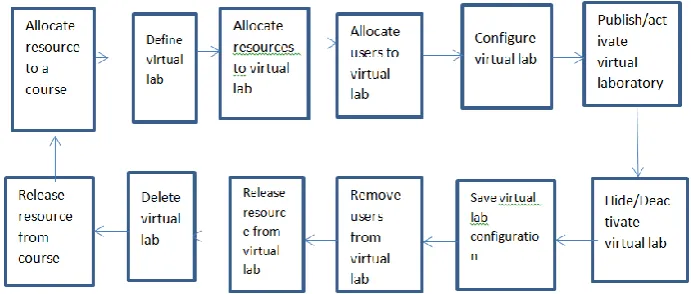
course for which the assets are asked for, the equipment and programming necessities and time limits for the accessibility of the cloud assets. The asset allotment ask for should be affirmed by the VLCS Environment Administrator before the real assets are designated. The Environment Administrator assigns assets just to the course level. The Content Generator is mindful to additionally distribute the assets to research centers and Content Consumers (understudies). For instance, an educator (Content Generator part) can ask for 30 virtual machines with a similar equipment design. At that point, 29 of these VMs will be apportioned to understudies while one of these VMs can be designed as a permitting server to be utilized by the other 29 machines. The lifecycle of a virtual lab (figure 1) is made out of the accompanying components:
Portion of cloud assets to a course. This progression is typically performed by the VLCS Content Generator and the demand is endorsed by VLCS Environment Administrator.
Characterizing the virtual lab inside a course. This progression is finished by the VLCS Content Generator. There can be numerous virtual research facilities for one course, all sharing the cloud assets assigned at the course level.
Distribution of cloud asset to the virtual research facility. In this progression the VLCS Content Generator characterizes which cloud assets designated for the course will be accessible for the current virtual research center Allocation of clients to the virtual lab. Before the VLCS Content Consumers can utilize the virtual research center the comparing clients should be added to the ebb and flow virtual lab. This progression is finished by the VLCS Content Generator. Client authorizations are additionally characterized at this progression.
the VMs arrangement, virtual system design and the timetable.
Distributing or initiating the virtual research center. Simply after a virtual lab is distributed the VLCS begins holding the assets as per the coveted calendar. This progression is finished by the VLCS Content Generator.
Covering up or deactivating the virtual research center. While dealing with the calendar of cloud assets VLCS does not consider the assets and timetables of dormant or delayed virtual research centers. This progression is finished by the VLCS Content Generator.
Spare the virtual research center setup. This progression, performed by VLCS Content Generator, is valuable keeping in mind the end goal to reproduce or reestablish a virtual lab at a later time. The spared data about of a virtual lab can incorporate name, portrayal, assets dispensed, clients distributed, VMs setup, virtual system arrangement, calendar and use history.
Expelling the clients from the virtual research facility. This progression can be performed naturally by VLCS or physically by VLCS Content Generator before expelling a virtual lab.
Discharge the cloud assets allotted at first to the virtual research facility. This progression can be performed naturally by VLCS or physically by VLCS Content Generator.
Erase the virtual research facility. This progression is finished by the VLCS Content Generator.
Discharge cloud assets designated to the course. This progression can be performed consequently by VLCS or physically by VLCS Content Generator. The arrival of assets should be possible incompletely or absolutely, if all the virtual research centers for that course are erased.
Keeping in mind the end goal to plan the utilization of cloud assets the accompanying situations are secured by the VLCS, in regards to the assignment of virtual machines: at least one virtual machines for every client (individual work area) [13] or per gathering of clients (pooled work area) [14], with nonstop uptime of the machine or planed (restricted) uptime of the machine The constrained or planed uptime of the virtual machine alludes to the timeframe when the machine ought to be accessible to utilize. Since this situation can apply to the scholarly condition, the quantity of clients who can profit by VLaaS can significantly increment when contrasting with the constant accessibility of virtual machines.
III.
RELATED WORK
The most related or comparative work to the VLCS introduced in this paper incorporates Virtual Computing research center (VCL) [15], Bluesky cloud structure [16], CloudIA [17], Snow Leopard Cloud [18], RESERVOIR [19]. These are centered for the most part around the administration of the cloud framework, while the VLCS concentrated on connecting the cloud foundation with the e-learning condition.
IV.
CONCLUSIONS
The proposed VLCS makes another connection between distributed computing and e-learning by giving virtual research centers as a support of however many clients as could be expected under the circumstances while expanding the use of private cloud assets. This approach offers the chance to upgrade the e-learning knowledge with better approaches for educating.
The VLCS is a software system design to fill the needs of an academic environment by creating a link between a Cloud MS and a Course MS or E-Learning System, for example Moodle [10]. VLCS will represent a new layer for creating and managing virtual labs. While a Cloud Management System (either commercial or open-source) is mandatory, the existence of a Course Management System is highly recommended but not necessary for the utilization of the VLCS.
V.
REFERENCES
[1]. M. Buzzetti, J. Kuchler, C. Lawrence, "Deploying a Cloud on IBM System z", IBM Redpaper, 2011 VMware, "VMware vCloud Architecting a vCloud", Technical White Paper, version 1.6 Microsoft Corporation, "Microsoft Private Cloud- Making It Real", White paper, 2013
[2]. A. Beloglazov, S. F. Piraghaj, M. Alrokayan, R. Buyya, "Deploying OpenStack on CentOS Using the KVM Hypervisor and GlusterFS Distributed File System", Technical Report CLOUDS-TR-2012-3, Cloud Computing and
Distributed Systems Laboratory, The University of Melbourne, 2012.
[3]. T. Grance, P. Mell, "NIST definition of cloud computing", National Institute of Standards and Technology, January 2011.
[4]. T. Velte, A. Velte, and R. Elsenpeter, "Cloud Computing, a Practical Approach (1 ed.)", McGraw-Hill, Inc., New York, USA, 2009 [5]. L. Wang, G.Laszewski, A. Younge, X. He, M.l
Kunze, J. Tao, C. Fu, "Cloud Computing: a Perspective Study", New Generation Computing, Volume 28, Issue 2, pp 137-146, Information Management System", Packt Publishing, 2011.
[8]. DF. Ferraiolo, DR. Kuhn, "Role-Based Access Control", 15th National Computer Security Conference, pp. 554– 563, 1992.
[9]. R. Sandhu, E.J. Coyne, H. L. Feinstein, C. E. Youman, "Role-Based Access Control Models", IEEE Computer (IEEE Press) 29 (2): 38–47, 1996.
[10]. Microsoft Corporation, "Deploying Personal Virtual Desktops by using Remote Desktop Web Access Step-by-Step Guide", 2011.
[11]. E, Stein S, Thompson J, "Powered by VCL— using Virtual Computing Laboratory (VCL) Technology to Power Cloud Computing", Proceedings of the 2nd international conference on the virtual computing initiative (ICVCI’08), 2008.
[12]. Dong B, Zheng Q, Qiao M, Shu J, Yang J, "BlueSky cloud framework: an e-learning framework embracing cloud computing Cloud Computing. LNCS, vol. 5931, Springer, 2009. [13]. A. Sulistio, C. Reich, F. Doelitzscher, "Cloud
[14]. E. Cayirci, C. Rong, W. Huiskamp, C. Verkoelen, "Snow Leopard Cloud: A Multi-national Education Training and Experimentation Cloud and Its Security Challenges", Cloud Computing. LNCS, Vol. 5931, Springer, 2009.