CSEIT1831448 | Received : 16 Feb 2018 | Accepted : 28 Feb 2018 | January-February-2018 [(3) 1 : 1795-1801]
International Journal of Scientific Research in Computer Science, Engineering and Information Technology © 2018 IJSRCSEIT | Volume 3 | Issue 1 | ISSN : 2456-3307
1795
Critical Analysis and Performance Comparison of Multicast
Routing Protocol in Mobile Ad-hoc Network
Tarali Kalita
*1, Prof. Shikhar Kr. Sarma
2*1Department of Computer science, NERIM group of Institutions, Khanapara, Guwahati, Assam, India 2Registrar, Cotton University, Guwahati, Assam, India
ABSTRACT
Mobile ad-hoc network (MANET) is a collection of mobile nodes and they can communicate via the radio signals. Multicasting plays significant role in MANET. There are so many protocol was developed for multicasting in MANET in last few years. Here we present comparative performance of five multicast routing protocol those are used in mobile ad-hoc network environment: MAODV, AMRIS, CAMP, ODMRP and MZRP. Keywords : MAODV, AMRIS, CAMP, ODMRP, MZRP, MANET, Multicasting.
I.
INTRODUCTION
Wireless network is very much popular day by day because of its advances and benefits. There are two types of Wireless network, one is infrastructured wireless network, where nodes (devices) can communicate via centralized administrator and other is infrastructureless wireless network which is also called mobile ad-hoc network (MANET). In MANET nodes are mobile and topology changes frequently. Because of this decentralized nature, it is not possible to use access point or router in MANET environment, so mobile nodes can act as a router as well as host and they can make direct communication between them. Here if receiver is unreachable from source using single hop it can use multiple hop. The characteristics of MANET are limited bandwidth due to radio waves, limited battery power and dynamic. Multicasting is a major challenge of mobile ad-hoc network. Multicasting means sending same packets from group of one or more sender to group of one or more receiver. It can minimize transmission cost while transmitting same packet from single sender to multiple receiver and also minimizes link bandwidth and reducing the power consumption. Multicasting is used in video/audio conferencing, battlefield, and
between source and destination. This paper organized as follows. Operations of five multicast routing protocols we summarized in section II. Section III gives the comparison among routing protocols. Section IV presents conclusion.
II.
PROTOCOL DESCRIPTION
A. Multicast extension for Ad-hoc On-demand Distance Vector (MAODV)
MAODV uses two processes, route discovery and route maintenance.
Route discovery process use route request (RREQ) and route reply (RREP) query. When a node wishes to join the multicast tree or if it has data to send to the node it broadcasts RREQ packet across the network. If a node is sending the join query then only the member of the multicast group will respond otherwise any node of the multicast tree can respond. After receiving the RREQ packet by a node, it can send the RREP packet to the source of the RREQ packet, if it is either the destination or it has the route to the destination with corresponding sequence number greater than or equal to that contained in the RREQ. If the message received by the intermediate node it rebroadcast the RREQ message to its neighbor. When a node receives RREQ message it update their information for the source node and creates the backward pointer to the source node in the routing table. A node can receive multiple RREP message, it can find out the route with greatest sequence number and shortest route to the member of the multicast group. Source node can send data packet to all the destination nodes after receiving the RREP packet.
For route maintenance purpose MAODV uses Group leader. When a node broadcast RREQ message it waits for RREP message and if it does not receive the RREP message, automatically send RREQ for second time and if it still does not get RREP message it act as group leader. Group leader is responsible for maintain the group tree by periodically sending hello message containing group sequence number for the
multicast group and this hello message refresh the routing table. When a node wants to terminate from group membership, if it is the leaf node it can easily terminate otherwise it must remain in the tree as a non group multicast group member.
B. Ad Hoc Multicast Routing Protocol Utilizing Increasing ID Numbers (AMRIS)
C. Core Assisted Mesh Protocol (CAMP)
CAMP has two types of mesh member: simplex member and duplex member. Simplex member can send out multicast data but duplex member can capable of both sending and receiving multicast data. When a node wishes to join multicast group, only core node is unreachable from the node that needs to join the group, the node broadcast the message using expanding ring search which eventually reaches some of the group member. CAMP ensures the shortest path from each source to each destination, the part of the multicast mesh. A node keeps the cache of the identifier of packet that it has recently forwarded, and node forward the multicast packet if packet identifier is not in the node’s cache. A node can easily leave from the group if no other node is dependent on it simply advertizing the change of group membership to their neighbors.
D. On- Demand Multicast Routing protocol Query message to entire network. After receiving the non-duplicate Join-query message the node store the information of upstream node and rebroadcast the message again. When the message received by the receiver it creates a Join-table and forward to its neighbor. When a node receive Join-table it checks whether next node Id from one of the entries match with its own Id. If yes then it means that this is the path to the source nodes and this node is a part of forward group. It then broadcast its own Join table to its neighbor. This process continues until it reaches
to source nodes via shortest path. Routes from sources to receivers build the mesh of nodes called forward group. In ODMRP source node periodically send Join-Query message to refresh the multicast route information between source and receiver node. E. Multicast Zone Routing Protocol (MZRP)
MZRP divides the entire network into some overlapping network zone of variable size. It is composed of Multicast InrAzone Routing Protocol(MIARP), and Multicast InteRzone Routing Protocol (MIERP). MIARP is able to keep track of group information in each node’s local routing zone and MIERP is able to construct the shared tree for a multicast group.
When a node wants to leave the multicast group and if it a leave node it can leave by sending prune message to its upstream node and upstream node remove the node from its downstream list. If the downstream list of an intermediate node becomes empty then it sends a TREE-PRUNE to its upstream node.
III.
Comparison of Multicast Routing
Protocol
A. Here we mentioned some comparison of the above protocols based on their performance.
1) Bandwidth
Bandwidth means the amount of data that can be carried from one point to another in a given time period (usually a second). Network bandwidth is usually expressed in bits per second (bps).
Proactive protocol (CAMP) consumes more bandwidth than reactive routing protocol (ODMRP, MAODV and AMRIS) since it periodically keeps track of up to date information of routes from source to receiver. ODMRP suffers from excessive flooding when there are a large number of senders and the duplicate transmissions waste bandwidth at low mobility. In AMRIS Joining and rejoining of a node may take long time and waste much bandwidth since each tries potential parent nodes arbitrarily. Also the usage of periodic beacons consumes bandwidth. MZRP also reduces the wastage of bandwidth. 2) Controlling packet
MAODV, AMRIS and ODMRP all are required packet control. But CAMP constructs a mesh without control packet flooding. It offers less control packet overhead and quick response to the mobility. MZRP reduces the control traffic produced by periodic flooding of routing information packets (proactive scheme).
3) Control overhead
Control overhead is a basic criterion on which highly reliable networks are made up and operated. The optimization of control overhead during the design
phase of a network gives high throughput and performance for the network. Controlling of overhead is a matter of concern in multicast networks. For the minimal overhead on demand routing protocols such as MAODV, AMRIS, MZRP and ODMRP can be best fit since they provide creation of mesh networks based on the need of the nodes that wants to join the group and thus the overhead can be balanced to a great extend.
ODMRP does not lead to extra overheads because link breaks does not generate control packets. ODMRP protocol does not support the large number of multicast sender which leads to extra routing overhead. In AMRIS, multicast beaconing mechanism is used to detect link failure which in turn results into extra overhead but it may incur very low overhead for a node to join or rejoin the session if it chooses a potential parent node which happens to be a tree node. In AMRIS routing overhead increases with smaller beaconing interval. In CAMP With correct routing information, shortest paths are included in the mesh and the joining procedure incurs very low overhead. It does not incur the overhead on addition of nodes to multicast group. But in CAMP, the periodic message exchanges among cores are a high overhead. MZRP reduces control overhead compared to reactive schemes. 4) Packet delivery ratio
Packet delivery ratio means number of data packet delivered to multicast receivers over the number of data packets supposed to be delivered to multicast receivers.
Since all the above protocols are used in MANET, so due to the mobility of nodes link is broken at any time which leads low packet delivery ratio. But mesh-based protocol provides better performance than tree-based protocol since they have alternate path in between source and receiver for packet transmission.
with increasing mobility of nodes. MZRP has more states at nodes involved in many groups, each having multiple sources. But due to IP tunnel used in data packet transmission, the data packet delivery ratio has improved.
5) Performance
In MAODV, multicast tree can be constructed more quickly and efficiently with the information of unicast route. But this protocol also has a disadvantage since the group leader continues flooding Group Hello messages even if no sender for the group exists. It uses shared tree approach which degrades the performance when single point of failure occurs. In AMRIS, the concept of increasing id-numbers is useful for constructing and maintaining a multicast tree. AMRIS results in poor performance due to number of transmissions and size of beacons. AMRIS can offer better performance by sending the beacon when no packets are being transmitted in given interval. CAMP gives better performance and supports scalability in comparison with the ODMRP. CAMP supports the increasing multicast group size. CAMP may give the better performance if it is modified to work with on-demand routing protocols. ODMRP does not support scalability. MAODV supports scalability as the group size increase which is not supported in ODMRP. MAODV uses shared tree approach which degrades the performance when single point of failure occurs. The performance of MAODV can be improved by reducing the overhead and controlling overhead can be done by using self pruning in network.
6) End-to-End Delay
End-to-end delay refers to the time taken for a
packet to be transmitted across a network from source to destination.
Here also mesh-based protocol better than tree based protocol. ODMRP proposes the concept of “forwarding group”. The offering of shortest paths reduces data delivery latency. ODMRP suffers from route acquisition delay while offering reduced network traffic. In AMRIS, nodes closer to the source have less end-to-end delay than nodes further away. CAMP offers less delay than ODMRP.
B. Here we compare protocols based on their characteristics.
1) Topology
Topology that can be used by the multicast routing protocols is either tree-based or mesh-based. MAODV, AMRIS and MZRP are tree based protocol and ODMRP and CAMP are mesh based protocol. If a protocol uses mesh topology, there are redundant path in between source and receiver, so failure of one link it can use another one for packet transmission. But on the other-hand in tree based protocols there is only single path in between source and receiver. Tree based protocols are simple but in MANET, packets are dropped until tree is reconstructed after the movement of a node.
2) Proactive/Reactive/Hybrid Protocol
CAMP is a proactive routing protocol. Proactive routing protocol is also known as Table-driven protocol, as routes to all destinations are assumed to exist in the form table, and it keeps the up to date information. Each nodes periodically update their information wherever topology changes. But MAODV, AMRIS and ODMRP all are reactive routing protocol. Reactive multicast routing protocols set up routes on demand. If a node wants to have communication with a node, to which it has no route, reactive protocols set up such route. Reactive protocols perform better for ad-hoc wireless network. MZRP is a hybrid protocol. Hybrid protocol takes the advantages of both proactive and reactive routing protocol. In MZRP routing is proactive inside the zone and reactive between the zones.
3) Initialization approach
4) Unicast routing protocol dependency
Using unicast routing protocol provides the information of availability of route. Unicast protocol is also used to work correctly in presence of router failure and network partition. To get correct distance to all destinations CAMP and MAODV both depends on unicast routing protocol but other protocols (AMRIS, ODMRP and MZRP) are not.
5) Periodic message
All the protocols discussed here use periodic message to get the information of presence of number of nodes, because in MANET at any time can join or leave the multicast group and topology can changes frequently.
6) Maintenance approach
Multicast topology formed is maintained either by soft state approach or hard state approach. In soft state approach the link between the nodes is maintained by sending refreshing control packets periodically thus resulting in high packet delivery with more control overheads. AMRIS and ODMRP use soft state approach. But in hard state approach control packets are flooded only when link failure is detected thus minimizes the cost of overhead which leads to low packet delivery ratio. MAODV, CAMP and MZRP use hard state approach.
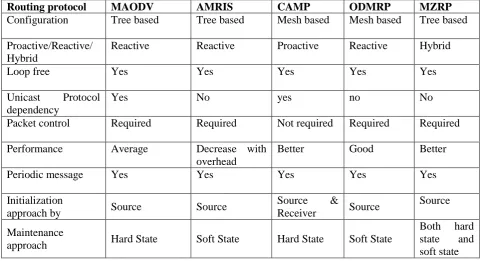
Table for comparison of Multicast routing protocol in MANET
Routing protocol MAODV AMRIS CAMP ODMRP MZRP
Configuration Tree based Tree based Mesh based Mesh based Tree based
Proactive/Reactive/ Hybrid
Reactive Reactive Proactive Reactive Hybrid
Loop free Yes Yes Yes Yes Yes
Unicast Protocol
dependency
Yes No yes no No
Packet control Required Required Not required Required Required
Performance Average Decrease with
overhead
Better Good Better
Periodic message Yes Yes Yes Yes Yes
Initialization
approach by Source Source
Source &
Receiver Source
Source
Maintenance
approach Hard State Soft State Hard State Soft State
Both hard
state and
soft state
IV.CONCLUSION
The general conclusion of this paper is that mesh-based routing protocols are out performed better than tree-based routing protocol. Tree based protocols gives the high data forwarding efficiency and low robustness. Tree based protocols are simple but in MANET packets are dropped until tree is reconstructed after the movement of a node. Mesh
based protocols provides robust performance due to redundant path availability.
bandwidth to keep routes up-to-date and little or no delay for route determination. Disadvantage is that it maintains routes that never be used. Reactive protocols perform better for ad-hoc wireless network as it causes lower overhead since routes are determined on demand. While network is divided into zones hybrid protocol is used. Each zone is a collection of nodes. Within the zone proactive protocol is used for routing and routing between the zones can be done using reactive routing protocol.
V.
REFERENCES
[1]. S. -J. Lee, M. Gerla, and C.-C. Chiang, "On-Demand Multicast Routing Protocol," In Proceedings of IEEE WCNC’99, New Orleans, LA, Sep. 1999, pp. 1298-1304.
[2]. C.W. Wu, Y.C. Tay, and C.-K. Toh, "Ad hoc Multicast Routing protocol utilizing Increasing id-numberS (AMRIS) Functional Specification," Internet-Draft, draft-ietf-manet-amris-spec-00.txt, Nov. 1998.
[3]. S.-J. Lee, W. Su, and M. Gerla, "On-Demand Multicast Routing Protocol (ODMRP) for Ad Hoc Networks," Internet-Draft, draft-ietf-manet-odmrp-01.txt, Jun. 1999.
[4]. "Multicast over wireless mobile ad hoc networks: Present and future directions", Carlos de Morais Cordeiro, Hrishikesh Gossain and Dharma P. Agrawal, IEEE Network, January 2003
[5]. "Exploring Mesh- and Tree Based Multicast Routing Protocols for MANETs", Kumar Viswanath, Katia Obraczka and Gene Tsudik. [6]. Z. J. Haas and M. R. Pearlman, "The
performance of query control schemes for the zone routing protocol," IEEE/ACM Transactions on Networking, Vol. 9, 2001, pp. 427-438. [7]. Xiaofeng Zhang and LillyKutty Jacob," MZRP:
An Extension of the Zone Routing Protocol for Multicasting in MANETs", Journal of Information Science and Engineering 20, 2004,pp. 535-551
[8]. Yufang Zhu and Thomas Kunz ,"MAODV Implementation for NS-2.26", Systems and Computing Engineering, Carleton University, Technical Report SCE-04-01, January 2004 [9]. "The Core-Assisted Mesh
Protocol",J.J.Garcia-Luna-Aceves and Ewerton L.Madruga.
[10]. Perkins, C. E. and Royer, E. M.; "Ad-hoc
On-Demand Distance Vector Routing", Proceedings of the 2nd IEEE Workshop on Mobile
Computing Systems and Applications