CSEIT1833196 | Received : 12 March 2018 | Accepted : 24 March 2018 | March-April-2018 [ (3 ) 3 : 409-416 ]
© 2018 IJSRCSEIT | Volume 3 | Issue 3 | ISSN : 2456-3307
409
A Novel Approach for Detecting and Matching Iris Crypts For
Human Recognition System
L. Ponnarasi1, S. Yoga2
1Research Scholar, Department of Computer Science, Sakthi college of Arts and Science For Women, oddanchatram, Tamil Nadu, India
2Assistant Professor, Department of Computer Science, Sakthi college of Arts and Science For Women, oddanchatram, Tamil Nadu, India
ABSTRACT
In a variety of applications, the iris is a secure biometric feature that has been extensively employed for human recognition. Though, exploitation of iris recognition in forensic applications has not been informed. A most important cause is being deficient in of human friendly approaches for comparing with iris. Additionally to endorse the utilization of iris recognition in forensics, the resemblance between irises be supposed to made visualizable and understandable. In recent times, a system was proposed, known as “a human-in-the-loop iris recognition system” which was based on detecting and matching iris crypts. Structuring on this system, a new approach for detecting and matching iris crypts automatically is proposed in this work. This detection method is capable to capture iris crypts of different sizes. This matching method is considered to handle possible topological modifications in the detection of the similar crypt in diverse images. This approach does better the well-known visible-feature-based iris recognition method on three dissimilar data sets. Subsequent to iris Crypts detection, Iris images were in use prior to and later than the treatment of eye disease and the outcome illustrates the mathematical divergence accomplished from treatment. Gabor filter is employed to extract the features. This iris recognition was efficiently endured with the majority of ophthalmic disease e.g. corneal oedema, iridotomies and conjunctivitis etc. This developed iris recognition be supposed to employed for resolving the potential issues that might reasonable in key biometric technology and medical diagnosis.
Keywords:Iris Recognition, Forensics, Human-In-The-Loop, Eye Pathology, Ophthalmic Disease, Iridotomies, Conjunctivitis, Visible Feature, Corneal Oedema.
I.
INTRODUCTION
Based on biometrics the demand for automated personal identification system has increased with a growing prominence in security. Because the conventional (cards or passwords based) can be broken by stealing cards and forgetting passwords. Thus, there is a requirement for identification systems identify humans which is independent on what person possesses or what person remembers. Biometrics can be separated into two main divisions: physiological and behavioral. The physiological class
is associated to the shape of the body which contains fingerprint, face recognition, palm print, hand geometry, and iris recognition. The behavioral class is associated to the behavior of a person and contains typing rhythm and voice.
pattern inconsistency among different persons is tremendous, since iris patterns acquire a high degree of randomness. Additionally, iris is extremely stable over time. Because the idea of automated iris recognition was developed in 1987, several researchers worked meanwhile that time and they developed different dominant methods. Those methods were based on the texture variations of the iris and can be separated into different techniques e.g. phase-based methods, texture analysis, and intensity variations etc.
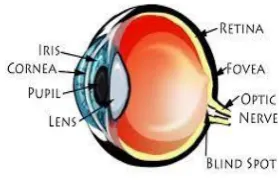
Figure 1. Structure of Iris
Nowadays most of the systems in used and they required unambiguous user collaboration, demanding that the user is placed properly to attain a quality image. These systems give acoustic response to the user to make certain that they are properly situated for image acquisition. In the United Kingdom, the Iris Recognition Immigration System (IRIS) is an intended system that appropriates travelers to authorize through border control stations at various airports rapidly, confirming their identification employing automated roadblocks. CANPASS in Canada is a related program to grant regular travelers to speedily proceed through security verification at airports.
Alternatively, as above study IRIS recognition is most reliable techniques in biometrics for human identification. Thus, the Daugman algorithm is able to acquire a false match rate below 1 in 200 billions. Iris recognition methods have been employed extensively by governments, for example the Aadhaar card project in India. Conversely, biometric feature in law of social control diligences the iris is under evaluation yet. One cause that obstructs the
forensic exploitation of iris is that iris recognition outcomes are not simply understandable to examiners. Thus “Iris Examiner Workstation” may be build equivalently to the “Tenprint Examiner Workstation”, which has been employed in forensics. In fingerprint recognition, a human auditor basis a choice on the number of matched details on two fingerprints. On compare, frequent iris recognition methods, e.g. Daugman’s framework, execute matching on an iris code, which is the outcome of employing a band-pass filter and quantizer to grayscale images. In these circumstances, the entire process becomes visible as a black-box to an examiner without knowing about image processing. Conduct tests have demonstrated that human examiners can act upon better in identity verification with iris images. The result was prepared based on human perception of the on the whole texture. Equivalent to fingerprints, one method to additional endorse the improvement of iris recognition in law enforcement applications is to build the resemblance between irises understandable with the intention that the entire procedure can be supervised and verified by human experts. Explicitly, the decision supposed to be ready based on quantitative matching of visible features in iris images.
II.
STATEMENT OF THE PROBLEM
to those acquired by human examination. In the matching algorithm, a matching model is adopted which is based on the Earth Mover’s Distance (EMD). This matching model is somewhat common in use.
Using this method the image quality is high and the level process is very fewer.
In this process Time consumption is very low
Easiest way to find crypts pattern also matching perform based on the distance.
III.
SCOPE OF THE RESEARCH
The scope of the research for this system is from the observation that the human iris provides an overall attractive structure on which it supports a technology for noninvasive biometric measurement. Especially it is identified in the biomedical area that the irises are diverse. Iris is an overt body; its outward show is acquiescent to remote examination with the help of a machine-vision system. Based on the observation the iris recognition issues originates from the deficiency of human interpretability in modern biometric techniques, which can be a obstruction to the official employment of iris recognition in forensics. The Gabor filter is employed in an iris recognition framework to extract the features. Generally, two iris images are given and the extracted visible features using Gabor filter on each image, then match the extracted features and evaluate the resemblance sequentially to verify whether the two images are from the same eye.
IV.
METHODOLOGY
Input Image: For reading an input image first choose the pathname and then filename set format by using the MATLAB syntax (imread).
Localization: The inner boundary and out boundary of distinctive iris can be chosen as circle. But both two circles are typically not co-centric. Inner circle also will be detecting pupil in iris. Due to the extreme low boundary level contrast the outer boundary of circle is more difficult to detect.
Normalization: The size of the pupil due to the change of variation and illumination elastic deformation. The outcome of pattern matching can be interposed by Iris texture. Then the inner boundaries as well as outer boundaries simple to detect map in iris ring.
Gaussian filter: The filter whose impulse response is a Gaussian function or approximate to it is known as a Gaussian filter. Gaussian filters have the properties that it is not exceed to a step function input while away minimizing the rise and fall time. This activity is directly associated to the conception that the Gaussian filter has the minimum probable group delay. It is conceived the ideal time domain filter, because of the ideal frequency domain filter. These properties are more significant in the fields e.g. oscilloscopes and digital telecommunication systems.
Morphological operation: Morphological image processing is a set of non-linear operations associated with the shape or morphology of traits in an image. Allowing morphological operations trust only on the proportional sequence of pixel values, even not on their numerical values, and consequently are particularly appropriate to the processing of binary images. Morphological operations can also be employed to grayscale images like their light transfer functions are indefinite and thus their complete pixel values are of no or small attention. Morphological techniques investigate an image with a small shape or pattern predicted as a structuring element. The structuring element is located at all probable locations in the image and comparison is done with the consequent neighborhood of pixels. Few operations test whether the element "fits" contained by the neighborhood, whereas others test whether it "hits" or intersects the neighborhood.
image. For the object(s) in the image the color used is the foreground color whereas the rest of the image is the background color. This is frequently referred to as "bi-tonal" in the document-scanning industry. Binary images are termed as bi-level or two-level. This intends that each pixel is stored as a single bit such as 0 or 1. The names frequently used for this concept are black-and-white, B&W, monochrome or monochromatic, but possibly will choose any images that contain just one sample per pixel, e.g. grayscale
images. The operations are segmentation,
thresholding, and dithering. Few input/output devices can only handle bi-level images are as laser printers, fax machines, and bi-level computer displays etc. As a bitmap a binary image can be stored in memory. A 640×480 image needs 37.5 KiB of storage. Fax machine and document management solutions normally use this format due to the small size of the image files. With simple run-length compression approaches most of the binary images also compress well.
Segmentation: In computer sight, the process of
partitioning a digital image into multiple
segments image segmentation is called the Image segmentation. The aim of segmentation is to make simpler and modify the illustration of an image into incredible that is additionally consequential and simpler to examine. Image segmentation is normally utilized to place objects and boundaries (lines, curves, etc.) in images. More accurately, image segmentation is the process of putting a label to each pixel in an image as pixels with the same label allocate convinced distinctiveness. The outcome of image segmentation is a collection of segments that cooperatively deal with the whole image, or a collection of contours extracted from the image. Each of the pixels in a region is similar concerning few qualities or computed property e.g. color, intensity, or texture etc. Adjacent regions are extensively dissimilar regarding the same characteristic(s) as employed to a stack of images, usually in medical imaging, the consequential contours after image segmentation can be utilized to construct 3D
renovation with the aid of interpolation algorithms such as marching cubes.
V.
EXPERIMENTAL RESULTS
5.1 Importing and Exporting Images
Image Processing Toolbox chains images produced by a broad range of devices, containing digital cameras, satellite and airborne sensors, medical imaging devices, microscopes, telescopes, and other scientific instruments. It may visualize, analyze, and process these images in various data types, containing single- and double-precision floating-point and signed and unsigned 8-, 16-, and 32-bit integers.There are numerous modes to import and export images into and out of the MATLAB background for processing. Image Acquisition Toolbox can be used to obtain live images from Web cameras, frame grabbers, DCAM-compatible cameras, and other devices. Using Database Toolbox, images can be accessed which are stored in ODBC/JDBC-compliant databases.
5.2 Displaying and Exploring Images
Image Processing Toolbox expands MATLAB graphics to offer image display capabilities which are extremely customizable. It can construct displays with multiple images in a single window, interpret displays with text and graphics, and create specialized displays e.g. histograms, profiles, and contour plots.
Additionally, to display functions, the toolbox provides a suite of interactive tools for exploring images and building GUIs.
5.3 Preprocessing and Post Processing Images
Image enhancement techniques in Image Processing Toolbox assist to improve the signal-to-noise ratio and accentuate image features by altering the colors or intensities of an image. It can:
Perform histogram equalization
Perform decorrelation stretching
Remap the dynamic range
Adjust the gamma value
Perform linear, median, or adaptive filtering
5.4 Analyzing Images
Image Processing Toolbox gives a widespread collection of reference-standard algorithms and graphical tools for image analysis tasks e.g. statistical
analysis, feature extraction, and property
measurement.
Statistical functions analyze the common
characteristics of an image by:
Computing the mean or standard deviation
Determining the intensity values along a line segment
Displaying an image histogram
Plotting a profile of intensity value
Edge-detection algorithms identify object boundaries in an image. These algorithms contain the Sobel, Prewitt, Roberts, Canny, and Laplacian of Gaussian methods. The dominant Canny method can detect true weak edges without being "fooled" by noise.
5.4 Working with Large Images
Few images are outsized that they are complicated to process and display with standard methods. Image Processing Toolbox offers exact workflows for working with larger images than or else possible. Devoid of loading a large image completely into memory, can create a reduced-resolution data set (R-Set) that partitioned an image into spatial tiles and resample the image at dissimilar resolution levels. This workflow develops performance in image display and navigation. A block processing workflow can be used to apply a function to each distinct block of a large image that considerably reduces use of memory. An additional alternative for functioning
with large images is to make use of the Parallel Computing Toolbox.
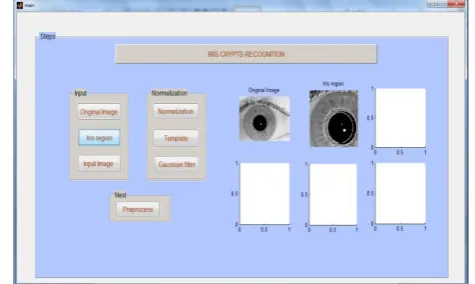
Figure 2. Start page of the Iris Crypts system
Figure 3. Getting the input image of the system
Figure 5. The extracted region of iris is taken as input image
Figure 6. The input image is normalized to remove uncertainties in an image
Figure 7. Generating the templates on the extracted iris region and then applying gaussian noise filter to
remove low-level features
Figure-8: Converting the filtered iris image into binary image
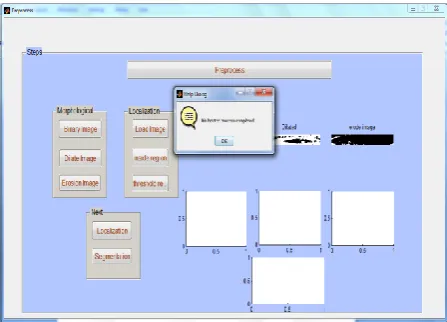
Figure 9. Binary image is further dilated for performing morphological operations
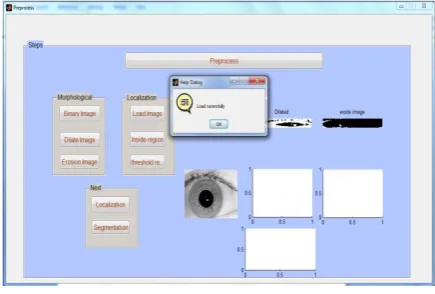
Figure 11. Final Preprocessed Iris Image
VI.
CONCLUSION
A novel method for detecting and matching iris crypts for the human-in-the-loop iris biometric system is introduced. The presented method develops predicting outcomes on the three tested datasets, in-house dataset, ICE2005, and CASIA-Iris-Interval. On Comparison with the existing method, this proposed method enhances the iris recognition performance by minimum 22% on the position one hit rate in the circumstance of human identification and by minimum 51% on the equal error rate in provisions of subject verification.
It is noticed that the three datasets under estimation were gathered using dissimilar facilities among diverse population groups. The constraints applied in this method were skilled on a different small set of homemade data. The generalization and usefulness of this method on varied image data can be presented. Additionally, to the extent that, this work is so distant the just estimation of a human-interpretable iris features matching method by using the public datasets (ICE2005 and CASIA-Iris-Interval), that provides a lead contrast with existing methods for
example Daugman’s framework. Experimental
analysis has shown the effectiveness of the proposed system.
VII.
REFERENCES
[1]. Pradeep Manikrao Patil "Iris Recognition in Less Constrained Environment" International Journal of Emerging Technology and
Advanced Engineering, Volume 3, Issue 7, July 2013.
[2]. Deepa, V.Priyanka and J.Pradeepa "Iris Recognition Based on Iris Crypts" International Journal of Engineering Sciences & Research Technology, February, 2017, DOI: 10.5281/zenodo.291855.
[3]. Mrigana walia and Shaily Jain "Iris Recognition System Using Circular Hough Transform" International Journal of Advance
Research in Computer Science and
Management Studies, Volume 3, July 2015. [4]. Proença H, Filipe S, Santos R, Oliveira J and
Alexandre LA "The UBIRIS.v2: a database of visible wavelength iris images captured
on-the-move and at-a-distance" IEEE
Transaction Aug 2010. doi:
10.1109/TPAMI.2009.66
[5]. Mustafa M. Alrifaee, Mohammad M.
Abdallah and Basem G. Al Okush "A Short Survey of Iris Images Databases" The International Journal of Multimedia & Its Applications (IJMA) Vol.9, No.2, April 2017
[6]. Shaik Touseef Ahmad and Sandesh Kumar B.
V "Ordinal Feature Selection for IRIS and Palm print Recognition" International Journal of Ethics in Engineering & Management Education, Volume 2, Issue 6, June 2015.
[7]. Vineetha John Tharakan and Shaikh Fairooz "Ordinal Features Based Palmprint and Iris Recognition for Military Security" International Journal of Advanced Research in Electrical, Electronics and Instrumentation Engineering, Vol. 6, Issue 4, April 2017. [8]. Priya. J and A. Alad Manoj Peter "Fusion of
Palm Print and Iris for Multimodal Biometric Recognition" International Journal of Scientific and Research Publications, Volume 6, Issue 5, May 2016.
Applied Research (AJAR) Volume 03- Issue 02- pp-18-23, 2017
[10]. Manisha Sam Sunder and Arun Ross "Iris Image Retrieval Based on Macro-features"
International Conference on Pattern
Recognition (ICPR), (Istanbul, Turkey), August 2010.
[11]. Dr.S. Prasath and A.Selvakumar "A Novel Iris Image Retrieval with Boundary Based Feature Using Manhattan Distance Classifier"
International Journal of Innovative
Technology and Creative Engineering, vol.5 no.7 july 2015.
[12]. Shweta Malvi and P.M.Agarkar "To Study Iris Recognition Systems, Databases, Complex Patterns and Segmentation Techniques" International Journal of Engineering, Science and Mathematics, Volume 2, Issue 2, June 2013.
[13]. Nozomi Hayashi and Akira Taguchi "A Novel Feature Extraction for Iris Identification using Morphological Skeleton" 18th European Signal Processing Conference August 2010.
[14]. Samanpreet Kaur and Er. Mandeep Singh "A
Review on various iris recognition
techniques in biometrics" international journal of engineering sciences & research technology, Vol. 4.(11), November, 2015. [15]. Manisha M. Khaladkar, Sanjay R. Ganorkar
"A Novel Approach for Iris Recognition" International Journal of Advanced Research in Computer Engineering & Technology Volume 1, Issue 4, June 2012.
[16]. Suganthy, M. and P. Ramamoorthy "Principal
Component Analysis Based Feature
Extraction, Morphological Edge Detection and Localization for Fast Iris Recognition" Journal of Computer Science 8 (9): 1428-1433, 2012.
[17]. Geetanjali Sharma and Neerav Mehan "Iris based Human Identification using Median and Gaussian Filter" International Journal of Latest Trends in Engineering and Technology
Vol.(7), DOI:
http://dx.doi.org/10.21172/1.73.560
[18]. Himanshi Budhiraja, Himani Tomar, Harshi Goel, Amar Singh "Fusion of Iris and Fingerprint Biometric for Recognition" International Journal Of Advance Research In Science And Engineering IJARSE, Vol. No.2, Issue No.4, April, 2013.
[19]. Joaquim de Mira Jr. and Joceli Mayer "Image Feature Extraction for application of Biometric Identification of Iris - A Morphological Approach" IEEE Symposium on Computer Graphics and Image Processing, 2003.