CSEIT11831472 | Received : 16 Feb 2018 | Accepted : 28 Feb 2018 | January-February-2018 [(3) 2 : 124-130 ]
International Journal of Scientific Research in Computer Science, Engineering and Information Technology © 2018 IJSRCSEIT | Volume 3 | Issue 2 | ISSN : 2456-3307
124
A Distributed Framework for Spatio-Temporal Data Streams
Processing through Continuous Query Process
1
Akkala Venkateswarlu Reddy,
2P. S. Naveen Kumar
1
PG Student, Department of MCA, St. Ann’s College of Engineering & Technology, Chirala, Andhra Pradesh, India
2
Assistant Professor, Department of MCA, St. Ann’s College of Engineering & Technology, Chirala, Andhra Pradesh, India
ABSTRACT
The enormous increment of cellular phones, GPS-like devices, and RFIDs brings about exceptionally unique situations where questions and also inquiries are constantly moving. In this paper, we show a persistent question processor planned particularly for exceedingly powerful situations (e.g., location-aware conditions). We executed the proposed nonstop inquiry processor inside the PLACE server (Pervasive Location-Aware Computing Environments); an adaptable location-awaredatabase server as of now created at Purdue University. The PLACE server stretches out information gushing administration frameworks to help location-awaresituations. Such conditions are described by the wide assortment of persistent spatio-temporal questions and the unbounded spatio-worldly streams. The proposed constant inquiry processor for the most part incorporates:
Developing new incremental Spatio-temporal administrators to help a wide assortment of consistent spatio-worldly inquiries.
Extending the semantic of sliding window questions to manage spatial sliding windows and temporal sliding windows.
Providing a shared execution structure for adaptable execution of an arrangement of simultaneous consistent spatio-temporal questions. Preparatory test assessment demonstrates the promising execution of the consistent question processor of the PLACE server.
Keywords : PLACE (Pervasive Location-Aware Computing Environments) server, adaptable location-aware database server, RFID.
I.
INTRODUCTION
The across the board of PDAs, handheld devices, and GPS-like innovation empowers conditions where for all intents and purposes all items know about their areas. Such conditions call for new question handling procedures to effectively bolster location-aware servers. Not at all like customary database servers, have location-aware servers had the accompanying recognized attributes:
(1) Data are gotten from moving and stationary protests as unbounded spatiotemporal streams
(2) Large number of persistent stationary and moving spatio-worldly inquiries.
(3) Any deferral of the question reaction brings about an old answer. Consider an inquiry that gets some information about the moving articles that lie in a specific area.
calculations that use customary database servers. In this paper, we go past the possibility of abnormal state calculations; rather, we exhibit a ceaseless inquiry processor that expects to alter the database motor to help a wide assortment of consistent spatio-temporal questions. Our constant question processor is executed inside the PLACE (Pervasive Location-Aware Computing Environments) server; as of now created at Purdue University. The PLACE server broadens both the PREDATOR social database administration framework and the NILE spilling database administration framework to help effective nonstop inquiry preparing of spatio-worldly streams. Specifically, the nonstop question processor of the PLACE server has the accompanying recognizing qualities:
Incremental assessment- The PLACE consistent inquiry processor utilizes an incremental assessment worldview by constantly refreshing the question reply. We recognize two kinds of updates; to be specific positive and negative updates. A positive/negative refresh shows that a specific question should be added to/expelled from the inquiry reply.
Spatio-temporal administrators- The PLACE persistent question processor utilizes another arrangement of spatio-temporal incremental administrators (e.g., INSIDE and in administrators) that help incremental assessment of a wide assortment of consistent spatio-worldly inquiries. Predicate-based Sliding Windows-We broaden the thought of sliding windows past time based and tuple-tally windows to suit for predicate-based windows (e.g., a question terminates from the window when it shows up again in the stream). Versatility -We utilizes a common execution worldview as a methods for accomplishing adaptability as far as the quantity of extraordinary persistent spatiotemporal inquiries. We introduce a review of the information model and SQL dialect utilized by the PLACE server. This paper presents different strategies for lapsing approaching tuples in the PLACE server. The incremental handling of persistent inquiries is talked about in Section
II.
Challenges and Related Work
In this area, we experience a portion of the difficulties we confronted while building the constant question processor of the PLACE location-aware server. With each test, we introduce its related work.
2.1 Challenge I: Incremental Evaluation of Continuous Queries Most of spatio-worldly inquiries is ceaseless in nature. Not at all like preview inquiries that are assessed just once, persistent questions require consistent assessment as the inquiry result winds up plainly invalid with the difference in data. An innocent method to deal with ceaseless inquiries is to extract the constant question into a progression of preview inquiries executed at consistent interim circumstances. Existing calculations for persistent spatiotemporal questions mean to streamline the time interim between every two occurrences of the depiction inquiries. For the most part, three distinctive methodologies are explored:
The legitimacy of the Outcomes- With each inquiry reply, the server restores a legitimate time or a substantial district of the appropriate response. Once the substantial time is lapsed or the customer leaves the legitimate district, the customer resubmits the nonstop inquiry for re-assessment.
PLACE persistent inquiry processor, we go past reconsidering proceeds spatio-worldly questions. Rather, we give an incremental assessment worldview, where just the updates of the outcome are accounted for to the client.
2.2 Challenge II: Wide Variety of Continuous Queries Most of the current question handling procedures concentrate on unravelling uncommon instances of constant spatio-worldly inquiries are legitimate just to move inquiries on stationary items, are substantial just for stationary range questions. Other work concentrates on total questions or k-NN inquiries. Endeavouring to help such wide assortment of constant spatio-worldly questions in alocation-aware server brings about executing an assortment of particular calculations with various access structures. In the PLACE persistent inquiry processor, we abstain from utilizing custom fitted calculations for every sort of ceaseless spatio-temporal questions. Rather, we outfit the PLACE server with an arrangement of crude pipelined inquiry administrators that can bolster a wide range of nonstop spatio-temporal questions.
2.3 Challenge III: Large Number of Concur-lease Continuous Queries Most of the current spatio-temporal calculations concentrate on assessing just a single spatio-worldly question. In a run of the mill location-aware server there is an immense number of simultaneously exceptional nonstop spatiotemporal questions. Dealing with each question as an individual element significantly corrupts the execution of the location-aware server. In spite of the fact that there is a great deal of research in sharing the execution of ceaseless web questions and persistent spilling inquiries, enhancement methods for assessing an arrangement of constant spatio-temporal inquiries are as of late tended to for unified and dispersed situations. The primary thought of is to deliver some portion of the question preparing down to the moving items, while the server fundamentally goes about as an arbiter among moving articles. In unified situations, the Q-file is displayed as an R-tree-like record structure to file the questions rather
than objects. Be that as it may, the Q-record is constrained in two angles:
(1) It performs re-assessment of the considerable number of inquiries (through the R-tree file) each T time units.
(2) It is appropriate just for stationary inquiries. Moving questions would ruin the Q-list and henceforth drastically corrupt its execution.
III.
Tuple Expiration
With the unbounded approaching spatio-temporal streams, it winds up plainly infeasible to store all approaching tuples. Be that as it may, some info tuples might be cushioned in memory temporarily. The decision of the put away tuples is principally question subordinate, i.e., we store just the tuples of intrigue. Since the inquiries are ceaselessly changing, there ought to be a component to lapse (erase) a portion of the put away tuples and supplant them with different tuples that turns out to be more important to the exceptional consistent spatio-temporal questions. In the PLACE constant question processor, we utilize three sorts of tuple lapse, specifically, temporal termination, spatial lapse, and predicate-based termination.
autos in the current history. The SQL of Q2 is like that of Q1 with just the expulsion of the window explanation.
3.3 Predicate-based Expiration Due to the idea of spatio-temporal streams, different types of tuple lapse may emerge. For instance, consider the inquiry Q3: "For each moving item, ceaselessly report the slipped by time between every two successive readings". Such an inquiry contains a self-join where objects from the flood of moving articles are self-joined in light of the protest identifier. The inquiry cradle needs to keep up just the most recent perusing of each moving article. Once the perusing of a specific question is accounted for, the past perusing is terminated. We call such sort of lapse as predicate-based where it is principally reliant on the question semantic.
IV.
Incremental Evaluations
To abstain from rethinking constant spatio-temporal questions, we utilize an incremental assessment worldview in the PLACE consistent inquiry processor. The fundamental thought is to just report the progressions of the appropriate response from the last assessment time. By utilizing incremental assessment, the PLACE server accomplishes the accompanying objectives:
(1) Fast inquiry assessment, since we register just the updates of the appropriate response not the entire answer.
(2) In an ordinary location-awareserver, question comes about are sent to the clients by means of satellite servers. In this manner, constraining the measure of transmitted information to the updates just as opposed to the entire question answer spares in arrange data transfer capacity.
(3) When typifying incremental calculations into physical pipelined inquiry administrators, restricting the tuples that experience the entire question pipeline to just the updates diminishes in the pipeline. In this way, effective question preparing is accomplished. To understand the incremental assessment handling in the PLACE server, we
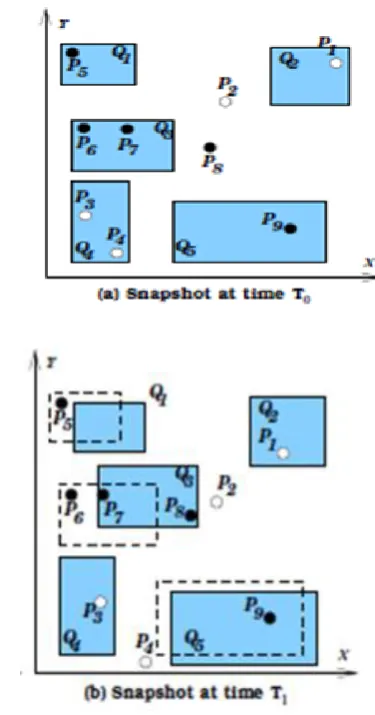
experience three fundamental advances. To start with, we characterize the abnormal state idea of incremental updates, by characterizing two sorts of updates; positive and negative updates. Second, we embody the handling of incremental calculations into pipelined inquiry administrators. Third, we change customary pipelined inquiry administrators (e.g., unmistakable and join) to manage the idea of negative tuples. Positive/Negative Updates Incremental assessment is accomplished through refreshing the past question reply. Principally, we recognize two sorts of updates; positive updates and negative updates. A positive/negative refresh demonstrates that a specific question should be added to/expelled from the inquiry reply.
Figure 1: Incremental evaluation of range queries
of the form (QID;OID) where _ indicates the type of the update and OID is the object identifier.
V.
Scalability
The PLACE continuous query processor exploits ashared execution paradigm as a means forachieving scalability in terms of the number of concurrentlyexecuting continuous spatio-temporal queries.
Figure 2: Shared execution of continuous queries.
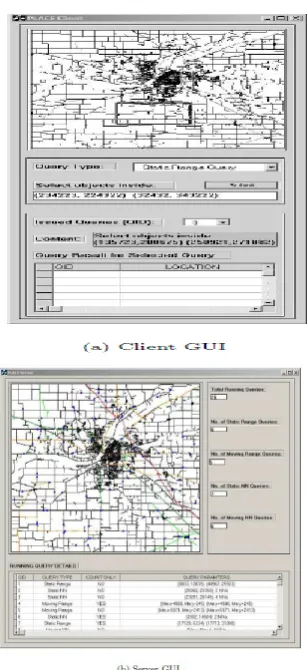
Figure 3: Snapshot of the PLACE client and server The main idea is to group similar queries in a query table. Then, the evaluation of a set of continuous queries is modelled as a spatial join between moving objects and moving queries. Similar ideas of shared execution have been exploited in the NiagaraCQ for web queries and PSoupfor streaming queries.
Execution plans of the two simple continuous spatio-temporal queries, Q1: "Find the objects inside region R1", and Q2: "Find the objects in- side region R2". With shared execution. Shared execution for a collection of spatio-temporal range queries can be expressed in the PLACE server by issuing the following continuous query:
SELECT Q.ID,
O.ID FROM Query Table Q, Object Table O
WHERE
Allocation inside Q.region
VI.
User interface in Place
Previews of the customer and server graphical UI (GUI) of PLACE, The customer GUI mimics a customer end gadget utilized by the clients. Clients can pick the kind of inquiry from a rundown of accessible question writes. The spatial district of the question can be resolved utilizing the guide of the territory of interest1 (the strong plotted rectangle on the guide). By squeezing the submit catch, the customer makes an interpretation of the inquiry into SQL dialect and transmits it to the PLACE server. Once the inquiry is submitted to the server, the outcome appears to the question as a rundown. A customer can send numerous questions of various sorts to the PLACE server. The PLACE server GUI is with the end goal of organization at the server side. The fundamental thought is to monitor the simultaneously executing ceaseless inquiries from each kind. All the prepared inquiries alongside their parameters are shown in the base left of the screen. Moreover, the server GUI contains a local guide demonstrating the development of articles, and the parameters of the chose inquiries.
VII.
7 Performance Evaluations
an arrangement of moving items that precede onward the street system of a given city. We pick a few focuses arbitrarily and consider them as focuses of square range inquiries.
Size of Incremental Answer looks at between the span of the incremental answer returned by using the incremental approach and the measure of the entire answer. The location-awareserver cushions they got refreshes from moving articles and inquiries and assess them at regular intervals. Figure 4a gives the impact of the quantity of moving articles that detailed a difference in area inside the most recent 5 seconds. The extent of the total answer is steady and is requests of size of the span of the most pessimistic scenario incremental answer.
VIII.
CONCLUSIONIn this paper, we present the continuous query processor of the PLACE (Pervasive Location-Aware Computing Environments) server; a database server for location-aware situations as of now created at
Purdue University. The PLACE server expands both the PREDATOR database administration framework and the NILE stream question processor to manage unbounded spatio-worldly streams. Notwithstanding the worldly tuple termination characterized in sliding window questions, we keep up different types of tuple lapses (e.g., spatial lapse). To effectively deal with extensive number of persistent inquiries, we utilize an incremental assessment worldview that contains:
(1) Defining the idea of positive and negative updates. (2) Encapsulating the calculations for incremental preparing into pipelined spatio-temporal administrators.
(3) Modifying customary inquiry administrators (e.g., unmistakable and join) to manage the negative updates that originates from the spatio-worldly administrators. Shared execution is utilized by the ceaseless inquiry processor as methods for accomplishing adaptability as far as the quantity of simultaneously nonstop inquiries. Preparatory exploratory outcomes demonstrate the promising execution of the PLACE persistent question processor.
IX.
REFERENCES
[1]. S. Saltenis and C. S. Jensen.Indexing of Moving Objectsfor Location-Based Services In ICDE, 2002.
[2]. S. Saltenis, C. S. Jensen, S. T. Leutenegger, and M. A.Lopez.Indexing the Positions of Continuously MovingObjects.In SIGMOD, 2000.
[3]. P. Seshadri. Predator: A Resource for Database Research.SIGMOD Record, 27(1):16{20, 1998. [4]. Z. Song and N. Roussopoulos.K-Nearest
NeighborSearch for Moving Query Point.In SSTD, 2001.
Future in Spatio-Temporal Databases.In ICDE, 2004.
[6]. J. Chen, D. J. DeWitt, F. Tian, and Y. Wang.NiagaraCQ:A Scalable Continuous Query System forInternet Databases. In SIGMOD, 2000.
[7]. B. Gedik and L. Liu.MobiEyes: Distributed Processingof Continuously Moving Queries on MovingObjects in a Cellular System. In EDBT, 2004.
[8]. A. Guttman. R-Trees: A Dynamic Index Structurefor Spatial Searching. In SIGMOD, 1984.
[9]. M. Hadjieleftheriou, G. Kollios, D. Gunopulos, andV. J. Tsotras. On-Line Discovery of Dense Areas inSpatio-temporal Databases. In SSTD, 2003.
[10]. S. E. Hambrusch, C.-M.Liu, W. G. Aref, and S. Prabhakar.Query Processing in Broadcasted Spatial IndexTrees.In SSTD, 2001.
[11]. M. A. Hammad, W. G. Aref, M. J. Franklin, M. F.Mokbel, and A. K. Elmagarmid.E_cient execution of sliding-window queries over data streams. Technical Report TR CSD-03-035, Purdue University Department of Computer Sciences, Dec. 2003.
[12]. M. A. Hammad, M. J. Franklin, W. G. Aref, and A. K.Elmagarmid. Scheduling for shared window joins overdata streams. In VLDB, 2003. [13]. SHAIKASHA,P.S.NAVEENKUMAR
Taxo-Finder to Build a Graph, Cgraph and Representing Domain Corpus and Their Associative Strengths Pages 1810-1814,2017 Publisher simhapuri publications.
[14]. W. G. Aref, S. E. Hambrusch, and S. Prabhakar. Pervasive Location Aware Computing Environments(PLACE).
http://www.cs.purdue.edu/place, 2003.