MLSA – A Multi-layered Reference Corpus for German Sentiment Analysis
Simon Clematide
∗, Stefan Gindl
Υ, Manfred Klenner
∗, Stefanos Petrakis
∗,
Robert Remus
+, Josef Ruppenhofer
ψ, Ulli Waltinger
φ, Michael Wiegand
πUniversity of Z¨urich, Institute of Comp. Linguistics,∗, MODUL University Vienna, Department of New Media TechnologyΥ, University of Leipzig, Department of Computer Science, Natural Language Processing Group+,
University of Hildesheimψ, University of Bielefeld, Artificial Intelligence Groupφ, Saarland University, Spoken Language Systemsπ
{klenner,siclemat,petrakis}@cl.uzh.ch∗, [email protected]Υ, [email protected]+, [email protected]ψ, [email protected]φ, [email protected]π
Abstract
In this paper, we describe MLSA, a publicly available multi-layered reference corpus for German-language sentiment analysis. The construction of the corpus is based on the manual annotation of 270 German-language sentences considering three different layers of granularity. The sentence-layer annotation, as the most coarse-grained annotation, focuses on aspects of objectivity, subjectivity and the overall polarity of the respective sentences. Layer 2 is concerned with polarity on the word- and phrase-level, annotating both subjective and factual language. The annotations on Layer 3 focus on the expression-level, denoting frames of private states such as objective and direct speech events. These three layers and their respective annotations are intended to be fully independent of each other. At the same time, exploring for and discovering interactions that may exist between different layers should also be possible. The reliability of the respective annotations was assessed using the average pairwise agreement and Fleiss’ multi-rater measures. We believe that MLSA is a beneficial resource for sentiment analysis research, algorithms and applications that focus on the German language.
Keywords:Sentiment Analysis, Emotion detection, Lexical resource
1.
Introduction
Sentiment analysis is a highly active research area that em-braces not only work on the identification of opinions, emo-tions and appraisals, but also on the construction of corpora and dictionaries. While various approaches and resources have been proposed for polarity or subjectivity classifica-tion for English (Pang et al., 2002; Wilson et al., 2005), relatively few benchmark collections and corpora that fo-cus on German have been made available. Moreover, with respect to existing work on corpora for sentiment analysis and opinion mining, most approaches have focused on user-rated product reviews at document-level, even though mul-tiple opinions and factual information may be found within single sentences.
In this paper, we present MLSA, the result from a Euro-pean research collaboration that aims to provide a publicly1
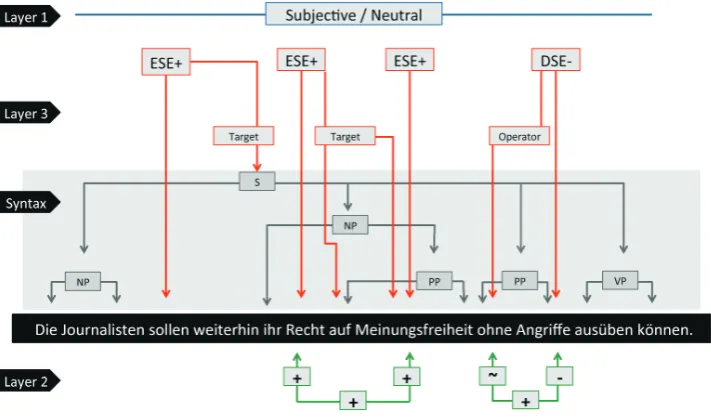
available multi-layered reference corpus for sentiment anal-ysis in German. The compilation of the MLSA corpus is based on manual annotation at different layers of granular-ity (cf. Figure 1.) using a set of 270 sentences. Within Layer 1, each sentence has been analyzed according to the notions of subjectivity/objectivity and their polarity, i.e. positive, negative or neutral. On Layer 2, the word- and phrase-level has been targeted, focusing on aspects of sub-jective and factual language. Layer 3 covers annotations on the expression-level, using the notions of private state and speech. Included in its annotations are the sources and targets of opinions. Each layer has been annotated by
mul-1The corpus is publicly available: http://synergy.
sentimental.li/Downloads
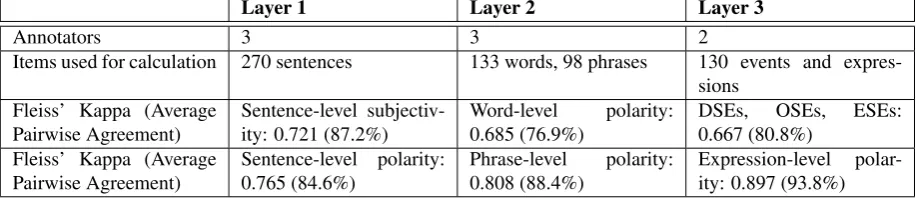
tiple raters, and the annotations’ quality has been assessed by two different inter-annotator agreement measures. The rest of the paper is structured as follows: In Sec-tion 2. we present related work. SecSec-tion 3. describes the multi-layered reference corpus for German-language sen-timent analysis and provides an overview of the data rep-resentation and the annotation schemata applied. Section 4. presents the assessment of the inter-annotator agreement and finally, Section 5. concludes this paper.
2.
Related Work
Figure 1: Excerpt from the multi-layered annotation.
3.
A Multi-layered Reference Corpus for
German Sentiment Analysis
For the construction of the multi-layered MLSA reference corpus, we used a set of sentences extracted from the DeWaC Corpus (Baroni et al., 2009). The DeWaC Cor-pus is a collection of German-language documents of vari-ous genres obtained from the web. DeWaC does include, but does not exclusively consist of, opinionated, expres-sive or polarity specific language. Its main properties are its generic nature, its sheer size and its concurrent repre-sentation of language used on the web. In order to sample sentences that better suit our research goals, we extracted those where negation of, intensification of, as well as con-trasts between polar words were detected. Using such sim-ple heuristics allowed for constructing a dataset that was sufficiently biased – up to a certain degree – towards “senti-mentality”, while still being generic enough. This detection was based on Clematide and Klenner (2010)’s polarity lexi-con and resulted in a set of 270 sentences. Consequently, all sentences were manually annotated at three layers of gran-ularity: we now describe each annotation layer in detail.
3.1. Layer 1: Sentence-level Annotations
Sentence-layer annotation is the most coarse-grained anno-tation in the corpus. We adhere to definitions of objectivity and subjectivity introduced in Wiebe et al. (2005). Addi-tionally, we followed guidelines drawn from Balahur and Steinberger (2009). Their clarifications proved to be quite effective, raising inter-annotator agreement in a sentence-layer polarity annotation task from about 50% to more than 80%. All sentences were annotated with respect to two di-mensions, subjectivity and polarity (cf. Table 1, 2). Sub-jectivity covers the existence of an actual attitude within a statement. Statements with purely informative content and without an explicit attitude are considered as objective, whereas statements with affective content are subjective. Factuality has two possible values, objective vs. subjective. The second dimension is the polarity of a statement.
Neg-ative polarity is equal to negNeg-ative sentiment, positive po-larity denotes positive sentiment and neutral popo-larity either denotes the lack of explicit sentiment or ambiguity within the sentence.
An example of a subjective sentence with negative polarity is:
(1) “Das Schlimmste aber war eine mir unerkl¨arliche starke innere Unruhe und das gleichzeitige Un-verm¨ogen, mich normal zu bewegen.”
[“But the worst thing was an inexplicable severe inner restlessness and the concomitant inability to move normal.”]
The sentence does not contain any obvious factual infor-mation, but only expresses the inner state of a person. An example of an objective sentence without any overt polarity is:
(2) “Die Bewegung der extrem detaillierten Raumschiffe basiert auf realen physikalischen Gesetzen.” [“The movement of the extremely detailed spaceships is based on real physical laws.”]
Non-neutral polarity can also be assigned to an objective sentence. This sounds like an oxymoron in the first place, but it becomes obvious with an example:
(3) “Die Folge war hohe Arbeitslosigkeit im Textil-gewerbe, das haupts¨achlich f¨ur den Export pro-duzierte.”
[“The result was high unemployment in textile indus-try, which mainly produced for export.”]
unemploy-Tag Marker #Words Examples #Top Phrases #All Phrases
positive + 335 hope 158 275
negative – 362 doubt 180 300
intensifier ∧ 63 heavy n.a. n.a.
diminisher % 9 low n.a. n.a.
shifter ∼ 51 against n.a. n.a.
bipolar # n.a. n.a. 21 54
neutral 0 n.a. n.a. 10 12
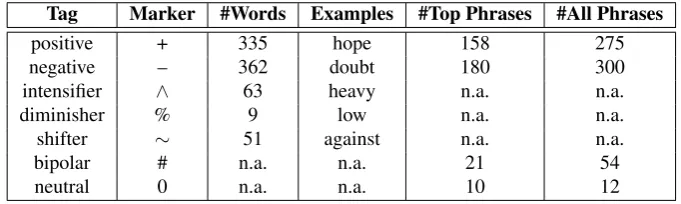
Table 3: Distribution of the polarity tags in Layer 2.
Another example, following the extact same steps, takes as input the phrase:
(9) “keine Angst vor dem schrecklichen Phantom” [“no fear for the horrible phantom”]
and outputs the following annotation with an overall posi-tive polarity:
(10) “[keine∼Angst– [vor dem schrecklichen Phantom– ]–]+”
Table 3 provides some descriptive statistics regarding the annotations produced on Layer 2. The Top Phrases column contains the counts for phrases that stand directly below the sentence-level, i.e. if such a phrase was to be composed into a higher level textual unit, that unit would be the sen-tence at hand. In a similar way, the All Phrases column con-tains the counts for all possible phrases below the sentence-level that have been annotated with polarity, including the top phrases. As a first general remark we can observe a slight tendency for negativity in our dataset, both on word-and phrase-level, while neutrality is observed seldom. Sec-ondly, we can see that primary examples of composition-ality, like the intensification and shifting phenomena also have a significant presence in our dataset. Finally, coming back to neutrality, although it was observed less frequently, we can see how a number of phrases have in fact been as-signed an overall neutral polarity although they contain po-lar words and/or phrases. For example the phrase:
(11) “Trotz dieser erheblichen Steigerung der absoluten Zahlen”
[“Despite this considerable increase of absolute numbers”]
is assigned an overall neutral polarity despite the presence of shifters and positive words:
(12) “[Trotz∼dieser erheblichen+ Steigerung+ der ab-soluten Zahlen]”
which provides us with an example where compositional-ity does not always break through to the top level. In other words, a phrase’s overall polarity will not necessarily al-ways be positive, negative or bipolar, although it contains polarized constituents.
Merged Annotator 1 Annotator 2
DSE 656 642 638
ESE 734 692 713
OSE 7 7 6
Table 4: Major annotation frame types in Layer 3.
Merged Annotator 1 Annotator 2
Source 261 254 249
Target 1124 1053 1074
Operator 60 54 58
Modulation 160 147 155
Polarity 23 23 18
Support 130 126 127
Table 5: Major frame label categories in Layer 3.
3.3. Layer 3: Expression-level Annotations
The annotation scheme of Layer 3 adheres to the main con-cepts of expression-level annotation of the MPQA corpus (Wiebe et al., 2005). This type of annotation is important for building systems for sentiment-related information ex-traction tasks, such as opinion summarization or opinion question answering (Stoyanov et al., 2005; Stoyanov and Cardie, 2011). In those tasks, the sentiment towards a spe-cific entity, e.g. a person, an organization or a commercial product, is to be extracted. Sentiment annotation on the sentence-level (Layer 1) or on complex phrases (Layer 2) are less helpful for such applications.
We annotate lexical units denoting frames of private states, i.e. states that are not open to observation and verification and their corresponding frame elements. We distinguish between the three types,Objective Speech Events (OSEs), such as sentence (13),Direct Speech Events (DSEs), such as sentence (14), andExplicit Subjective Expressions (ESEs), such as sentence (15). The latter are used by speakers to express their frustration, wonder, positive sentiment, mirth, etc., without explicitly stating that they are frustrated, etc. (Wiebe et al., 2005).
(13) “Peter [sagte]OSE, dass es regnete.” [“Peter [said]OSEit was raining.”]
7.
References
A. Balahur and R. Steinberger. 2009. Rethinking sentiment analysis in the news: from theory to practice and back. In Proceeding of the 1st Workshop on Opinion Mining and Sentiment Analysis (WOMSA).
Marco Baroni, Silvia Bernardini, Adriano Ferraresi, and Eros Zanchetta. 2009. The wacky wide web: A collection of very large linguistically processed web-crawled corpora. Language Resources and Evaluation, 43(3):209–226.
John Blitzer, Mark Dredze, and Fernando Pereira. 2007. Biographies, Bollywood, Boom-boxes and Blenders: Domain Adaptation for Sentiment Classification. In Pro-ceedings of the 45th Annual Meeting of the Association for Computational Linguistics (ACL), pages 440–447. Sabine Brants and Silvia Hansen. 2002. Developments in
the tiger annotation scheme and their realization in the corpus. InProceedings of the Third Conference on Lan-guage Resources and Evaluation, pages 1643–1649, Las Palmas.
Simon Clematide and Manfred Klenner. 2010. Evaluation and extension of a polarity lexicon for german. In Pro-ceedings of the First Workshop on Computational Ap-proaches to Subjectivity and Sentiment Analysis, pages 7–13.
Hoa Trang Dang. 2009. Overview of the TAC 2008 Opin-ion QuestOpin-ion Answering and SummarizatOpin-ion Tasks. In
Proceedings of the Text Analysis Conference (TAC), Gaithersburg, MD, USA.
Joseph L. Fleiss. 1981. Statistical Methods for Rates and Proportions. Wiley series in probability and mathemati-cal statistics. John Wiley & Sons, New York, second edi-tion.
J. Richard Landis and Gary G. Koch. 1977. The Measure-ment of Observer AgreeMeasure-ment for Categorical Data. Bio-metrics, 33(1):159–174.
Bo Pang and Lillian Lee. 2005. Seeing stars: Exploiting class relationships for sentiment categorization with re-spect to rating scales. InProceedings of the 43rd Annual Meeting of the Association for Computational Linguis-tics (ACL’05), pages 115–124, Ann Arbor, Michigan, June. Association for Computational Linguistics. Bo Pang, Lillian Lee, and Shivakumar Vaithyanathan.
2002. Thumbs up? sentiment classification using ma-chine learning techniques. In Proceedings of the 2002 Conference on Empirical Methods in Natural Language Processing, pages 79–86. Association for Computational Linguistics, July.
Robert Remus and Christian H¨anig. 2011. Towards Well-grounded Phrase-level Polarity Analysis. InProceedings of the 12th International Conference on Intelligent Text Processing and Computational Linguistics (CICLing), number 6608 in LNCS, pages 380–392. Springer. Yohei Seki, Lun-Wei Ku, Le Sun, Hsin-Hsi Chen, , and
Noriko Kando. 2010. Overview of Multilingual Opin-ion Analysis Task at NTCIR-8 - A Step Toward Cross Lingual Opinion Analysis. InProceedings of NTCIR-8 Workshop Meeting.
Veselin Stoyanov and Claire Cardie. 2011. Automatically
creating general-purpose opinion summaries from text. In Proceedings of the International Conference Recent Advances in Natural Language Processing 2011, pages 202–209, Hissar, Bulgaria, September. RANLP 2011 Or-ganising Committee.
Veselin Stoyanov, Claire Cardie, and Janyce Wiebe. 2005. Multi-perspective question answering using the opqa corpus. In Proceedings of Human Language Technol-ogy Conference and Conference on Empirical Methods in Natural Language Processing, pages 923–930, Van-couver, British Columbia, Canada, October. Association for Computational Linguistics.
Cigdem Toprak, Niklas Jakob, and Iryna Gurevych. 2010. Sentence and expression level annotation of opinions in user-generated discourse. InProceedings of the 48th An-nual Meeting of the Association for Computational Lin-guistics, pages 575–584, Uppsala, Sweden, July. Associ-ation for ComputAssoci-ational Linguistics.
Janyce Wiebe, Theresa Wilson, and Claire Cardie. 2005. Annotating expressions of opinions and emotions in language ann. Language Resources and Evaluation, 39(2/3):164–210.