Annotating Errors in a Hungarian Learner Corpus
Markus Dickinson, Scott Ledbetter
Indiana University {md7,saledbet}@indiana.edu
Abstract
We are developing and annotating a learner corpus of Hungarian, composed of student journals from three different proficiency levels written at Indiana University. Our annotation marks learner errors that are of different linguistic categories, including phonology, morphology, and syntax, but defining the annotation for an agglutinative language presents several issues. First, we must adapt an analysis that is centered on the morpheme rather than the word. Second, and more importantly, we see a need to distinguish errors from secondary corrections. We argue that although certain learner errors require a series of corrections to reach a target form, these secondary corrections, conditioned on those that come before, are our own adjustments that link the learner’s productions to the target form and are not representative of the learner’s internal grammar. In this paper, we report the annotation scheme and the principles that guide it, as well as examples illustrating its functionality and directions for expansion.
Keywords:Hungarian, learner language, error annotation
1.
Introduction and Motivation
Learner corpora have become increasingly popular in the last twenty years, as illustrated by the 2011 conference on Learner Corpus Researchat the Universit´e catholique de Louvain. Such corpora, especially when annotated with errors, have been useful for studying various aspects of the interlanguage of language learners (e.g., Myles, 2005; Granger, 2008), for developing pedagogical materi-als and lexicographic resources (e.g., Nicholls, 2003), and for developing and evaluating error detection systems (e.g., Meurers et al., 2010; Granger, 2003). One limitation has been that most of the work has focused on Western Euro-pean languages. Determining how to annotate learner cor-pora of more morphologically-rich languages has had very little work (though, see Lee et al., 2011; Hana et al., 2010). As morphologically-rich languages have different types of errors and error patterns, we focus in this paper on defin-ing an error annotation scheme for corpora containdefin-ing data from learners of Hungarian.
Our goal is to define the scheme such that, after applying it to a corpus, error detection systems can be developed and evaluated for learner Hungarian—specifically, systems ca-pable of providing feedback. Part of that goal is thus to describe learner interlanguage (see, e.g., Ellis, 2008): by analyzing non-target forms and their features, we can be-gin to understand learner grammars and how they differ from those of native speakers. This is a crucial step toward providing individualized, relevant feedback to the language learner.
To achieve this, we must define an annotation scheme. This consists of: defining the units of analysis (i.e., morphemes), defining the annotation categories—some of which need to be tailored to Hungarian—and accounting for interactions between layers of linguistic analysis. Our proposal incor-porates a distinction between error annotation and a sec-ondary layer of annotation which does not represent errors, but maps to a target form. While we focus on the basic principles for annotating learner data in an agglutinative language, the distinction between errors and secondary
ad-justments is relevant for any language.
In section 2., we discuss the properties of Hungarian rele-vant for annotating learner data and some background on error annotation in learner corpora. Our data and general annotation framework are described in section 3. before turning to the bulk of the work, in section 4., where the annotation scheme is described, and heuristics are outlined for handling multiple possible analyses. In section 5., ex-tended examples are examined, highlighting some of diffi-culties and solutions. The annotation scheme is relatively simple, clearly distinguishes errors from secondary emen-dations, and covers a range of phenomena in Hungarian.
2.
Background
2.1. Hungarian
Hungarian belongs to the Finno-Ugric language family, known for its agglutinative morphology: words are formed by concatenating morphemes, resulting in rich inflectional and derivational systems, as in (1).
(1) a. fut run
-ott -PST
-´al
-2SG.INDEF
‘you [2sg.] ran’ b. k¨onyv
book -eim -1SG.PL
-ben -INESSIVE
‘in my books’ c. h´az
house -ban -INESSIVE ‘in (a) house’
Another characteristic of Hungarian, and other Finno-Ugric languages, is vowel harmony. Stems select allomorphs based on distinctions between back and front vowels, and within front vowels between rounded and unrounded vow-els. For example, the inessive case suffix is realized with a front vowel,-ben, in (1b) because the rootk¨onyvcontains only a front vowel, whereas in (1c) it appears with a back vowel,-ban, because of the back vowel in the rooth´az.
2.2. Error-annotated learner corpora
We follow a line of work on annotating learner corpora with error information (e.g., Nicholls, 2003; L¨udeling et al., 2005; Rozovskaya and Roth, 2010). Some annotation schemes make use of multi-layered annotation, such as with the FALKO corpus of German (L¨udeling et al., 2005). This allows for multiple interpretations and makes it easy to an-notate errors spanning more than one word. Multiple lay-ers of annotation also allow one to treat error annotation as an incremental process, e.g., building from smaller con-stituents to larger ones (Boyd, 2010; Hana et al., 2010), a key point we build from in section 4. In particular, Hana et al. (2010) use a “two-stage annotation design, based on three levels.” Level 0 is the transcribed input; Level 1 contains orthographic and morphological corrections, with only individual forms treated; and Level 2 handles all other corrections, including, e.g., changes in word order. Our scheme shares much in spirit with this approach.
Turning to agglutinative languages, Lee et al. (2011) anno-tate post-positional particle errors in Korean. While useful for developing particle error detection systems, they explic-itly ignore other error types. The agglutination forces them to add a segmented layer of annotation before any other layers, a practice we follow.
3.
Data and Annotation
The initial corpus has been collected from students of Hun-garian at Indiana University from three different levels: be-ginning, intermediate, and advanced. The texts are jour-nals, composed of entries on various topics (chosen by the student), and each one is ten to fifteen sentences in length. Currently, data from fourteen journals is included (9 begin-ning, 1 intermediate, and 4 advanced). More data is being collected, but this is sufficient to begin defining the annota-tion.
Annotation was carried out using EXMARaLDA (Extensi-ble Markup Language for Discourse Annotation), a freely available tool (Schmidt, 2010).1 EXMARaLDA allows for
multiple simultaneous tiers of annotation; can be exported in XML format; and provides a corpus management tool and concordancer for ease of maintenance and analysis.
To define the annotation, the second author, an advanced student of Hungarian, marked the annotation, consulting native Hungarian speakers throughout the process to check the work. Preliminary data from each level (beginner, in-termediate, and advanced) was consulted to define the first
1EXMARaLDA and related tools are available online at
http://www.exmaralda.org/en index.html
iterations of the scheme.
Each text was first transcribed and then segmented manu-ally by morpheme in EXMARaLDA, keeping both versions in the annotation file. Next, the learner errors were marked in the segmented data according to the annotation scheme detailed below. After a number of files were annotated, the results were checked by a native speaker instructor of Hun-garian for accuracy—a process which has been continually repeated. During annotation, we kept a record of decisions, which now comprise the annotation manual for the project.
4.
Annotation scheme
4.1. Anotation scheme overview
Similar to Hana et al. (2010), the annotation scheme is a compromise between annotating every relevant property and focusing on what can be annotated reliably within a small project. We turn now to an overview.
First, as Hungarian is agglutinative, we recognize the need to segment the data into morphemes before annotating. To mark case errors and corrections, for example, we need the case marker to be an individual unit of analysis.
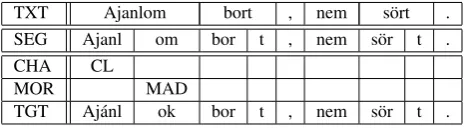
Secondly, there are different types of errors reflecting dif-ferent levels of linguistic analysis. For instance, for (2), the annotation is as in Figure 1, marking a CL (vowel length) error on the verb stem and an MAD (definiteness) error on the verb suffix—i.e., the definite suffix does not agree with the indefinite noun complements.
(2) Ajanl recommend
-om 1SG.DEF
bor wine
-t ACC
, ,
nem not
s¨or beer
-t ACC
. .
‘I recommend wine, not beer.’
TXT Ajanlom bort , nem s¨ort . SEG Ajanl om bor t , nem s¨or t . CHA CL
MOR MAD
TGT Aj´anl ok bor t , nem s¨or t .
Figure 1: Error annotation for (2) (some layers not shown)
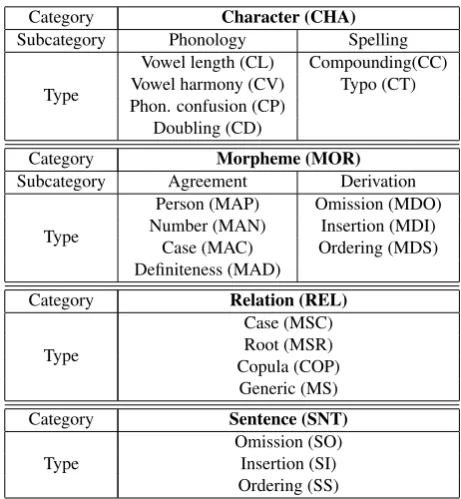
We distinguish annotationcategoriesfrom annotation lay-ers, where layers reflect an ordering between corrections and categories are unordered within a layer. We define four basic error annotation categories, reflecting charac-ter(CHA),morphological(MOR),grammatical relation
(REL), andsentence(SNT) errors. Conceptually, we treat them all as one layer; i.e., different categories of errors can be annotated for the same word, and error spans can over-lap, if necessary.2 The collection of error categories (see section 4.3.) and the target (TGT) sentence make up this
error layer.
In principle, each category could be annotated with its own target form, allowing for a series of ordered, explicit correc-tions. This would capture the fact that, e.g., a spelling error could precede a word order error (cf. Hana et al., 2010).
2
an-TXT de mi nem baratomok vannak .
SEG de mi nem barat om ok van nak .
Layer
1
CHA CL
MOR MDI MAP
REL
SNT SS-1 SS-1
TGT de mi nem van unk bar´at ok .
Layer
2
CHA MOR
REL MSR
SNT
TGT de mi nem vagy unk bar´at ok .
Figure 3: An extended example of error annotation, for (4)
sonant doubling), we draw a distinction because they are contrastive features in the language.
The morpheme level concerns agreement and derivation (i.e. inflectional and derivational morphology). Agreement errors cover the inflection of nouns and verbs, as seen in (1). Verbs are analyzed for person, number, and definite-ness, while nouns are analyzed for person, number, and case. Derivation errors concern the omission, insertion, and ordering of morphemes.
Relation errors concern the interaction of different tokens and largely represent errors in selection. This category in-cludes case (as determined by the verb), the copula (the use of which depends on context and person), and choice of morpheme (root or affix) when the choice depends on other elements in the sentence.
Finally, the sentence category represents errors which go beyond selection and may interact with semantics or prag-matics. Just as with morphemes, words can be inserted, omitted, or ordered in non-target-like ways. Because word order is flexible in Hungarian and dependent on specific contexts, only fairly strict ordering rules are observed in the analysis. In other words, we follow the Principle of Mini-mal Interaction (Hana et al., 2010): if a construction can be grammatical, it is kept as correct, even if a better version exists (see also section 4.4.).
As noted above, these four categories are used for both the error layer and the adjustment annotation layer.
4.4. Multiple analyses
As there can be multiple possible ways of interpreting an error and positing a correction (cf., e.g., L¨udeling et al., 2005), we employ a few heuristics to narrow the scope of possible annotations.
First, we use context as much as possible. Given that we are annotating journals, the meaning of a sentence is of-ten straightforward and derivable from the overall narrative. Secondly, we try to give the learner the benefit of the doubt and posit as few errors as possible (Dickinson and Ragheb, 2009). If two analyses seem equally likely, based upon the context, we posit the one which leads to fewer corrections. Thirdly, we bias towards more informative annotation over less informative, in the interest of making searching for
lin-guistic properties easier. For example, if a learner has an error which could be posited as a vowel harmony error or a spelling error, we annotate it as a vowel harmony error, all other things being equal. In this way, someone searching for vowel harmony can find it (and call it a spelling error for themselves, if they wish). Such a property is less easily findable if annotated with the less informative category.
Finally, if truly necessary, we can employ the original inten-tion of the multi-layered annotainten-tion and annotate multiple possible interpretations. Although our effort is still young, we have yet to need this option.
We will see how these heuristics play out in some of the examples in the next section.
5.
Annotation examples
We now present several specific cases that informed our de-cisions and show the extensibility of the annotation scheme. The first two cases deal with label definitions, while the last three deal with handling multiple analyses.
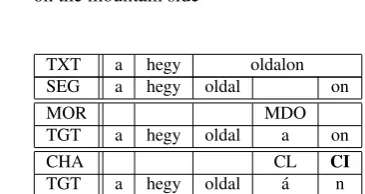
Looking at the annotation for sentence (5) in Figure 4, the single error MDO (derivation: omission) reflects an incom-plete possessive structure. The second nounoldalshould be suffixed witha, as shown in the first layer target form. This triggers two phonological rules in the adjustment layer— the selection of the allomorphndue to the suffix vowel and a lengthening of the a—the former of which was not ac-counted for in the original scheme.
(5) a the
hegy mountain
oldal side
-on
SUPERESSIVE ‘on the mountain side’
TXT a hegy oldalon SEG a hegy oldal on
MOR MDO
TGT a hegy oldal a on
CHA CL CI
TGT a hegy oldal ´a n
One solution is to use an additional error code, CI (charac-ter: insertion). More generally, if we find a production that cannot be annotated with the current scheme and requires a new code, there is almost no change to the annotation workflow. The code simply needs to be added to the XML definitions of the error codes, and from that point on, it is available for use in annotation. The alternative is to redefine the set of error codes we already have, and such decisions have to be done on a case-by-case basis, balancing infor-mativeness with the scheme’s compactness.
For (6), annotated in Figure 5, the learner produces a suffix with a front rounded vowel (FRD), matching the quality of the stem’s vowel. Though the features match, the correct form is actually an irregular allomorph (with a front vowel).
(6) k¨onyv book.FRD
-¨ok PL.FRD ‘books’
TXT k¨onyv¨ok SEG k¨onyv ¨ok
CHA CV
TGT ek
Figure 5: Annotation for (6), showing the CV label being used for an irregular (non-harmonic) ending
While CV (vowel harmony) is the correct label, the scheme does not recognize that the learner correctly followed a phonological rule. We would need to include features linked to the error in order to capture the fact that the learner selected a correctly-harmonized, though incorrect, variant.
Turning to cases where multiple analyses may be applica-ble, in (7) there is an ambiguous error concerning either vowel length or morphological case. For the meaning of ‘I went home’, the long´ashould be short, written without an accent. However, the accent would be correct if the learner meant ‘I went [(in)to] his/her house’. To achieve the sec-ond meaning, the learner would have to select the inessive or allative case forh´azrather than the unmarked nomina-tive that was used. This would be indicated by an MSC error—and also an additional article beforeh´az.
(7) Ment Go[PST]
-em 1SG
h´az house
-a 3SG
‘I went home’
TXT Mentem h´aza SEG Ment em h´az a
CHA CL
TGT Ment em haza
Figure 6: Annotation for (7), annotating the simpler vowel length (CL) error over a case error
As can be seen in in Figure 6, we opt to annotate a vowel length error, in accordance with our heuristics. This is the
simplest correction and results in the fewest changes to the learner’s production, i.e., the fewest morphemes to change. It also more appropriately matches the context in the jour-nal before this sentence.
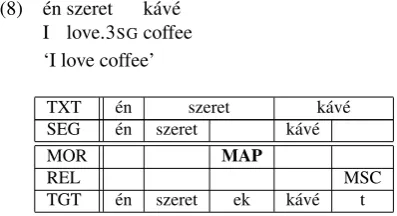
In (8), the verbszeretis in the base form, which is identical to the third person singular form, but the context requires a first person suffix.
(8) ´en I
szeret love.3SG
k´av´e coffee ‘I love coffee’
TXT ´en szeret k´av´e SEG ´en szeret k´av´e
MOR MAP
REL MSC
TGT ´en szeret ek k´av´e t
Figure 7: Annotation for (8), where an informative tag (MAP) was chosen over a less informative one (MDO)
The corresponding error MAP (agreement: person) in Fig-ure 7 could also be MDO (derivation: omission) to indicate a lack of inflection. In line with our heuristic of being more informative when context cannot disambigaute, we choose the more informative tag MAP. Users of the corpus can thus search for and evaluate person agreement errors.
The issue of the amount of information present in the an-notation can become complicated. In (9), the learner has supplied two cases: accusative and inessive (where super-essive would be correct). At most one case is permitted on any noun in Hungarian.
(9) ez this
sz´ep beautiful
nyar summer
-at
ACCUSATIVE -ban INESSIVE. ‘this is beautiful in summer’
TXT ez sz´ep nyaratban SEG ez sz´ep nyar at ban
CHA CL
MOR MDI
REL MSC
TGT ez sz´ep ny´ar on
Figure 8: Annotation for (9), illustrating the annotation for erroneous use of two case endings
In the annotation scheme, a case error (MSC) reflects the selection of an inappropriate case, as shown with the anno-tation for the second case used in Figure 8, as the inessive is corrected to the superessive. We seem to have at least three options here: 1) treatatandbanas a unit on the REL and TGT tiers, as a single MSC error; 2) treat them as two separate MSC errors, correcting one toonand the other to nothing; or 3) treat one (ban) as an MSC error and the other (at) as an insertion (MDI).3
3
The first option is appealing, but note that it conflates what really are two errors: multiple cases, as well as the wrong case (i.e., an insertion and a substitution). The second op-tion is informative, but also redundant, as both errors are treated equally (MSC), even though the errors are of a dif-ferent nature. The third option is the one we pursue, as it treats the different errors uniquely. While the MDI (deriva-tion: insertion) label seems to result in a loss of informa-tion, by not marking this as a case error, it importantly shows that the error is not a problem with selection—as the relation (REL) errors imply—but simply in the constraints on case usage in Hungarian. In the future, new error codes or features attributed to specific errors could capture more fine-grained information for further analysis.
6.
Summary and Outlook
Our annotation scheme allows for the description of an ag-glutinative and morphologically-rich language. We take morphemes as the base unit of analysis in order to capture the errors learners make at all levels of linguistic structure and provide error codes for each linguistic category. We also distinguish errors from adjustments, which allows for ordered corrections and avoids penalizing the learner for additional changes conditioned on error corrections.
The annotation scheme is rather coarse-grained, but is fea-sible for the scope of the project. We have a single anno-tator, and the scheme is extensible to account for new phe-nomena with minimal changes to the annotation workflow.
In the future, the most important step is to continue collect-ing and annotatcollect-ing more data. As far as modifications to the annotation scheme, we hope to add annotation linking errors to a “conditioning” element, e.g., linking a case error to the verb which licenses that case (cf., e.g., Hana et al., 2010). In EXMARaLDA, this can be accomplished with references to the IDs corresponding to each morpheme in the segmentation tier. We also plan to add features to the final annotation, in order to better analyze a learner’s inter-language. By comparing the features of learner productions to those of target language examples, we will be able to identify aspects of the interlanguage to target with specific feedback.
Acknowledgments
We would like to thank Val´eria Varga for her help in check-ing annotations, the IU CL discussion group for feedback, and the anonymous reviewers for their comments.
References
Adriane Boyd. 2010. EAGLE: an error-annotated corpus of beginning learner German. InProceedings of LREC-10. Malta.
Markus Dickinson and Marwa Ragheb. 2009. Dependency annotation for learner corpora. In Proceedings of the Eighth Workshop on Treebanks and Linguistic Theories (TLT-8), pages 59–70. Milan, Italy.
Rod Ellis. 2008. The Study of Second Language Acquisi-tion. Oxford University Press, Oxford, second edition.
Sylviane Granger. 2003. Error-tagged learner corpora and CALL: A promising synergy. CALICO Journal, 20(3):465–480.
Sylviane Granger. 2008. Learner corpora. In Anke L¨udeling and Merja Kyt¨o, editors, Corpus Linguistics: An international handout, volume 1, pages 259–275. Mouton de Gruyter.
Jirka Hana, Alexandr Rosen, Svatava ˇSkodov´a, and Barbora ˇStindlov´a. 2010. Error-tagged learner corpus of Czech. In Proceedings of LAW-10, pages 11–19. Upp-sala, Sweden.
Sun-Hee Lee, Markus Dickinson, and Ross Israel. 2011. Challenges in annotating korean particle errors. Talk given at Learner Corpus Resarch 2011. Louvain-la-Neuve, Belgium. September 16, 2011.
Anke L¨udeling, Maik Walter, Emil Kroymann, and Peter Adolphs. 2005. Multi-level error annotation in learner corpora. In Proceedings of Corpus Linguistics 2005. Birmingham.
Detmar Meurers, Niels Ott, and Ramon Ziai. 2010. Com-piling a task-based corpus for the analysis of learner lan-guage in context. InProceedings of Linguistic Evidence 2010, pages 214–217. T¨ubingen.
Florence Myles. 2005. Review article: Interlanguage cor-pora and second language acquisition research. Second Language Research, 21(4):373–391.
Diane Nicholls. 2003. The cambridge learner corpus - er-ror coding and analysis for lexicography and ELT. In
Proceedings of Corpus Linguistics 2003, pages 572–581. Lancaster University.
Alla Rozovskaya and Dan Roth. 2010. Annotating ESL errors: Challenges and rewards. InProceedings of NLP-BEA, pages 28–36. Los Angeles.
Thomas Schmidt. 2010. Linguistic tool development be-tween community practices and technology standards. In
Proceedings of the Workshop on Language Resource and Language Technology Standards. Malta.