
Is it Useful to Support Users with Lexical Resources? A User Study.
Ernesto William De Luca
University of Applied Science Potsdam Friedrich-Ebert-Str. 4, 14467 Potsdam, Germany
Phone: +49 331 580 1520 Fax: +49 331 580 1599 [email protected]
Abstract
Current search engines are used for retrieving relevant documents from the huge amount of data available and have become an essential tool for the majority of Web users. Standard search engines do not consider semantic information that can help in recognizing the relevance of a document with respect to the meaning of a query. In this paper, we present our system architecture and a first user study, where we show that the use of semantics can help users in finding relevant information, filtering it ad facilitating quicker access to data.
Keywords: Information Retrieval, Lexical Resources, User Studies, Semantics, Clustering, Wordnet, Word Sense Disambigua-tion.
1.
Introduction
Search engines are an essential tool for the majority of Web users for finding information in the huge amount of docu-ments available online. For most ad-hoc search tasks they perform satisfyingly, however certain fundamental prop-erties still leave room for improvement. For example, if users perform general questions, they frequently get lost in the huge amount of documents returned. More recent ap-proaches, such as Yippi1 (formerly Viv´ısimo (Koshman et al., 2006)) organize search results into categories (hierar-chical clusters), based on textual similarity. However, these methods only consider the word distribution in documents, without taking into account linguistic criteria derived from the underlying query, such as different meanings of a term. Therefore, the assigned categories usually do not represent the categories a user is expecting for the issued query. Lin-guistic information (e.g. semantics) can provide valuable support for the user’s search process. Retrieved documents could for instance be grouped by the meanings of the query, allowing the user to choose one of these meanings and nav-igate only the documents related to it.
Wordnet-based Categorization.Currently there are no ef-ficient systems that support the user in searching informa-tion with semantic knowledge. In this paper, we want to evaluate our approach that aims to help users in searching and browsing information using lexical resources, based on the idea of supporting them with meanings in an interactive search process.
Lexical resources contain the different meanings of the words and the related linguistic relations providing seman-tic information. In order to access information by their meanings, different problems have to be solved: disam-biguating words contained in the query, and categorizing and presenting the results appropriately. Ideally, with a semantic-based approach the system should understand the users without having them reformulate their query. Different work has been already done on semantic
1http://search.yippy.com/
WordNet-based categorization methods ((Gonzalo et al., 1998; Tokunaga et al., 1998; Varelas et al., 2005)). These categorization techniques have been criticized from the per-formance point of view, where linguistic information seems not to be useful and too poor for text categorization (Mos-chitti and Basili, 2004; Bloehdorn et al., 2006). Hovewer, different other approaches have shown that it can be bene-ficial if linguistic information is combined with clustering techniques (De Luca and N¨urnberger, 2006b; Elberrichi et al., 2008; Li et al., 2009; Buscaldi and Rosso, 2010).
2.
Sense Folder System (SFS)
In the following we describe our Sense Folder System (SFS) architecture and how we build the semantic con-cepts provided for supporting the user during the inter-action process. The SFS combines linguistic informa-tion with knowledge-based word sense disambiguainforma-tion and clustering methods (De Luca, 2008) like described also in (Gliozzo et al., 2004; Mihalcea, 2006).
2.1. SFS Architecture
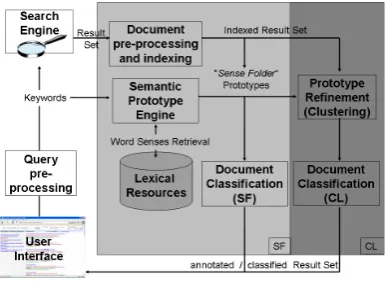
The search process starts after the user submits her query by means of a user interface (see Figure 1). The query is simultaneously sent to the search engine and to the Sense Folder Engine(SFE). While documents are retrieved and indexed, the SFE retrieves the different meanings [q1, ..., qn](SynSets) of the query from a lexical resourceR
(in our case Wordnet), thus forming differentSense Fold-ers. For every meaningqi a Sense FolderS~i is created as
Figure 1: Sense Folder System Architecture
2006b; Elberrichi et al., 2008; Li et al., 2009). The se-mantic information assigned is appended to the document as additional information in order to help the user in find-ing the relevant documents, without the need of browsfind-ing all documents.
2.2. Sense Folder Definition
Users interacting with the SFS are asked to choose a ”main query word” Qdescribing the concept they are searching for (in our case e.g. chair) and have the possibility to add other ”optional query words”Othat better specify the meant concept for disambiguation purposes (e.g.furniture, wood, etc.). Given the main query wordQ={q1, ..., qn},
we create different Sense Folders S = {S~1, ..., ~Sn} that
define the different meanings [q1, ..., qn] of the query Q.
We also define the linguistic contextC={c1, ..., cn}, that
contains the different linguistic relations[c1, ..., cn]of
ev-ery meaning[q1, ..., qn]retrieved from a lexical resourceR.
Different ”optional query words”O ={o1, ..., on}can be
given by the user and are included in all Sense Folders, be-cause they could help in better describing the user context. Thus, the system builds, on the basis of the ”main word”, the Sense Folders (representing all meanings of this ”main word”). Every Sense FolderS~iis a container that includes
only one meaning of the main wordqi, all its related
lin-guistic information (linlin-guistic context)ci retrieved from a
lexical resourceR(in our case Wordnet) and the user typed ”optional query words”oi.
3.
User study
User studies (Dumais et al., 2001), (Labrou and Finin, 1999) have shown that categorized information can im-prove retrieval performance. Motivated by these evalua-tions, the SFS has been evaluated within an interactive user interface to verify the assumption that the semantic filtering support is beneficial for the users. We provided a user in-terface, where additional disambiguating information was added to the documents of a search result. This additional information is used in order to enable categorization, re-structuring or filtering of the retrieved document set (see Figure 2(c)).
(a) Results for “chair” from Google. The results are a ranked list without considering the sense of the word.
(b) Results for “chair” from Yippi. Yippi clusters search results based in key terms, it does however not seem to base the clusters on the semantic meaning of the query.
(c) Results for “chair” in the Sense Folder System. There are 4 Sense Folders, one for each sense.
Word Synonyms Domain
chair professorship Pedagogy
chair Furniture
chair electric chair, hot seat Law chair president, chairperson Person (d) WordNet noun collocation of the term “chair”. The same presented by the Sense Folder System in Fig-ure 2(c)
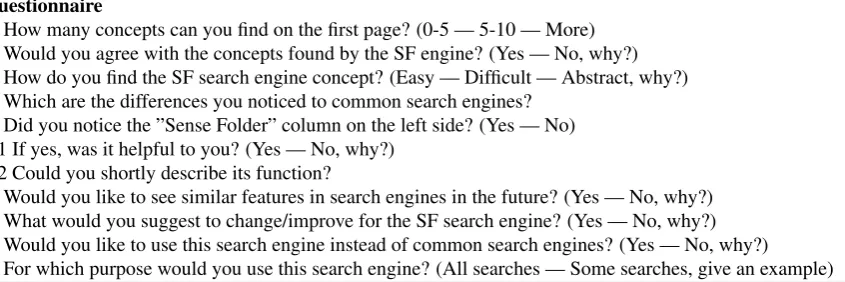
Questionnaire
1. How many concepts can you find on the first page? (0-5 — 5-10 — More) 2. Would you agree with the concepts found by the SF engine? (Yes — No, why?) 3. How do you find the SF search engine concept? (Easy — Difficult — Abstract, why?) 4. Which are the differences you noticed to common search engines?
5. Did you notice the ”Sense Folder” column on the left side? (Yes — No) 5.1 If yes, was it helpful to you? (Yes — No, why?)
5.2 Could you shortly describe its function?
6. Would you like to see similar features in search engines in the future? (Yes — No, why?) 7. What would you suggest to change/improve for the SF search engine? (Yes — No, why?) 8. Would you like to use this search engine instead of common search engines? (Yes — No, why?) 9. For which purpose would you use this search engine? (All searches — Some searches, give an example)
Table 1: Questionnaire used for the evaluation.
3.1. Evaluation Results.
In order to evaluate the performance of the SFS, a user study was conducted. A total of 9 questions covering dif-ferent aspects of the Sense Folder search results presenta-tion were asked. Sixteen participants were presented with results of the same queries from Google2, Yippi3and a lo-cal deployment of the Sense Folder System (see Figure 2). Yippi was chosen because it groups similar results together into ”clouds”4. Table 1 summarizes the questionnaire used in the user study including questions and answers given to the users. All questions had at least one negative and one positive answer, most allowed the participants to leave short comments and motivations to their answers.
1. Users were asked to recognize the different concepts of one given word related to the search results re-trieved by the search systems. Most of them (94%) recognized between one and five concepts. 6% said that there are more than five concepts.
2. Users were asked whether or not they agreed with the concepts found by the Sense Folder System. 94% said that all expected concepts were presented. 6% said that other concepts were missing.
3. The participants had to estimate the difficulty of the interaction with the Sense Folder System. 75% found it easy, while 19% difficult and the remaining 6% ab-stract.
4. Users were asked to describe the differences between Google, Yippi and the Sense Folder System. 81% were positive to the added value of the Sense Folder Annotation. The system was intuitive and supported them in disambiguating the concepts related to the query. 50% of the users saw the list of semantic con-cepts as positive. 25% said that the Sense Folder Sys-tem clustered documents similarly to Yippi. They also noticed that Google and Yippi only covered one domi-nant concept. 6% of the participants observed that the Sense Folder System did not allow search for different media types. 19% did not notice any difference.
2http://www.google.com 3http://search.yippy.com/ 4http://search.yippy.com/
about-yippy-search
5. We asked if the Sense Folder System had been helpful and why. 81% explained that the use of filtering by semantic concept for the query was very positive and they could access information quickly and categorized by concepts. They also saw an easy way of filtering re-sults. 19% claimed the coverage of topics was incom-plete and said that they prefered to use longer queries instead.
6. Participants were asked whether they would like to use features similar to the Sense Folder System in fu-ture search engines. 81% where positive. They also said that the feature reduces non-relevant information and gives quick access to good results. 19% said they preferred e.g. the Wikipedia disambiguation page due its clustering. However, Wikipedia only presents concepts, without clustering documents related to the found concepts or to a given query.
7. We asked if the participants had suggestions for im-proving the Sense Folder System. 31% liked it as-is. 25 % would like to choose concepts not to consider. This functionality is implicity available as documents are already filtered by concepts, by clicking on a con-cept, others are automatically excluded. 19% would however prefer a nicer graphical user interface. 13% wanted to search not only for text, but also for other media and 12% would like to have more explanations about the concepts retrieved.
8. Users were asked if they would use the Sense Folder System instead of common search engine. 81% would. 31% because of the better support for find-ing relevant of documents, as well as the filterfind-ing of search results (50%). 19% who would not, said that old habits die hard and questioned the usability.
9. We wanted to know from the 81% of the users (that would use the Sense Folder System instead of com-mon search engines) for which kind of search they would use the Sense Folder System. 62% of them would use it for all searches, while 38% for specific searches.
4.
Coarse-grained Evaluation
SF [tf] KM [tf] EM [tf] DB [tf]
0.37 0.43 0.28 0.33
SF [tf] [stem] KM [tf] [stem] EM [tf] [stem] DB [tf] [stem]
0.41 0.45 0.28 0.43
SF [tfxidf] KM [tfxidf] EM [tfxidf] DB [tfxidf]
0.42 0.41 0.30 0.41
SF [tfxidf] [stem] KM [tfxidf] [stem] EM [tfxidf] [stem] DB [tfxidf] [stem]
0.31 0.39 0.32 0.32
Table 2: Overall Fine-grained Evaluation [Syn, dom, gloss]
SF [tf] [stem] [merge] KM [tf] [stem] [merge] SF [tfxidf] [merge] KM [tfxidf] [merge]
Dom 0.1/1.0 0.49 0.44 0.52 0.49
Cxt 0.7 0.45 0.46 0.45 0.43
Hyper 0.7 0.40 0.42 0.42 0.37
Hypo 0.3 0.40 0.41 0.43 0.38
Table 3: Overall Single Coarse-grained Evaluation [Syn, dom, gloss]
Single and Multi-Stage Coarse-Grained Evaluation Comparison Comparing the results presented in Table 3 and Table 4 it emerges that in both cases the single and multi-stage merging methods that consider the hyperonyms or hyponyms for merging word senses decrease the classi-fication performance, because these terms are too general or too specific to be helpful for classification. When such linguistic information is combined with clustering methods, in some cases, the classification performance is strongly en-hanced, because similar documents are recognized. Some-times this semantic information already contained in lexical resources is sufficient to recognize the linguistic context of a document given a query, so that clustering methods are not needed or their use affects negatively the classification. An overall improvement of the “pure” Sense Folder classi-fication performance applying the k-Means clustering algo-rithm has been shown. The few exceptions from that trend refer to cases where the only use of the Sense Folders was already sufficient to achieve good results.
Merging word senses using the the single “context” and “domain” merging methods (Cxt0.7 and Dom0.1) enhance good results, but their multi-stage coarse-grained combi-nation results show a better performance (Cxt0.7Dom0.1), outperforming all baselines. We can face up to the facts that as in the fine-grained evaluation the multi-stage coarse-grained classification works better with thetf-based doc-ument representation and stemming methods than with the tf ×idf-based document representation. Comparing the results with the “Random” and “First Sense”baselines (see (McCarthy et al., 2004)) in more detail, we can see that all baselines are outperformed in the overall perfor-mance, except in single cases for “argomento” “lingua” or “regola”, due to the known unbalanced class distribu-tion problem that persists. Considering the “Most Fre-quent Sense” (MFS) baseline (Mihalcea, 2006), we can no-tice that the multi-stage merging methods behave similar to the respective single methods, apart from the multi-stage Cxt0.7Dom0.1merging method. It usestf document vec-tors and outperforms the overall baseline, hence classify-ing better both for English and Italian. This baseline is outperformed of0.10for English with the k-Means
algo-rithm and 0.03for Italian and in the overall performance the “pure” Sense Folder classification overbids the base-line of0.06while k-Means of0.02. The same multi-stage merging method combined withtf×idfdocument vectors outperformed the English MFS baseline, but not the Italian one. The lower quality of results achieved when applying the Italian stemmer are an indication that this stemmer does not reduce the terms to their correct base form. Its applica-tion is partially beneficial and partially not. For the English language the stemmer works better and could be used for this language, for achieving better results.
Nevertheless, the multi-stage coarse-grained classification works better with the tf-based document representation and stemming methods than with thetf ×idf-based doc-ument representation. This is most likely to be attributed to theidfmeasure that cannot be estimated very good and be meaningful adopted, because the document collection is still relative small. When the number of documents would be higher, a more reasonable weight ofidfwould be avail-able.
5.
Conclusions
SF [tf] [stem] [merge] KM [tf] [stem] [merge] SF [tfxidf] [merge] KM [tfxidf] [merge]
Cxt 0.7 Dom 0.1 0.57 0.53 0.55 0.47
Cxt 0.7 Hyper 0.7 0.48 0.49 0.47 0.42
Hyper 0.7 Dom 1.0 0.53 0.52 0.46 0.46
Hypo 0.3 Dom 1.0 0.50 0.47 0.49 0.44
Table 4: Overall Multi-Stage Coarse-grained Evaluation [Syn, dom, gloss]
6.
References
Stephan Bloehdorn, Roberto Basili, Marco Cammisa, and Alessandro Moschitti. 2006. Semantic kernels for text classification based on topological measures of feature similarity. In Proceedings of the Sixth International Conference on Data Mining, ICDM ’06, pages 808–812, Washington, DC, USA. IEEE Computer Society. D. Buscaldi and P. Rosso. 2010. Indexing with wordnet
synonyms may improve retrieval results. InRevised Se-lected Papers CLEF-2009. Springer-Verlag, LNCS. W. Bruce Croft. 1995. What do people want from
informa-tion retrieval? (the top 10 research issues for companies that use and sell ir systems).D-Lib Magazine.
Ernesto William De Luca and Andreas N¨urnberger. 2006a. Rebuilding Lexical Resources for Information Retrieval using Sense Folder Detection and Merging Methods. In Proceedings of the 5th International Conference on Lan-guage Resources and Evaluation (LREC 2006), Genova, Italy.
Ernesto William De Luca and Andreas N¨urnberger. 2006b. Using Clustering Methods to Improve Ontology-Based Query Term Disambiguation. International Journal of Intelligent Systems, 21:693–709.
Ernesto William De Luca. 2008. Semantic Support in Mul-tilingual Text Retrieval. Shaker Verlag, Aachen, Ger-many.
Ernesto William De Luca. 2010. A corpus for evaluat-ing semantic multilevaluat-ingual web retrieval systems: The sense folder corpus. InProceedings of the Seventh con-ference on International Language Resources and Eval-uation (LREC’10), Valletta, Malta.
Susan T. Dumais, Edward Cutrell, and Hao Chen. 2001. Bringing order to the web: Optimizing search by show-ing results in context. InCHI01, pages 277–284. Zakaria Elberrichi, Abdelattif Rahmoun, and
Mo-hamed Amine Bentaalah. 2008. Using wordnet for text categorization. The International Arab Journal of Information Technology, 5.
Alfio Gliozzo, Carlo Strapparava, and Ido Dagan. 2004. Unsupervised and supervised exploitation of semantic domains in lexical disambiguation. Computer Speech and Language, 18(3):275–299.
Julio Gonzalo, Felisa Verdejo, Irina Chugur, and Juan Cigarrin. 1998. Indexing with wordnet synsets can im-prove text retrieval. InProceedings of the COLING/ACL Workshop on Usage of WordNet in Natural Language Processing Systems, pages 38–44.
Frank Honza. 2005. Clustering mit a-priori annahmen ¨uber clusterspezifische attributwichtigkeiten. Master’s thesis, University of Magdeburg, Germany.
Sherry Koshman, Amanda Spink, and Bernard J. Jansen.
2006. Web searching on the vivisimo search engine. J. Am. Soc. Inf. Sci. Technol., 57(14):1875–1887.
Yannis Labrou and Timothy W. Finin. 1999. Yahoo! As an Ontology: Using Yahoo! Categories to Describe Docu-ments. InCIKM, pages 180–187.
Jianqiang Li, Yu Zhao, and Bo Liu. 2009. Fully auto-matic text categorization by exploiting wordnet. In Gary Lee, Dawei Song, Chin-Yew Lin, Akiko Aizawa, Kazuko Kuriyama, Masaharu Yoshioka, and Tetsuya Sakai, ed-itors, Information Retrieval Technology, volume 5839 of Lecture Notes in Computer Science, pages 1–12. Springer Berlin / Heidelberg.
D. McCarthy, R. Koeling, J. Weeds, and J. Carroll. 2004. Finding predominant word senses in untagged text. In 42nd Annual Meeting of the Association for Computa-tional Linguistics, Barcelona, Spain.
Rada Mihalcea, 2006. Knowledge-Based Methods for WSD, pages 107–131. Springer, Netherlands.
Alessandro Moschitti and Roberto Basili. 2004. Complex linguistic features for text classification: a comprehen-sive study. In Proceedings of the 26th European Con-ference on Information Retrieval (ECIR, pages 181–196. Springer Verlag.
Rila Mandala Tokunaga, Rila M, Tokunaga Takenobu, and Tanaka Hozumi. 1998. The use of wordnet in informa-tion retrieval. InProceedings of the COLING/ACL Work-shop on Usage of WordNet in Natural Language Process-ing Systems.
![Table 2: Overall Fine-grained Evaluation [Syn, dom, gloss]](https://thumb-us.123doks.com/thumbv2/123dok_us/1063281.1133067/5.595.71.522.198.261/table-overall-fine-grained-evaluation-syn-dom-gloss.webp)
