Arabic Word Generation and Modelling for Spell Checking
Khaled Shaalan
▢
▢
▢
▢
,Younes Samih‡, Mohammed Attia†
▢
▢
▢
▢
,
Pavel Pecina◊, and Josef van Genabith†
▢The British University in Dubai, UAE [email protected] ‡Heinrich-Heine-Universität, Germany
[email protected] ◊ Institute of Formal and Applied Linguistics,
Faculty of Mathematics and Physics, Charles University in Prague, Czech Republic
†School of Computing, Dublin City University, Ireland {mattia,josef}@computing.dcu.ie
Abstract
Arabic is a language known for its rich and complex morphology. Although many research projects have focused on the problem of Arabic morphological analysis using different techniques and approaches, very few have addressed the issue of generation of fully inflected words for the purpose of text authoring. Available open-source spell checking resources for Arabic are too small and inadequate. Ayaspell, for example, the official resource used with OpenOffice applications, contains only 300,000 fully inflected words. We try to bridge this critical gap by creating an adequate, open-source and large-coverage word list for Arabic containing 9,000,000 fully inflected surface words. Furthermore, from a large list of valid forms and invalid forms we create a character-based tri-gram language model to approximate knowledge about permissible character clusters in Arabic, creating a novel method for detecting spelling errors. Testing of this language model gives a precision of 98.2% at a recall of 100%. We take our research a step further by creating a context-independent spelling correction tool using a finite-state automaton that measures the edit distance between input words and candidate corrections, the Noisy Channel Model, and knowledge-based rules. Our system performs significantly better than Hunspell in choosing the best solution, but it is still below the MS Spell Checker.
Keywords: Arabic, spelling error detection and correction, finite state morphological generation, character-based language model, Arabic open-source spell checker
1.
Introduction
With the advent of the era of free and open-source software, the need for language resources has become even stronger. Very few researchers and developers have tried to develop a free alternative to the proprietary Microsoft Arabic spell checker. One example is the Arabic Spell1 open-source project (designed for Aspell), which relies on the Buckwalter morphological analyser and generates about 900,000 inflected words. Another example is the Ayaspell2 word list, which is the official resource used in OpenOffice applications. Developers of this word list created their own morphological generator, and their word list contains about 300,000 inflected words. In this paper we use the term ‘word’ to designate fully inflected surface word forms, while the term ‘lemma’ is used to indicate the uninflected base form of the word without affixes or clitics.
We create a very large word list for Arabic using AraComLex3, an open-source finite-state large-scale morphological transducer (as presented in Section 2), which generates about 13 million words, of which 9 million are found to be valid forms. For the sake of comparison, we also use a word list created from a corpus
1
http://sourceforge.net/projects/arabic-spell/files/arabic-spell
2 http://ayaspell.sourceforge.net/ 3 http://aracomlex.sourceforge.net/
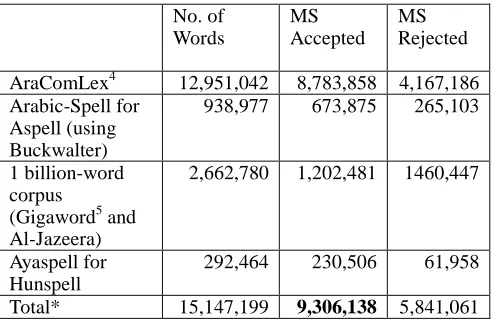
of 1,000,000,000 words. We automatically match all the word lists against the Microsoft Spell Checker (in the Office 2010 suite) to determine how many words are accepted and how many are rejected. We note her that at this stage, the acceptance and rejection decisions by MS Spell Checker are taken per se without any further checking. The results are shown in Table 1.
No. of Words
MS Accepted
MS Rejected
AraComLex4 12,951,042 8,783,858 4,167,186 Arabic-Spell for
Aspell (using Buckwalter)
938,977 673,875 265,103
1 billion-word corpus
(Gigaword5 and Al-Jazeera)
2,662,780 1,202,481 1460,447
Ayaspell for Hunspell
292,464 230,506 61,958
Total* 15,147,199 9,306,138 5,841,061
Table 1: Arabic word lists matched against Microsoft Spell Checker
* Totals will not add due to the removal of duplicates
4 http://arabic-wordlist.sourceforge.net/
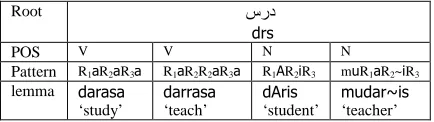
constrained examples, some verbs, such as ()*šakara ‘to thank’, generate 2,552 valid forms. This considerable amount of form variation is a good indication of the productive power of Arabic morphology.
Attia et al. (2011) build a large-scale open-source finite-state morphological transducer for Arabic, AraComLex, that contains 30,587 lemmas. There are a number of advantages of this finite-state technology that makes it especially attractive in dealing with human language morphologies (Wintner, 2008). Among these advantages are the ability to handle concatenative and non-concatenative morphotactics, compactness, high speed, and efficiency.
No. of
Words
Coverage Accuracy f-measure
AraComLex 12,951,042 0.9697 0.9803 0.9899
Arabic-Spell
for Aspell
938,977 0.6553 0.6586 0.7917
1 billion
-word corpus
2,662,780 0.9982 0.9845 0.9921
Ayaspell for Hunspell
292,464 0.5529 0.5681 0.7190
AraComLex Extended
9,306,138 0.9840 0.9998 0.9999
Table 4: Comparison of coverage, accuracy and f-measure of AraComLex Extended against other resources
Another main advantage of finite-state morphology is that it is bidirectional, which makes it suitable for both analysis and generation. We use this generation feature to produce all the possible words within this morphology. AraComLex generates 12,951,042 words. When automatically validated using MS Spell Checker 4,167,186 forms are rejected, leaving 8,783,858 as accepted forms, that is 68% of the data. At the current stage, we just accept MS decisions without questions, yet more validation is needed to check how accurate the MS Spell Checker is in accepting and rejecting forms. The word list that we have created will be available as an open-source resource under GPLv3 license.
In order to test the the various components in this research project, we create a test set of 400,000 words collected from documents from Arabic news websites, and we make sure that these documents are not included in the Gigaword corpus. Words in the test set are automatically marked by MS Spell Checker as either ‘correct’ or ‘incorrect’. We test the coverage, accuracy, and f-measure of AraComLex Extended against this test set and compare it to the other available resources, as shown in Table 4. AraComLex Extended has the best scores in accuracy and f-measure, and second best in coverage after the corpus.
3.
Error Detection
We use two methods, the direct method, that is matching against a word list, and a language modelling method in case such a word list is not available.
3.1
Direct Detection
The direct way for detecting spelling errors is to match words in an input text against a list of correct words. Such a word list in Arabic can run into several millions as shown earlier. This is why it is more efficient to use finite state automata to store words in a more compact manner. Input string can then be composed against the valid word list paths and spelling errors will merely be the difference between the two word lists (Hassan et al., 2008).
3.2
Detection through language modelling
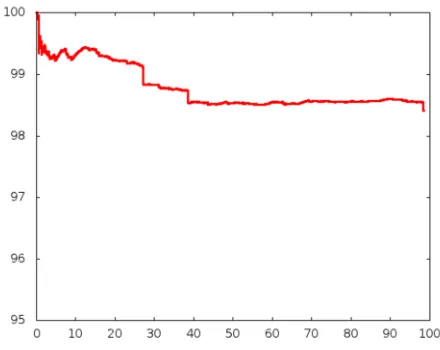
Language modelling has been used frequently for the purpose of spelling correction (Magdy and Darwish, 2006; Brill, Eric and Moore, 2000; Choudhury et al. 2007). However, here we build a language model in order to help in the validation and classification of Arabic words either in the existing word list or in new forms that can be encountered at future stages. Arabic is challenging for language modelling due to the high graphemic similarity of Arabic words. This is shown by Ben Othmane Zribi et al. (2003) who conducted an experiment using four editing operations (addition, substitution, deletion and interchanging two adjacent letters), calculating the number of correct forms among the number of automatically built forms (or lexically neighbouring words) resulting from these editing operations. They found that the average number of neighbouring forms for Arabic is 26.5, which is significantly higher than that for French, 3.5 and English, 3.0.Figure 1: New Results of the LM classifier identifying valid and invalid Arabic word forms
We build a character-based tri-gram language model using SRILM9 in order to classify generated words as
valid and invalid. We split each word into characters, and create two language models: one for the total list of words accepted as valid (9,306,138 words), and one for the total list rejected as invalid (5,841,061 words) through MS Spell Checker filtering as shown in Table 1 above. The maximum word length attested in the data is found to be
annotated gold standard, resulting in 80.54% accuracy.
b. We also evaluate Hunspell-Ayaspell first order choice for the 1,799 spelling errors, resulting in 45.64% accuracy. 4. We generate a group of candidates for each of
spelling the errors (1,799) using edit distance 1 and 2.
5. For the misspelled words with candidates, we want to rank the candidates so that the best correction goes high up in the list. For this purpose we use two approaches: the first uses the Noisy Channel Model alone, and the second uses the Noisy Channel Model with knowledge-based language-specific heuristics.
Type Count Examples
Normal Words 493 XYرZ[\ا African X]^_`ا craftsmanship Xabcd`ا comforting Proper Nouns 364 نfgZh Biden
ijkZl McCain m`n)`Zl Malcolm Newly coined 222 X^cY(`ا digitalizing
Xط(plf`ا
democratization X^_qrc`ا personalized Newly borrowed 38 تZjhn` lobbies
Zjhn[nltuvا Islamophobia تZھnhZx taboos Colloquial 39 yz{^xا destroyed
ygداn| tales شf|Zl nobody
Unknown 34 W~•ln€
Xgndu(p`ا Xj^gflو Classical 23 روزbc`ا sinful
موزbc`ا critical „c…c`ا soaked Table 5: Analysis of false negatives in the test corpus.
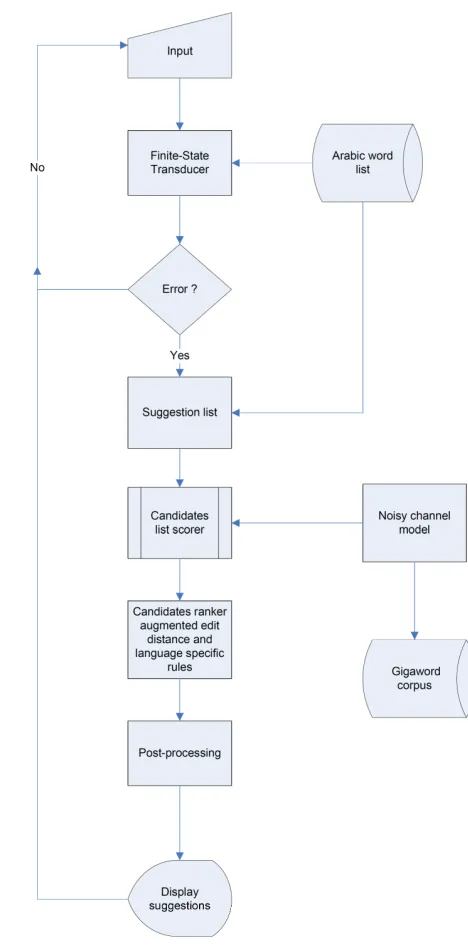
Figure 2 shows a diagram of the procedure for ranking spelling error candidates. The finite state transducer takes input and matches it against our list of 9.3 million words. If a word is not found, it is considered as containing a spelling error and is passed to the ‘suggestion list generator’ which uses the Edit Distance algorithm to generate all words within distance 1 and 2 from the input word. This is then passed to the candidate list scorer which uses the Noisy Channel Model (trained on the corpus) and Edit Distance augmented with language-specific rules. We post-process the output before displaying suggestions. This process is explained in more detail in the following sections.
4.2.1 Candidate Generation
We integrated a candidate generator in our system in the
form of an edit distance finite-state transducer. It generates all possible words that are within edit distance 1and 2 from the entries included in the word list (Oflazer, 1996; Hulden, 2009). It is basically a character-based generator as it replaces each character with all possible characters in the alphabet as well as deleting, inserting, and transposing neighbouring characters. This is a brute-force process that ends up with a huge list of candidates that need to be reduced and scored. To filter out unnecessary words, only words that are found in the word list (by the transducer) are passed to the scorer. This is done by composing two automata . . where stands for the lexical items in the word list and is the words generated by the edit distance generator.
Figure 2. Flow chart of spelling error correction
4.2.2 Scoring the Candidates
Model (Kernigan, 1990). The posterior probability of each plausible candidate is evaluated according to Bayes‘ formula which is equivalent to:
| = | /
where p(c) is the language model or a prior probability of the correction c; p(w|c) is the error model or the
probability that the word w was misspelled when the user meant c, p(w) is a normalizing constant, is the scoring mechanism that computes all plausible values of the correction c and maximizes its probability given the original word w. These probabilities are trained on our one-billion word corpus.
4.2.3 Final Ranking
First Approach. At this stage, every word is reordered by
the scores previously computed by the Noisy Channel Model and a normalized minimum edit-distance so that corrections that exceed a pre-defined threshold are discarded. In this way, our program yields a reduced number of corrections.
Technically speaking, the problem of threshold definition can be empirically solved if it is understood in terms of allowable errors (Davis and de Salles, 2007). Ideally, the maximum number of allowable errors k for a string S is defined as shown in the following equation:
k = (1.0 – δ) . |S|
A Frequency distribution analysis of word lengths in the corpus is used to give an approximate calculation of the individual word matching threshold. The separation of 8 million words from the corpus has revealed that 80% of words have between 4 and 9 characters. As a result, defining a threshold of δ=0.87 means to allow for a
maximum of one error in a 3 to 9 letters word, and 2 errors for a 10 to 15 letter word.
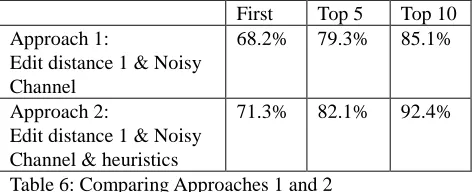
First Top 5 Top 10 Approach 1:
Edit distance 1 & Noisy Channel
68.2% 79.3% 85.1%
Approach 2:
Edit distance 1 & Noisy Channel & heuristics
71.3% 82.1% 92.4%
Table 6: Comparing Approaches 1 and 2
Second Approach. In the second approach, we adopt a
slightly different but well established method to improve the ranking results. The ranking mechanism we have used so far is based on the Noisy Channel Model and a simple minimum edit where the cost assignment is based on arbitrary letter change. We primed the edit distance scoring mechanism with different rules following the error patterns for Arabic as defined by Shaalan et al. (2003) so that substituting letters belonging to the same groups are evaluated at reduced edit costs (Mitton, 1996).
{آ ,إ ,أ ,ا}, {ـg,ن,ث,ت,ب}, {خ,ح,ج}, {ذ,د}, {ز,ر}, {ش,س}, {ض,ص}, {ظ,ط}, {غ,ع}, {ق,ف}, {ة،ه}, {ؤ,و}, {ى,ي}
For example, substituting letters within the same group only costs 0.5 instead of 1.0 . This extension to the basic edit distance improved accuracy of the ranking algorithm by 3.1% (Table 6). The ranking results of Approaches 1 and 2 are reported in Table 6 showing accuracy for having the gold correction in the first, top 5 and top 10 candidates.
Approaches 1 and 2 have been concerned with the re-ranking of candidates. We supplement Approach 2 with a post-processing step that simplistically handles the set of unknown words (227 words) for which no candidates have been generated at all. Inspecting the list of unknown words, we found that 63% of them are two or more words that are joined together, such as —c•]`ارnd~`ا “scientific development”, mgاf`اf˜™ “Abdul-Dayem”, fg(xšو “and does not want”, and ثf›gZl “what happens”. We deal with those words through regular expression replace rules which separates 7 words and particles that are commonly found in the joint word forms. These words are:
{f˜™, Zg, nhأ, šو, š, Zlو, Zl}
This simple process corrects 102 words from a total of 105 words affected. This step yields significant improvement on the system’s accuracy raising it up to 75% (Table 7). In future research we need to develop a more structure strategy to deal with unknown words, maybe through language modelling or machine learning.
We compare our first order selection (or auto-correction) results against both the Microsoft Spell Checker in Office 2010 and the OpenOffice Hunspell-ar using the Ayaspell Arabic spell checker. Our test results show a significant improvement over Hunspell, yet our results are still below the accuracy of MS Spell Checker, as shown in Table 7.
Spell Checker First order ranking
MS Spell Checker 80.54%
Hunspell using Ayaspell 45.64% Approach 1: Edit distance &
Noisy Channel
68.20%
Approach 2: Adding heuristics to Edit distance
71.3%
Approach 2 with post-processing
75%
Table 7: First order ranking for 1,799 misspelled words
5.
Conclusion
validation of existing word lists and making decision on new unseen words. We also create a hybrid spelling correction methodology that significantly outperforms Hunspell in first order ranking of candidates.
Acknowledgements
This research is funded by the Irish Research Council for Science Engineering and Technology (IRCSET), the UAE National Research Foundation (NRF) (Grant No. 0514/2011), the Czech Science Foundation (grant no. P103/12/G084), and the Science Foundation Ireland (Grant No. 07/CE/I1142) as part of the Centre for Next Generation Localisation (www.cngl.ie) at Dublin City University.
References
Attia, Mohammed, Pavel Pecina, Lamia Tounsi, Antonio Toral, Josef van Genabith. (2011). An Open-Source Finite State Morphological Transducer for Modern Standard Arabic. International Workshop on Finite State Methods and Natural Language Processing (FSMNLP). Blois, France.
Beesley, K. R., and Karttunen, L. (2003). Finite State
Morphology: CSLI studies in computational linguistics. Stanford, Calif.: CSLI.
Ben Othmane Zribi C. and Ben Ahmed M., Efficient Automatic Correction of Misspelled Arabic Words Based on Contextual Information, Lecture Notes in
Computer Science, (Springer, 2003), Vol. 2773,
pp.770–777.
Brill, Eric and Robert C. Moore. 2000. An improved error model for noisy channel spelling correction. ACL '00 Proceedings of the 38th Annual Meeting on Association for Computational Linguistics.
Choudhury, Monojit, Rahul Saraf, Vijit Jain, Animesh Mukherjee, Sudeshna Sarkar and Anupam Basu. 2007. Investigation and modeling of the structure of texting language. International Journal on Document
Analysis and Recognition. Volume 10, Numbers 3-4,
157-174, DOI: 10.1007/s10032-007-0054-0
Davis, Clodoveu A., Emerson de Salles. (2007). Approximate String Matching for Geographic Names and Personal Names. In Proceedings of GeoInfo'2007. pp.49-60.
Hajič, J., Smrž, O., Buckwalter, T., and Jin, H. (2005). Feature-Based Tagger of Approximations of Functional Arabic Morphology. In: The 4th Workshop on Treebanks and Linguistic Theories (TLT 2005), Barcelona, Spain.
Hassan, Ahmed, Sara Noeman and Hany Hassan. (2008). Language Independent Text Correction using Finite State Automata. IJCNLP. Hyderabad, India
Hulden, Mans. (2009). Fast Approximate String Matching with Finite Automata. Proceedings of SEPLN. Hulden, Mans. (2009). Foma: a Finite-state compiler and
library. EACL '09 Proceedings of the 12th Conference of the European Chapter of the Association for Computational Linguistics. Association for Computational Linguistics Stroudsburg, PA, USA
Kernigan, M., Church, K., Gale W. (1990). A Spelling Correction Program Based on a Noisy Channel Model. AT & T Laboratories, 600 Mountain Ave., Murray Hill, NJ.
Kiraz, G. A. (2001). Computational Nonlinear
Morphology: With Emphasis on Semitic Languages.
Cambridge University Press.
Levenshtein, V. I. (1966). Binary codes capable of correcting deletions, insertions, and reversals. In: Soviet Physics Doklady, pp. 707-710.
Magdy, Walid and Kareem Darwish. (2006). Arabic OCR error correction using character segment correction, language modeling, and shallow morphology. EMNLP '06 Proceedings of the 2006 Conference on Empirical Methods in Natural Language Processing.
Mitton, Roger (1996). English spelling and the computer. Harlow, Essex: Longman Group
Oflazer, K. (1996) Error-tolerant finite-state recognition with applications to morphological analysis and spelling correction. Computational Linguistics 22(1): 73-90
Watson, J. (2002). The Phonology and Morphology of
Arabic, New York: Oxford University Press.