1
Professional versus institutional morality
The design of ethics programs and their influence on non-compliant behaviour in universities
Authors: Marlies Oost
Abstract
This research investigates the influence of ethics programs on non-compliant behaviour in universities and the design of these ethics programs in an academic setting. In this way, the most appropriate way to organise ethics becomes apparent. Universities can use this ‘best practice’ to decrease the non-compliant behaviour in their university. To accomplish the objective, interviews are conducted with academic professionals and the results of the interviews are analysed with the support of literature. This study shows that professionals in universities often do not behave compliantly and therefore, the ethics programs of universities do not sufficiently support professionals to behave compliantly. To organise ethics within organisations, two strategies can be used: compliance strategy and integrity strategy. Concrete standards of behaviour are developed and communicated to all members of the organisation in the compliance strategy. The integrity strategy relies on the responsibility of the individuals and does not rely on compliance to strict rules. These strategies can be combined with both professional and institutional ethics. Professional ethics involve all issues and values in the profession’s roles and conduct in society, whereas institutional ethics are implemented formally and explicitly into daily organisational life. By combining these two strategies and these two ethics a new way of organising ethics has been proposed, which is likely to decrease the non-compliant behaviour currently present in universities.
KEYWORDS: compliance strategy, ethics program, institutional ethics, integrity strategy, professional ethics, university
Introduction
Around the globe, within all sorts of businesses, there is an increasing trend towards a growing awareness of ethics (Pelletier and Bligh, 2006). Ethics do not just become more prominent in large scale organisations or when big scandals are exposed; they arise in every kind of business as they are present in the everyday decision making of organisations. As a consequence, research on institutional ethics programs has strongly developed over the past decades. According to McDonald and Nijhof (1999, p. 133), an ethics program is a coherent set of actions which is directed primarily at the operational level in order to stimulate morally responsible behaviour of persons in a specific organisation. Institutional ethics are ethics which are implemented formally and explicitly into daily organisational life. By means of a formal code, the ethics are supposed to be used in the daily decision making and work practices at the lower organisation levels (Sims, 1991). Thus, institutional ethics begin with the employer, not the employee; ethics are imposed by the institution.
2
of the organisation. Because of this knowledge, professionals are powerful and autonomous (Brien, 1998, p. 391). Due to this autonomous character, this research focuses on whether institutional ethics programs in professional bureaucracies support professionals to behave compliantly and in which way an ethics program has to be designed to decrease this non-compliant behaviour most effectively.When an ethics program does not exist within an organisation, the employees must decide on what can or cannot be considered as ethical behaviour. In contrast, when an ethics program does exist, the individual interpretation on ethical behaviour seems ‘overruled’ by the interpretation stated by the organisation. In those situations, employees are no longer seen to rely only on their own values, but have to comply with the preset organisations’ values (Tenbrunsel et al., 2003, p. 297). Effective ethics programs in an academic environment must include (Weaver et al., 1999): formal ethics codes; ethics committees, which are charged with developing ethics policies and evaluating company or employee actions; ethics communication systems to report abuses or obtain guidance; ethics officers or ombudsperson that coordinate policies, providing ethics education, or investigating allegations; ethics training programs and disciplinary processes to address unethical behaviour.
Individuals in professional bureaucracies see themselves both as members of a profession and as members of an organisation. For this reason, there is friction between the institutional or organisational ethics and the professional ethics. This dual loyalty of the professionals is a potential for conflict (Von Weltzien Hoivik, 2002).
Ethical obligations of members in an academic setting stress an important topic for public discussion and research about causes and effects of misconduct (Robie and Kidwell, 2003; Sponholz, 2000). Within universities, there are developments that might result in increased levels of unethical behaviour, for example quantity before quality with regards to publications (Feist, 1997). Essential to ethics failure is intentionality; the harmful act must generally be done wilfully (Bruhn, 2002, p. 476). Acts of moral failure within universities are usually protected under the umbrella of academic freedom and hidden by the cloak of collegiality when convenient. Moreover, ethical issues within universities are difficult to discover; evidence of moral failure may not always be apparent to others, may not be repeated often enough to be considered “an issue”, may occur at times and places when there are few people around or may be tolerated, ignored or dismissed as characteristics of a particular difficult faculty member (Bruhn, 2002, p. 477).
This research focuses on the design of ethics programs and their influence on non-compliant behaviour in the context of universities, specifically, three Dutch technical universities. The aim of this research is to investigate whether the ethics programs of the three Dutch universities support professionals to behave compliantly in these organisations, and to investigate the most appropriate way to design an ethics program in an academic setting.
In the first section, two strategies for organising ethics are discussed in order to find out which strategy is most appropriate for organising ethics in an academic setting. Then, a list of ethical issues for the academic staff is given. Subsequently, the methodology of this research is discussed. The next part, focuses on whether non-compliant behaviour occurs within universities in order to find out whether a need exists for this research. As a result of these findings, the universities’ ethics programs are compared to the requirements stated in literature (Weaver et al., 1999). Subsequently, an analysis is given to apply ethics strategies in an academic context, to find out what the most appropriate way is to organise ethics in an academic setting. Finally, the conclusions and recommendations are stated.
Strategies for organising ethics
3
The first strategy is the compliance strategy, in which concrete standards of behaviour are developed that are communicated to all members of the organisation. Controlling and sanctioning ethical behaviour is the focus of the compliance strategy. This strategy aims at preventing, detecting and sanctioning violations. It requires various conditions to be met, in order to apply it successfully. First of all, there is need for concrete guidelines. Secondly, there must be some type of control on the behaviour of the members of an organisation. Thirdly, procedures to report unethical behaviour must be apparent, and finally, members that do not comply with the standards have to be sanctioned (Graafland et al., 2003).The second strategy is the integrity strategy or value strategy. This strategy relies on the responsibility and integrity of the individuals themselves and does not rely on compliance to strict rules. This strategy is a combination between a concern for rules and an emphasis on managerial responsibility for ethical behaviour. Integrity here means that employees and managers are prepared to fulfil tasks in a professional, accurate and responsible way, taking all relevant interests into account (Graafland et al., 2003). The integrity strategy defines what a company is and what it stands for. Similarly to the compliance strategy, the integrity strategy also requires several conditions to be met in order to be successful (Graafland et al., 2003, p. 47; Paine, 1994, p. 112). First of all, clearly defined core values and the communication of these values to the organisation’s members have to be present. Secondly, leaders of an organisation have to be personally committed, credible and willing to take action on the values they espouse. Thirdly, there have to be trainings on how to apply these core values in specific situations. Fourthly, the values have to be integrated into the whole organisation. Fifthly, the organisations’ systems and structures have to support and reinforce the espoused values and finally, the organisation’s managers need to have decision making skills, knowledge, and competencies required to make ethical decisions on a day-to-day basis.
The compliance strategy and the integrity strategy have features in common: codes of conduct, training, reporting and investigating potential misconduct, and audit and controls to ensure that laws and company standards are being met (Paine, 1994, p.111).
According to Paine (1994) and Trevino et al. (1999), the integrity strategy to ethics is more effective than the compliance strategy because it is broader, deeper and more demanding than the compliance strategy. Employees following the integrity strategy are more likely motivated to behave in accordance with the shared values of the organisation, since the integrity strategy is based on self-governance.
Ethical issues for the academic staff
Universities play a critical role in shaping moral behaviour of future generations (Kelley et al., 2005; Weber, 2006). Despite this critical role, universities still cannot control unethical behaviour within their university. Within universities, ‘activities’ exist which can be considered unethical:, discrimination issues, plagiarism and others. So, it clearly remains a topic of importance for both researchers and practitioners to learn about universities’ ethics. According to Bruhn (2002) it would be reasonable to set high moral standards to academics, as they are in a prime position to influence young minds.
There are institutional measures within universities that attempt to prevent unethical behaviour. Despite the measures universities take to control the behaviour of professionals in their organisation, signals exist which are not in line with the regulations of ethical behaviour. The problem with non-compliant behaviour of professionals is that when violations become too transparent and widespread, the right of a professional to regulate itself is threatened and the profession’s status can then be decreased (Rich, 1984, p. 4).
4
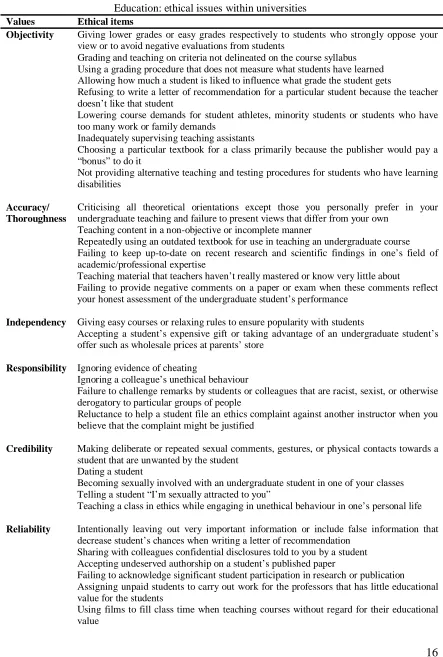
Part of existing literature focuses on issues like copying for private purposes and side jobs. These issues are included in this study, but are not the main focus. The focus of this study is on ethical issues related to the two main core processes of the staff working at universities: education and research. Other activities of universities, mostly being part of the societal service of universities, are left aside.In order to come to an overview of ethical issues, it is necessary to express the moral values that can be expected of academic staff. According to the Dutch code of conduct for scholarly activities of the VSNU (2004) and according to the Center for Academic Integrity (1999), the following values are the moral values that academic professionals are obliged to respect during their employment.
o Objectivity is not biased, not led by personal interest, preference or sympathy. One must deal with facts or conditions which have to be perceived without distortion by personal feelings, prejudices, sympathy, preference or interpretations. Also, the judgements and decisions cannot be based on personal feelings, prejudices, sympathy, preference or interpretations.
o Accuracy/thoroughness is freedom from mistake or error and marked by full detail carried through to completion. Academic professionals act accurately when they show dedication and care necessary for a good practice of their profession. Although the primary concern of scientists must be to further develop the interests for which the profession has been created, namely the acquisition and extension of knowledge, another requirement of thoroughness is not to harm the interests of third parties in an unnecessary or disproportional way.
o Independency means that the professional is not dependent on anyone, not subordinated or subjected to anyone, not limited in behaviour by anyone; not in somebody’s power or at somebody’s disposition; not determined or controlled by something. When presenting opinions as correct and relevant, scientists are independent when they only allow themselves to be influenced by the judgement of others in as far as that judgement has scientific authority. o Responsibility is the willingness to take action against wrongdoing, despite peer pressure, fear,
loyalty or compassion.
o Credibility means to only take actions to match and support the image of ethical behaviour towards colleagues and students and other people concerned. So, credibility corresponds to the extent to which an academic professional is believed by people in their environment.
o Reliability is the fact that or the degree to which something or somebody can be trusted and is reliable. Academic professionals act reliably when they do not betray the justified expectations of others with respect to the way they practice their profession. Reliability both relates to the behaviour of scientists and to their written work.
o Respect for others is characterised by academic professionals who show respect by taking students’ ideas seriously, providing full and honest feedback on their work, valuing their aspirations and goals, and recognising them as individuals.
o Transparency is the degree of visibility or accessibility of information. Actions are verifiable when others are able to check whether the actions meet certain relevant standards.
5
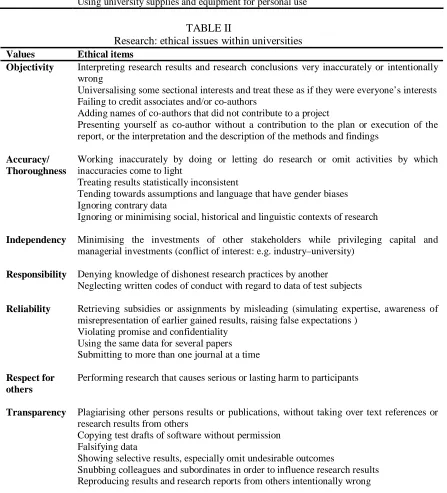
Insert TABLE I: Education: ethical issues within universitiesInsert TABLE II: Research: ethical issues within universities
Methodology
This study servers an explorative investigation into whether ethics programs sufficiently support professionals to behave compliantly and which way is most appropriate to design an ethics program in universities. Organisations are the units of analysis. The research has been executed in the three Dutch universities of technology: Delft University of technology, Eindhoven University of Technology and University of Twente. In 2007, these three technical universities have been united into the 3TU-federation, which is the first cooperation between Dutch universities at this level. Since this federation has recently been founded and is currently under construction, it is the right moment to give recommendations to the leaders of the 3TU-federation with regards to their ethics programs.
To execute this research, the following research program has been designed.
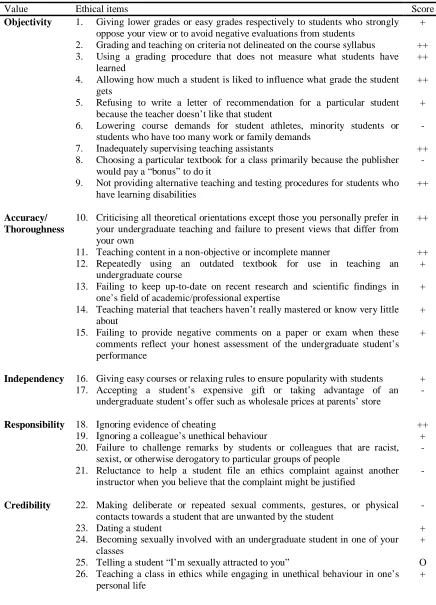
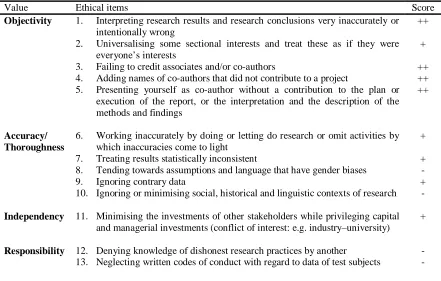
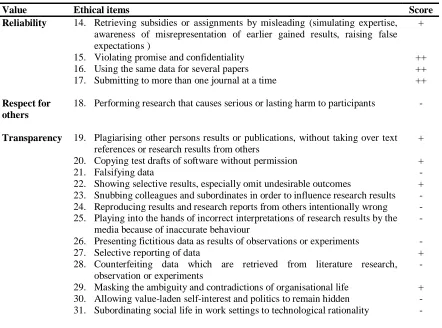
First, it is necessary to find out which ethical issues are present in daily practice of the three Dutch universities of technology. If no signals of non-compliant behaviour within these universities are present, there is no need for this research to be conducted. To find out which ethical issues seem relevant, six experts have been interviewed. The experts have been chosen by contacts within the three universities. In this context experts are employees who: 1) have worked in the same university setting for at least ten years; 2) have a function as a teacher and/or as a researcher; 3) have no interest in creating a good image of the university 4) are extrovert and independent; 5) are social and critical. Using these criteria, the respondents should have enough knowledge about their university and should give honest and open answers. This is by means a basis for reliable conclusions. The respondents of this research do not have the same characteristics as the population from which the respondents are selected. However, this research does not require the respondents to be representativeness. This part is only aimed at finding evidence that non-compliant behaviour does indeed occur within these three universities. In each university two interviews have been conducted: one concerning research and one concerning education. Before the actual interviews were conducted, two pilot interviews were performed to improve the interview questions. The only subjects of the interview were the ethical issues of table I and table II. In the interviews, the respondents have been asked whether the ethical issues are present in their academic setting. The options they could chose from are: without doubt present (++); think it is present in their academic setting, but do not know for sure (+); not present in their academic setting (-); or have no idea (o). The results of these interviews are shown in two tables in Appendix A regarding the two core processes. The scores of the three universities have been assessed in the following way. The score ‘have no idea’ (o) is not taken into account. The average is taken from the remaining scores and rounded up. For example, the scores -, +, o, resulted in + and the score, and -, ++, ++, resulted in ++. The results of these interviews are explained in a couple of quantitative terms as well, and in terms of the moral values that professionals are obliged to respect during their employment. The ethical issues are not discussed separately.
In the second step, an overview of the current ethics measurements of the three universities has been made. The universities’ measurements are compared to the requirements of effective ethics programs of Weaver et al. (1999). Subsequently, the current institutional ethics programs of the universities have been studied in relation to the signals of non-compliant behaviour. In this way, it has been evaluated whether the ethics programs sufficiently support professionals to behave compliantly within the three universities.
6
ResultsIndications for ethical issues of the academic staff
Six experts have been interviewed to find out if indications of non-compliant behaviour are apparent. Per university, two experts have been questioned, of which one on core process education and one on core process research. Besides being experienced academic teachers, two of the three interviewees in the core process education were also (former) members of the examination committee. During the interviews, it became obvious that the interviewees who were, or had been, a member of the examination committee, were more aware of ethical issues in their academic setting than the interviewee with only teaching experience. The three interviewees in the core process research have had many years of experience in doing research and supervising people carrying out research.
The interviews clearly showed that there are ethical issues present in the daily practice of professionals in an academic setting. These issues include dating a student, teaching under influence of alcohol or drugs, failure to credit associates and/or co-authors, and violating promises and confidentiality. The differences between the three technical universities are small, as can be seen in Appendix A.This table shows which ethical issues are present in the academic setting of these three universities.
Appendix A indicates that 32 percent of the total number of described issues in the core process education (41) is undoubtedly present in the universities and 41 percent is probably present. Only 24 percent of the described issues does not occur in the universities in the core process education. The Appendix also indicates that 42 percent of the described issues in the core process research (31) does not occur in the universities, 23 percent in the core process research is undoubtedly present and 35 percent of these issues is presumably present in the three universities. Consequently, non-compliancy is noticed more often in core process education than in core process research. It is obvious that the majority of the values are violated. It can be concluded that in both core processes, the values objectivity, independency and reliability are not met by academic professionals. Especially the values objectivity and reliability attract attention in core process education. Only two of the fourteen issues in these two values do not occur in the investigated universities. The value accuracy/thoroughness and the value responsibility do not meet expectations in the core process education, but in the core process research these values score better. Credibility is only measured in the core process education and it seems that academic professionals do not always behave credibly. A short comment must be given on the value credibility. The interviews have shown that when this value is not satisfied, this only takes place very rarely. Within the universities, there is respect for others in the core process research, but there is not always respect for the students in the core process education. A couple of issues in the value transparency are present in the three universities, but overall, the academic professionals behave in a transparent way.
Competitiveness of ethics programs
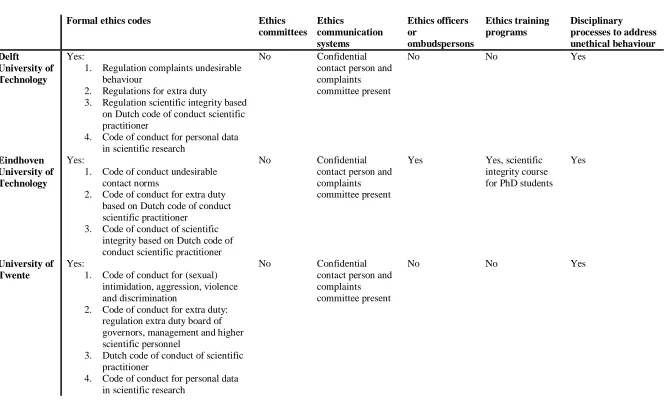
In this paragraph, the requirements of Weaver et al. (1999) will be compared with the three Dutch technical universities (see table III). First of all, the three technical universities all use codes of conduct. The differences between these codes of conduct of the universities are limited. The universities have a code of conduct for undesirable behaviour and one for extra duty. Besides these codes of conduct, the codes of conduct of the Association for Dutch Universities (VSNU) apply to all Dutch universities. The following codes of conduct can be obtained from the VSNU: the Dutch code of conduct of scientific practitioner and the code of conduct for personal data in scientific research
7
it is the only university to have an ethics officer or ombudsperson. Important to note is that the integrity course for Ph.D. students has just started this year.With regards to the aim of this research, the ethics program of the universities can support professionals to behave compliantly within the universities. Three codes of conduct which are in use in the three universities support professionals to behave compliantly are: a) regulations complaints undesirable behaviour, contact norms or intimidation, aggression, violence and discrimination; b) code of conduct for scientific practitioner; c) code of conduct for personal data in scientific research. These three codes all have a relation with the described ethical issues. Most of all issues are addressed within these codes. Despite the three codes of conduct supporting professionals to behave compliantly, there are still signals of non-compliancy.
The confidential contact persons, complaints committees and disciplinary processes also do not seem to support professionals to behave compliantly, as seen from the clearly present signals of non-compliancy. Within the Eindhoven University of Technology, there are an ethics officer and an ethics trainings program. However, compared to Delft and Twente, these extra measures do not influence the non-compliant behaviour, since the signals are nearly identical in all three universities.
Summarising, the signals of non-compliant behaviour currently present in the three investigated universities reveal that the ethics programs of these universities do not sufficiently support professionals to behave compliantly, even though these programs contain appropriate codes of conduct.
Insert TABLE III: Ethics measurement in three Dutch universities
Applying ethics strategies in an academic context
The three Dutch technical universities have taken measures to stimulate ethical behaviour in their organisation. The most important measures are the codes of conduct, the ethics communication systems and the disciplinary processes to address unethical behaviour. The universities have used the compliance strategy to organise ethics in their institution. This can be concluded from the presence of concrete standards for behaviour in the form of codes of conduct, procedures to report unethical behaviour in the form of ethics communication systems, and disciplinary processes to address unethical behaviour. Furthermore, there are no clearly stated values within the ethics programs of the universities, which is the first and most important condition for the integrity strategy.
At the studied universities, the compliance strategy is used in conjunction with institutional ethics, since the ethics program is imposed by the institution. Despite the ethics program, it appears that there are still signals of non-compliant behaviour in both the academic settings of research and education. The interviews that have been held with the professionals during this research have shown that non-compliant behaviour is more often noticed in the core process education than in the core process research. The most proper argument for this result is that more control in the core process education exists; students are aware of the behaviour of their teachers. When such signals of non-compliancy are apparent, this is communicated to the examination committee by the students.
Ethics programs should include several features (see above) to be effective. The ethics programs of the three investigated universities do not include all of these recommended features. Therefore, it can be concluded that the ethics programs of the universities are not very effective. But even if the investigated universities would have included all those features into their ethics programs, would the ethics program have been effective? Probably not! In implementing the ethics programs, the universities have neither taken into account the two strategies of organising ethics, nor the existence of institutional and professional ethics. Therefore, only implementing an institutional ethics program is not sufficient.
8
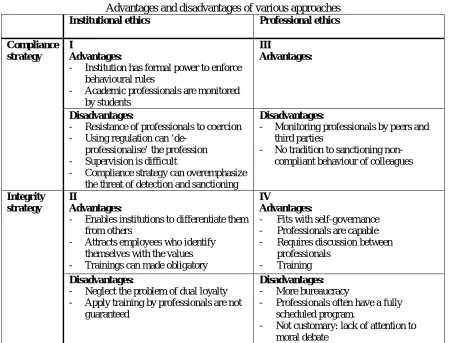
of compliant behaviour of the academic professionals. The main question to be answered is: “what is the most proper and realistic approach in a professional bureaucracy like a university?”First of all, we will analyse the possibility of organising a professional bureaucracy by implementing institutional ethics using the compliance strategy within an academic setting (approach I). Guidelines and procedures can be imposed by universities, for example by using codes of conduct. The institution can impose guidelines and procedures, because the institution has the formal power to do so. The problem with imposed guidelines and procedures is that it goes against the nature of professionals; most professionals have a natural resistance to coercion (Nijhof et al., 2000). One of the properties of a profession is the absence of regulatory legislation and the reliance upon the profession to regulate itself. Thus, using regulation would tend to ‘de-professionalise’ the profession. Regulations remove control of the professionals from the profession itself and places it in the hands of the institution (Brien, 1998, p. 393). Supervision of the behaviour of the academic professionals by the institution is difficult to fulfil, because professionals have specialised knowledge which is not held by every member of the organisation; non-compliant behaviour will often not be detected. Because of this specialised knowledge, academic professionals are powerful and autonomous and difficult to monitor. However, teaching professionals are monitored by the students. When signals of non-compliancy of teachers are apparent, this behaviour is communicated to the examination committee by the students. So, a limited part of ethical issues are neutralised in rules. Discipline is needed in every organisation’s ethical system, but the compliance strategy can overemphasize the threat of detection and sanctioning in order to stimulate compliant behaviour. When this happens, there is a fair chance that professionals react negatively on ethics programs, especially if the ethics programs have been made without any involvement of the academic professionals and are enforced by the institution (Paine, 1994).
Secondly, the question arises whether it is possible to organise a professional bureaucracy by implementing institutional ethics using the integrity strategy within an academic setting (approach II). The most important condition, i.e., defining clear core values and communication of these values to the professionals within universities, can be accomplished, as these core values can be imposed by the institution, for example in annual reports or formal organisation occasions. With the help of the espoused values, a university can differentiate itself from other universities, thereby attracting employees who identify themselves with the (espoused) values of the university. Approach II neglects the problem of dual loyalty of the professionals within an academic setting. The universities interpret the professionals only as organisation members and not as professional members and so the professional’s academic freedom can become an issue.
Trainings for professionals in which they learn how to apply core values in various situations can be made obligatory by the universities. In this way, the academic professionals learn how to apply the university’s core values. With the help of the trainings, the espoused values are reflected in the university’s critical activities. A possible problem that arises in this approach, is that when the professionals have fulfilled the training, this does not necessarily mean that the professionals will apply the imposed values. This is a result of the autonomous character of the professionals, of their own responsibility, and of their academic freedom. Consequently, there is no guarantee that the core values will be reflected in the university’s critical activities. By making use of a second non-active teacher in a classroom, this possible shortcoming of this way of organising ethics can be eliminated in the core process education.
9
specialised knowledge of professionals and their academic freedom. Monitoring behaviour of professionals by peers is not feasible. According to Brien (1998, p. 393), professions often display a noticeable reluctance to report ethical violations of their members and to discipline them. When this occurs, the accountability of the profession is highly decreased. Also, within an academic setting, it is not customary to sanction non-compliant behaviour of colleagues.Fourthly, it should be considered whether it is possible to organise a professional bureaucracy by implementing professional ethics using the integrity strategy within an academic setting (approach IV). The integrity strategy is based on self-governance according to chosen standards and so, the professionals are more likely motivated to behave in accordance with the shared values (Paine, 1994). Professionals then function best and are motivated to perform education and research to the best of their capacity. Within professional ethics, it is possible to define clear core values and communicate these values to the academic professionals. This is because the professionals themselves are capable of inventing the values themselves. In this way, the values can easily be communicated within the profession. Making core values for the organisation requires discussion with other professionals. Within universities, there is often a lack of attention to moral debate which is not customary, although this can be decreased by trainings. Consequently, to apply the values in specific situations, the employees have to be trained. This is feasible within an academic setting. In contrast to institutional ethics, professional ethics assume “active” human beings, making competences a lifelong process (Von Weltzien Hoivik, 2002 ). Thus, academic professionals will understand the added value of the training. With the support of the training, the values will be integrated into the decision making channels and will be reflected in the critical activities of the organisation. By integrating the values, there is a fair chance that both the structure and system of the university have to be changed. The professionals agree with the values, because they themselves have made these values. Therefore, they are willing to participate in changing the system and structure if needed. With the support of the previous conditions, the academic professionals will have the decision making skills, knowledge, and competencies to make ethical decisions in the daily business.
The question in this case is whether the professionals are willing to define professional and all-embracing codes of ethics. Professionals often have a fully scheduled program consisting of what they would call professional activities. Defining, implementing and learning ethical codes will very likely be considered as yet another consequence of the ongoing bureaucracy in universities (Clark, 2003), which makes it a waste of time. This problem might be resolved by (a) pointing out the current non-compliant behaviour to the professionals and (b) reminding the professionals that when this non-compliant behaviour becomes too flagrant, the right of the professionals to self-regulate is threatened. Peers are the best qualified people to judge a professional’s work since professionals believe in self-regulation (Hammer, 2000), but are these peers willing to judge the professionals? When the integrity strategy is implemented in such a way that all the conditions are lived up to, the peers are probably willing to report unethical behaviour of the professionals; when everybody is participating in accordance to the rules, the professionals are highly committed to their organisation, and non-compliant behaviour is reported and investigated.
10
covered in approach IV. In the current situation, approach I, this right is covered and often exercised by students.It is clear by now that none of the four approaches is applicable on its own. The ideal way of organising ethics in an academic setting is using approach IV, facilitating this approach by the strengths of approach II, and adding the judgemental power of students of approach I.
Insert TABLE IV: Advantages and disadvantages of various approaches
Conclusion and recommendations
Individuals in professional bureaucracies see themselves both as members of a profession and as members of an organisation. For this reason, there is friction between the institutional and professional ethics. This dual loyalty of professionals is a potential for conflict.
In literature, several values are mentioned in accordance to which academic professionals are expected to behave while practising their profession. During interviews conducted among six experts, it was established that professionals in universities often do not behave according to the majority of these values, both in practising education and research. This clearly indicates the existence of non-compliant behaviour.
The ethics programs of the universities do not sufficiently support professionals to behave compliantly, even though these programs contain appropriate codes of conduct.
Two strategies exist for organising ethics in organisations: compliance strategy and integrity strategy. The compliance strategy is a strategy in which the organisation develops concrete standards of behaviour. The integrity strategy relies on the responsibility and integrity of the individuals themselves and does not rely on compliance to strict rules.
The best way of organising ethics in an academic setting is by using the integrity strategy based on professional ethics, facilitating this approach by the advantages of the integrity strategy based on institutional ethics, and adding judgemental power of students of the compliance strategy based on institutional ethics. Since the involved universities currently do not organise ethics in this way, these universities are recommended to change the way they organise ethics. The exact manner of implementing this new way of organising ethics in these universities remains topic for further investigation. A possibility is that the universities of the 3TU-federation join their strengths by exchanging ethical experiences.
The cultural and scientifical background of the universities have an important impact on the present ethical issues. The recommendation stated above, on how to change the way of organising ethics, is only valid for other universities assuming that the ethical issues which are present in the investigated universities are present in other universities. This has to be further investigated.
The reasons for non-compliant behaviour in an academic setting are not discussed in this study and so, it is recommended to further examine the causes of non-compliant behaviour in universities. This can best be carried out from the inside of the university, for example by conducting surveys or additional interviews with employees.
11
Appendix A. Indications for ethical issues of the academic staffTable V: Education; ethical issues within universities
Value Ethical items Score
Objectivity 1. Giving lower grades or easy grades respectively to students who strongly oppose your view or to avoid negative evaluations from students
+
2. Grading and teaching on criteria not delineated on the course syllabus ++ 3. Using a grading procedure that does not measure what students have
learned
++
4. Allowing how much a student is liked to influence what grade the student gets
++
5. Refusing to write a letter of recommendation for a particular student because the teacher doesn’t like that student
+
6. Lowering course demands for student athletes, minority students or students who have too many work or family demands
-
7. Inadequately supervising teaching assistants ++
8. Choosing a particular textbook for a class primarily because the publisher would pay a “bonus” to do it
-
9. Not providing alternative teaching and testing procedures for students who have learning disabilities
++
Accuracy/ Thoroughness
10. Criticising all theoretical orientations except those you personally prefer in your undergraduate teaching and failure to present views that differ from your own
++
11. Teaching content in a non-objective or incomplete manner ++
12. Repeatedly using an outdated textbook for use in teaching an
14. Teaching material that teachers haven’t really mastered or know very little about
+
15. Failing to provide negative comments on a paper or exam when these comments reflect your honest assessment of the undergraduate student’s performance
+
Independency 16. Giving easy courses or relaxing rules to ensure popularity with students +
17. Accepting a student’s expensive gift or taking advantage of an undergraduate student’s offer such as wholesale prices at parents’ store
-
Responsibility 18. Ignoring evidence of cheating ++
19. Ignoring a colleague’s unethical behaviour +
20. Failure to challenge remarks by students or colleagues that are racist, sexist, or otherwise derogatory to particular groups of people
-
21. Reluctance to help a student file an ethics complaint against another instructor when you believe that the complaint might be justified
-
Credibility 22. Making deliberate or repeated sexual comments, gestures, or physical
contacts towards a student that are unwanted by the student
-
23. Dating a student +
24. Becoming sexually involved with an undergraduate student in one of your classes
+
25. Telling a student “I’m sexually attracted to you” O
26. Teaching a class in ethics while engaging in unethical behaviour in one’s personal life
12
Table V continuedValue Ethical items Score
Reliability 27. Intentionally leaving out very important information or include false
information that decrease student’s chances when writing a letter of recommendation
+
28. Sharing with colleagues confidential disclosures told to you by a student ++ 29. Accepting undeserved authorship on a student’s published paper + 30. Failing to acknowledge significant student participation in research or
publication
33. Failing to maintain regularly scheduled office hours +
34. Once tenured, only doing the minimum amount of work to get by +
35. Teaching under influence of alcohol or recreational drugs ++
36. Using one’s role to influence students to support causes in which you have an interest
+
Respect for others
37. Belittling, insulting, or ridiculing a student in the student’s presence ++
38. Ridiculing a student in a faculty-only discussion ++
39. Teaching that homosexuality is a mental sickness or that certain races are intellectually inferior
-
Transparency 40. Privately tutoring students in the department for a fee -
41. Using university supplies and equipment for personal use ++
Table VI: Research; ethical issues within universities
Value Ethical items Score
Objectivity 1. Interpreting research results and research conclusions very inaccurately or
intentionally wrong
++
2. Universalising some sectional interests and treat these as if they were everyone’s interests
+
3. Failing to credit associates and/or co-authors ++
4. Adding names of co-authors that did not contribute to a project ++ 5. Presenting yourself as co-author without a contribution to the plan or
6. Working inaccurately by doing or letting do research or omit activities by which inaccuracies come to light
+
7. Treating results statistically inconsistent +
8. Tending towards assumptions and language that have gender biases -
9. Ignoring contrary data +
10. Ignoring or minimising social, historical and linguistic contexts of research -
Independency 11. Minimising the investments of other stakeholders while privileging capital
and managerial investments (conflict of interest: e.g. industry–university)
+
Responsibility 12. Denying knowledge of dishonest research practices by another -
13
Table VI continuedValue Ethical items Score
Reliability 14. Retrieving subsidies or assignments by misleading (simulating expertise, awareness of misrepresentation of earlier gained results, raising false expectations )
+
15. Violating promise and confidentiality ++
16. Using the same data for several papers ++
17. Submitting to more than one journal at a time ++
Respect for others
18. Performing research that causes serious or lasting harm to participants -
Transparency 19. Plagiarising other persons results or publications, without taking over text
references or research results from others
+
20. Copying test drafts of software without permission +
21. Falsifying data -
22. Showing selective results, especially omit undesirable outcomes + 23. Snubbing colleagues and subordinates in order to influence research results - 24. Reproducing results and research reports from others intentionally wrong - 25. Playing into the hands of incorrect interpretations of research results by the
media because of inaccurate behaviour
-
26. Presenting fictitious data as results of observations or experiments -
27. Selective reporting of data +
28. Counterfeiting data which are retrieved from literature research, observation or experiments
-
14
ReferencesAshforth, B.E., & Anand, V.: 2003. “The normalization of corruption in organization”, in: R.M. Kramer and B.M. Staw (eds.), Research in Organizational Behavior, 1st edition (Greenwich, CT, JAI Press), pp. 1-52.
Babbie, E.:2001 The practice of social research (Wadsworth: Thomson, 9th edition)
Birch, M., & Elliot, D.: 1999, “Black and white and shades of gray: a portrait of the ethical professor”, Ethics & Behavior 9(3), 243-261.
Brien, A.: 1998. “Professional ethics and the culture of trust”, Journal of Business Ethics 17(4), 391-409.
Brimble, M. & Stevenson-Clarke, P.: 2005, “Perceptions of the prevalence and seriousness of academic dishonesty in Australian universities”, The Australian Educational Researcher 32(3), 19-44.
Bruhn, J.G., Zajac, G., Al-Kazemi, A., & Prescott, L.D.: 2002, “Moral positions and academic conduct: parameters of tolerance for ethics failure”, The Journal of Higher Education 73(4), 461-493.
Center for academic integrity (CAI): 1999, “The fundamental values of academic integrity. Des Plaines: Office of college relations. Also at
http://www.academicintegrity.org/pdf/FVProject.pdf.
Clark, B.R.: 2003, “Sustaining change in universities: continuities in case studies and concepts”, Tertiary Education and Management 9, 99-116.
Dotterweich, D.P., & Garrison, S.:1998, “Research ethics of business academic researchers at AACSB institutions”, Teaching Business Ethics 1, 431-447.
Feist, G.J.:1997, “Quantity, quality, and depth of research as influences on scientific eminence: is quantity most important?”, Creativity Research Journal 10(4), 325-335.
Fritz, J.M.H., Arnett, R.C., & Conkel, M.: 1999, “Organizational ethical standards and organizational commitment”, Journal of Business Ethics 20(4), 289-299.
Gardner, H.: 2007, “The ethical mind”, Harvard Business Review 85(3), 51-56.
Graafland, J., Ven van de, B., & Stoffele, N.: 2003, “Strategies and instruments for organising CSR by small and large businesses in the Netherlands”, Journal of Business Ethics 47(1), 45-60.
Haggerty, K.D.: 2004, “Ethics creep: governing social science research in the name of ethics”, Qualitative Sociology 27(4), 391-414.
Hammer, D.P.: 2000, “Professional attitudes and behaviors: the A’s and B’s of professionalism”, American Journal of Pharmaceutical Education 64, 455-464.
Howe, K.R., & Moses, M.S.: 1999, “Ethics in educational research”, Review of Research in Education 24, 21-59.
Kelley, P.C., Agle, B.R., & Demott, J.: 2005, “Mapping our progress: identifying, categorizing and comparing universities’ ethics infrastructures”, Journal of Academic Ethics 3, 205-229. Keith-Spiegel, P.C., Tabachnick, B.G., & Allen, M.: 1993, “Ethics in academia: students’ view of
professors’ action”, Ethics & Behavior 3(2), 149-162.
KNAW, VSNU& NWO: (2001), “Notitie wetenschappelijke integriteit”, Amsterdam: KNAW. Lewellyn, P.A.G.: 1996, “Academic perceptions: ethics in the information systems discipline”,
Journal of Business Ethics 15(6), 559-569.
McCabe, D.L., Trevino, L.K. & Butterfield, K.D.: 2002, “Honor codes and other contextual influences on academic integrity: a replication and extension to modified honor code settings”, Research in Higher Education 43(3) 357-378.
15
McDonald, G.: 1999, “Business ethics: practical proposals for organisations”, Journal of BusinessEthics 19(2), 143-158.
McDonald, G., & Nijhof, A.:1999, “Beyond codes of ethics: an integrated framework for stimulating morally responsible behaviour in organisations”, Leadership & Organisation Development Journal 20(3), 133-146.
Merriam-Webster online: “English dictionary” http://www.m-w.com/dictionary/.
Nijhof, A., Fisscher, O. & Looise, J.K.: 2000, “Coercion, guidance, and mercifulness: the different influences of ethics programs on decision-making”, Journal of Business Ethics 27(1), 33-44.
Paine, L.S.: 1994, “Managing for organizational integrity”, Harvard Business Review, March-April, 106-117.
Payne, S.L.: 2000, “Challenges for research ethics and moral knowledge construction in the applied social sciences” Journal of Business Ethics 26(4), 307-318.
Pelletier, K.L. & Bligh, M.C.: 2006, “Rebounding from corruption: perceptions of ethics program effectiveness in a public sector organization”, Journal of Business Ethics 67(4), 359-347. Rich, J.M.:1984 Professional ethics in education (Springfield: Charles C Thomas).
Robie, C., & Kidwell, R.E.: 2003, “The “ethical” professor and the undergraduate student: current perceptions of moral behavior among business school faculty”, Journal of Academic Ethics 1, 153-173.
Shadish S.R., Cook C.D., Campbell D.T.:2002, Experimental and Quasi experimental Design, for generalized Causal Inference )Boston: Houghton Mifflin Company)
Sims, R.R.: 1991, “The institutionalization of organizational ethics”, Journal of Business Ethics, 10(7), 493-506.
Sponholz, G.: 2000, “Teaching scientific integrity and research ethics”, Forensic Science International 113, 511-514.
Tabachnick, B.G., Keith-Spiegel, P., & Pope, K.S.: 1991, “Ethics of teaching: beliefs and behaviors of psychologists as educators”, American Psychologist 46(5), 506-515.
Tenbrunsel, A.E., Smith-Crowe, K., & Umphress, E.E.: 2003, “Building houses on rocks: the role of the ethical infrastructure in organizations”, Social Justice Research 16(3), 285-307.
Trevino, L.K., Weaver, G.R., Gibson, D.G., & Toffler, B.L.: 1999, “Managing ethics and legal compliance: what works and what hurts”, California Management Review, 41(2), 131-151. VSNU: (2004), “Dutch code of conduct for scholarly activities; principles of good scientific
education and research”, Amsterdam: VSNU
Weaver, G.R., Trevino, L.K., & Cochran, P.L.: 1999, “Corporate ethics programs as control systems: influences of executive commitment and environmental factors”, Academy of Management Journal, 42(1), 41-57
Weber, J.: 2006, “Implementing an organizational ethics program in an academic environment: the challenges and opportunities for the Duquesne University Schools of Business”, Journal of Business Ethics 65(1), 23-42.
16
TABLE IEducation: ethical issues within universities
Values Ethical items
Objectivity Giving lower grades or easy grades respectively to students who strongly oppose your view or to avoid negative evaluations from students
Grading and teaching on criteria not delineated on the course syllabus Using a grading procedure that does not measure what students have learned Allowing how much a student is liked to influence what grade the student gets
Refusing to write a letter of recommendation for a particular student because the teacher doesn’t like that student
Lowering course demands for student athletes, minority students or students who have too many work or family demands
Inadequately supervising teaching assistants
Choosing a particular textbook for a class primarily because the publisher would pay a “bonus” to do it
Not providing alternative teaching and testing procedures for students who have learning disabilities
Accuracy/ Thoroughness
Criticising all theoretical orientations except those you personally prefer in your undergraduate teaching and failure to present views that differ from your own
Teaching content in a non-objective or incomplete manner
Repeatedly using an outdated textbook for use in teaching an undergraduate course Failing to keep up-to-date on recent research and scientific findings in one’s field of academic/professional expertise
Teaching material that teachers haven’t really mastered or know very little about
Failing to provide negative comments on a paper or exam when these comments reflect your honest assessment of the undergraduate student’s performance
Independency Giving easy courses or relaxing rules to ensure popularity with students
Accepting a student’s expensive gift or taking advantage of an undergraduate student’s offer such as wholesale prices at parents’ store
Responsibility Ignoring evidence of cheating
Ignoring a colleague’s unethical behaviour
Failure to challenge remarks by students or colleagues that are racist, sexist, or otherwise derogatory to particular groups of people
Reluctance to help a student file an ethics complaint against another instructor when you believe that the complaint might be justified
Credibility Making deliberate or repeated sexual comments, gestures, or physical contacts towards a
student that are unwanted by the student Dating a student
Becoming sexually involved with an undergraduate student in one of your classes Telling a student “I’m sexually attracted to you”
Teaching a class in ethics while engaging in unethical behaviour in one’s personal life
Reliability Intentionally leaving out very important information or include false information that decrease student’s chances when writing a letter of recommendation
Sharing with colleagues confidential disclosures told to you by a student Accepting undeserved authorship on a student’s published paper
Failing to acknowledge significant student participation in research or publication Assigning unpaid students to carry out work for the professors that has little educational value for the students
17
Failing to maintain regularly scheduled office hoursOnce tenured, only doing the minimum amount of work to get by Teaching under influence of alcohol or recreational drugs
Using your role to influence students to support causes in which you have an interest
Respect for others
Belittling, insulting or ridiculing a student in the student’s presence
Ridiculing a student in a faculty-only discussion
Teaching that homosexuality is a mental sickness or that certain races are intellectually inferior
Transparency Privately tutoring students in the department for a fee Using university supplies and equipment for personal use
TABLE II
Research: ethical issues within universities
Values Ethical items
Objectivity Interpreting research results and research conclusions very inaccurately or intentionally wrong
Universalising some sectional interests and treat these as if they were everyone’s interests Failing to credit associates and/or co-authors
Adding names of co-authors that did not contribute to a project
Presenting yourself as co-author without a contribution to the plan or execution of the report, or the interpretation and the description of the methods and findings
Accuracy/ Thoroughness
Working inaccurately by doing or letting do research or omit activities by which inaccuracies come to light
Treating results statistically inconsistent
Tending towards assumptions and language that have gender biases Ignoring contrary data
Ignoring or minimising social, historical and linguistic contexts of research
Independency Minimising the investments of other stakeholders while privileging capital and
managerial investments (conflict of interest: e.g. industry–university)
Responsibility Denying knowledge of dishonest research practices by another
Neglecting written codes of conduct with regard to data of test subjects
Reliability Retrieving subsidies or assignments by misleading (simulating expertise, awareness of misrepresentation of earlier gained results, raising false expectations )
Violating promise and confidentiality Using the same data for several papers Submitting to more than one journal at a time
Respect for others
Performing research that causes serious or lasting harm to participants
Transparency Plagiarising other persons results or publications, without taking over text references or research results from others
Copying test drafts of software without permission Falsifying data
Showing selective results, especially omit undesirable outcomes
18
Playing into the hands of incorrect interpretations of research results by the media because of inaccurate behaviourPresenting fictitious data as results of observations or experiments Selective reporting of data
Counterfeiting data which are retrieved from literature research, observation or experiments
19
4. Code of conduct for personal data in scientific research
2. Code of conduct for extra duty based on Dutch code of conduct
2. Code of conduct for extra duty: regulation extra duty board of governors, management and higher scientific personnel
3. Dutch code of conduct of scientific practitioner
20
Table IVAdvantages and disadvantages of various approaches
Institutional ethics Professional ethics
I
Advantages:
- Institution has formal power to enforce behavioural rules
- Academic professionals are monitored by students
III
Advantages: Compliance
strategy
Disadvantages:
- Resistance of professionals to coercion - Using regulation can
‘de-professionalise’ the profession - Supervision is difficult
- Compliance strategy can overemphasize the threat of detection and sanctioning
Disadvantages:
- Monitoring professionals by peers and third parties
- No tradition to sanctioning non-compliant behaviour of colleagues
II
Advantages:
- Enables institutions to differentiate them from others
- Attracts employees who identify themselves with the values - Trainings can made obligatory
IV
Advantages:
- Fits with self-governance - Professionals are capable - Requires discussion between
professionals - Training Integrity
strategy
Disadvantages:
- Neglect the problem of dual loyalty - Apply training by professionals are not
guaranteed
Disadvantages: - More bureaucracy
- Professionals often have a fully scheduled program.