
Process model for the learnership
programme in Rustenburg
By:
Harold Topper (s0049379)
Roy Spenkelink (s0005630)
Civil Engineering,
University of Twente, The Netherlands
Rustenburg (South Africa) and Enschede (The Netherlands), June 2007
Internship supervisors:
Mr. M. Laubscher
Director LITEworks
Process model for the learnership
programme in Rustenburg
M
M
a
a
n
n
a
a
g
g
e
e
m
m
e
e
n
n
t
t
s
s
u
u
m
m
m
m
a
a
r
r
y
y
This report describes the research to a process model for the learnership programme in Rustenburg, South Africa. The reason for the research is formed trough the problems of the learnership to attain the programme’s main objective of delivering leaner contracting companies. The problem is two-folded:
- delays in the project provision
- lack of structure in the mentoring services
The provision of projects is necessary for the learners’ practical experience in labour-intensive construction and for the mentor to give them the on-site support. A good mentoring schedule helps the mentor to give the best possible support. Out of this problem analysis the object of the research is formulated:
“Developing a process model from initiation to project completion to improve the quality of the learner contractors at the end of the Labour Intensive Construction Learnership Programme in Rustenburg by a) analysing the provision of the projects and by,
b) analysing the process and the content of the mentoring services”
The research is executed at the mentoring company of the programme, LITEworks. The relevant data for the research is gathered by the method of participating observation. Through LITEworks the researchers have formed part of the learnership programme in Rustenburg bipartitely; as a mentor and as members of the management of this programme.
Two different models are developed: a linear phasing model for the provision of the projects and a mentoring model based on project management and experiential learning theory. Together they form a process model from initiation to project completion. This process model can contribute to improve the quality of the learners at the end of the learnership programme in Rustenburg.
The linear phasing model seems to be the most suitable method to use for the provision of learnership projects, because of the low level of complexity and uncertainty of learnership projects. The model is based on the linear phasing model for conventional construction projects and is adapted to labour-intensive construction projects. The implementation of this model is recommended because the current model of the RLM is too much focussed on conventional projects.
The analysis of the current mentoring services with the experiential learning theory shows that the focus of the learnership needs to be changed. The process needs to be a process of learning instead of a process to execute projects. The conclusion of the analysis to the content of mentoring is that the content needs to be extended and to be described in more detail. These time aspects can contribute to mentor in an efficient and effective manner.
P
P
r
r
e
e
f
f
a
a
c
c
e
e
This report is the final report of our internship for the Civil Engineering and Management study (University of Twente, The Netherlands). The internship has been carried out at the company LITEworks in South Africa. LITEworks is the provider of the mentorship services at the learnership programme in Rustenburg. On this programme for emerging contractors LITEworks mentors them on how to run their own labour-intensive construction companies. Our function was to mentor the learners in the learnership programme in Rustenburg and to analyse this programme. During the executing of the programme several things were not going as planned. This report presents our research on the learnership programme in Rustenburg.
As a part time mentor we have assisted the learners of the programme in successfully realizing their construction projects. Through this mentoring we have learned a lot about the influences of the history of South Africa on the current situation and about the culture of the black people. Solomon Radzilani, colleague mentor, has given us insight in the culture of the black community; we have learned some words of the language and the ‘braai’ is an aspect of the South African culture what we have appreciated. Solomon, we are most grateful to you.
To carry out this research a couple of people have supported us. First of all Mr. Sirp de Boer, he has helped us to come in touch with LITEworks. Secondly Mr. Andreas Hartmann has supported us as our supervisor of the University of Twente. Before our period in South Africa he assisted us with providing us with subjects to do research on and during our stay abroad and especially at our return in the Netherlands he assisted us with finalizing the report and provided a critical view on the academic part of the research.
In South Africa we were received with open arms by Filip Taylor Parkins. We will thank Micheal Laubscher for the discussions we have had about our research and the learnership programme and for the opportunity he has offered us to follow a course in labour-intensive construction. Besides of this, Craig advices us to discover the country of South Africa and Michael gives us the opportunities to make these trips. We appreciate both of them with helping us to settle down in South Africa because we have had a wonderful time over there.
T
T
e
e
r
r
m
m
i
i
n
n
o
o
l
l
o
o
g
g
y
y
a
a
n
n
d
d
a
a
b
b
b
b
r
r
e
e
v
v
i
i
a
a
t
t
i
i
o
o
n
n
s
s
Bill of Quantities = BOQ
Construction Education and
Training Authority = CETA
Department of Public Works = DWP
Expanded Public Works Programme = EPWP
Experiential Learning Theory = ELT
Labour-Intensive Construction = LIC
Learnership programme Rustenburg = learnership programme
LITE Works Technical Training
and Education (PTY) LTD = LITEworks
Municipal Infrastructure Grant = MIG
National Qualification Framework = NQF
Provincial Infrastructure Grant = PIG
Rustenburg Local Municipality = RLM
T
T
a
a
b
b
l
l
e
e
o
o
f
f
c
c
o
o
n
n
t
t
e
e
n
n
t
t
s
s
1. Introduction ... 8
1.1 National context ... 8
1.2 Learnership programme in Rustenburg ... 9
1.3 Problem description ... 10
1.4 Objective of the research ... 11
1.5 Research Model ... 12
1.6 Research Strategy ... 12
1.7 Report structure ... 13
2. Model project provision ... 14
2.1 Theoretical model ... 14
2.2 Current provision of the projects in Rustenburg ... 20
2.3 Model provision of the projects in Rustenburg ... 24
2.4 Conclusion ... 27
3. Process model mentoring ... 28
3.1 Problem analysis ... 28
3.2 Framework of mentoring ... 30
3.3 Theory ... 32
3.4 Current situation ... 36
3.5 Analysis ... 36
3.6 Conclusion ... 38
4. Process model ... 40
5. Conclusion ... 42
6. Recommendations ... 43
References... 43
Appendix 1 Country analysis ... 50
Appendix 2 Expanded Public Works Programme ... 56
Appendix 3 Labour-intensive construction ... 60
Appendix 4 Clarification of the research on the provision of projects ... 64
Appendix 5 Current situation execution mentorship services ... 66
Appendix 6 Phasing models ... 72
Appendix 7 Kolb’s Learning Styles ... 73
Appendix 8 Interview with Gugu Matsotso ... 74
Appendix 9 Interview with the RLM ... 76
T
T
a
a
b
b
l
l
e
e
o
o
f
f
f
f
i
i
g
g
u
u
r
r
e
e
s
s
Figure 1 Organization chart ... 9
Figure 2 Planning of the learnership programme in Rustenburg (update until mid-June) ... 10
Figure 3 Research model ... 12
Figure 4 Level of uncertainty and level of complexity [Groote, 2001] ... 15
Figure 5 Methods of phasing [Groote, 2001] ... 16
Figure 6 Standard linear model [Groote, 2001] ... 17
Figure 7 Theoretical model provision LIC-projects ... 20
Figure 8 Model provision of the projects for the learnership programme in Rustenburg ... 26
Figure 9 The structure of the learnership according to the EPWP guidelines [DPW, 2005] ... 29
Figure 10 Progression of the EPWP mentorship [EPWP, 2005b] ... 32
Figure 11 Control cycle [Groote, 2001] ... 33
Figure 12 Kolb's Experiential Learning Cycle [Businessballs, 2007] ... 34
Figure 13 A wrong door ... 36
Table 1 Created work opportunities ... 8
Table 2 Phasing model of the RLM [De Jager, 2006] ... 20
Table 3 Project characteristics ... 31
1
1
.
.
I
I
n
n
t
t
r
r
o
o
d
d
u
u
c
c
t
t
i
i
o
o
n
n
This chapter gives background information to the research, which has been executed for the labour-intensive contractor learnership programme in Rustenburg. The introduction starts with a description of South Africa, which focuses on unemployment and the Expanded Public Works Programme (section 1). This is followed by a brief description in section 2 about the learnership programme in Rustenburg and a brief problem analysis of this learnership. Section 4 to 6 describe the research; section 4 the research objective, section 5 the research model and section 6 the research strategy. The last section (section 7) sets out the structure of the report.
1.1
National context
South Africa is the economical driving force of the African continent (more information about South Africa in Appendix 1), but its economy isn’t growing at a rate that is sufficient to generate enough jobs. South Africa has had jobless growth for the last 25 years, which means less employment is being generated per unit of expenditure. The South African economy has become more capital intensive. This resulted in an extremely high unemployment rate, which seems rather structural than cyclical. The unemployment rate has risen rapidly the last 25 years; from 7% in 1980, through 18% in 1991 to between 27% and 37% in 2001 (and it can be higher than 70% in the rural areas) depending on a narrow or broad definition of employment. A large proportion of these unemployed people has never worked before and is also largely unskilled. This is mostly because of the Apartheid legacy, which downgraded the education of the black people (about 80% of the inhabitants [CIA, 2006]).
‘The Expanded Public Works Programme (EPWP)’ is one of the government’s short-to-medium term programmes that focus on this high unemployment rate, but not on the origin of it. The objective of the EPWP is to alleviate the unemployment with a minimum of one million people within the period of 2004 till 2009. The government needs to create work opportunities for at least one million unemployed, accompanied with training so that they increase their capacity of earning an income in the future to attain this objective. The EPWP involves all government layers and a reorientation of their budgets to increase the work opportunities created by government expenditures. The coordination of this programme has been appointed to the Department of Public Works (DPW). More information about unemployment and the EPWP can be found in Appendix 2.
For the implementing of the EPWP there have been opportunities identified in the following sectors: infrastructure, economical, social and environmental sector. The objectives of creating work opportunities in the four sectors are summarized in Error! Reference source not found.. The emphasis in the infrastructure sector lies on creating extra work opportunities through the use of labour-intensive construction (LIC) methods
(LIC is further described in Appendix 3). Approximately R15 billion will be invested in labour-intensive construction projects over the next five years, which is one third of the total infrastructure budget. Within the
infrastructure sector a labour-intensive contractor learnership programme for emerging contractors is started. The Skills Development Act of 1998 introduces learnership programmes in South Africa. It is a new way of acquiring a qualification that has been registered on the National Qualifications Framework (NQF). The NQF is a framework on which standards and qualifications are registered. So the NQF let the learners benefit from quality education provision of qualifications that have national recognition [SAQA, n.d.]. Learnerships do not equal to a qualification but structures the route to nationally recognised qualifications that relates to a specific occupation. Instead of apprenticeships in South Africa this can be any occupation. It is a work-based route and consists of structured learning components and practical work experience. These learnerships are an agreement between an employer, a learner and learner provider. [De Jager et al, 2002]
1.2
Learnership programme in Rustenburg
Labour-intensive contractor learnership programmes for emerging contractors are implemented by municipalities and provinces. The Rustenburg Local Municipality (RLM) is one of the municipalities that have a learnership programme running at the moment. The learnership programme aims to produce small contracting companies qualified to execute work accordance to the labour-intensive guidelines.
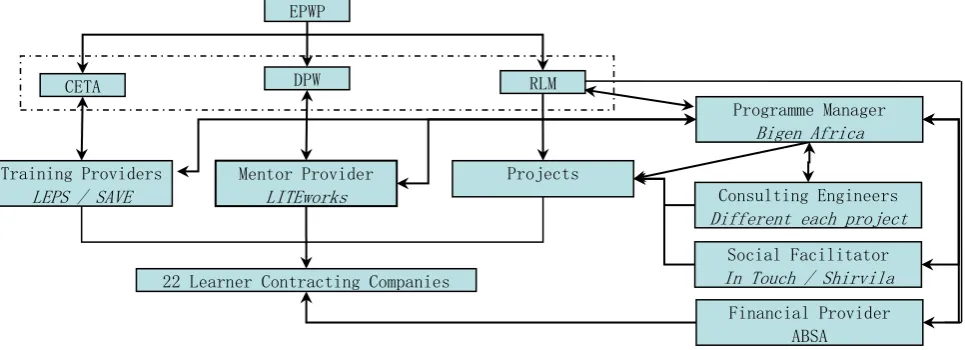
The learnership programme stretches over a period of two years and started in May 2005 with 22 learner contracting companies. It consists of a combination of three blocks of classroom training and three projects for the practical experience. The training and projects are provided sequentially and during the whole programme the learner contracting companies have a mentor available; this mentorship is meant to assist the learner contracting companies to successfully complete their projects. The 22 learner contracting companies each consist of a team of three people. The first person is the learner contractor, which is educated at the ‘National Qualification Framework (NQF) level 2 contractor learnership’. The other two persons needs to be site supervisors, they are educated at ‘NQF level 4 site supervisor’. These companies are provided with different facilities by the programme organization. The current relations between the companies within this organization are visualised in the organization chart below.
Figure 1 Organization chart
services in the area of specialist training needs for public infrastructure provision. LITEworks is providing services and support in a range of functions including: civil and building construction, construction and materials management, project management, mentoring and institutional capacity building, accredited training of SME contractors and labour-intensive construction. Already several hundreds of engineering consultants, technicians, construction professionals and public officials have been trained by LITEworks in the use of labour-intensive methods and management approaches. With this LITEworks contributes to the establishment of the government programme on labour-intensive construction.
1.3
Problem description
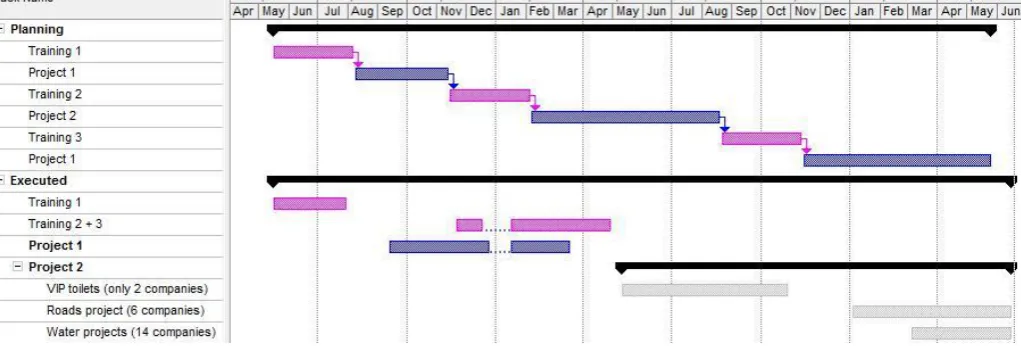
The learnership programme in Rustenburg is one of the learnerships that is executed under the Expanded Public Works Programme. This learnership programme has been started with 22 learner contracting companies (66 learners) and was planned according the normal format of learnerships within the EPWP programme, but this learnership programme is not executed according to these guidelines. Twenty of the 22 learner contracting companies have waited for 8-12 months where they should already have started with their third project (see
Figure 2).
Figure 2 Planning of the learnership programme in Rustenburg (update until mid-June)
The mentor can start his job to assist the learner contracting companies in successfully finishing their projects when the correct documents are delivered. A complete problem analysis has been made in Appendix 5, which is here shortly described. This mentoring of the learners (who have projects) has a demand driven / problem solved approach. The mentors visit the projects to assist the learner contractor and his/her supervisors with problems that have occurred during the process. So the mentorship approach is based on the lessons that learners learn from their mistakes. The learners are making mistakes and are learned how to solve those mistakes. This demand driven / problem solved approach shows how to solve problems, but managing projects is all about controlling the risks in such a way that most of the problems can be foreseen and be prevented [Groote, 2001]. Another problem is the short-term vision of the learners. The learners are focused on earning money as soon as possible and not on the learning part of the programme. But teams (contractors and supervisors) increase their effectiveness and team members can develop team skills when a team intentionally focuses on learning [Kolb, 2005a]. A process model which focuses on the content and the process learning can help the mentors to mentor in a more effective manner.
Both the provision of the projects and a good mentoring schedule are vital elements to attain the programmes main objective to deliver learner contracting companies. The provision of projects is necessary for the learners’ practical experience in labour-intensive construction and for the mentor to give them the on-site support. To give them the best possible support as a mentor there needs to be a good mentoring schedule. The combined model can contribute to impart the practical knowledge in an effective and efficient manner.
1.4
Objective of the research
“Developing a process model from initiation to project completion to improve the quality of the learner contractors at the end of the Labour-Intensive Construction Learnership Programme in Rustenburg by c) analysing the provision of the projects and by,
1.5
Research Model
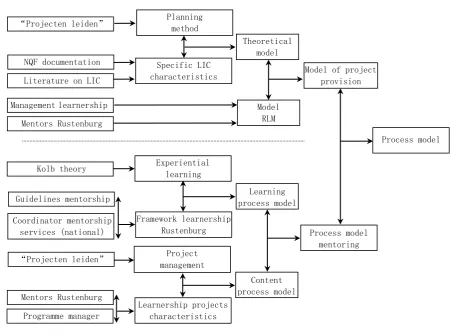
Figure 3 Research model
This model is a visualisation of the research that has been executed as part of the study civil engineering and management of University of Twente and what is presented in the report. To attain the objective of determining a process model the research has been split up into two individual researches. The upper part of the research model is an analysis of the provision of the projects and is executed by Harold Topper. The lower part of the model focuses on the process and the content of the mentoring services and is executed by Roy Spenkelink.
1.6
Research Strategy
To come to the information that is needed to reach the objective of the research the method participating observation has been used. This method uses observations while forming a part of the organisation that is subject of the research. During this internship the researchers have formed part of the learnership programme in Rustenburg bipartitely for 3.5 months; as a mentor and as members of the management of this programme. The major advantage of this form of gathering information is that it gives a good insight in the way of acting of the organization. This form of gathering information is a very intensive one, because the researches are insiders and outsiders at the same time. Besides the work within the organization the relevant information for the research needs to be selected at the same time. The researchers had an open way of acting; the organisation knew that the involvement had to do with a research to the programme.
The involvement of the researches in the learnership programme makes direct observations possible. Direct observation increases the internal validity of this research because it reduces the gap between the research data and the reality. This strong involvement of the researchers has also two disadvantages on the internal validity. The organization can adjust their way of acting when they know that they are researched. This first one is called reactivity, but the effect decreases on the long term. The second disadvantage occurs in the long term and is called going native. The researchers become part of the community and the risk is that the researchers are going to think in line with the local organization and lose their interests in the theory. [‘t Hart, 2006]
The relative long period of gathering the information for the research minimizes the disadvantage of changing the way of acting of the organization. The second disadvantage is minimized unintentionally, because the main part of the research is written after gathering the information. This minimizes the inside focus during the writing process, but the data flow is quit small during this process of writing.
1.7
Report structure
2
2
.
.
M
M
o
o
d
d
e
e
l
l
p
p
r
r
o
o
j
j
e
e
c
c
t
t
p
p
r
r
o
o
v
v
i
i
s
s
i
i
o
o
n
n
The learners need to be onsite to impart the practical knowledge, but to be onsite the projects need to be provided correctly and on time. The provision of the projects is a major problem for the learnership programme in Rustenburg. There is no continuity in the provision of the projects which is causing huge delays to the learnership programme. Each learner contracting company in the programme has received his first project, but most contractors are now already waiting eight months for their second project. So question marks can be set by the method that the Rustenburg Local Municipality uses to plan the provision of the projects. Therefore this chapter focuses on a model for the provision of the projects for the learnership programme in Rustenburg. To come to this model it has to be clear which activities has to be executed from the start of a project till the moment the actual construction can be started. A method to control this process is phasing. A phasing model suitable for labour-intensive construction projects and the specific circumstances of the learnership in Rustenburg can contribute to reduce the delays with the provision of the projects.
A theoretical model will be set out to phase the provision of labour-intensive construction projects in section 1. This theoretical model is used to optimise the practice at Rustenburg. Section 2 analyses the phasing model of the RLM and the current provision of the projects. This results in strong and weak points of the current provision of the learnership projects. The last section (section 1.3) gives a final phasing model based on the theoretical model and the strong and weak points of the current project provision by the RLM.
2.1
Theoretical model
This section sets out the theoretical phasing model for the provision of labour-intensive construction projects. Subsection 1 determines the most appropriate phasing model for the development of the theoretical model. Subsection 2 describes the determined model. Subsection 3 describes specific characteristics of the planning of labour-intensive construction projects as described in the literature of LIC. In subsection 4 these characteristics of LIC-projects are combined with the earlier described linear phasing model to come to a theoretical model which is suitable for the provision of LIC-projects.
Determination of the phasing model
Before the determination of the phasing model the broader context of phasing is set out in subsection 1. Subsection 2 gives an overview of different types of phasing models. It is important to understand the context of the learnership programme in Rustenburg (subsection 3) for the determination of the phasing model. Based on the circumstances the most appropriate model is determines (subsection 4).
Context of phasing
The civil construction sector works project-based (this method is further explained in section 3.3). The Project Management Institute defines project management as [Hendrikson, 1998]: “Project management is the art of directing and coordinating human and material resources throughout the life of a project by using modern management techniques to achieve predetermined objectives of scope, cost, time, quality and participation satisfaction.”
object can be seen as a phased process of decision making in which unknown variables are concretised in multiple steps [Doree, 1996]. Phasing is used to create logical and natural groups of activities which have to be executed to reach the goal of the project and to control the process from start to finish. This gives the following effects [Groote, 2001]:
- Stepwise concretising the final result
- Reducing the risks to the units of work that can be influenced - Stimulating decision making
- Improving the controllability of the work
- Motivating the project partners trough the delivery of sub results
The building process of a civil object is a so called “producing process” in which the development of a civil object takes place. This process can roughly be separated into three main phases [Doree, 1996]:
1. Programming: description of the problem for which a solution is sought. In this phase there is also attention to the requirement of the client and the constraints that are in place. 2. Designing: translating the problem and the requirements into an executable solution. 3. Realising: the construction of the design.
In phasing a building process these three phases can be seen as the minimum that has to be taken into account. The total amount of phases can be chosen randomly and will depend on the kind of project. Important is that activities are organised in such way that it is possible to make a decision at the end of a phase.
Types of phasing models
There are different phasing models which are used in project-based working. The number of models in this report is limited to the three main groups that are described by Geert Groote et al [Groote, 2001]: linear phasing model, cyclic phasing and parallel phasing. A description of these models can be found in Appendix 6.
The different models can be classified by two different aspects: level of uncertainty and level complexity. The levels of these aspects are influenced by different elements as shown in Figure 4.
Figure 4 Level of uncertainty and level of complexity [Groote, 2001]
It is possible to visualise these different main groups of models in a figure with the level of uncertainty and the level of complexity on the axis. The result can be seen in Figure 5.
Elements of the aspect complexity:
- Initial possible definition of the final result - The possibility to generate requirements and
solutions
- Influence of the environment
- The possibilities of changes and their effects
-Cyclic phasing So which model is the best to use depends on a projects uncertainty and complexity.
Learnership Rustenburg
The model needs to be suitable to implement in the learnership programme in Rustenburg, so it should take the circumstances in Rustenburg into account. To come to a model for the provision of the projects the most important circumstances are the project characteristics. Based on these characteristics a type of phasing can be chosen. Thereby it is important to bear in mind that the Rustenburg Local Municipality is the one who needs to implement the model. So the capabilities of the Rustenburg Local Municipality on providing LIC-projects form a boundary condition for the determination of the model.
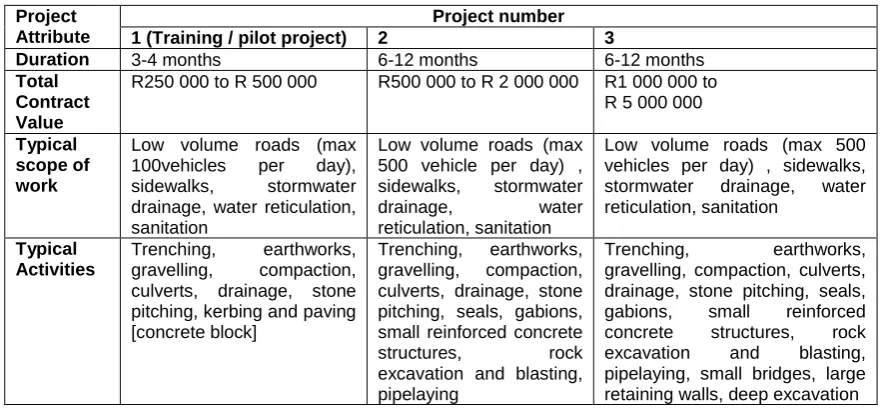
Project characteristics: Each learner contracting company receives three projects for the practical experience. The characteristics of the projects that need to be provided/executed for the learnership programme are given in section 3.2. The types of project that can be expected are [EPWP, 2004]: low volume roads, sidewalks, stormwater drainage, water reticulation and sanitation. It are very concrete projects of which the end-result can be well defined in a early stage of the project, which take away a lot of uncertainties. With each new project the contract value, duration and complexity increases. Though the projects are still relatively small. Work that is normally executed by one contractor is now divided over multiple learner contractors. The projects have a low level of complexity as well compared to conventional construction projects, because the projects have to be constructed with techniques that can be executed by hand.
Capability of the RLM: The provision of labour-intensive construction projects is new for the RLM. Within the RLM there is not much knowledge available on how to provide this kind of projects. The concept of LIC and the implications it has on the project provision is still a learning issue for the management of the learnership programme. So the model should be easy to implement and simple to understand
Determination of the phasing model
model. The linear model is the least complex model of three different groups of model. This makes it the easiest phasing model to understand and work. Thereby it meets the boundary condition that was set by the low capability of the RLM of providing LIC-projects. So for the development of a phasing model of the provision of the learnership projects in Rustenburg it is most appropriate to use a linear phasing model
Linear phasing model
The linear or sequential phasing model in conventional construction management is used for the development of the theoretical phasing model for LIC learnership projects. As a basis for the development of this model the standard linear model that is described by Groote et al (2001) which consist of six different phases is used. A visualisation of this standard linear model is shown in Figure 6. The characteristics of a linear model are that the phases follow each other sequentially and that every phase will be completely finished before moving to the next phase.
Figure 6 Standard linear model [Groote, 2001]
Each phase has its own range of activities which forms a complete whole. Thereby ends each phase with a concrete decision whereby it is examined if the outcome of that phase fits with earlier made decisions, besides an approach is made for the next phase and which activities still have to be executed. This gives insight if the project is still on track. The controllability of the project is enhanced by this approach.
Each phase has a unique assignment [Groote, 2001]:
- Initiation: the first ideas about the project now have to be concretised into a global description of the end-result. Thereby it is important to analyse the reasons why the project should be realised, which problems it solves, what goals it pursues and what the scope of the project is.
- Definition: during this phase the project is further defined. A thorough analysis of the problems and goals is made. Besides a description of the project requirements needs to be made: functional and non-functional requirements, preconditions, design limitations etcetera. This all comes together in the TOR (Terms of Reference) or the Project Charter which defines the project: what, who, how and when.
- Design: a number of design alternatives are developed bases on the TOR of the definition phase.
After one of the design alternatives is chosen the final design is made up.
- Preparation: the realisation phase needs to be prepared to ascertain a smooth execution of the
project. Construction methods and work instructions are detailed and the necessary equipment is ordered. When it is necessary permits has to be arranged as well.
- Realisation / Maintenance: after all the necessary preparations the project result will be realised after
which it can be used by the client. After realisation the project result needs to be controlled and maintained.
Specific Characteristics of labour-intensive construction projects planning
The literature shows some specific characteristics of labour-intensive construction in which LIC differs from conventional construction projects. Some of these characteristics affect the described linear phasing model for conventional construction projects in the first subsection. The LIC documentation of NQF 5/7 (managing intensive construction) from CETA describes these specific characteristics of labour-intensive construction projects. Three specific characteristics of labour-labour-intensive construction are distinguished with regard to the planning of LIC-projects:
- Pre-feasibility analysis
- LIC suitable designs
- Task based working
This subsection describes each of these three characteristics.
Pre-feasibility analysis
Conventional construction projects are normally preceded with a feasibility analysis, which is normally executed during the definition phase. This is done to get insight in among other the scale, cost and time of the construction project, so that a client can make a decision if it is viable to actually start the project. In labour-intensive construction a second feasibility analysis is introduced. This analysis is called the pre-feasibility analysis.
A right project choice is absolutely essential for LIC-projects to be successful. The main aim of the pre-feasibility analysis is to gain insight and asses the suitability of the project itself with regard to labour-intensive construction methods. This analysis is executed to gain clarification on several critical issues even before there is started with designs to be able to make a decision to go on with the project. These critical issues are mostly aspects that are normally taken for granted during conventional construction projects. One example of aspects that need to be researched is the availability of sufficient labour in the area around the project that is willing to work. This kind of aspects makes or breaks a LIC-project. The pre-feasibility analysis is carried out on behalf of the client of the project by a consulting engineer. Only when there is a sufficient chance on success the client should be advised to proceed with the project.
The issues that should form the basis of the pre-feasibility report are set out in the “Interim Guidelines For Employment-intensive Construction Projects” from professor R.T McCutcheon.
- Client/public sector authority: it is important that the client has commitment to the greater use of
labour per unit of expenditure and understand the implications of such a decision. The client should also be prepared to be flexible to face obstacles and not to handle any obstacles as “business as usual”. Therefore it is absolutely necessary that they understand the concepts of labour-intensive construction.
- Project: the most important thing that has to be assessed is the type of project. Not every project is suitable to execute by labour-intensive methods (see Appendix 3).
- Community / local authority: community participation is the involvement of the local people with
because they should be fully involved and multiple agreements with them have to be reached, like nature of the project, labour availability, payment rates and so on.
- Contractor: attention needs to be given on what the required contractors experience in LIC should
be for the project execution and how they should be approached.
- Consultant: it is important that the consultant is familiar with LIC-techniques and can adopt the project approach to optimise the use of labour-intensive construction. He needs to be able to make an appropriate design. Because of the conflict of interest, the consulting engineer also performs the pre-feasibility analysis, it is logical to asses the competency of the consultant by an independent organisation.
LIC suitable designs
In the “Manual on the Planning of Labour-Intensive Construction” from Allal and Edmonds the conclusion is made that if one intends to increase the use of labour per unit of expenditure then the design has to be completely reappraised. But adjusting designs to make it appropriate to execute the project by labour-intensive methods is not an easy job. Designs that are used for conventional construction projects are primarily focussed on the use of equipment and thereby not usable.
It is important that the design itself is made suitable to be constructible by labour-intensive methods. Thereby it should be realised that not everything can be done by hand, but often much more than consulting engineers think. It takes a lot of creativity to come with suitable designs to optimise the use of labour. Besides the presentation of the design needs to be adjusted as well. The presentation should be simple and clearly to understand with a specific focus on “how” things need to be constructed. It has to be kept in mind that a lot of the labourers on these projects are not properly educated. An option for simplifying the presentation of the designs is the use of orthophoto’s where the design has been laid over.
Task-based working
Labour that is working on LIC-project is getting paid based on task- or piecework and not on a daily work basis, because it increases the productivity of the labour significantly. A task is defined as “what an average person can do in an average day”. There are already standard task norms for a great variety of construction activities based on experience of LIC-projects, but the task norm always greatly depends on the on-site circumstances. To be able to set realistic task norms for a project there need to be done example sections on the actual project site.
Theoretical model for the provision of LIC-projects
To come to a complete theoretical model for the provision of labour-intensive construction projects it is necessary to implement the specific LIC-characteristic as described in section 1.1.2 into the in section 1.1.1 given linear phasing model for convention construction.
Definition LIC suitable Design
Preparation Realisation Maintenance
Initiation
Pre-feasibility
first assessment of the on-site circumstances is done during the pre-feasibility analysis and should be done again by the engineer during the design phase. This is necessary to be able to set realistic task norms and gain insight in the financial feasibility. In addition to the preparation activities of conventional projects a contractor needs to balance tasks to guarantee a good progress during the realisation of the projects. When these additions are implemented the theoretical model for the provision of LIC-projects looks as follows:
Figure 7 Theoretical model provision LIC-projects
2.2
Current provision of the projects in Rustenburg
This section describes the current provision of the projects for the learnership programme by the Rustenburg Local Municipality and is done according to the phasing model of the RLM. The description is based on the experiences working as a mentor at the programme in Rustenburg. Subsection 1 starts with an outline of the phasing model that is used by the RLM. Subsection 2 describes the execution of the different phases. Subsection 3 gives an overview of the strong and weak points of the current provision of the projects in Rustenburg.
Phasing model of the RLM
The phasing model that is used by the Rustenburg Local Municipality for the provision of the projects for the learnership programme is a linear phasing model. It consists of six different phases which follow each other sequentially. These phases are shown in Table 2 and are drawn by Mr. De Jager of the infrastructure department of the RLM.
Table 2 Phasing model of the RLM [De Jager, 2006]
The RLM uses this model for their conventional construction projects as well. So they haven’t made any adjustments for the labour-intensive construction nature of the learnership projects.
Description current process provision of the projects by the RLM
learnership programme in Rustenburg, because this didn’t give insight in the execution of all phases additional interviews are taken as well.
Identification of a project
The identification process is started by the order of the mayor of Rustenburg to start investigations in the communities to identify backlogs and problems. These investigations are the responsibility of the ward counsellors and their ward committees. When there is an overview of the problems within the communities then possible projects are identified. So the identification of the projects takes place within the communities itself. [De Jager, 2006]
With the identification of the projects there is taken into account that the greater part of the projects of the learnership are funded by the Municipal or Provincial Infrastructure Grant (MIG/PIG). The aim of this funding programme is to provide all South-Africans with a basic level of service by the year 2013 [MVULA, 2006]. Broadly speaking the projects consists of three types [De Jager, 2006]:
- Road
- Water and sanitation
- Electricity
Prioritising projects
The identified projects are handed over to the directorate of infrastructure development and management. They make a prioritisation of the projects, because there is not enough funding to execute them all at once. This prioritisation needs to be approved by the municipal council in which also all 35 ward counsellors take place [Rustenburg, 2006]. For the learnership projects this approval has taken more time. The obtainment of this council resolution is often delayed by the discussion of the counsellors on the proposal of the prioritisation [De Jager 2006].
After the council resolution the directorate of infrastructure development and management looks which projects can be selected to be done by labour-intensive construction under the EPWP. These are the projects that are executed by the learner contracting companies. The RLM doesn’t always decide immediately after the prioritisation if a project is appointed as an EPWP-project. It occurs often that this is done in a later phase.
When the projects are selected there is started with the registration of the MIG or PIG for the funding of the projects. The RLM struggles a lot with these registrations which delays the process.
Appointment of consultants
Preliminary design
The designs are prepared by the consulting engineers. But in most of the designs for the learnership projects it isn’t taken into account that the projects need to be executed by labour-intensive construction methods. This has two effects on the execution of the projects, which will be explained by an example:
- Designs can’t be executed by hand: The content of one of the projects is pipe-laying to ensure the provision of water. According the design the pipe should be lain in ground that consists of rock. This can only be done by blasting because rock is too hard to excavate by hand. It is notable that most of the designs are modifications of conventional designs.
- Designs don’t maximise the labour content: A second phase project was the building of VIP-toilets. In the designs it is specified that these toilets must be build by pre-fabricated components. These kinds of decisions reduce the labour content of the learnership projects. These toilets could also be produced with bricks which in some circumstances even can be produced on-site. Another option would be to use in-situ cast concrete. Both option increases the labour content.
Thereby it is come to the attention that a lot designs changes are made in following phases. What is notable as well is that the designs are presented in the same way as conventional construction projects.
Tender stage
When the final design is approved by the RLM the consulting engineer compiles the contract documentation for the tendering. The tendering of the learnership projects is a closed tendering on a negotiated price basis. After completion of the contract documentation it is handed over to the leaner contracting companies for tendering. During the completion of the tendering by the learner contractors the contract documentation is still undergoing lots of changes. A lot of design chances are implemented during this phase and with every design chance the bill of quantities chances as well. Even projects are withdrawn by the RLM after the start of the tendering. The most important issues of the contract documentation are the drawings, project specifications and bill of quantities (BOQ). During the tender stage of second phase projects it became clear that the contract information most of the time was incomplete and consisted lots of mistakes. Drawings and project specifications weren’t attached, incorrect quantities in the BOQ and on-site information of the wrong areas.
During the tendering stage of the second phase projects most of the rate calculations to complete the tendering is done by the mentors instead of by the learners, because the tendering had to be completed very quick. So the mentor sets up team balancing schedules and plans the work activities to be able to estimate good rates which causes that the learners doesn’t learn to tender by themselves.
After completion of the tendering the contract to the learner contracting company is awarded by the director of the infrastructure directorate of the RLM. The construction cannot start before the contract is officially awarded. The learners don’t start to prepare the projects as well.
Strong / weak points current provision of the projects by the RLM
Strong point
The identification of projects: It’s a strong point that the identification of the projects takes place within the communities. This stimulates community participation from the beginning of the process, because the communities have the possibility to make their ward counsellors aware of any backlogs and problems.
Weak points
Obtainment of council resolution: there is not enough time taken into account to obtain the council resolution which is necessary to approve the prioritisation of the identified projects. It happens often that the different counsellors differ on the view of which projects has the highest priorities. They all want the best for the community they serve. These discussions slow down the approval in the municipal council which only comes together ones a month. So the total process of prioritisation of the project costs more time then the two months the RLM has estimated for it.
Changing the project type: the type of project (conventional or labour-intensive) is decided during the prioritisation of the project, but the RLM often changes the type of project later on in the process. It causes major delays when late in the process the project type is changed from conventional to labour-intensive, because they became aware that the project would be suitable to execute by LIC methods. This means that a lot of work has to be done again. Changes from learnership project to conventional happens as well, when becomes clear that a project is not suitable for execution by labour-intensive methods. This is because the suitability of the projects for LIC is not properly assessed before starting with the designs. Learnership projects are even withdrawn very late in the process.
Funding application: the RLM doesn’t have a clear structure for completion of the MIG-registration for the learnership projects, which causes that funds are not available on time for the projects.
Appointment of consultants: the appointment of the consulting engineers for the learnership projects is one of the major weak points of the current provision. Currently the qualifications of the consulting engineers aren’t controlled. Therefore most consulting engineers working on the learnership projects aren’t compliant with the EPWP guidelines, which prescribed that they should have a NQF 7 qualification in labour-intensive construction. This is the main cause of the problems with the designs that aren’t suitable for LIC-methods and don’t maximise the labour content and the improper contract documentation.
Many design changes: currently the designs change a lot even after the design has been approved. This is caused by the fact that the engineers aren’t aware of on-site circumstances and that there is hardly ever any communication with the client or community during the design phase. Communication with the client and the community them most of the time only took place after the final design was prepared. Implementing design adjustments demanded by the client and community at that stage takes a lot of time. Thereby the contract documentation needs to be adjusted every time as well.
much time pressure on the tendering that it is impossible for the learners to complete the tendering by themselves. This pressure is put on by the director of the infrastructure directorate, because DPW had pointed out to the RLM that they almost hadn’t used their MIG-budget.
2.3
Model provision of the projects in Rustenburg
A linear phasing model suitable for labour-intensive construction projects and the specific circumstances of the learnership in Rustenburg could reduce the current delays with the provision of the projects. In subsection 1 the strong/weak points of the current provision of the learnership projects in Rustenburg is combined with the theoretical model for the provision of LIC-projects. Subsection 2 gives a linear phasing model to improve the provision of the learnership projects in Rustenburg.
Theoretical model combined with strong/weak points current provision
In this subsection the strong and weak points (see section 2.2) are combined with the theoretical model (see section 2.1). By combining this it becomes clear which adjustments need to be made to the theoretical model to come to a model for the provision of the learnership projects in Rustenburg. Hereby it is important to examine if the theoretical model offers a solution for the weak points and if the current strong points are incorporated in the theoretical model.
The only strong point is the identification of the projects. With this identification process early community participation is established which is an important aspect for LIC-projects. This phase of project identification replaces the project initiation of the theoretical model.
The obtainment of the council resolution causes delays, because of the discussions between the counsellors in the municipal council. The use of the theoretical model doesn’t overcome this problem. Therefore it is advisable to extent the model with a separate phase for the obtainment of the council resolution, so the length of this process is taken into account.
The appointment of consulting engineers with the right qualifications for labour-intensive construction is vital for the learnership projects and is a very weak point in Rustenburg. It is important that the consulting engineer is familiar with LIC-techniques and can adopt the project approach to optimise the use of labour-intensive construction. He needs to be able to make an appropriate design. Therefore it is important that the competency of the consulting engineers is properly assessed. This forms part of the pre-feasibility analysis of the theoretical model. Because of the conflict of interest, the consulting engineer also performs the pre-feasibility analysis, it is logical to asses the competency of the consultant by an independent organisation like the RLM or Bigen Africa. .
The tendering of the learnership projects is a very weak point because incomplete contract documentation is transferred to the leaner and heavy time pressure. The theoretical model doesn’t give any solution for this. To overcome this weak point the contract documentation and the tendering can be separated in two phases. The prepared contract documentation of the consulting engineer should be examined by the programme manager to see if it is complete. If not, then there can’t be moved on to the tendering phase.
The funding application of the learnerships projects lacks a clear structure. The funding of the learnership projects through MIG-funding is so specific for South Africa that the theoretical model doesn’t overcome this lack of structure. To structure the application the activities which need to be executed to gain the MIG-funding should be made visible within the model. To gain MIG-MIG-funding the project needs to be registered early in the process and the application needs to be completed after the pre-feasibility analysis. [Matsotso, 2006] [DPLG, n.d.]
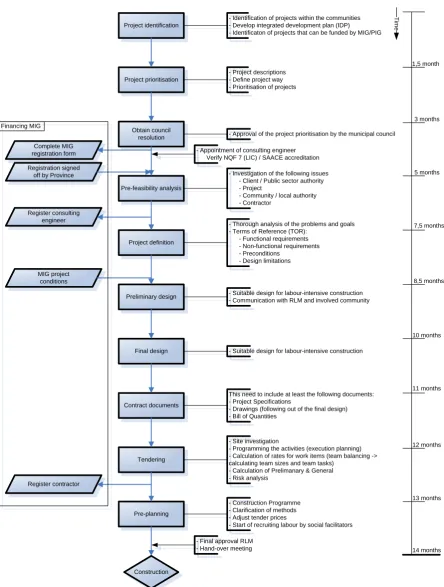
Model provision of the projects for the learnership programme Rustenburg
Project identification - Identificaton of projects that can be funded by MIG/PIG
- Project descriptions - Define project way - Prioritisation of projects
- Approval of the project prioritisation by the municipal council
- Appointment of consulting engineer
This need to include at least the following documents: - Project Specifications
- Drawings (following out of the final design) - Bill of Quantities
- Site investigation
- Programming the activities (execution planning) - Calculation of rates for work items (team balancing -> calculating team sizes and team tasks)
2.4
Conclusion
The provision of the projects is vital for the learners to gain their practical experience. Before the projects of the learnership programme can be provided by the RLM a lot of activities have to be executed. This process can be structured and controlled trough the use of phasing which is used to create logical groups of activities that has to be executed to reach the goal of the project. For the provision of learnership projects the linear phasing model is the most appropriate, because of its suitability for projects with a low level of uncertainty and complexity.
By analysing the specific characteristics of labour-intensive construction with regard to planning aspects it can be concluded that there should be two adjustments to the standard linear phasing model of conventional construction projects: the addition of pre-feasibility analysis in which the suitability of a project with regard to LIC-methods is assessed and that designs needs to be made suitable for LIC.
The Rustenburg Local Municipality uses their linear phasing model for conventional projects also for the provision of the learnership projects. The current process of the provision of projects has a lot of weak points: change of project type, many design changes, incomplete contract documentation, non-qualified consulting engineers etcetera. These are all causes that the current project provision has major delays.
3
3
.
.
P
P
r
r
o
o
c
c
e
e
s
s
s
s
m
m
o
o
d
d
e
e
l
l
m
m
e
e
n
n
t
t
o
o
r
r
i
i
n
n
g
g
The process model for the mentoring services is developed in this chapter. The model consists of two parts: the content of mentoring and the process of mentoring. These two aspects occupies centre stage in this chapter, each chapter is divided in these two parts. Before the developing the model can really start the causes of the current lack of structure needs to be find out. Section one analyses the current problem of the lack of structure through an analysis of the context of the mentorship services in Rustenburg. The model needs to be satisfactory to the requirements of DWP and needs to be suitable to the characteristics of the programme in Rustenburg. These points are described in section two before the theory is explained in section three. The theory forms the basis for the new process model that needs to be implemented in the current situation of mentoring (section four). Section five describes the results of the confrontation of the theory with the objectives and the local circumstances. Finally the results of the content of the model and the process of mentoring are unified.
3.1
Problem analysis
The mentoring services are currently delivered with a lack of structure and with a focus on project completion instead of on the learning process of the learners (see Appendix 5), but the cause of this problem is not clear yet. In this section the framework of the mentorship services is analysed to find the causes of this problem. First the relation with DPW is analysed in subsection 1 and 2. Subsection 3 pays attention to the organizational situation of the Rustenburg learnership and subsection four describes the situation within the company of LITEworks. Finally some conclusions out of these analyses are drawn.
Mentoring objectives
The Department of Public Works has to appoint and to control the mentoring teams of the learnerships. DPW has made a document with the specifications of the mentorship services within the EPWP Learnership Programme. This document tells the mentoring team in seven pages the content of their work. In this subsection the content of this document will be discussed.
The main objective of the EPWP learnership programmes is to create job opportunities. The mentor is the person who should, together with the trainers, impart the competences that are necessary to become a full-fledged labour-intensive contracting company. But the objectives for the mentoring services according to DPW focus on a supporting role for the mentor: [EPWP, 2004]
- Minimize the Public Body’s risk of the projects not being constructed to stated requirements, within budget and on time;
- Provide access to project and commercial expertise that learner contracting companies may lack during the execution of the three projects which form an integral part of the EPWP contractor learnership programme;
- Capacitate learner contracting companies to successfully complete their contracts with the Public Body and to work independently and profitably;
The mentor has to minimize the financial risks for the ABSA Bank and has to guarantee the quality of the projects; otherwise the learnership cannot be financed and be executed. Especially the Department of Public with its supporting and controlling role of the mentor should focus their objectives of mentoring on the learning process of the learner and not focus the objectives on the managing tasks of the mentor. The primary role of the mentor should be assisting and supporting the learner contracting companies to become full-fledged labour-intensive construction companies. The learners have to have enough knowledge at the end of the programme to reach this main objective of the learnership. Besides the trainer, the mentor is the only person who can impart this knowledge.
Mentoring control
The focus of the mentoring reports to DPW is on the progress of the projects of the learner contracting companies. The learner contracting companies need to have certain competences at the end of the programme to be an independent construction company and the learnership is the process to reach this objective. DPW should control the mentor to reach this objective. The main question is: are the learners still on track to reach this objective or does the mentor has to change the mentoring approach to a specific learner or learner contracting company? According to the documents the mentor should test the learners’ competences at the start and at the end of every project or every 3 months by form E.1a (Learner Contractor Competency Evaluation) [Watermeyer, 2006], but this form doesn’t correspond with the unit standards of the NQF qualifications and this form is ‘testing’ the skills of the learners only. The level of competence is defined as: ‘the ability to apply knowledge, understanding and skills in performing to the standards required in employment’ [Beaumont, 1996].So the learner must have the skills, but also needs to understand the line of thought of the skill (knowledge). Furthermore the mentor fills in the form, so the outcome depends on the interpretation of the mentor and DPW doesn’t control this evaluation. The outcomes of the forms are not used to optimize the mentoring services.
Organizations within the learnership in Rustenburg
The mentor has to assist and support the learners in their experiential way of learning and with the realisation of their projects. The Programme Manager is together with the Public Body and the Consulting Engineers responsible for the provision of the projects for the learning contracting companies. They should provide the learner contractors with correct (labour-intensive) documents and drawings. According to the documents (EPWP guidelines) the role of the mentor within the organization can be visualised as shown in Figure 9.
Figure 9 The structure of the learnership according to the EPWP guidelines [DPW, 2005]
The figure shows that the mentor should not be involved in providing the projects, but has to focus on the learner. The organisations in Rustenburg, who should provide the project documentation, don’t have the knowledge and the qualifications to provide the labour-intensive construction documents. The mentoring company is the only organization with the right knowledge to prepare those documents correct, so the mentoring team has been asked to assist them in preparing those documents. A consequence of this strong involvement of the mentor in the organization is that the communication to the learners goes along the mentor instead of straight from the programme manager (representative of the public body) to the learner. So the mentor is besides a mentor to the learners also part of the management of the organization, thereby making mentoring of the learners not their primary focus.
LITEworks
In this subsection an internal analysis is made to find out the internal organization of LITEworks. The mentoring to the learners is mainly executed by three inexperienced site mentors with a NQF 5 qualification. These mentors are assisted by two experienced mentors. The site mentors are able to assist the learners on a daily basis, but are not able to create a structured plan to impart knowledge and skills to the learners. The experienced mentors have to focus their work on the management tasks and the site mentors don’t have enough guidelines on how to mentor in a structured way on the long term. This structure of the mentoring company can fulfil the mentoring tasks as formulated by DPW, but a guideline for the site mentors is needed to impart the knowledge in structured, efficient and effective way.
Conclusion
The mentor should have a primary focus on imparting the practical competences to the learner contracting company to become a full-fledged labour-intensive construction company. The mentor can only fulfil his job when his primary focus is on mentoring and not on assisting the organization of the learnership with preparing these documents; the mentor is now more a representative of the learners instead of someone who is assisting and supporting them. A second aspect is DPW’s general objectives of mentoring. The mentoring organisation within LITEworks has been organised to reach these DPW´s general objectives. So LITEworks is fulfilling his mentoring tasks but not the EPWP overall objectives in an effective way. The focus of (controlling) the mentor is not on the learning process of the learner contracting company individually, but on their ability to finish the project successfully. The mentoring approach can almost be completely determined by the mentor itself because DPW’s requirements for the mentorship services are quite minimal. This applies for the content as well as for the process of the mentoring services. This framework of the content of mentoring and the process of mentoring are explained in the following section.
3.2
Framework of mentoring
Content of mentoring
The theory has to be implemented in the current organization and according to the current rules and requirements. The first subsection pays attention to the mentoring requirements for the aspects that need to be imparted to the learners. These aspects need to be learned during the execution of LIC projects. The characteristics of these projects (subsection 2) give background information to the theory, so can be seen on what kind of projects the theory has to be implemented.
Mentoring requirements
The required aspects that need to be imparted to the learners are defined in the EPWP documents. These documents only mention the areas in which the mentor should impart knowledge. As formulated in the Learner Guide: ´the mentor provides a wide range of support and advice functions, including but not limited to: finance and dealing with banks, business management, commercial management, technical and engineering´ and some more. This description shows a very broad definition of the aspects with respect to the content. The documents give only this very broad definition and not a more detailed one. So the requirements give enough space to the mentor to point out the knowledge and skills that needs to be imparted to the learners.
Project framework
The theory of project management has to be applied in the learnership projects of Rustenburg. The project characteristics are needed to implement the theory, because realization of a huge and complicated project (like an Olympic stadium) needs another project management approach than realization of a small project (like a cabin in your backyard to store your wood for the fireplace). This subsection describes the specific project characteristics of the projects in the learnership, the characteristics of LIC are described in Appendix 3.
The projects are executed by hand, so the projects are not complicated technically (see Table 3). These projects in the learnership are executed by the community (under the minimum wage), for the community and in the community. So a good relation with the community is very important.
Process of mentoring
The ‘Specification for the mentorship services within the EPWP Learnership Programme’ pays little attention to the way of mentoring. The requirements for the mentoring approach are very general and don’t pay any attention to the process of learning. The tendencies of the requirements about the process of mentoring the learners are:
- To advise, coach, counsel, guide, teach, instruct and tutor the leaner contracting company, in the execution of his duties;
- To assess the strengths and weaknesses of a learner contracting company during each phase of the learnership agreement and focus on the development of the identified areas of weakness;
- To visit the site as frequently as deemed necessary to control the works.
Figure 10 Progression of the EPWP mentorship [EPWP, 2005b]
These mentorship services should start with a direct involvement of the mentor and gradually go to a role as a trusted and respected advisor (see Figure 10). The delivery of the mentorship services excludes the performance of essential daily contracting functions on behalf of the mentored contractor. So the mentor is not restricted in the way of mentoring and can develop their mentorship approach. According to the national coordinator of mentorship services Johann Watermeyer: ‘a plan for the contractors and the supervisors should be made on how to assist them. So it is important to test their capabilities before the start of projects’ [Watermeyer, 2006], but according to the official documents the learners need to be tested only.
3.3
Theory
A theory is developed out of an analysis. A theory gains insight into the situation. In this section theories are described for the content and the process of mentoring.
Content of mentoring
The aspects that need to be mentored are those capacities that are needed to execute a project successfully. The contractor is responsible for realizing the construction; during this process the most important thing that the contractor has to do is controlling this execution. Project based working looks after a strategic way of working to realise a (construction) project. Project based working consist of three important aspects: phasing the project, decide and control [Groote, 2001]. The control cycle defines how to control the construction. This subsection elaborates the theory of the control cycle, but first the general aspects of project management are described.
Project control
The civil engineering industry works project-based. A project can be characterized as result-orientated. The project results are already defined at the beginning of the construction phase, but the way to these results is
START of LEARNERSHIP END of LEARNERSHIP
not clear in the beginning of the project (especially for the learners). The way to these results is controllable, when using a systematic method project based working. The principles for project-based working are:
Plan before acting
Think through the project forwards and backwards
Work from rough to fine
These principles are for the process as a whole (from initiating until maintenance; see chapter 2), but can also be used for a phase like the construction phase itself.
The principle of plan before acting needs a plan that has certain focuses which are important in project-based working. Time, cost, quality, information and organisation are the five aspects that need to be controlled to realize the project. These aspects need continuous attention during the whole process of realizing the project. With an example of the aspect this will be explained. A time planning must be made before the construction phase starts, but this planning must be checked regularly to look if the project is still on track during the construction. If this is not the case the planning needs to be adjusted to finish the project on time. These five aspects can help to focus the plan, so it will be a specific plan which tells you how to realize the project.
Figure 11 Control cycle [Groote, 2001]
This control process can be clarified with
![Figure 4 Level of uncertainty and level of complexity [Groote, 2001] -](https://thumb-us.123doks.com/thumbv2/123dok_us/1041507.1129847/15.595.102.532.562.672/figure-level-uncertainty-level-complexity-groote.webp)
![Figure 5 Methods of phasing [Groote, 2001]](https://thumb-us.123doks.com/thumbv2/123dok_us/1041507.1129847/16.595.190.433.74.245/figure-methods-of-phasing-groote.webp)
![Figure 6 Standard linear model [Groote, 2001]](https://thumb-us.123doks.com/thumbv2/123dok_us/1041507.1129847/17.595.101.539.270.305/figure-standard-linear-model-groote.webp)
![Figure 9 The structure of the learnership according to the EPWP guidelines [DPW, 2005]](https://thumb-us.123doks.com/thumbv2/123dok_us/1041507.1129847/29.595.95.506.617.718/figure-structure-learnership-according-epwp-guidelines-dpw.webp)
![Figure 10 Progression of the EPWP mentorship [EPWP, 2005b]](https://thumb-us.123doks.com/thumbv2/123dok_us/1041507.1129847/32.595.99.494.255.315/figure-progression-epwp-mentorship-epwp-b.webp)