The LOIS Project
Wim Peters*, Maria Teresa Sagri,** Daniela Tiscornia**, Sara Castagnoli***
*NLP Group, Department of Computer Science, University of Sheffield, U.K.**Istituto di Teoria e Tecniche per l'Informazione Giuridica del Consiglio Nazionale delle Ricerche, Italy {Sagri | Tiscornia}@ittig.cnr.it
*** Scuola Superiore di Lingue Moderne per Interpreti e Traduttori, Università di Bologna, Italy [email protected]
Abstract
The legal knowledge base resulting from the LOIS (Lexical Ontologies for legal Information Sharing) project consists of legal WordNets in six languages (Italian, Dutch, Portuguese, German, Czech, English). Its architecture is based on the EuroWordNet (EWN) framework (Vossen et al, 1997). Using the EWN framework assures compatibility of the LOIS WordNets with EWN, allowing them to function as an extension of EWN for the legal domain. For each legal system, the document-derived legal concepts are integrated into a taxonomy, which links into existing formal ontologies. These give the legal wordnets a first formal backbone, which can, in future, be further extended.
The database consists of 33,000 synsets, and is aimed to be used in information retrieval, where it provides mono- and multi-lingual access to European legal databases for legal experts as well as for laymen.The LOIS knowledge base also provides a flexible, modular architecture that allows integration of multiple classification schemes, and enables the comparison of legal systems by exploring translation, equivalence and structure across the different legal wordnets.
1.
Introduction
Today, search engines for legal information retrieval do not include legal knowledge into their search strategies. These strategies include keyword and metadata search, but do not address the semantics of the keywords, which would allow, for instance, conceptual query expansion. In other words, there is no semantic relationship between information needs of the user and the information content of documents apart from text pattern matching. Often, query formulation by either legal practitioners or laymen users is only an imperfect description of an information need (Matthijssen, 1999).
The LOIS project (EDC 22161)1 aims to remedy this
semantic lacuna by means of the development of a multi-language legal thesaurus, whose structure is based on existing de facto standards for semantic thesaurus construction.
From the start, the project integrated a number of methodologies, in order to cope with the acquisition and combination of multilingual domain specific terminology and existing general language repositories. Our architecture ensures the coverage of the semantic peculiarities of the legal dominion, and facilitates the capture of essential semantic differences between the legal systems involved.
2.
Law and Language
Law and language are connected in many ways. First of all, they have a similar structure: each has, at his essence, rules which are constitutive of a system and which ensure its consistency. A second aspect is the dependency of law on language, since regulatory knowledge must be communicated, and the written and oral transmission of social or legal rules passes through verbal expression. Therefore legal conceptual knowledge
1 See http://www.loisproject.org/
is closely related to language use within the legal domain. Legal discourse can never escape its own textuality (MacDonald, 1997). This means that linguistic information plays an important role in its definition, which may lead to the postulation that there is, as in other terminological domains, a relatively high level of dependence between legal concepts and their linguistic realization in the various forms of legal language .
The legal language, like law, has a multi-layered structure: according to Kalinowsky (1965), it consists of the language of law and language of Jurists. The former is the language in which legal rules are written: not any linguistic expression in a legal text is a legal term, but every legal term is a linguistic expression. The latter is a meta-language. It is composed of the “judge's language”, which they use to speak about legal rules and about persons and behaviours bounded by legal rules; and the “language of jurisprudence”, which puts legal language and judicial interpretation into concepts, to make the structure of the system consistent and systematic2.
Similarly to legal language, law has a hierarchical and multilevel architecture, where primary or regulative norms (Hart, 1961) are enacted according to secondary meta-norms which create all the apparatus (entities, powers, procedures) necessary to produce the law. A specific kind of a two-level regulative situation is the interrelation between European and National law-making, where Member States are the addressees of European rules, committed to implement them by creating new rules in national systems.
Given the structural domain specificity of legal language and the involved concepts, we cannot speak about “translating the law” to ascertain correspondences between legal terminology in various languages, since the translational correspondence of two terms satisfies neither the semantic correspondence of the concepts they denote,
2 A good example is “negozio giuridico” (juridical act): the term
nor the requirements of the different legal systems (see section 3.3). Overall, there is a lack of a clear language level where the equivalence has been set up. In “translating law” we have to negotiate the distance between the statute and the law or, more generally, between the law and its verbalization.
A legal “language”, consisting of a complex structure of concepts, forms an abstraction from legal textual material. When examining the legal vocabulary, we encounter two different types of semantic information associated with elements from legal text. On the one hand, there is ontological structuring in the form of a conceptual model of the legal domain; on the other hand, there is a vocabulary of lexical items that lexicalize concepts (a lexicon), which are not necessarily restricted to the legal domain, and are associated with specific linguistic information (e.g. nouns versus verbs and syntactic preference). In building the Lois database, we have therefore taken in account the unavoidable intertwining between the linguistic and the content dimensions, and have distinguished legal and lexical concepts by adopting a strict notion of “legal” concepts as concepts explicitly defined in legislation.
The Lois domain ontology is populated by concepts, relations and instances extracted in a bottom-up fashion from the legal documents. This domain ontology can be classified as a lexicon, also called lightweight ontology. Lightweight ontologies are generic and based on a weak abstraction model, since the elements (classes, properties, and individuals) of the ontology depend primarily on the acceptance of existing lexical entries.
In order to connect linguistic expressions of concepts to the underlying conceptual domain entities, an intermediate structure (a core ontology) is needed, made up of units of understanding, to distinguish language-independent concepts and relations from concepts and relations which are not. A core legal ontology is a complete and extensible ontology that expresses the basic concepts of Law, and that can provide the basis for specialization into domain-specific concepts and vocabularies. A core legal ontology such as CLO (Gangemi et al., 2003) and LRI-Core (Breuker et al., 2005) intends to bridge the gap between domain-specific concepts and the abstract categories of formal upper level or foundational ontologies such as DOLCE (Gangemi et al., 2002), transforming lexical relations into formal properties consistent with the top-down formal semantics imposed by the upper ontology. Foundational ontologies contain domain-independent concepts, relations and meta-properties, which provide ontology builders with a formal semantic framework, i.e. high-level formal ontological distinctions to categorize entities in a domain. The elements from the domain ontology are consistent with the top-down formal semantics imposed by the upper ontology.
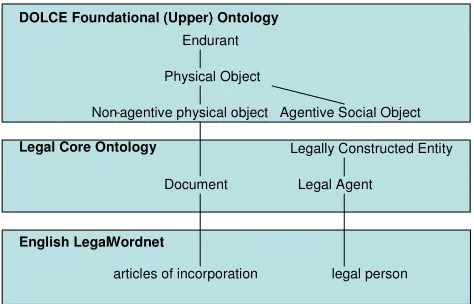
Given a superset of entities and relations in six wordnets, each pertaining to a particular legal system, this logical backbone will help to distinguish language-independent concepts and relations from concepts and relations which are not. Figure 1 illustrates the interconnection of the different types of ontology.
At this stage of the project, conceptual relations derived from legal text have only partly been formalized;
the ontological level has been introduced mainly to support conceptual consistency of the knowledge base. Subsumption of concepts into ontological classes makes sense distinctions explicit, e.g. “contract” as a document and “contract” as a legal transaction,, where the latter two are concepts from the core legal ontology; (Gangemi et al., 2003). They also separate classes from instances. For example, “competent authority” in the EU Directive on data protection is a class; the “garante per la protezione dei dati personali” in Italian legislation and the “Agencia de Proteccion de Dato” in Spanish legislation are instances.
It is envisaged that the formalization of LOIS will be ex-tended by transforming additional lexical relations into formal relations. This will take place in the following ways (Gangemi et al., 2003):
transforming lexical definition into formal description;
interpreting lexical relations from a thesaural structure as ontological relations;
checking the consistency of a hybrid knowledge base on the base of the meta-properties of ontological classes;
modularizing the resulting hybrid ontology into a structure that is consistent with the relations between entities defined in a core ontology. From a multilingual point of view, ontological classes might be even used at later stages to enhance comparison between different legal systems, by grouping similar national instantiations of a given class (e.g. the Italian “Camera dei Deputati” and the English “House of Commons” as instances of the ontological class “legal institutions”) which might not – due to the country-dependence of the legal domain – be perfect equivalents (see section 3.3).
3.
The LOIS Database Architecture
3.1.
Choice of database structure
As its methodological starting point, LOIS adopts the structure of two widely known and used thesauri. Figure 1: The interconnection of different ontologies
DOLCE Foundational (Upper) Ontology
Endurant
Physical Object
Non-agentive physical object Agentive Social Object
Legal Core Ontology
Document
Legally Constructed Entity
Legal Agent
English Legal Wordnet
Québec: Linguatech, Conseil de la langue française. pp. 271-282.