4.
Database verification
Database verification was done in two steps. As explained in section 2.3, a recording assistant listened to the most intelligible signal of the different microphones during the recordings. In this way, we could make sure that the speaker made no mistakes and the volume of his/her voice was within acceptable limits. After the recordings, all of the recorded signals were listened to in order to verify the quality of the recorded files.
5.
Application to noise-robust VAD
Since the non-traditional microphones rely on the fact that the human voice can also be transmitted through other media than air and since the ambient noises travel to the microphones through the surrounding air, these special microphones should exhibit more noise robust properties. However, because of the fact that they pick up the speech signal that propagates through bones and tissues, higher frequency components are attenuated and only a low pass speech signal is retained. These two properties make these microphones as such interesting in applications that are sensitive to noise, but where the speech quality is of less importance. VAD is an example of such an application.
5.1 Experiments
In our experiments, we used the part of the database that was manually segmented (numbers) to have a reference for the speech-pause detection. The VAD algorithm used was the INNL VAD [Dekens et al., 2007]. We applied this VAD to the selected sound files using 32ms long speech frames with 75% overlap and several threshold values. For each threshold the speech detection probability (SDP) was calculated by dividing the number of frames that were correctly classified as speech by the total number of speech frames, and the false alarm probability (FAP) was calculated as the number of pause frames that were classified as speech frames divided by the total number of pause frames.
We used two types of microphones in our experiments: the Bluetooth close talk microphone and the throat microphone. The recorded files were downsampled to 16 kHz and converted to 16 bit precision. Since some low frequency noise is present in the throat microphone signal
and since this signal contains no high frequency energy, only the frequency band [250, 5000] Hz of this signal was used for the VAD. For the minimum length of a speech and a pause segment we used 250 ms and 100 ms, respectively. Detected speech regions were extended 50 ms before and after the detected region. This ensures that when speech begins or ends with certain sounds that are hard to detect in the presence of noise (e.g. /s/), these sounds can still be classified as speech while using relatively high threshold values.
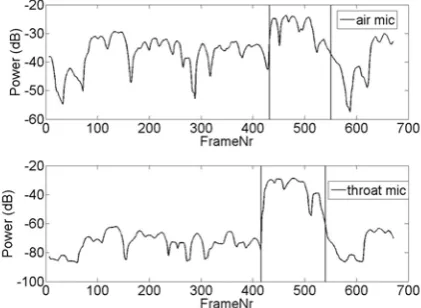
Figure 2 shows an example of the power (in the frequency band used) of the signals of the two microphones in the case of an interfering speaker. The vertical lines indicate the speech start and stop positions. It can be seen that the throat microphone’s signal exhibits a much higher signal to noise ratio, which is why we expect this signal to be much more suitable for a reliable Voice Activity Detection.
Figure 2: Signal power, top: air signal, bottom: throat signal (vertical lines indicate start and end of speech)
5.2 Results
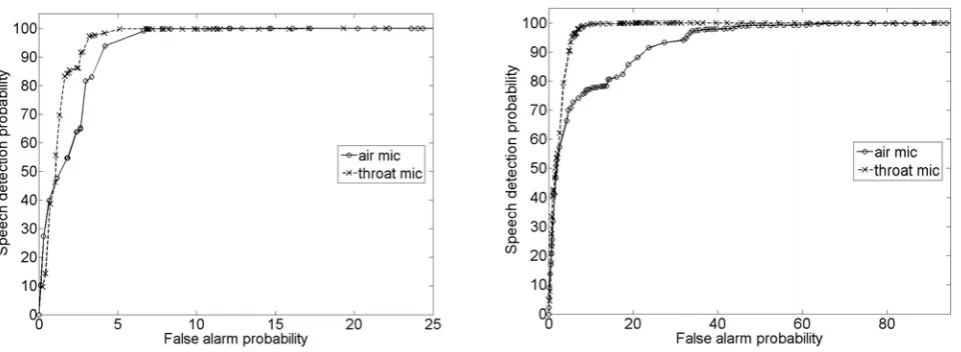
suitable as a VAD input signal. Moreover, the right hand panel of figure 5, where the FAP and SDP are calculated using two noise types, shows that when the throat microphone signal is used, the VAD is not as sensitive to the type of noise as when the air microphone is used, i.e. with one fixed set of VAD parameters good results can be obtained in different kinds of background noises.
Figure 5: Speech detection probability vs False alarm probability. Left: Speaker 6, noisetype5, right: Speaker 6, noisetype5 + 6 Figure 4: Speech detection probability vs False alarm probability. Left: Speaker 4, noisetype2, right: Speaker 4, noisetype4
6.
Conclusion
In this paper a database of noisy speech, picked up by a set of different microphones was presented. Using this database, it should be very interesting to study the properties of some of these microphones and their usefulness for noise robust speech applications. In this paper it was shown that one aspect of speech processing, i.e. voice activity detection, could certainly benefit from the use of these microphones.
7.
Acknowledgements
Part of this work was performed in the context of the EU project SAFIR (IST-2002-507427). The authors would like to thank BASF Ludwigshafen and the Department of Mechanical Engineering and Acoustics of the Vrije Universiteit Brussel for their help in recording the database.
8.
References
AKG,
http://www.akg.com/site/products/powerslave,id,985,p id,985,nodeid,2,_language,EN.html
Behringer,
http://www.behringer.com/XM1800S/index.cfm?lang= eng
Clearercom,
http://www.clearercom.com/pc_throat_mic.htm Dekens T., Demol M, Verhelst W. and Beaugendre F,
(2007), "Voice Activity Detection based on Inverse Normalized Noise Likelihood Estimation,"
proceedings of the XIII-th Convention of Electrical Engineering, CIE 2007, Santa Clara, Cuba. Available at
http://www.etro.vub.ac.be/Research/DSSP/Publication s/Publications.htm
Event,
http://www.eventelectronics.com/index/index.php?pag e=Products&product=SP8
Genelec,
Invisio,
http://www.swatheadsets.com/tactical/invisio/invisio.h tml
MSA, http://www.gallet.fr/index.php?id=188&L=5 Sennheiser,
http://www.sennheisercommunications.com/comm/ic m_eng.nsf/root/05350
Testo,