Design and Recording of Czech Audio-Visual Database
with Impaired Conditions for Continuous Speech Recognition
Jana Trojanov´a, Marek Hr ´uz, Pavel Campr, Miloˇs ˇ
Zelezn´y
Department of Cybernetics, Faculty of Applied Sciences, University of West Bohemia Univerzitni 22, 306 14, Plzen, Czech Republic
{trojana, mhruz, campr, zelezny}@kky.zcu.cz
Abstract
In this paper we discuss the design, acquisition and preprocessing of a Czech audio-visual speech corpus. The corpus is intended for training and testing of existing audio-visual speech recognition system. The name of the database is UWB-07-ICAVR, where ICAVR stands for Impaired Condition Audio Visual speech Recognition. The corpus consist of 10000 utterances of continuous speech obtained from 50 speakers. The total length of the database is 25 hours. Each utterance is stored as a separate sentence. The corpus extends existing databases by covering condition of variable illumination. We acquired 50 speakers, where half of them were men and half of them were women. Recording was done by two cameras and two microphones.
Database introduced in this paper can be used for testing of visual parameterization in audio-visual speech recognition (AVSR). Corpus can be easily split into training and testing part. Each speaker pronounced 200 sentences: first 50 were the same for all, the rest of them were different. Six types of illumination were covered. Session for one speaker can fit on one DVD disk. All files are accompanied by visual labels. Labels specify region of interest (mouth and area around them specified by bounding box). Actual pronunciation of each sentence is transcribed into the text file.
1.
Introduction
The automatic speech recognition (ASR) has attracted re-searchers from early 1960th. From that time it has devel-oped through the recognition of the isolated words from one speaker to speaker-independent continuous speech. Nowa-days systems accomplish good recognition rates under lim-ited conditions dependent on the type of the task. The factors that influence the recognition rate most of all are environment and type of the speech. By the environment it is especially meant environmental noise that degrades acoustic signal. In this case the visual part of the speech can be used to increase recognition rate. Such a system is called an audio-visual speech recognition (AVSR). This paper deals with design, recording and preprocessing of the audio-visual speech database.
There are many databases for ASR recognition that contain big number of speakers, different types of utterances and degradations of the signal. In the domain of AVSP only a few databases were collected that would meet variable configuration as continuous speech, several appearances of the person (beard, glasses, hairs), other than front face ori-entation, moving during recording, two or more speakers in one scene. The reason is that audio-visual databases have problems with time consuming acquisition, storage of the data and their distribution. To acquire a database with high resolution, sufficient number of frames per second and high quality synchronization with acoustic data, needs good quality equipment and storage for the data. With respect to the high demand of the databases they are mainly recorded under different project on individual universities and re-search labs. Despite of that existing databases contain small number of speakers that do not allowed to develop method which would work in realistic scenario.
With our database we are trying to come closer to realistic scenario. This is done by covering the problem of
vari-able illumination during the speech. The aim of recording database with impaired conditions is to test existing visual parameterization (C´ısaˇr et al., 2007). This parameterization consist of lip shape information and pixel based informa-tion about inner part of the mouth. To stay concentrated on the parameterization it is crucial to preprocess the database. The preprocessing means that database contains informa-tion about posiinforma-tion of the region of interest (ROI). In this case it is a part of the face around lips. ROI information is used as an input of the visual parameterization algorithm. This paper is organized as follows. Next section list some of existing databases that were already released. Section three describe database specification and recording. Section four deals with database preprocessing. The last section sum-marizes the facts about our database.
2.
Existing Audio-Visual Databases
Databases can be divided acording to several views. Fol-lowing subdivision is by type of utterances. First type of database is for recognition of vowels and consonants. We can mention French database (Teissier, 1999), or english one David (Chibelushi et al., 1996).
Another type are databases for recognition of isolated or connected digits. Database Tulip1 (Movellan, 1995) con-tain 12 speakers that are saying numbers one to four, French database M2VTS (Pigeon and Vandendorpe, 1997) contain all digits for 37 speakers, English one David (Chibelushi et al., 1996) consist of isolated words, newest one is CUAVE from University of Clemon that contains 36 speakers saying numbers(Patterson et al., 2002). The CUAVE and DAVID are the only databases that contain more than one speakers during acquisition.
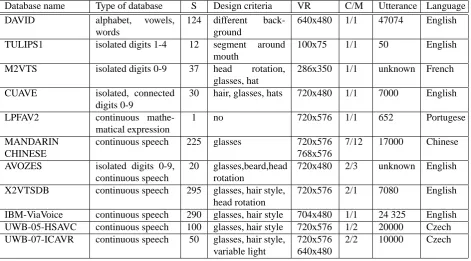
Database name Type of database S Design criteria VR C/M Utterance Language
DAVID alphabet, vowels,
words
124 different back-ground
640x480 1/1 47074 English
TULIPS1 isolated digits 1-4 12 segment around mouth
100x75 1/1 50 English
M2VTS isolated digits 0-9 37 head rotation, glasses, hat
286x350 1/1 unknown French
CUAVE isolated, connected
digits 0-9
30 hair, glasses, hats 720x480 1/1 7000 English
LPFAV2 continuous
mathe-matical expression
1 no 720x576 1/1 652 Portugese
MANDARIN CHINESE
continuous speech 225 glasses 720x576 768x576
7/12 17000 Chinese
AVOZES isolated digits 0-9, continuous speech
20 glasses,beard,head rotation
720x480 2/3 unknown English
X2VTSDB continuous speech 295 glasses, hair style, head rotation
720x576 2/1 7080 English
IBM-ViaVoice continuous speech 290 glasses, hair style 704x480 1/1 24 325 English UWB-05-HSAVC continuous speech 100 glasses, hair style 720x576 1/2 20000 Czech UWB-07-ICAVR continuous speech 50 glasses, hair style,
variable light
720x576 640x480
2/2 10000 Czech
Table 1: Comparison of the existing databases. Abbreviation: S represent number of speakers,VR stands for video resolu-tion, C/M number of cameras and microphones, Utterance represent total number of utterances in database.
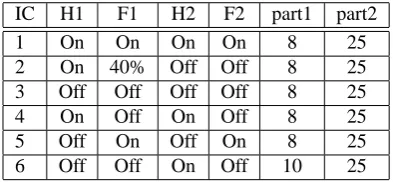
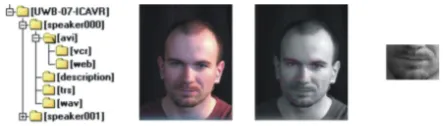
Figure 1: Database recording. First row recorded by VCR camcorder Canon MVX3, the second by webcamera Philips SPC 900NC. First snap is with clapper board, the rest snaps are for illumination conditions IC 1-6 look at the table 2
was in the past. The distribution is also easy thanks to the internet connection. The list of some databases is as fol-lows: LPFAV2(Pera et al., 2004),MANDARIN CHINESE (Liangi et al., 2004), AVOZES (Goecke and Millar, 2004), XM2VTS (Messer et al., 1999), IBM ViaVoice (Neti et al., 2000), UWB-05-HSCAVC (C´ısaˇr et al., 2005).
There could be many criteria to compare the databases see Table 1 for other comparison.
3.
Data Collection
The design criteria for the database is to record data set that would contain variable illumination conditions for a large number of speakers. The visual information of the speech contains part of the vocal tract that can be seen (lips, teeth, tongue and face). It does not contain as much information as acoustic part and it can not be used separately. Rather, it is used as a supplement for acoustic speech recognition. For the visual component of the speech, various
parameter-izations are used. The overview of existing methods can be found in (Potamianos et al., 2004).
3.1. Database Specification
Database UWB-07-ICAVR (UWB stands for University of West Bohemia, 07 for year of recording, ICAVR for impaired conditions audio visual speech recognition) en-larges the previous database UWB-05-HSCAVC (C´ısaˇr et al., 2005) which was recorded for research on visual speech parameterization. The purpose to record a new database is to test the existing visual parameterization (C´ısaˇr et al., 2007) under variable illumination.
Speech, and Signal Processing, volume 2, pages 2017 – 2020.
Vitor Pera, Antonio Moura, and Diamantino Freitas. 2004. Lpfav2: a new multi-modal database for developing speech recognition systems for an assistive technology application. In SPECOM.
St´ephane Pigeon and Luc Vandendorpe. 1997. The m2vts multimodal face database (release 1.00). In AVBPA ’97: Proceedings of the First International Conference on Audio- and Video-Based Biometric Person Authentica-tion, pages 403–409, London, UK. Springer-Verlag. G. Potamianos, C. Neti, J. Luettin, and I. Matthews,
2004. Audio-Visual Automatic Speech Recognition: An Overview, chapter 10. Issue in Visual and Audio-Visual Speech Processing.
V. Radov´a and P. Vop´alka. 1999. Methods of sentences selection for read-speech corpus design. In TSD ’99: Proceedings of the Second International Workshop on Text, Speech and Dialogue, pages 165–170, London, UK. Springer-Verlag.