Parallel Syntactic Annotation of Multiple Languages
Owen Rambow , Bonnie Dorr
, David Farwell
, Rebecca Green
, Nizar Habash
Stephen Helmreich
, Eduard Hovy
, Lori Levin
, Keith J. Miller
Teruko Mitamura
, Florence Reeder
, Advaith Siddharthan
Center for Computational Learning Systems, Columbia University, New York, NY, USA
rambow, habash @cs.columbia.edu
University of Maryland, College Park, MD, USA
bonnie, rgreen @umd.edu
New Mexico State University, Las Cruces, NM, USA
david, shelmrei @crl.nmsu.edu
ISI, University of Southern California, Marina Del Rey, CA, USA [email protected]
MITRE, McLean, VA, USA
keith, freeder @mitre.org
LTI, Carnegie Mellon University, Pittsburgh, PA, USA
lsl, teruko @cs.cmu.edu
Cambridge University, Cambridge, UK [email protected]
Abstract
This paper describes an effort to investigate the incrementally deepening development of an interlingua notation, validated by human annotation of texts in English plus six languages. We begin with deep syntactic annotation, and in this paper present a series of annotation manuals for six different languages at the deep-syntactic level of representation. Many syntactic differences between languages are removed in the proposed syntactic annotation, making them useful resources for multilingual NLP projects with semantic components.
1.
Introduction: Goals of Annotation
The IAMTC project (Farwell et al., 2004) aims at defining a level of interlingual annotation (the information needed to translate a text from one language to the next) based on annotating parallel multilingual texts (i.e., multiple transla-tions into English of source texts in six foreign languages).1
As a first step in the sequence of annotations, we annotate texts for syntax. This level of annotation is called IL0. Sub-sequently, we augment IL0 with semantic disambiguation annotations, namely concepts from an ontology and seman-tic roles (IL1). This annotation does not change the struc-ture of IL0. We then reconcile different IL1s from parallel texts into the common interlingual representation (IL2). In this paper, we discuss annotation standards for IL0 for Ara-bic, English, French, Hindi, Japanese, Korean, and Spanish. For details on the other levels of annotation, see (Farwell et al., 2004).
There has been much activity in syntactic annotation of cor-pora, starting with the Penn Treebank for English (Marcus et al., 1993), and more recently, there has also been seman-tic annotation on top of the Treebank, such as PropBank (Kingsbury et al., 2002). However, our project imposes spe-cific requirements on syntactic annotation, which are not faced by other annotation projects:
Because our goal is in fact interlingual annotation and syntax is just an intermediate representation, we are only concerned with the syntactic predicate-argument
1This work has been supported by NSF ITR Grant
IIS-0325887.
structure amongst the meaning-bearing words of a sentence, but not with certain details of syntax, such as function words.
Because in IL2 we reconcile representations based on the augmented syntactic representations from different languages (as well as paraphrases from the same lan-guage), we want to choose representations that elim-inate non-semantic syntactic differences as much as possible (see the example in Section [4.]).
These requirements lead us to push the syntactic annotation as “deep” as possible without becoming semantic. It also means that choices in one language are coordinated with choices in the other languages.
This paper is structured as follows. We first discuss related work in Section [2.]. We then lay out the basics of our syn-tactic annotation in Section [3.], and illustrate the effect of multilingual annotationin Section [4.]. We discuss the fea-tures used in Section [5.], and some more constructions in Section [6.]. We finish with some comments on the practi-cal aspects of annotation.
2.
Related Work
The IL0 level of representation is very similar to (and in-spired by) the tectogrammatical level of representation of the Prague theory (Sgall et al., 1986).2 Annotated corpora
2The deep-syntactic level of representation of Meaning-Text
are available for Czech and English in the Prague Depen-dency Treebank (Hajiˇc et al., 2001). Our IL0 takes from the tectogrammatical representation the notion that the linguis-tic contribution of (most) function words should be repre-sented by features rather than by nodes in the tree (though IL0 keeps prepositions as separate nodes). The princi-pal difference is that the tectogrammatical representation is a hybrid syntactic-semantic level of representation, with some arguments and all adjuncts annotated with semantic labels, while our scheme postpones any semantic label to further levels of annotation (IL1 and IL2). A secondary difference is that we keep prepositions in our IL0.
The PropBank (Kingsbury et al., 2002) shares many char-acteristics with IL0. IL0 is a purely syntactic level of anno-tation, while PropBank captures some aspects of lexical se-mantics. In particular, for a given set of alternations of one verb, the arguments are labeled consistently for that alterna-tion, and the arguments are given labels specific to that set of alternations. For example, in both John loaded the truck
with hay and John loaded hay into the truck, hay would
have the same role label in PropBank, but different role la-bels in IL0 (it would be the object of a prepositional argu-ment in the first sentence, the direct object in the second). Thus, both the Tectogrammatical Representation and Prop-Bank are a level of representation intermediate between our IL0 and IL1. For a fuller discussion of these representa-tional choices, see (Rambow et al., 2003).
Projects which might be seen as in some sense similar to the IAMTC annotation effort include Eurotra, EuroWordNet and the Universal Networking Language initiative (UNL). A crucial difference between our annotations and these projects is that our work is conceived of as an annotation project, while none of these projects included annotation. Eurotra (Allegranza et al., 1991) is similar to our effort in that it was a multi-site, multilingual effort but focused on developing a common framework for describing different natural languages on a range of levels: lexical, morpholog-ical, syntactic and semantic. However, Eurotra assumed a transfer-based approach to MT and so each language had its own syntactic and semantic processes and representa-tions which were to be interconnected by pairwise transfer rules. There was no concern with developing an Interlingua and the methodology was essentially linguistic, motivating the framework on the basis of counter-examples rather than by way of corpus analysis and annotation.
EuroWordNet (Vossen, 1998), initially an effort to build WordNet resources for six European languages in paral-lel, is essentially lexical in nature. The central method-ology was to translate the original Princeton WordNet for English into the other language, most importantly facing up to the problems of lexical mismatches or overlaps of the target language and filling in any lexical gaps in the orig-inal English resource. It was not concerned with sentence meaning or how it is represented. With the introduction of Inter-Lingual-Indexes, an effort was made to establish a cross-language mapping at the lexical level but, again, the developers did not follow a corpus based methodology and there was no related annotation effort.
Universal Networking Language (UNL) is a formal lan-guage designed for rendering automatic multilingual
infor-mation exchange (Martins et al., 2000). It is intended to be a cross-linguistic semantic representation of sentence meaning consisting of concepts (e.g., ‘cat’, ‘sit’, ‘on’, or ‘mat’), concept relations (e.g., ‘agent’, ‘place’, or ‘object’), and concept predicates (e.g., ‘past’ or ‘definite’). UNL syntax supports the representation of a hypergraph whose nodes represent “universal words” and whose arcs represent “relation labels”. Several semantic relationships may hold between universal words including synonymy, antonymy, hyponymy, hypernymy, meronymy, etc. Like the IAMTC effort, the UNL consortium is looking to create an practical IL by comparing translations across multiple languages at multiple sites and the results of both efforts may prove to be mutually informative both methodologically (multilingual, multi-site annotation) and at the level of formal representa-tion.
Our goals are in some way similar to the goals of the Par-Gram project (Butt et al., 2002), in which grammars for several languages are developed in close consultation and in parallel; however, the ParGram project is motivated by the theoretical assumption that grammars of different lan-guages are in fact similar (Universal Grammar), an issue we are agnostic on. Furthermore, ParGram is a grammar development project, while our project is a text annotation project.
3.
Our Syntactic Annotation
In Section [1.], we motivated our IL0 representation, and we concluded that we wanted a representation that con-centrates on meaning-bearing (autosemantic) lexemes, and that reduces cross-linguistic differences. These require-ments have led us to define IL0 as an unordered deep syn-tactic dependency representation. Only content words are represented. The dependency relations reflect syntactic predicate-argument structures, not (neecissarily) surface-syntactic relations (such as case marking or agreement; see Section [6.2.] for an example). Function words (aux-iliaries, determiners) are omitted and their meaning repre-sented as features on the content nodes. Missing arguments (such as embedded subjects in control constructions) are added as lexically empty nodes with coindexation informa-tion. Nodes are annotated with the citation form of the in-flected word, its base part-of-speech (noun, verb, etc), and several POS-specific morphological and morpho-syntactic features (such as voice, aspect, number, gender, etc). Arcs are annotated with the underlying syntactic relation, which is either a type of argument or simply MODfor modifiers (adjuncts). The argument roles are normalized for regular syntactic transformations, which include active/passive al-ternation. We do not normalize alternations which always involve at least one PP such as load trucks with hay/load
hay into trucks. For such constructions, the IL1 annotation
expresses their similar meaning. Note that representations very similar to our IL0 are sometimes called “semantic”, but the relevant criteria for IL0 are in fact purely syntactic.
4.
Cross-Linguistic Aspects
red [Adj,Pred,past]
SUBJ umbrella [N,sing,def]
HamrA’ [Adj,Pred,past]
SUBJ miZal˜ap [N,sing,def]
akai [Adj,Pred,past]
SUBJ kasa [N,topic]
Figure 2: IL0 deep-syntactic representation for the umbrella was red, kAnat AlmiZal˜apu HamrA’F, and kasa-wa akakatta
llegar [V,fut]
SUBJ Juan [PN]
arrive [V,fut]
SUBJ Juan [PN]
Figure 1: IL0 deep-syntactic representation for llegar ´a
Juan and Juan will arrive
The basic definition of IL0 presented in Section [3.] equalizes certain differences, by not representing word order, and by representing function words as features.
The basic definition leaves many option for defin-ing the structure given a certain construction. When choosing the syntactic analysis for IL0, we look at all languages, and choose a uniform analysis for related constructions. Here, we may end up with an analy-sis which gives some languages a syntactic structure which at first sight may not be the most obvious one.
We discuss and exemplify these cases in turn. Many syntac-tic differences between languages are removed by remov-ing word order and function words. For example, English forms the future tense with an auxiliary, while Spanish has an inflectional morpheme, and also a postposed subject:
(1) llegar´a arriveFUT
Juan Juan
Juan will arrive
However, both sentences are structurally identical at IL0, as seen in Figure 1.
5.
Features on Nodes
We record all syntactic information in IL0 so that the sur-face form (both morphological and syntactic) can determin-istically be generated from it. Since the morphology and morphosyntax of different languages express different fea-tures, we accept that we cannot have a uniform feature set cross-linguistically. By way of example, we will discuss the part-of-speech feature, and then the features found on verbs.
5.1. Parts of Speech
The lists of parts of speech is the same in all languages we deal with.
V: verbs, but not auxiliary verbs (=Aux)
N: common nouns and personal pronouns
PN: proper nouns
Adj: adjectives
Adv: adverbs
P: prepositions and subordinating conjunctions
Conj: coordinating conjunctions, but not subordinat-ing conjunctions; also includes the comma used in enumerations instead of repeated and
Det: determiners; only used for demonstratives and so on, since the and a do not appear in IL0
Aux: auxiliary verbs; at IL0, only modal auxiliaries are included, not the auxiliaries for passive, progres-sive, etc.
Pun: punctuation marks, but not the comma used in conjunctions
Sym: various symbols (dollar signs and the like)
Uh: speech-specific sounds, even if meaningful (such as /UH HUH/)
Misc: everything else, including greetings (Hi, Hello) and interjections (Okay)
For some of the languages, not all parts of speech are al-ways recognized in the traditional analyses. For exam-ple, in Arabic, adjectives are not traditionally distinguished from nouns, since their morphology is identical. However, the distinction can be made in Arabic as well by referring to English cases.
We now discuss features present for verbs and predicative nouns, adjectives, and prepositions. Here, the morphology and morphosyntax of the languages imposes certain differ-ences. These features do not capture semantics (this is han-dled at later stages of annotation), but rather morphological and morphosyntactic forms (morphemes, auxiliaries) that have been removed in IL0.
Progressive (prog): a binary feature that marks whether a verbal complex is progressive. Present in English (is sneezing, will have been eating) and Span-ish (est´a realizando ‘is carrying out’).
Perfective (perf): a binary feature that marks whether a verbal complex is perfective. Present in English (has
eaten, will have been eating), Spanish (ha comido,
Tense (tense): a feature that takes as value different possible tenses. In English, French, and Spanish, it marks whether a verbal complex is past (ate, mangea), present eats, mange), or future (will eat, mangera). Note that the feature is insensitive to whether there is a bound morpheme or an auxiliary expressing it. In Korean and Japanese, there is only a past/non-past dis-tinction. In Arabic, there is no tense at all (see “per-fective”).
Mood (mood): a feature that marks for English whether a verbal complex is indicative (eats), imper-ative (Eat!), or subjunctive (eat in lest he eat). Dif-ferent languages have difDif-ferent moods. While the in-dicative and imperative are common, the subjunctive is less so, and Arabic alone also has a jussive. In many cases, the subjunctive carries no meaning per se and is lexico-syntactically conditioned and carries no mean-ing (French je ne crois pas qu’il vienne, I NEG think NEG that he come/subj, ‘I don’t think he will come’), while in other cases the choice among moods is mean-ingful and will be transformed into semantic features at later levels of annotation (e.g., choice between in-dicative and imperative).
6.
Some Constructions
Many constructions such as clausal embedding are treated similarly across languages. We discuss in this section three constructions in more detail as they differ cross-linguistically in interesting ways: copula constructions, the causative, and serial verbs.
6.1. Copular Constructions
The second case (in which the basic definition of IL0 is not sufficient to make two languages look similar) is illus-trated by the copular construction (predicative nouns, ad-jectives, and prepositions). Consider the following predica-tive adjecpredica-tive sentences. In Arabic, the copula is omitted for present tense but present for past tense. In Japanese, ad-jectives are morphologically like verbs in that they inflect for present or past tense. English always uses a copula in main clauses, no matter what the tense.3
(2) a. AlmiZal˜apu the-umbrella
HamrA’N the-red
(Standard Arabic)
the umbrella is red
b. kAnat was
AlmiZal˜apu the-umbrellaNOM
HamrA’F the-red (Standard Arabic)
the umbrella was red
c. kasa-wa umbrellaTOP
akai redPRES
(Japanese)
the umbrella is red
3For Arabic, we use the Buckwalter transcription of diacritized
orthography (http://www.qamus.org/transliteration.htm).
red ruby [past]
PREDARG umbrella canopy [sing,def]
Figure 3: IL1 (semantically annotated) representation for
kAnat AlmiZal˜apu HamrA’F, kasa-wa akakatta, and the umbrella was red; umbrella canopy and red ruby are
pointers to nodes in the ontology
d. kasa-wa umbrellaTOP
akakatta redPAST
(Japanese)
the umbrella was red
We uniformly analyze predicative nouns, adjectives, and prepositions as the syntactic head, and any copula as an auxiliary. The auxiliary is omitted and its contribution is represented by features, following the basic IL0 definition. Thus, Arabic, Japanese, and English all have the the same syntactic structure for such predicative constructions, as shown in Figure 2. The adjective gets the feature Pred, which means it is being used predicatively, and it then can also have verbal features, including tense. In Figure 2 we show the past tense examples, and the present tense exam-ples are identical, but have the featurepresent. The IL1 we derive (in all cases) is shown in Figure 3.
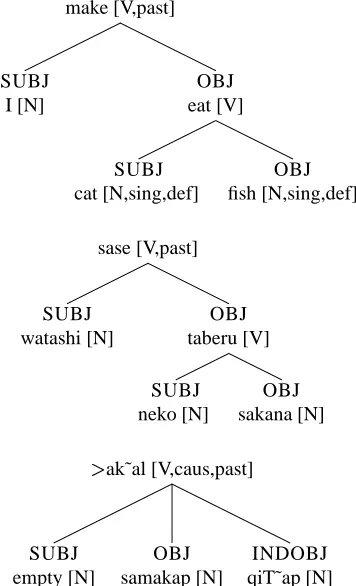
make [V,past]
SUBJ I [N]
OBJ eat [V]
SUBJ cat [N,sing,def]
OBJ fish [N,sing,def]
sase [V,past]
SUBJ watashi [N]
OBJ taberu [V]
SUBJ neko [N]
OBJ sakana [N]
ak˜al [V,caus,past]
SUBJ empty [N]
OBJ samakap [N]
INDOBJ qiT˜ap [N]
Figure 4: IL0 deep-syntactic representation for I made the
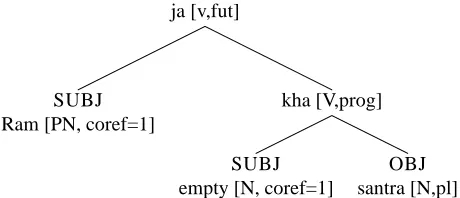
ja [v,fut]
SUBJ Ram [PN, coref=1]
kha [V,prog]
SUBJ empty [N, coref=1]
OBJ santra [N,pl]
Figure 6: IL0 deep-syntactic representation for Hindi Ram santre kha-ye jayega (6b)
7.
Practical Aspects
In our project, we constructed IL0 by hand-correcting the output of a dependency parser or from scratch, depend-ing on the language. We used the TrEd annotation tool (Hajiˇc et al., 2001) developed at Prague, which is eas-ily configurable to any annotation format. Furthermore, it has the advantage that it is easy to convert the input and output to other formats, thus facilitating interfacing with a parser. The IL0-annotated structures were subsequently augmented with IL1 by annotators using a new tool which we developed; Passonneau et al. (2006) report on the inter-annotator agreement of that effort and shows that IL0 in-deed was a successful starting point for IL1 annotation.
8.
Conclusion
Creating a syntactic annotation manual for a language amounts to writing a descriptive grammar with nearly com-plete coverage. It is a daunting task. Many choices must be made. These choices should be informed by an analy-sis of data, by syntactic theory (which one hopes is itself informed by an analysis of data), and/or by the goal of the annotation. Our syntactic annotation has two characteris-tics: it is only the first step in a semantic annotation ef-fort; and it is intended to be used in the presence of parallel texts in different languages, i.e., different representations of the same content. We have taken these goals of the an-notation task as our primary motivating forces in making decisions about annotation. We believe that just as par-allel syntactic annotation leads to better semantic annota-tion, the parallel creation of syntactic annotation manuals leads to better-founded syntactic representations, and elim-inates non-essential differences between languages which only complicate work in linguistics and natural language processing.
9.
References
Allegranza, V.; Bennett, P.; Durand, J.; Eynde, F. Van; Humphreys, L.; Schmidt, P.; ; and Steiner, E. (1991). Linguistics for machine translation: The eurotra linguis-tic specifications. In Copeland, C.; Durand, J.; Krauwer, S.; ; and Maegaard, B., editors, The Eurotra Linguistic
Specifications, pages 15–124. CEC, Luxembourg.
Butt, Miriam; Dyvik, Helge; King, Tracy Holloway; Ma-suichi, Hiroshi; and Rohrer, Christian (2002). The paral-lel grammar project. In Proceedings of COLING-2002
Workshop on Grammar Engineering and Evaluation,
pages 1–7, Taipei, Taiwan.
Farwell, David; Helmreich, Stephen; Reeder, Florence; Dorr, Bonnie; Habash, Nizar; Hovy, Eduard; Levin, Lori; Miller, Keith; Mitamura, Teruko; Rambow, Owen; and Siddharthan, Advaith (2004). Interlingual annota-tion of multilingual text corpus. In Proceedings of the
NAACL/HLT Workshop: New Frontiers in Corpus Anno-tation.
Hajiˇc, Jan; Hajiˇcov´a, Eva; Holub, Martin; Pajas, Petr; Sgall, Petr; Vidov´a-Hladk´a, Barbora; and ˇRezn´ıˇckov´a, Veronika (2001). The current status of the prague de-pendency treebank. In LNAI 2166, LNAI 2166, pages 11–20. Springer Verlag, Berlin, Heidelberg, New York. Kingsbury, Paul; Palmer, Martha; and Marcus, Mitch
(2002). Adding semantic annotation to the Penn Tree-Bank. In Proceedings of the Human Language
Technol-ogy Conference, San Diego, CA.
Marcus, Mitchell M.; Santorini, Beatrice; and Marcinkiewicz, Mary Ann (1993). Building a Large Annotated Corpus of English: The Penn Treebank.
Computational Linguistics, 19.2:313–330.
Martins, T.; Rino, L.H. Machado; Nunes, M.G. Volpe; Montilha, G.; ; and Novais, O. Osvaldo (2000). An in-terlingua aiming at communication on the web: How language-independent can it be? In Proceedings of
Workshop on Applied Interlinguas, ANLP-NAACL.
Mel’ˇcuk, Igor A. (1988). Dependency Syntax: Theory and
Practice. State University of New York Press, New York.
Passonneau, Rebecca; Habash, Nizar; and Rambow, Owen (2006). Inter-annotator agreement on a multilingual se-mantic annotation task. In Proceedings of LREC. Rambow, Owen; Creswell, Cassandre; Szekely, Rachel;
Taber, Harriet; and Walker, Marilyn (2002). A depen-dency treebank for english. In Proceedings of LREC, Las Palmas, Spain. ELRA.
Rambow, Owen; Dorr, Bonnie; Kipper, Karin; Kuˇcerov´a, Ivona; and Palmer, Martha (2003). Automatically de-riving tectogrammatical labels from other resources: A comparison of semantic labels across frameworks.
The Prague Bulletin of Mathematical Linguistics, (79–
80):23–36.
Sgall, P.; Hajiˇcov´a, E.; and Panevov´a, J. (1986). The
mean-ing of the sentence and its semantic and pragmatic as-pects. Reidel, Dordrecht.
Vossen, P. (1998). EuroWordNet: A Multilingual Database