CSEIT1846133 | Published – 08 May 2018 | May-June 2018 [ (4 ) 6 :705-709 ]
National conference on Engineering Innovations and Solutions (NCEIS – 2018)
International Journal of Scientific Research in Computer Science, Engineering and Information Technology
© 2018 IJSRCSEIT | Volume 4 | Issue 6 | ISSN : 2456-3307
705
Solid Waste Management Using IoT
Megha Ramesh
1, N Harshita Subbaiah
1, Punyashree B S
1, Rachana Gowda H C
1, Sowjanya M N
21Students, Department of EIE,VTU, Mysuru, Karnataka, India 2Assistant Professor, Department of EIE,VTU, Mysuru, Karnataka, India
ABSTRACT
Recent days in India, government and companies are looking for solutions to increase the collection level of various waste types by using new technologies and devices such as smart sensors, internet of things (IoT), cloud platforms etc,. Some time bin will be overflowing by the garbage which attracts dogs and cattle’s, these animals will make the garbage to spill on the road. Currently there is no bin monitored remotely so complete automation is needed. This paper mainly briefs about checking the level sensors to provide the status of the bin filled level and also provides the information like temperature, humidity, with latitude and longitude of the bin position using u-blox GPS to send the information to control centre which is used an additional feature for distributing the messages for the multiple users published by authorized person for complete automation with information exchange will be given using MQTT protocol. Therefore, waste management system aims to provide the efficient way to keep the environment clean and green.
Keywords. Internet Of Things (IoT), Cloud Platform, MQTT Protocol.
I.
INTRODUCTIONThe internet of things (IoT) is constantly evolving and is giving unique solutions to the everyday problems faced by human being. “Smart city” is one such implementation aimed at improving the lifestyle of human beings. One of the major hurdles in most cities is its solid waste management, and effective management of the solid waste produced becomes an integral part of a smart city. This project aims at providing an IoT based architectural solution to tackle the problems faced by the present solid waste management system. By providing a complete IoT based system, the process of tracking, collecting, and managing the solid waste can be easily automated and monitored efficiently. By taking the example of the solid waste management crisis of Bengaluru city, India, we have come up with the overall system architecture and protocol stack to give a IoT based solution to improve the reliability and efficiency of the system.
The technology can be simply explained as a connection between humans-computer–things. All
equipment’s we use in our day to day life can be controlled and monitored using the IoT. A majority of process is done with the help of sensors in IoT. Sensors are deployed everywhere and these sensors convert raw physical data into digital signals and transmits them to its control centre. By this way we can monitor environment changes remotely from any part of the world via internet. This system architecture would be based on context of operations and processes in real-time scenario.
subscription made by devices for the corresponding topics which will be received by the users.
II.
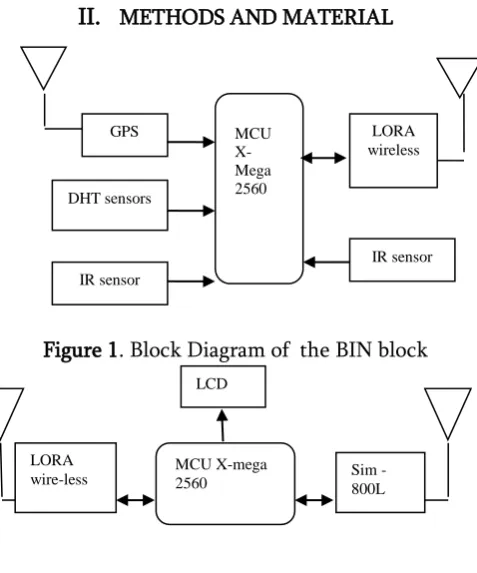
METHODS AND MATERIALFigure 1. Block Diagram of the BIN block
Figure 2. Block Diagram of the Sever Block
Figure 3. Block Diagram of the Communication system
A.Component of proposed system.
1) IR sensor. IR sensor emits the light, which is invisible to naked eye but the electronic components can detect it. It consists of IR transmitter and IR receiver. Both analog and digital output is produced by IR sensor. This sensor produces the output logic’1’ at the digital output when it senses the object and logic’0’ when it doesn’t sense any object. Depending on the distance between the object and sensor,
sensor produces the analog output voltage between 0-5v.
2) MQ-7 CO Sensor. The MQ-7 gas sensor composed by micro AL2O3 ceramic tube, Tin Dioxide (SnO2) sensitive layer, measuring electrode and heater are fixed into a crust made by plastic and stainless steel net. The heater provides necessary work conditions for work of sensitive components. The enveloped MQ-7 have 6 pin, 4 of them are used to fetch signals, and other 2 are used for providing heating current. Standard measuring circuit of MQ-7 sensitive components consists of 2 parts. one is heating circuit having time control function. The second is the signal output circuit, it can accurately respond changes of surface resistance of the sensor.
3)DHT11 Sensor. DHT11is a sensor used to measure percentage of relative humidity and temperature in degree centigrade. This sensor uses 1-wire protocol for 32 bit data (16 bit each for relative humidity and temperature respectively) with additional 8 bit CRC data transmission from sensor. Conversion of 8 bit received data into relative humidity and temperature are computed by grouping binary into decimal followed by division by decimal value 10 in order to obtain the true values.
4) U-blox GPS. GPS-634R" is an exceedingly coordinated smart GPS module with a ceramic GPS fix receiving wire. The receiving wire is associated with the module by means of a LNA. The module is with 51 channel securing engine and 14 channel
B. Proposed system design
NO
YES
It consist of U-blox GPS to send latitude and longitude values, DHT11, carbon monoxide and IR sensor to provide levels of filled waste in the bin. Lora wireless is used to send temperature and humidity level status to the centralized unit. All these peripherals are monitored and controlled by ATmegs2560 8- bit microcontroller which has 256k byte ROM to store the program and 8k byte of RAM. These controllers can execute 16 million instructions for external oscillator.
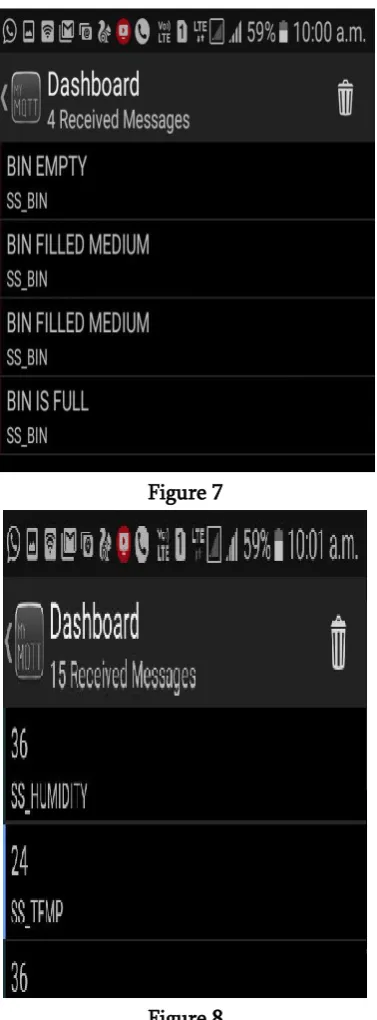
It is considered as centralized block which received data from bin block and display it on LCD like temperature and humidity sensor status and latitude and longitude of the bin. The same information is passed to node MCU, Wi-Fi which in turn sends the data to the cloud server using MQTT protocol. User can access the information using ready app using Google play store called as MY MQTT. User need to provide specific IP with port addresses for server connection. Once the messages sent by the unit by entering receive latitude and longitude in Google app, user can view the exact position of the bin in maps.
III.
RESULTIn past few years, the growth of cities is rapidly going high. And in coming few years the cities would become developed and smart one. But, the smart city is incomplete without a smart garbage management system. So, we have designing a system for proper management of garbage. The objective of the project is for the real time access of information about the dustbin .This IOT based management of waste is very useful for smart cities in many aspects. The embedded technique is enhancing the system to achieve the desired result. This system will prevent the overflow of dustbin and make the environment neat and clean. It will reduce the wastage of time, cost and energy of human. It will also prevent the occurrence of any disease. The truck drivers easily get the information about the clearing process and do their work immediately.
Figure 4
Figure 5
Figure 6
START
check whether dustbin is full=?
Send the message to the
control room
Send the truck driver for
collecting the waste
Update the status of bin
REPEA
Figure 7
Figure 8
IV.
CONCLUSIONThis advanced embedded system provides bin information for the corresponding locations by taking the requirements of complex design need with minimised essentials for analysing in different places for restorative needs. This system checks corresponding intended information from different sensors to help oversee about the bin status. The proposed research enhances the smart waste management and minimal exposure to pollution. In
crisis the framework cautions the personal to oversee about the dangerous levels and conditions for furthermore. It alerts to the corresponding personal in the event that he/she is checking for furthermore to make by implementing the designed work. The fundamental estimation of the exactness is inside permissible ±2% error depending on the computations, the solitary results with percentage of error gives a clear picture that the proposed system performs better and consumes minimal latency to quantify the key hazards.
V. REFRENCES
1. "World Bank. What a Waste – Solid Waste Management in Asia. Urban and Local Government Working Papers", U.S.A, 1999. 2. M Faccio, A. Persona, and G. Zanin, "Waste
collection multi objective model with real time traceability data",Waste Management, Vol. 31, pp. 2391-2405, 2011.
3. MA.A.Mamun, M.A.Hannan, A.Hussain H.Basri”Real Time Bin Status Monitoring For Solid Waste Collection Route Optimization” 4. DimitrisKaradimas, Andreas Papalambrou, John
Gialelis and Stavros Koubias”An integrated node for Smart- Cityapplications based on active RFID tags; Use case on waste-bins”978-1-5090-1314-2/16/2016 IEEE
5. WANG Jing-yang, YU Guang-ping, YUAN Ming-zhe, ”Research on Application of IOT in Domestic WasteTreatment and Disposal”July 4 2014
6. Md Abdulla Al Mamun, Mahammad A. Hannan, AiniHussain”Integrated Sensing Systems and Algorithms forSolid Waste Bin State Management Automation” Ieee Sensors Journal, Vol. 15, No. 1, January 2015
7. RoshanIssac,Akshai M”SVASTHA.An Effective Solid Waste ManagementSystem For Thiruvalla Municipality in Android OS”978-1-4799-1095-3/13/2013 IEEE
On Sensors, Elevator and GSM”978-1-5090-5297-4/17/2017 IEEE
9. ShubhamThakker,R.Narayanamoorthi” Smart and Wireless Waste Management”978-1-4799-6818-3/15/2015 IEEE
10. Chen Tao,Li Xiang”Municipal Solid Waste Recycle Management Information Platform Based onInternet of Things Technology”978-0-7695-4258-4/10 2010 IEEE
11. ShashikaLokuliyana,
AnuradhaJayakody,LakmalRupasinghe”IgoeIot Frame Work For Waste Collection Optimization”978-1-5090-4729-1/17 2017 ieee 12. SauroLonghi_,
DavideMarzioniy,EmanueleAlidoriy, Gianluca Di Buo_”Solid Waste Management Architecture using Wireless Sensor Network technology”978-1-4673-0229-6/12/2012 IEEE
V.
BIBILOGRAPHYMEGHA RAMESH B.E in Electronics and instrumentation from GSSS Institute of Technology for Women, Mysuru.
N HARSHITA SUBBAIAH B.E in Electronics and instrumentation from GSSS Institute of Technology for Women, Mysuru.
PUNYASHREE B S B.E in Electronics and instrumentation from GSSS Institute of Technology for Women, Mysuru.