Students’ Projects Based on Web Engineering
Thida Win
1, Kyi Zar Nyunt
2, Wint Aye Khaing
21,2,3
Faculty of Information Science, University of Computer Studies (Taungoo), Myanmar
[email protected]
,
[email protected]
,
[email protected]
Abstract:
The main purpose of a university have for decades been teaching, project, research and service. And then the university must produce the perfected skills and knowledge web engineers. The students engage with the industry, community and business to solve their problems. Students that involved the projects gain project’s experience and easy to understand the theory and method of web engineering. So, Final year students construct a project based on Web Engineering. This paper presents how to support the courses, Web engineering from learned previous academic years and how to create the students’ Web Application projects.
Keywords
Web Engineering, skills and knowledge, Web Application
1. Introduction
Web Engineering is the application of systematic, disciplined and quantifiable approaches to development, operational and maintenance of Web-based system or applications. [3] Web engineering proposes an agile, yet disciplined framework for building industry-quality Web Applications. Web engineers must understand that modern business demands adaption, business strategies and rule change rapidly. In order to produce high quality Web applications, the development process is short, within the budget and monitored by suitable measurement program. Although many development methods have been proposed for building Web applications such as waterfall, spiral and agile is the suitable for all Web applications. Agile process is an iterative approach in which customer satisfaction is at highest priority as the customer has direct involvement in evaluating the software. [2] A framework establishes the foundation for a complete Web engineering process by identifying a small number of framework activities. Five generic framework activities are: communication, planning, modeling, construction and deployment. [7]
This paper gives how to create the students’ project based on Web engineering framework
activities by addressing the questions: a) what is Web Engineering? b) what skills and knowledge are required to build the Web application projects? c) what are Web engineering methods? d) how does students’ project access?
2. Web Engineering
In the early 1990’s, the research community started to work in a new area of software engineering oriented toward the special characteristics of the Web environment.[1] In the early days of the World Wide Web (crica 1990 to 1995), “websites” consisted of little more than a set of linked hypertext files that presented information using text and limited graphics, As time passed, Hypertext Markup Language (HTML) was augmented by development tools and technologies (e.g, Extensible Markup Language (XML) , Java) that enabled Web engineers to provide both client-side and server-side computing capability along with content. Today, Web Application (WebApp) have involved into sophisticated computing tools that not only provide stand-alone functionality to the end user but also have been integrated with corporate and governmental databases and application. [7]
3. Skills and Knowledge
Students can meet the challenges to create the Web-based applications. They must have the basic knowledge and skills about Web-based technologies. Before entering the field of Web engineering, it is expected that most students have taken courses in the following subjects during the previous academic years. There is the most influential factor for the success of Web-based projects. An important step in teaching Web engineering consists of identifying the skills that one expects Web engineers to posses. There are three groups of skills are required for only Web engineer:
b) Specific skills: it provides the ability to perform key tasks of the Web engineering development process.
c) Generic skills: is concerned with writing, reading, communication, dialogue, teamwork and project planning. These skills are essential for Web engineers in a work situation. [4]
3.1 Integrate Skills and Courses
This phase presents the tables that the students gained the required skills and knowledge in the previous academic years. They make their projects according to the subjects since first year. So, they are very interest in projects and gained experiences from their subjects’ projects. (See Table 1 and Table 2)
Table 1. Integrate Skills and Language
Skills Courses Year
Prerequisite Skill
-HTML
-C++ Programming Language
First Year
-Java Script
-Database Development (JDBC, MySQL) -Object-oriented modeling (OOSD, Java SE, Java EE)
Second Year
-Database Development (JDBC, MySQL) -Object-oriented modeling (UML, C#, ASP.Net)
Third Year
-Database Development (JDBC, MySQL) -Object-oriented modeling (UML)
Fourth Year
Specific Skills
Web Engineering -disciplines
-development philosophy -context and functions -constraint and
performance
-system modeling tasks -constriction tasks -testing
Fifth Year
Generic Skills
-Software Engineering -Reuse of design principle, frameworks, architecture
-Project planning and management -Networking -E-Business -Ethics
Second Year Third Year Fourth year
Table 2. Students’ Projects
Year Project
First Year HTML project
Second Year
Requirement Engineering project HTML and CSS project
Database project
Mini project (Java SE, Java EE)
Third Year Database project
C# project JSP.Net project
Fourth Year Project Proposal Report
Business Plan
PHP and Android application
Fifth Year Web-based System
4. Web Engineering Methods
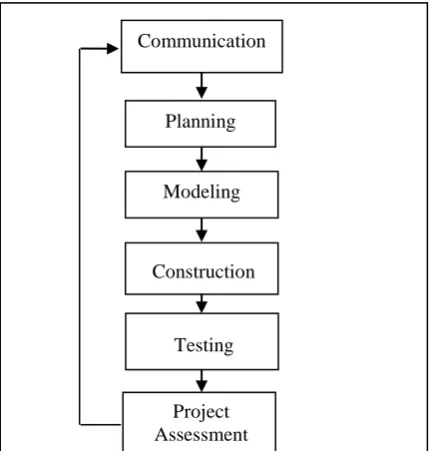
The Web Engineering (WebE) methods landscape encompasses a set of technical tasks that enable a Web engineer to understand, characterize, and then build high-quality Web applications. Web engineering method consist abroad array of actions and tasks that includes communication, planning, requirements analysis, design modeling, program construction and testing, and project assessment.
4.1 Communication
The Web application project begins with the communication activity. It is the place where Web engineers and stakeholders (e.g. end users, business clients, problem domain experts, content designer, team leaders, and project managers) engage in a series of Web engineering actions that (1) ask and answer a set of fundamental questions about the Web-based project and its business context. (2) elicit
Figure 1. Web Engineering Activities.
Communication
Planning
Modeling
Construction
Testing
requirements that will serve as the basis for all activity (3) negotiates needs against the realities of time, resources, cost and technology. We can adapt this activity suitable for our projects. So, this activity consists of four actions: (1) project team organization, (2) selection the project, (3) requirement specification and (4) negotiation.
4.1.1 Project Team Organization
Firstly, students organize the project teams. All the development teams are small with four or five students. The most of the development projects are small because the development time is short. The team is organized by choosing students’ team members by themselves. Team members have collaboration and cooperation through the development project.
4.1.2 Selection the Project
The project teams study the business problems. They select the business or organization problem to make a project. They communicate with the stakeholder who is responsible from the business or organization. They ask the stakeholders about the problems and its business context with a set of fundamental questions and collect the answers to make the Web-based project.
4.1.3 Requirement Specification
Eliciting and specifying requirements are important steps in the development cycle of every software system. [8] Project Teams collect the requirements from the stakeholder. They specify the requirements in detail. Then they write user scenario to discuss with stakeholders again.
4.1.4 Negotiation
Teams communicate with stakeholders to determine stakeholder’ requirements in sufficient detail to proceed the subsequent Web engineering activities for a Web increment. Web engineer and stakeholders often enter into a process of negotiation where a stakeholder may be asked to balance functionality, performance, and other product or system characteristics against cost and delivery time.
4.2 Planning
Once WebE teams understand the requirements, take the planning activity. Planning activity depends on the complexity of the WebApp increments. If the WebApp increment is simple, planning will take very little time. On the other hand, if the increment is complex, planning will require greater effort. The following activities are required to plan:
Risk management defines risks that are potential problems-it might happen, it might not.
Developing a schedule is an activity that allocates the estimated effort for specific WebE tasks across the planning time line for building an increment.
Estimate effort and time: The WebE team assesses whether a planned WebApp increment can be developed with available resources such as cost, time and people. Quality management: Once WebApp
increment is released to end user, it is exercised and feedback is provided to the WebE team.
Changes management: It is often possible to delay the introduction of requested changes until the next increment because development time is short.
Tracking the project: We need to track progress of the development project.
4.3 Modeling
Modeling helps address the problem using a combination of text, graphical, and diagrammatic forms to depict content and function, architecture and component detail, interfaces, navigation, and aesthetics in ways that are relatively easy to understand and more important to review for correctness, completeness and consistency. Modeling activity includes two main actions: Analysis modeling and Design modeling.
4.3.1 Analysis Modeling
Before attempting the modeling activity, students must already posse prerequisite knowledge in object-oriented modeling with UML and Object-object-oriented System Analysis and Design (OOSD). Furthermore, student must have understood the requirements problems. The purpose of analysis modeling is concerned with the specification of the problem requirements. [4] After writing the analysis report, the students present and discuss with supervisor and business partners. There are five major steps in this activity:
Review the problem requirements Elaborate class specification Define the content relationship Create the interaction model
Write the analysis report
4.3.2 Design Modeling
The objective of the design modeling activity is twofold. First, the design of the system by addressing both architectural issues (client-server, packages, components, nodes) and detailed design issues (collaborations). Second, the elaboration of the analysis models developed in the previous phase that is, adding detailed design and extending existing use case models to effectively turn them into design documents. Before attempting this design activity, student must have performed the analysis activity. The expected outcome is a design report. There are five major steps: [4]
Read the analysis modeling report Design the overall system architecture Design the logical components using
component diagram
Design the physical components and nodes using deployment diagrams
Write the design report
4.4 Construction and Testing
WebE team must construct a Web application using design report as a guide. This activity involves code generation and testing.
4.4.1 Code Generation
Students create Web application content and functions using a broad set of languages, tools and related technology such as PHP, ASP.Net, JDBC, Java Servelts, and MySQL. They distribute the responsibility for building the Web Application content and functions. Students must have performed modeling activity before attempting this activity. The expected outcome is a piece of well-documented and tested software that implements the design model. The software solution must be on the three-tier client/server architecture.
4.4.2 Testing
Testing shouldn’t wait until the project finished. Start testing before you write one line of code. Web testing has many dimensions. Each unit of a Web Application such as page, code, site, navigation, standards, and legal requirements must be tested. A test plan provides a roadmap so that the Web application can be evaluated through requirements or design state. It also helps to estimate the time and effort needed for testing. Lam groups Web testing into the following broad categories and provides
excellent practical guidelines on how to test Web-based system. [6]
Browser compatibility Page display
Session management Usability
Content analysis Availability
Backup and recovery Transactions
Shopping, order procedures System integration
Performance Login and security
5
Project Assessment
It is helpful for several reasons to have scheduled progress presentations from the students given to faculty and also company partners. The evaluation consisted of assessing:
The quality of the submitted project
The presentation of project results to the hole classroom
The active participation of the students in project work.
Supervisors monitor the project teams and mark the activities of each member. This mark is added to the exam result by 10%. After the project is completed, they must present their projects’ presentation in the product show that invited the business, organization, schools, and other university.
6
Conclusion
Web engineering focuses on the methodologies, techniques, and tools that are the foundation of Web application development and which support their design, development, evolution, and evaluation. Web application development has certain characteristics that make it different from traditional software, information system, or computer application development. In this paper, the courses that previously studied first year through final year to gain the needed knowledge to build the Web-based projects are already presented by tables. And then, how to create a project using Web engineering methods are discussed. The paper also shows the project assessment method by the supervisor in our university.
7
References
[2] B.Boehm and R.Turner, "Balancing Agility and Discipline: A Guide for the Perplexed", Addison, Wesley, 2003.
[3] Deshpande, Y., Murugesan, s., Ginige, A., Hansen, S., "Web Engineering" , Journal of Web Engineering, Vol 1, No.1 (2002) 003-017
[4] Hadjerrouit, S.,"Designing a Pedagogical Model for Web Engineering Education: An Evolutionary Perspective", Agder University College, Kristiansand, Norway
[5] Hatch, L., Heistracher, T. J.,"Student Research in Web Engineering: An International Perspective on Internal and External Opportunities"
[6] Lam, W., "Testing e-commerce systems: A practical guide, IT Professional", 2001, 3*2, (19-27)
[7] Pressman, R. S., Lowe, D.,"Web Engineering: A Practitioner's Approach Text Book", Baca Raton, Florida, USA