Design and Implementation of Web-Based Heat Emission System
Sai Sie Thu Kyaw1
, Daw Moh Moh Khaing2
1Information Technology Dept, Technological University, Taunggyi, Myanmar 2Information Technology Dept, Technological University, Taunggyi, Myanmar
Abstract:
Hot objects emit heat. Excessive heat damages computer equipments. Monitoring the temperature of central processing unit and other computer components can help keeping them running properly. British thermal unit (BTU) is a standard unit of measurement used to denote the amount of heat energy. Computer cooling is essentially required to remove the waste heat produced by computer equipments, to keep components within their safe operating temperature limits. This thesis is intended to implement a website that can calculate amount of BTU emitted by computer equipments. Recommendation systems are essential to the success of websites. In this thesis, ways of reducing heat are described as recommendation. Users can also calculate the amount of heat emitted by them. This system gives ways as recommendation to minimize heat emission to become minimal heat emission computing system. This system is implemented with C# and ASP.NET languages.
Keywords: ASP.NET Language British thermal unit(BTU), Heat Emission,
1.Introduction
With the rapid development of the information industry all over the world and the emergence cloud computing, the demand for the storage device is becoming greater. Therefore, the industry of heat emission products will be the key to development, especially the heat emission with low power consumption and high efficiency. People worry about their computers when they are working twenty four hours a day with the new heat emission device. People need devices that are designed with the goal of high efficiency, low power consumption, low vibration, low noise and long service life.
With the concept of environmental
protection, the heat emission fan with high efficiency and low power consumption will
be more popular in the future. More researches need to be taken to pursuing the innovation of the products.
Computer cooling is required to remove the
waste heat produced by computer
components, to keep components within their safe operating temperature limits. Various cooling methods help to improve processor performance or reduce the noise of cooling fans. Components which produce heat are susceptible to performance loss and damage include integrated circuits such as central processing unit (CPU), chipset and graphics cards, along with hard drives though excessive cooling of hard drives has been found to have negative effects. Overheated parts fail early and may give sporadic problems resulting in system freezes or crashes.
2.Objectives
Objectives of this paper are to calculate the
amount heat emitted by computer
equipments, to know the side effects of computer heat, to inform people ways to minimize the amount of heat, to understand British thermal unit (BTU) and Watt and to recommend suitable ways for users.
3.Background Theory
imponderable fluid, to which was given the name caloric.
The sensation caused by the force or influence of heat when excessive, or above that which is normal to the human body; the bodily feeling experienced on exposure to fire, the sun's rays, etc.; the reverse of cold. Heat is a high temperature, as distinguished from low temperature, or cold; as, the heat of summer and the cold of winter; heat of the skin or body in fever, etc. Indication of high temperature; appearance, condition, or color of a body, as indicating its temperature; redness; high color; flush; degree of temperature to which something is
heated, as indicated by appearance,
condition, or otherwise. Heat is a single complete operation of heating, as at a forge or in a furnace; as, to make a horseshoe in a certain number of heats.
It is also often described as the process of transfer of energy between physical entities. In this description, it is an energy transfer to the body in any other way than due to work performed on the body.
In engineering, energy transfer by heat between objects is classified as either
thermal conduction, first described
scientifically by Joseph Fourier, by fluid convection, which is the mixing of hot and
cold fluid regions due to pressure
differentials, and by thermal radiation, the transmission of electromagnetic radiation described by black body theory.
Thermodynamically, energy can only be transferred by heat between objects, or regions within an object, with different temperatures, a consequence of the zeroth law of thermodynamics. This transfer happens spontaneously only in the direction to the colder body, as per the second law of thermodynamics. The transfer of energy by heat from one object to another object with an equal or higher temperature can happen only with the aid of a heat pump via mechanical work or by using mirrors or lenses to focus electromagnetic radiation which thereby increase its energy flux density.
A related term is thermal energy, loosely defined as the energy of a body that increases with its temperature. Heat is also often referred to as thermal energy, although many definitions require this thermal energy to be in transfer between two systems to be called heat, otherwise, many sources prefer to continue to refer to the internal quantity as thermal energy.
In physics and thermodynamics, heat is the process of energy transfer from one body or system to another due to thermal contact, which in turn is defined as an energy transfer to a body in any other way than due to work performed on the body. A related term is thermal energy, loosely defined as the energy of a body that increases with its temperature. Heat is also loosely referred to
as thermal energy, although many
definitions require this thermal energy to actually be in the process of movement between one body and another to be technically called heat otherwise, many sources prefer to continue to refer to the static quantity as thermal energy.
4.Computer and Heat
Everyone really wants a fast hot computer when to do some business computing and when want to play those high speed games. But people don't want a fast and hot computer in the literal sense. Heat will destroy any computer component if not removed in time. And the CPU chip is one of the main components of system that produces heat. The heat sink has the all important task of keeping the CPU chip cool so it does not overheat. And there may be times when the heat sink will fail to perform its job and must be changed.
good and can even lead your CPU to burn or to work in an unstable way. In this thesis user will learn what the effects of high temperature are over the CPU, will learn how to measure user’s CPU current temperature and will have access to tables
5.British Thermal Unit
The British thermal unit (BTU) is a traditional unit of energy equal to about 1 055.05585 joules. It is approximately the amount of energy needed to heat 1 pound (0.454 kg) of water 1 °F (0.556 °C). It is used in the power, steam generation, heating and air conditioning industries. In scientific contexts the BTU has largely been replaced by the SI unit of energy, the joule, though it may be used as a measure of agricultural energy production (BTU/kg). It is still used unofficially in metric English-speaking countries such as Canada, and remains the standard unit of classification for air conditioning units manufactured and sold in
many non-English-speaking metric
countries [1].
6.Web-based Recommendation System
The continuous growth in the size and use of the World Wide Web imposes new methods of design and development of online information services. Most web structures are large and complicated and users often miss the goal of their inquiry, or receive ambiguous results when they try to navigate through them. On the other hand, the e-business sector is rapidly evolving and the need for Web marketplaces that anticipate the needs of the customers is more evident than ever.
Therefore, the requirement for
predicting user needs in order to improve the usability and user retention of a website can be addressed by personalizing it. Web personalization is defined as any action that adapts the information or services provided by a website to the needs of a particular user or a set of users, taking advantage of the
knowledge gained from the users’
navigational behavior and individual
interests, in combination with the content and the structure of the website. The objective of a web personalization system is to provide users with the information they want or need, without expecting from them to ask for it explicitly.
7. Implementation of the System
System design is shown in Figure 1.
Figure 1. System Design
In this system, user must register to get recommendation for computer cooling methods. When the user finished the login process, the user can calculate amount of BTU. And user can get recommendation that suitable for user’s interest. Home page of the system is shown in Figure 2.
Registration process is shown in Figure 3. When the user registers in this system, user must fill required information, such as name, password, email, age, address, sex and interests.
Figure 3. Registration Page of the System
If the registration process is completed, the user will see as shown in Figure 4.
.
Figure 4. Registration Complete Page
Login page of the system is shown in figure 5. User name and password are required to login.
Figure 5. Login Page
If the user completes logging process, the user can reach choosing page of system shown in Figure 6. If the user clicks the recommendation button, user can get
recommendation suitable for his/her
interests. When the user clicks the BTU calculator button, he/she will reach BTU calculator page.
Figure 6. Choosing Page
When the user clicks BTU calculator button, the calculator is displayed shown in Figure 7. For calculating amount of BTU, user must fill load Watt, number of appliances, and average usage hour per day. When the user clicks the total button, the amount of BTU is displayed to user. By calculating amount of BTU, users can know amount of BTU and get knowledge to reduce emission of heat.
Figure 7. BTU Calculator
If the user clicks recommendation button, recommendations that is suitable with
his/her interest are presented as
recommendation shown in Figure 8.
Figure 8. Recommendation Page
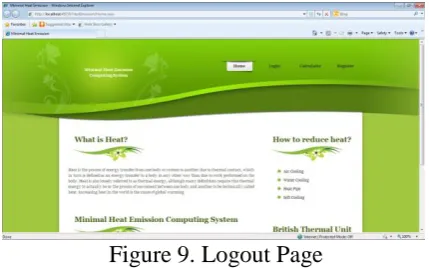
Figure 9. Logout Page
8. CONCLUSIONS
It is well known that the World Wide Web may be considered as a huge and global
information center. A website usually
contains great amounts of information distributed through hundreds of pages. Without proper guidance, a visitor often
wanders aimlessly without visiting
important pages, loses interest and leaves the site sooner than expected. This consideration is at the basis of the great interest about web information mining both in the academic and the industrial world. So, the author hopes this paper can help people who interested in heat emission systems.
9. ACKNOWLEDGEMENT
The author appreciates and thanks to Daw Moh Moh Khaing, Lecturer, Department of
Information Technology, Technological
University (Taunggyi), for her mentoring, for her numerous suggestions concerned with this paper and for her kindness.
10.REFERENCES
[1] “Personalized Links
Recommendation Based on Data Mining in
Adaptive Educational Hypermedia
Systems”, Cristóbal Romero, et.cl, Córdoba
University, Campus Universitario de
Rabanales, Córdoba, Spain. .
[2] “Web Mining for Web
Personalization”, Magalini Eirinaki and