Robust Fuzzy Extractors and
Authenticated Key Agreement from Close Secrets
∗Yevgeniy Dodis† Bhavana Kanukurthi‡ Jonathan Katz§
Leonid Reyzin‡ ¶ Adam Smithk
Abstract
Consider two parties holding samples from correlated distributionsW andW0, respectively, where these samples are within distancetof each other in some metric space. The parties wish to agree on a close-to-uniformly distributed secret keyR by sending a single message over an insecure channel controlled by an all-powerful adversary who may read and modify anything sent over the channel. We consider both thekeyless case, where the parties share no additional secret information, and the keyed case, where the parties share a long-term secret SKExt that they can use to generate a sequence of session keys{Rj}using multiple pairs {(Wj, Wj0)}. The
former has applications to, e.g., biometric authentication, while the latter arises in, e.g., the bounded-storage model with errors.
We show solutions that improve upon previous work in several respects:
• The best prior solution for the keyless case with no errors (i.e., t= 0) requires the min-entropy ofW to exceed 2n/3, wherenis the bit-length ofW. Our solution applies whenever the min-entropy ofW exceeds the minimalthresholdn/2, and yields a longer key.
• Previous solutions for the keyless case in the presence of errors (i.e.,t >0) required random oracles. We give the first constructions (for certain metrics) in the standard model.
• Previous solutions for the keyed case were stateful. We give the first stateless solution.
1
Introduction
A number of works have explored the problem of secret-key agreement based on correlated infor-mation, by which two parties holding samplesw, w0 of correlated random variables W, W0 commu-nicate in order to generate a shared, secret, close-to-uniform key R. The problem has variously
∗
This is an expanded and corrected version of [15, 23]. It appears in IEEE Transactions on Information Theory (on-line in 2012, DOI 10.1109/TIT.2012.2200290).
†
Dept. of Computer Science, New York University. [email protected]. This research was supported by NSF Grants #0133806, #0311095, and #0515121.
‡
Dept. of Computer Science, University of California, Los Angeles. [email protected]. Work done while at Boston University. This research was supported by NSF grants #0311485, #0515100, #0546614, #0831281, #1012910, and #1012798.
§
Dept. of Computer Science, University of Maryland. [email protected]. This research was supported by NSF grants #0310751, #0447075, and #0627306.
¶
Dept. of Computer Science, Boston University. [email protected]. This research was supported by NSF grants #0311485, #0515100, #0546614, #0831281, #1012910, and #1012798.
k
been called “information reconciliation” (especially when the challenge is to handle differences between the samples held by the parties), “privacy amplification” (especially in the case when
W = W0 and the goal is to transform a nonuniform shared secret to a uniform one), or “fuzzy extraction.” Early work [43, 5, 26, 3] assumed the parties could communicate over apublic but au-thenticated channel or, equivalently, assumed a passive adversary. This assumption was relaxed in later work [29, 30, 42, 27, 33], which considered an active adversary who could modify all messages sent between the two parties.
The goal of the above works was primarily to explore the possibility ofinformation-theoretic se-curity, especially in the context of quantum cryptography; however, this is not the only motivation. The problem also arises in the context of using noisy data (such as biometric information, or obser-vations of some physical phenomenon) for cryptographic purposes, even if computational security suffices. The same problem also arises in the context of the bounded-storage model (BSM) [28] in the presence of errors [14, 17]. We discuss each of these in turn.
1.1 Authentication Using Noisy Data
In the case of authentication/key agreement using noisy data, the random variablesW, W0areclose
(with respect to some metric) but notidentical. For simplicity, we assume the noisy data represents biometric information, though the same techniques apply to more general settings. In this context, two different scenarios have been considered:
“Secure authentication”: Here, a trusted server stores some biometric datawof a user, obtained during an initial enrollment. Later, when the user and the server want to establish a secure communication session over an insecure channel, the user locally obtains a fresh biometric scan w0
which is close, but not identical, to w. The user and the server then usew and w0 to authenticate each other and agree on a keyR.
“Key recovery”: In this scenario, a user utilizes his biometric datawto generate a random keyR
along with some public information P, and then storesP on a (possibly untrusted) server. The key R is then used, for example, to encrypt some data for long-term storage. At a later point in time, the user obtains a fresh biometric scanw0 along with the value P from the server; together, these values enable the user to recoverR (and hence decrypt the encrypted data).
In the second setting the user is, in effect, running a key agreement protocol with himself at two points in time, with the (untrusted) server acting as the “communication channel” between these two instances of the user. This second scenario inherently requires a noninteractive (i.e., one-message) solution since wis no longer available at the later point in time. Note also that any solution for the second scenario also provides a solution for the first.
Several protocols for key agreement using noisy data over anauthenticatedchannel are known [5, 3, 22, 20, 16]. Most of the existing work for anunauthenticated channel, however, solves the problem only for two special cases [29, 30, 42, 27, 33]: (1) whenW =W0, or (2) whenW andW0 consist of (arbitrarily many) independent realizations of the same random variable; i.e.,W = (W(1), W(2), . . .) and W0 = (W0(1), W0(2), . . .). In the case of biometric data, however, W, W0 are not likely to be equal and we cannot in general obtain an unbounded number of samples.
R remains secret but the user can be fooled into using an incorrect key R0). Boyen et al. [9] showed two solutions to the problem. Their first solution is noninteractive and thus applies to both scenarios above, but relies on random oracles. Their second solution is interactive, and relies on password-based key exchange as a primitive. This means that it providescomputationalrather than
information-theoretic security; furthermore, given the current state-of-the-art for password-based key exchange, their solution is impractical without additional assumptions such as random oracles or the existence of public parameters.
1.2 The Bounded-Storage Model and the Keyed Case
Key agreement using correlated information arises also in the context of thebounded-storage model
(BSM) [28] in the presence of errors [14, 17]. In the BSM, two parties share a long-term secret key SKBSM. In each time period j, a long random string Zj is broadcast to the parties (and the adversary); the assumption is that the length ofZj is more than what the adversary can store. The parties useSKBSM and Zj to generate a secret session key Rj in each period. This process should achieve “everlasting security” [1], meaning that even ifSKBSM is revealed to the adversary in some time period n, all session keys {Rj}j<n remain independently and uniformly distributed from the perspective of the adversary.
A paradigm (formalized by [39]) for achieving the above is for SKBSM to contain a seed SKSam for a sampler1 and another seedSKExtfor a randomness extractor. The parties useSKSamto sample some portion of Zj in each period; in the absence of errors, this results in each party holding the same value wj. Since the adversary may have some partial information about wj, however, this shared value is not uniformly distributed from the point of view of the adversary, and the parties must therefore use a randomness extractor with the seedSKExt to generate a uniform keyRj for the current period. In the presence of transmission errors in Zj the problem is even more difficult, as the parties then hold correlated (but possibly unequal) stringswj, w0jafter the initial sampling. The parallels to biometric authentication should be clear. Nevertheless, the problems are incomparable: in the case of the BSM with errors there is a stronger setup assumption (namely, that the parties share a long-term keySKBSM) but the security requirements are more stringent sinceSKBSM needs to be reusable and everlasting security is required.
1.3 Our Contributions
We focus on the abstract problem of secret-key agreement between two parties holding instances
w, w0 of correlated random variables W, W0 that are guaranteed to be close but not necessarily identical. Specifically, we assume that w and w0 are within distance t in some underlying metric space. Our definitions as well as some of our results hold for arbitrary metric spaces, while other results assume specific metrics.
We restrict our attention to noninteractive protocols defined by procedures (Gen,Rep) that operate as follows. The first party, holding w, computes (R, P) ← Gen(w) and sends P to the second party; this second party computes R0 ← Rep(w0, P). (If the parties share a long-term key
SKExt thenGen,Rep take this key as additional input.) The basic requirements, informally, are Correctness: R=R0 whenever w0 is within distancet ofw.
1A sampler [2] is a function that mapsSK
Sam to a set of bit positions. In fact,SKSammay simply encode a set of
Security: If the min-entropy of W is high, thenR is uniformly distributed even given P.
So far, this gives exactly afuzzy extractor as defined by Dodis et al. [16] (although we additionally allow the possibility of a long-term key). Since we are interested in the case when the parties communicate over anunauthenticated channel, however, we actually want to constructrobust fuzzy extractors [9] that additionally protect against malicious modification of P. Robustness requires that if the adversary sends any modified value ˜P 6=P, then with high probability the second player will reject (i.e., Rep(w0,P˜) =⊥). We distinguish between the notion ofpre-application robustness
and the stronger notion of post-application robustness, where in the latter case the adversary is given R before it generates ˜P. Post-application robustness is needed in settings where the first party may begin using R before the second party computes R0, and is also needed for the “key recovery” scenario discussed earlier (since previous usage of R may leak information about it).
We now summarize our results:
The case of no errors. Although our focus is on the case whenW, W0 are unequal, we obtain improvements also in the case when they are equal (i.e.,t= 0) but nonuniform. Letm denote the min-entropy ofW and letn≥mdenote its bit-length. The best previous noninteractive solution in this setting is due to Maurer and Wolf [27] who show that whenm >2n/3 it is possible to achieve pre-application robustness and generate a shared key R of length m−2n/3. On the other hand, results of [18, 19] imply that a non-interactive solution is impossible when m ≤ n/2. (As shown in [27, Section III-C], interactive solutions can do better; in fact, it is possible for the length ofR
to be nearly m [33, 19, 11].)
We bridge the gap between known upper- and lower-bounds and show that whenever m > n/2 it is possible to achieve pre-application robustness and generate a shared key R of length 2m−n. This improves both the required min-entropy ofW and the length of the resulting key. Moreover, we give the first solution satisfying post-application robustness. That solution also works as long asm > n/2, but extracts a key half as long (that is, of lengthm−n/2).
Handling errors. The only previously known construction of robust fuzzy extractors [9] relies on the random oracle model. We (partially) resolve the main open question of [9] by showing a construction of robust fuzzy extractorsin the standard model for the specific cases of the Hamming and set-difference metrics.2 (The solution in [9] is generic and applies to any metric admitting a good error-correcting code.) Our construction achieves post-application robustness.
The techniques of this paper were subsequently generalized in [12].
Using a shared long-term key. There are scenarios in which the two parties trying to derive
R from w and w0 already share a long-term secret key. Motivated by such settings, we define and construct a keyed robust fuzzy extractor for general metrics. In the process, we introduce a new primitive called an extractor-MAC: a one-time information-theoretic message authentication code whose output is independent of the key if the message has sufficient entropy.
Application to the BSM with errors. Prior work focusing on the BSM with errors [14, 17] showed a noninteractive (i.e., single-message) solution to the problem discussed in Section 1.2 when the samples wj, w0j of the parties have constant relative Hamming distance. The solution of [14] is stateful: the long-term key SKBSM is updated by both parties after each time period using information derived from Zj. If a party misses a time period and is no longer synchronized with
2
the other party, it is not clear how to recover. The solution of [17] is stateless; the parties keep the same long-term keySKBSMand can communicate even if one of them misses someZj. However, this solution assumes the parties can communicate over an authenticated channel. Building on keyed robust fuzzy extractors, we show astatelesssolution for the BSM with errors (under the Hamming metric) using an unauthenticated channel.
2
Definitions and Preliminaries
For strings a and b, we use akb to denote their concatenation and let |a| denote the length of a. If S is a set, x ← S means thatx is chosen uniformly from S. If X is a probability distribution, thenx←X means that xis chosen according to X. The notation PrX[x] denotes the probability assigned by X to the value x. (We often omit the subscript when the probability distribution is clear from context.) If A is a probabilistic algorithm and x is an input, A(x;ω) denotes the output of Arunning with random coins ω, andA(x) is the random variable A(x;ω) for uniformly sampled ω. IfX is a distribution, then A(X) is the random variable obtained by samplingx←X
and then runningA(x). We let U` denote the uniform distribution over {0,1}`. All logarithms are base 2.
Let X1, X2 be two probability distributions over some set S. Their statistical distance is SD(X1, X2)def= 12Ps∈S|PrX1[s]−PrX2[s]|. If two distributions have statistical distance at mostε,
we say they areε-close and writeX1 ≈εX2. Note thatε-close distributions cannot be distinguished with advantage better than ε by an adversary who gets a single sample, even if the adversary is computationally unbounded.
The min-entropy of a random variableX is defined asH∞(X) =−log(maxxPrX[x]). Follow-ing [16], we define the (average) conditional min-entropy ofX given Y as
e
H∞(X|Y) =−logEy←Y
2−H∞(X|Y=y)
(where the expectation is over y for which Pr[Y = y] is nonzero). This definition is suited for cryptographic purposes because the probability that an adversary can predict X when given the value of Y is 2−He∞(X|Y).
Lemma 1 ([16, Lemma 2.2]) Let Y have at most 2λ elements in its support. Then
e H∞(X | Y)≥H∞(X, Y)−λ. (More generally, He∞(X|Y, Z)≥He∞(X, Y |Z)−λ.)
2.1 Hash Functions and Extractors
We recall the notion of almost-universal hashing [10, 36].
Definition 1 A family of efficient functions H=hi :{0,1}n→ {0,1}` i∈I is δ-almost universal if for all x6=x0 we have Pri←I[hi(x) =hi(x0)]≤δ. Families with δ= 2−` are calleduniversal. ♦ A simple universal family [36, Theorem 5.2] can be constructed by identifying I and {0,1}n withGF(2n) in the natural way, and defininghi(x) as the high-order`bits of i·x.
Definition 2 LetI be a set and the uniform distribution over that set. A functionExt:{0,1}n×
I → {0,1}` is a strong(m, ε)-extractor if for all distributionsX over {0,1}n withH∞(X)≥m we
have SD((Ext(X;I), I),(U`×I))≤ε. ♦
We refer to the second argument toExt as theseed.
We need to strengthen the above definition to account for external information E an adversary knows that may be correlated with X. To do so, we generalize the min-entropy constraint on X
to average min-entropy, and require the extracted string to be uniform even givenE. Namely, we require that for anyX, Esuch thatHe∞(X |E)≥mwe haveSD((Ext(X;I), I, E),(U`×I ×E))≤
ε. Such extractors are calledaverage-case extractors. Note that any (m−log 1ε, ε0)-extractor is an (m, ε+ε0)-average-case extractor, because Pre←E[H∞(X |e) ≤m−log 1ε
]≤ε by Markov’s inequality; Vahdan [40] proves the stronger statement that any (m, ε)-extractor form≤n−1 is also an (m,3ε)-average-case extractor. However, the additional loss is not always necessary. Indeed, the Leftover Hash Lemma generalizes without any loss to the average-case setting. (Multiple versions of this lemma have appeared; we use the formulation of [37, Theorem 8.1], augmented by [16, Lemma 2.4] for the average case; see [21] and references therein for earlier formulations.)
Lemma 2 (Leftover Hash Lemma) Fix `, m, ε > 0. If H = {hi : {0,1}n → {0,1}`}i∈I is
a (2−`(1 + 4ε2)−2−m)-almost universal family, then H is a strong (m, ε)-average-case extractor (where the index of the hash function is the seed to the extractor). In particular, if H is universal and `≤m+ 2−2 log ε1, then H is a strong (m, ε)-average-case extractor.
The above holds even when H depends on E, i.e., when ˜H = {He}e∈E is a collection of almost-universal families, one for each value of the external informationE.
2.2 One-Time Message Authentication Codes
An (information-theoretic) one-time message authentication code (MAC) consists of polynomial-time algorithms (Mac,Vrfy). The first algorithm takes a key SK and a message M ∈ {0,1}n and outputs a tag t; we write this as t = MacSK(M). The verification algorithm Vrfy takes as input a key SK, a message M ∈ {0,1}n, and a tag t, and outputs either 1 or 0, with the former being interpreted as acceptance and the latter as rejection. Correctness requires that for all SK and all M ∈ {0,1}n, we have Vrfy
SK(M,MacSK(M)) = 1. Security requires that when SK is chosen uniformly, an unbounded adversary cannot output a valid tag on a new message even after being given the tag on any message of its choice. Formally:
Definition 3 Message authentication code (Mac,Vrfy) is a δ-secure one-time MAC if for any ad-versaryA and any messageM, the probability that the following experiment outputs “success” is at most δ: Choose uniform key SK; let t = MacSK(M); let (M0, t0) ← A(t); output “success” if
M06=M and VrfySK(M0, t0) = 1. ♦
We next recall the notion of (almost)strongly universal hashing [41, 36].
Definition 4 A family of efficient functions H = hi:{0,1}n→ {0,1}` i∈I is δ-almost strongly
universal if for all x 6= x0, y, y0 it holds that: (a) Pri←I[hi(x) = y] = 2−` and (b) Pri←I[hi(x) =
y ∧ hi(x0) =y0]≤δ2−`. Families with δ = 2−` are called strongly universalorpairwise independent.
♦
A strongly universal family [36, Theorem 5.2] is obtained by identifying {0,1}n with GF 2n,
An almost strongly universal hash family can be used for information-theoretic authentication of a message M using a secret key i, by letting the tag be t = hi(M). The property of being
δ-almost strongly universal implies that this is a δ-secure one-time MAC.
2.3 Secure Sketches and Fuzzy Extractors
We review the definitions of secure sketches and fuzzy extractors from [16]. Let M be a metric space with distance function dis. Informally, a secure sketch enables recovery of a string w ∈ M
from any “close” string w0 ∈ M, without leaking too much information aboutw.
Definition 5 An (m,m, t˜ )-secure sketchforMis a pair of efficient randomized algorithms (SS,SRec) such that:
1. The sketching procedure SS takes an input w ∈ M and outputs a string s ∈ {0,1}∗. The recovery procedure SRec takes as inputs an element w0 ∈ M and a string s ∈ {0,1}∗, and returns an element ofM.
2. Correctness: Ifdis(w, w0)≤t then
SRec(w0,SS(w)) =w.
3. Security: For any distributionW overMwithH∞(W)≥m, we haveHe∞(W |SS(W))≥m˜. The quantitym−m˜ is called theentropy loss of the secure sketch. ♦
For the case of the Hamming metric on M = {0,1}n, we will make use of the syndrome construction from [16] (this construction also appeared as a component of earlier work, e.g., [4]). Here the sketch s= SS(w) consists of the k-bit syndrome3 of w with respect to some (efficiently decodable) [n, n−k,2t+ 1]-error-correcting code. We do not need any details of this construction other than the facts that sis a (deterministic)linear functionof w and that the entropy loss is at most|s|=k. We also note that this construction can be extended to the set-difference metric [16]. As opposed to a secure sketch, whose goal is to recover the original input, a fuzzy extractor enables generation of a close-to-uniform stringR from w, and subsequent reproduction ofR from any w0 close tow.
Definition 6 An (m, `, t, ε)-fuzzy extractor for M is a pair of efficient randomized algorithms (Gen,Rep) such that:
1. The generation procedureGentakes inputw∈ Mand outputs an extracted stringR∈ {0,1}` and a helper stringP ∈ {0,1}∗. The reproduction procedure Reptakes as inputs an element
w0 ∈ Mand a string P ∈ {0,1}∗, and returns a string in {0,1}`.
2. Correctness: Ifdis(w, w0)≤t and (R, P) is output by Gen(w), then Rep(w0, P) =R.
3. Security: For any distributionW overMwith min-entropym, the stringRis close to uniform conditioned onP. I.e., ifH∞(W)≥mand (R, P)←Gen(W), thenSD((R, P),(U`×P))≤
ε. ♦
3
Composing an (m,m, t˜ )-secure sketch with an average-case ( ˜m, ε)-extractor Ext:M ×I → {0,1}` yields a (m, `, t, ε)-fuzzy extractor withP = (SS(w), i) andR =Ext(w;i) (see [16, Lemma 4.1]).
Just as with ordinary extractors, a more general definition of fuzzy extractors accounts for external information E and requires that for any W, E with He∞(W | E) ≥ m it holds that SD((R, P, E), U`×(P, E)) ≤ ε. A fuzzy extractor satisfying this definition is called an
average-case fuzzy extractor, and all known constructions satisfy this more general definition.
In this work we will also use keyed fuzzy extractors where both Gen and Rep use the same key SKExt, which is uniform and independent of the input distribution W. Here we require the additional security property that SKExt, R are independently uniform conditioned on P. This stronger requirement stems from the fact that SKExt needs to be reusable; thus, it should remain uniform and independent ofP, R in order to be useful next time. This requirement implies (by a hybrid argument) that keyed fuzzy extractors can be used multiple times (with the same keySKExt) to extract independent keys {Rj} from independent {Wj}. It also implies that any extracted key
Rj remains uniform even to an adversary who learns SKExt and Pj (but not wj).
Definition 7 An (m, `, t, ε)-keyed fuzzy extractorforMis a pair of efficient randomized algorithms (Gen,Rep) such that:
1. Algorithm Gen, on input a key SKExt and w ∈ M, outputs R ∈ {0,1}` and P ∈ {0,1}∗; we denote this by (R, P) ← GenSKExt(w). Algorithm Rep takes as input a key SKExt, an
element w0 ∈ M, and a string P ∈ {0,1}∗, and returns a string in{0,1}`; we denote this by
R0 ←RepSKExt(w0, P).
2. Correctness: For any keySKExt, ifdis(w, w0)≤tand (R, P) is output byGenSKExt(w), then it
holds thatRepSKExt(w0, P) =R.
3. Security: If SKExt is uniform, the distribution W over M is such that H∞(W) ≥ m, and (R, P)←GenSKExt(W), then SD SKExt×(R, P), U|SKExt|×U`×P
≤ε. ♦
For some applications we need to impose the additional condition that, informally,P not reveal any information about the distributionW. Formally, the distributionP should be the same regard-less of the distribution W, as long as W has sufficient min-entropy. It is easiest, though slightly more restrictive than necessary, to simply require P to be uniform (for any W with sufficient min-entropy). That is, we say that (Gen,Rep) has uniform helper strings if the security condition is strengthened to require SD SKExt×(R, P), U|SKExt|×U`×U|P|
≤ ε. This additional security condition was subsequently explored in the setting of interactive key agreement [7].
This additional requirement may seem strange: after all, security of a fuzzy extractor depends not on secrecy of thedistribution W, but only on the fact thatW has high min-entropy, which en-sures that the specific samplewis secret. However, there are applications that need the distribution
2.4 Robust Fuzzy Extractors
Fuzzy extractors protect against a passive attack in which an adversary observes P and tries to learn something about the extracted key R. However, the definition says nothing about what happens if an adversary can modify P as it is sent to the user holding w0. That is, there are no guarantees about the output of Rep(w0,P˜) for ˜P 6=P.
Boyen et al. [9] propose the notion of robustfuzzy extractors, which provide strong guarantees against such an attack. Specifically,Repcan now output either a key or a special value⊥(denoting “fail”). The definition requires that with high probability any value ˜P 6= P produced by the adversary (after being given P) causes Rep(w0,P˜) to output ⊥. Modified versions of the public information P will therefore be detected.
We consider two variants of this idea, depending on whether Genand Repadditionally share a long-term keySKExt. (Boyen et al. considered only the keyless version.) Furthermore, we distinguish between two adversarial attacks, and thus two notions of robustness, depending on whether the adversary has access to R when modifying P. Indeed, if R is used (e.g., for encryption) and the adversary can observe some effect of this use (e.g., the ciphertext) before modifying P, then the notion of robustness from Boyen et al. (in which the adversary is given no information aboutR) is insufficient. Our stronger notion accounts for this by giving the adversary access to R in addition to P. This is a conservative choice that results in a broadly applicable definition: security holds regardless of howRis used and whether it remains hidden partially, computationally, or not at all. We call this stronger notion post-application robustness, and refer to the original notion (whereR
is not given to the adversary) as pre-application robustness. Pre-application robustness suffices if the adversary’s ability to modifyP ends prior to any observable use ofR.
If W, W0 are two (correlated) random variables over a metric space M, we saydis(W, W0)≤t
if the distance betweenW and W0 is at mosttwith probability one. We call (W, W0) a (t, m)-pair
ifdis(W, W0)≤t and H∞(W)≥m.
Definition 8 An (m, `, t, ε)-fuzzy extractor haspost-application (resp., pre-application) robustnessδ
if for all (t, m)-pairs (W, W0) and all adversariesA, the probability that the following experiment outputs “success” is at mostδ: Sample (w, w0) from (W, W0); let (R, P)←Gen(w); let ˜P ← A(R, P) (resp., ˜P ← A(P)); output “success” if ˜P 6=P and Rep(w0,P˜)6=⊥. ♦
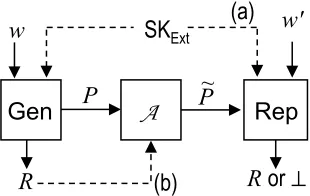
The definition is illustrated in Figure 1. Note that the definition is interesting even whenw=w0
(i.e., whent= 0), because ordinary extractors are not usually robust. We construct (keyless) robust fuzzy extractors in Section 3, and keyed robust fuzzy extractors in Section 4.
The definition of robust extractors composes with itself in some situations. For example, a generalization of the above (used in [9]) allows the adversary to output ( ˜P1, . . . ,P˜j); the adversary succeeds if there exists an i with Rep(w0,P˜i) 6=⊥. A simple union bound shows that the success probability of an adversary in this case increases at most linearly inj.
Similarly, suppose two players (Alice and Bob) receive a sequence of pairs of random variables (W1, W10),(W2, W20), . . . ,(Wj, Wj0) (with Alice receiving the{Wi}and Bob receiving the{Wi0}), such thatdis(Wi, Wi0)≤tfor alli, and the entropy ofWi conditioned on the information{(Wk, Wk0)}k<i from prior time periods is at least m. Alice and Bob can agree on random and independent keys
w
!
Gen
A
Rep
w
SK
ExtR
R
or
!
(a)
(b)
P
P
~
Figure 1: Robust extractors (cf. Definition 8). Dashed lines indicate variations in the definition: (a)Keyed extractorstake an additional inputSKExtshared by GenandRep. (b) Forpre-application robustness, the adversary does not have access to the extracted keyR.
valid ˜Pi is at most δ in any given period i (this can be shown by simply giving the attacker (W1, W10), . . . ,(Wi−1, Wi0−1)); thus, the overall probability of forgery over all time periods is at mostjδ.
For keyed fuzzy extractors, robustness is defined exactly as in Definition 8 with the only dif-ference being that Genand Rep both use the same (uniform) key SKExt (which is not given to the adversary); see Figure 1. At first glance, the addition of a long-term key may seem to trivialize the problem of constructing robust fuzzy extractors. For example, one might attempt to useSKExt as a key for a message authentication code and, given output (R, P) from a fuzzy extractor, simply append to P the tag MacSKExt(P). While this may work in the computational setting, it will not
suffice in the information-theoretic setting if we want to support an unbounded number of time periods (or if we want to use a key SKExt whose length does not grow linearly in the number of time periods supported). Furthermore, such a construction will not satisfy the security property of Definition 7 becauseSKExt will not be uniform conditioned on P and MacSKExt(P).
3
Constructing (Keyless) Robust Fuzzy Extractors
We begin by analyzing the case of no errors (i.e.,t= 0), and then consider the more general case.
3.1 The Errorless Case (w=w0)
v
bits
n – v
bits
a
b
X
i
R
v
bits
n-2v
bits
[ia]
1v+
σ
Figure 2: Construction for the errorless case.
to the key ˜R that Bob derives. Instead, we use w itself to authenticate P and show that this approach works for a particular choice of strong extractor and message authentication code.
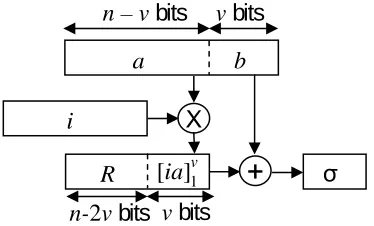
We define algorithms Gen,Rep as follows. To computeGen(w), parse w as two strings aand b
of lengths n−v and v, respectively, wherev < n/2 is a parameter of the construction. View aas an element of GF2n−v and b as an element of GF2v (the representation of field elements does not matter, as long as addition in the field corresponds to exclusive-or of bit strings). Choose random
i∈GF2n−v, let [ia]nv+1−v denote the most significantn−2v bits ofia∈GF2n−v, and let [ia]v1 denote
the remaining v bits of ia. View [ia]v1 as an element of GF2v. Then compute σ = [ia]v1 +b, set
P = (i, σ), and let the extracted key beR= [ia]nv+1−v. See Figure 2.
Rep(w,P˜), where ˜P = (i0, σ0), proceeds as follows. Parse w as two strings a and b as above. Then verify that σ0 = [i0a]v1 +b and output ⊥ if this is not the case. Otherwise, compute the extracted key R0 = [i0a]nv+1−v.
The following theorem states the parameters for which (Gen,Rep) is a robust fuzzy extractor. (Since t = 0 here, the metric over {0,1}n is irrelevant.) Observe that extraction is possible as
long as H∞(W) def= m > n/2, and in the case of pre-application robustness (which is the notion considered in [27]) we extract a key of length roughly 2m−n. This improves on the result of Maurer and Wolf [27] who requirem >2n/3 and extract a key of length roughly m−2n/3.
Theorem 3 Fix v, and let `=n−2v be the length of the extracted key. Then:
• For any ε, δ satisfying
`≤2m−n−max2 log 1δ,4 log 1ε ,
(Gen,Rep) is an (m, `,0, ε)-fuzzy extractor with pre-application robustness δ.
• For any ε, δ satisfying
`≤min (
2m−n−2 log 1δ
3 , 2m−n−4 log 1 ε
)
,
(Gen,Rep) is an (m, `,0, ε)-fuzzy extractor with post-application robustness δ.
Extraction. We begin by showing that H ={hi :hi(a, b) def= (σ, R)} is a universal hash family. Indeed, for (a, b)6= (a0, b0) we have
Pri[hi(a, b) =hi(a0, b0)] = Pri
h
[ia]v1−[ia0]v1 =b0−b V
[ia]nv+1−v = [ia0]nv+1−vi.
This is equivalent to Pri
i(a−a0) = 0n−2vk(b0−b), where “k” denotes concatenation (this is be-cause we insisted that addition/subtraction in the finite fields corresponds to bitwise exclusive-or). If a=a0 then we must have b6=b0 and so the probability is 0. If a6=a0, then there is a unique i
that satisfies the equality. Thus, the probability is at most 1/|GF2n−v|= 2v−n.
Using the above and the leftover hash lemma (Lemma 2) we see that (R, P) = (R,(i, σ)) is 2((`+v)−m−2)/2 ≤ε/2-close to (U`×Un−v×Uv) or, put differently, thatSD((R, P), U`×Un)≤/2. This implies SD((R, P), U`×P)≤using the triangle inequality.
Pre-application robustness. We prove the stronger result that robustness holds for worst-case choice of i. Fix i and A, and let Succ be the event that A succeeds. Since A is unbounded, we may assume it is deterministic. Upon observing σ, the adversary outputs A(σ) = (i0, σ0) 6= (i, σ). If i0 =i, then Rep will reject unless σ0 =σ; therefore, we need only consider the case i0 6=i. By definition,A succeeds only ifσ0 = [i0a]v1+b.
Call a triple (σ, i0, σ0) a transcript, and say it is possible if A(σ) = (i0, σ0). For any possible transcript tr = (σ, i0, σ0) the following holds (in the probability expressions below, akb are chosen according to the distributionW conditioned on tror, equivalently, conditioned on σ):
Pr[Succ|tr] = Prakb[ [ia]v1+b=σ V
[i0a]v1+b=σ0]
= Prakb
[ia]v
1−[i0a]v1 =σ−σ0 V
b=σ−[ia]v 1
= Prakb
[(i−i0)a]v1 =σ−σ0 V
b=σ−[ia]v1,
where the final equality holds because we insisted that addition/subtraction in our fields corresponds to bitwise exclusive-or. The term (i−i0)·atakes on each possible value inGF2n−v exactly once as
avaries; therefore, there are 2n−v/2|σ|= 2n−2v values of afor which [a(i−i0)]v1 =σ−σ0. For each such value ofa, there is a unique value of bthat satisfiesb=σ−[ia]v1. Each (a, b) pair occurs with probability at most 2−H∞(W|σ). Thus,
Pr[Succ|tr]≤2n−2v·2−H∞(W|σ).
The overall success probability ofA is given by
Etr[Pr[Succ|tr]] ≤ 2n−2v·Etr2−H∞(W|σ)
= 2n−2v·2−He∞(W|σ).
Since |σ|=v, we have He∞(W |σ)≥m−v and we conclude that Pr[Succ]≤2n−v−m≤δ.
Post-application robustness. Because |R| = `, providing R to the adversary can increase its success probability by a multiplicative factor of at most 2` as compared to pre-application robustness.4 Thus, if 3` ≤ 2m−n−2 log 1δ the adversary’s success probability (in the post-application robustness game) is at most 2`·2n−v−m= 2`·2(n+`−2m)/2 ≤δ.
3.1.1 Improved Post-Application Robustness
In this section, we present a construction of an extractor with post-application robustness that extracts a key of length m−n/2−log 1δ
, an improvement by a factor of 3/2 as compared to the construction given above.
Assumenis even for simplicity. To computeGen(w), letaandbdenote the first and last halves of w, respectively, and view a and b as elements of GF2n/2. Choose a random i ∈ GF2n/2 and
computey=ia+b. Letσ be the firstv bits ofy, wherev < n/2 is a parameter of the scheme, and let R be the remainder ofy; i.e., σ= [y]v1 and R= [y]n/v+12.Output P = (i, σ).
Rep(w,P˜), where ˜P = (i0, σ0), proceeds in the obvious way: Parse w as two strings a, b as above. Then verify that σ0 = [i0a+b]v1 and output⊥ if this is not the case. Otherwise, compute the extracted keyR0= [i0a+b]n/v+12.
Before giving the formal proof, we provide some intuition as to why this construction has better post-application robustness. Recall that in the previous construction w is parsed as two strings
a and b of lengths n−v and v, respectively, and the values σ, R are computed as σ = [ia]v1 +b
and R = [ia]nv+1−v. Increasing v improves robustness but decreases the number of extracted bits. For pre-application robustness, setting v = n−m+ log 1δ suffices, and thus the construction extracts nearly (2m−n) bits. For post-application robustness, however, a largerv must be used and consequently the number of extracted bits is decreased.
The post-application robustness game reveals more information to the adversary A about w
than the pre-application robustness game. This additional information—namely, R itself—may make it easier for A to guess σ0. The key to our improvement is to use the pairwise-independent functionhi(a, b) = ia+b to compute both σ and R. Because of pairwise independence, the value (σ, R) of hi(a, b) leaks nothing about the value (σ0, R0) = hi0(a, b) for any i0 6= i. (This holds
when (a, b) is uniform; when (a, b) has min-entropy m, then A may have up to n−m bits of information about σ0.) In contrast, in the previous construction only σ was computed using a pairwise-independent hash function. This works better for pre-application robustness (because b
can be taken shorter), but worse for post-application robustness.
Theorem 4 Fix v, and let ` = n/2−v be the length of the extracted key. Then for any ε, δ
satisfying
` ≤ m−n/2−log1
δ
m ≥ n/2 + 2 log1
ε,
(Gen,Rep) is an (m, `,0, ε)-fuzzy extractor with post-application robustness δ.
Proof We first show that R ∈ {0,1}` is nearly uniform given P. The proof proceeds along the lines of the analogous proof for Theorem 3. As before, we begin by showing that H = {hi :
hi(a, b) = (σ, R)}is universal. Indeed, for (a, b)6= (a0, b0) we have
Pri[hi(a, b) =hi(a0, b0)] = Pri[ia+b=ia0+b0]
= Pri[i(a−a0) = (b−b0)], .
Ifa=a0 thenb=6 b0 and so Pri[i(a−a0) = (b−b0)] = 0. Ifa6=a0, then there is a uniqueifor which
The above and Lemma 2 imply that (i, R, σ) is 2(n/2−m)/2−1-close toUn/2×U`×Uv. As in the previous proof, and recalling thatP = (i, σ), this means thatSD((R, P), U`×P)≤2(n/2−m)/2 ≤.
Post-application robustness. As in the previous proof, we prove that robustness holds for worst-case choice ofi. FixiandA, and letSuccbe the event thatAsucceeds. SinceAis unbounded, we may assume it is deterministic. Thus, upon observing σ, R the adversary outputs (i0, σ0) 6= (i, σ); the adversary succeeds if [i0a+b]v1 = σ0. Note that if i0 = i then Rep will reject unless σ0 = σ; therefore, we need only consider the casei06=i.
We now let a transcript be a tuple tr= (σ, R, i0, σ0), and say it is possible ifA(σ, R) = (i0, σ0). For any possible transcript tr= (σ, R, i0, σ0) we have the following (in the probability expressions below,akbare chosen according to the distributionW conditioned ontror, equivalently, conditioned on σ):
Pr[Succ|tr] = Prakb
ia+b=σkR V [i0a+b]v1 =σ0
= X
R0∈{0,1}` Prakb
ia+b=σkR V i0a+b=σ0kR0.
For any fixedR0, there is a unique value (a, b) for whichia+b=σkRandi0a+b=σ0kR0. Each (a, b) pair occurs with probability at most 2−H∞(W|σ,R). We thus see that
Pr[Succ|tr]≤2`·2−H∞(W|σ,R).
The overall success probability ofA is given by
Etr[Pr[Succ|tr]]≤2`·2−He∞(W|σ,R).
Since |σ|+|R|=n/2, we haveHe∞(W |σ, R)≥m−n/2 and so Pr[Succ]≤2`−m+n/2 ≤δ.
3.1.2 Authenticating a Message While Extracting
Each of the constructions given previously uses the parties’ input w to authenticate the extractor seed i. Each construction can be extended to additionally authenticate a message M, i.e., to be simultaneously a robust fuzzy extractor and an information-theoretic one-time MAC. In this setting, both Gen and Rep will take an additional input M, and it should be difficult for an adversary to cause Rep to accept a different M. (We are being informal here since this is merely a stepping stone to the results of the following section.) This could be done naively by using (a part of) R
as a key for a MAC, but this would correspondingly reduce the final number of extracted bits. In contrast, the approach presented here (almost) does not reduce the length of R at all.
We show how to extend the original construction given at the beginning of Section 3.1; the construction of Section 3.1.1 can be extended similarly. We adapt a standard technique [6, 13, 38] for authenticating messages using polynomial-based almost-universal hash functions. Let |M| =
L·(n−v), whereLis known to both parties in advance. SplitM intoLchunksM0, . . . , ML−1, each
n−vbits long, and view these as coefficients of a polynomialM(x)∈GF2n−v[x] of degreeL−1. To computeGen(w, M), parse wasakb, choose random i∈GF2n−v, computeσ = [a2M(a) +ia]v1+b, and setP = (i, σ). As before, the extracted key is R= [ia]nv+1−v.
The procedure Rep, given w, M0, and ˜P = (i0, σ0), verifies that |M0| = L·(n−v) and that
Extraction and robustness (which here means that neither i nor M can be modified without detection) are proved in a manner very similar to the proof of Theorem 3. Fix arbitrary M, known to the adversary. To argue that R is nearly uniform given P = (i, σ), we will show that
H={hi :hi(a, b) def
= (σ, R)} is universal. Indeed, for (a, b)6= (a0, b0), we have
Pri[hi(a, b) =hi(a0, b0)] = Pri
h
i·(a−a0) =0n−2v k
(a0)2·M(a0)−a2·M(a)v 1+b
0−bi,
If a = a0 then b 6= b0 and the above equality cannot be satisfied; if a 6= a0, there is a unique i
satisfying the equality. This proves universality. The rest of the proof proceeds as before.
For (pre-application) robustness, fix arbitrary M and i (known to A) and proceed as before. The only difference is that we now need to compute the number of values ofafor which
[a2M(a) +ia−a2M0(a)−i0a]v1 =σ−σ0. (1)
The crucial property is that the polynomialx2M(x) +ix−x2M0(x)−i0x is nonconstant if (M, i)6= (M0, i0). A nonconstant polynomial of degree at most L+ 1 can take on a given value at most
L+ 1 times; hence, there are at most (L+ 1)2n−2v values ofa satisfying Eq. (1). The probability that the adversary succeeds (in changing either i or M without being detected) is thus at most (L+ 1)·2n−v−m. Note that the resulting forgery probability is affected only by a multiplicative factor of (L+ 1); since we expect (L+ 1)1/δ in practice, the impact is small.
3.2 Adding Error-Tolerance (w6=w0)
We now consider settings when the inputw0 held by the second party is close, but not identical to, the inputwused by the first party. An obvious first attempt is to include a secure sketchs=SS(w) along with (i, σ), and to authenticate s using the message-authentication technique discussed in the previous section; s would allow recovery of w from w0, and then verification could proceed as before. Unfortunately, this does not quite work: if the adversary modifies the sketch s, then a different value w∗ 6= w may be recovered; however, the results of the previous section apply only when the receiver uses the same w as the sender. In effect, we have a circularity: the receiver uses w to verify that s was not modified, but the receiver computes w (from w0) using a possibly modified s.
We show how to break this circularity using a modification of the message-authentication tech-nique from earlier. The key idea is to exploit algebraic structure in the metric space, and to change the message authentication code so that it remains secure even when the adversary can influence the key (this is sometimes referred to as “security against related-key attacks”; our approach was generalized in [12]). Specifically, we first treat the case where the distance between w and w0 is small in the Hamming metric; in Section 3.2.3 we extend the approach to the set-difference metric. Another problem arises from the fact that the performance of our previous constructions de-grades not only when the min-entropy m of the input decreases, but also when the entropy gap
3.2.1 Tolerating Binary Hamming Errors
We begin by extending the construction presented at the beginning of Section 3.1 to tolerate binary hamming errors; we then extend the construction from Section 3.1.1.
Our metric space is M={0,1}nand the distance between two strings is Hamming distance— i.e., the number of bit positions in which they differ. Suppose the input W is a distribution of min-entropymoverM, and thatw0 is guaranteed to be within distancetofw. Our starting point is to use a deterministic, linear, secure sketch s = SS(w) that is k bits long; let n0 = n−k and note that He∞(W | SS(W)) ≥ m−k. We assume that SS is a surjective, linear function (this is the case for the syndrome sketch for the Hamming metric), and so there exists ak×nmatrixS of rank ksuch thatSS(w) =S·w. LetS⊥ be an n0×nmatrix such that the n×nmatrix SS⊥
has
full rank. We let SS⊥(w) def= S⊥w. One can view SS⊥(w) as the information remaining inw once
SS(w) has been learned by the adversary.
We defineGen,Repas follows. Gen, on inputw, begins by computings=SS(w) andc=SS⊥(w). It then parses c ∈ {0,1}n0 as two strings a, b with |a| = n0 −v and |b| = v, where v ≤ n0/2 (so
|a| ≥ |b|) is a parameter of the construction. Letting L= 2d k
2(n0−v)e, it pads s with 0s to length
L(n0−v) and parses the resulting string assL−1ksL−2k · · · ks0 withsi ∈GF2n0−v. It chooses random
i←GF2n0−v, and defines fs,i(x) = xL+3+x2·(sL−1xL−1+sL−2xL−2+· · ·+s0) +ix. Finally, it setsσ= [fs,i(a)]v1+b, and outputs R= [ia]
n0−v
v+1 and P = (s, i, σ).
Rep, on inputsw0 and ˜P = (s0, i0, σ0), first computes w∗=SRec(w0, s0)∈ {0,1}n. It checks that
dis(w∗, w0)≤tandSS(w∗) =s0; if not, then it outputs⊥. Otherwise, letc0 =SS⊥(w∗) and parsec0
asa0kb0 with|a0|=n0−v and|b0|=v. Check thatσ0 = [fs0,i0(a0)]v
1+b0: if not, output⊥; otherwise output R0 = [i0a0]nv+10−v.
Before turning to the detailed analysis, we note that the polynomial fs,i defined above differs from the message-authentication technique in the previous section only in the leading term xL+3
(and the forcing of Lto be even). It has the property that for any pair (s0, i0)6= (s, i), and for any fixed offset ∆a, the polynomial fs,i(x)−fs0,i0(x+ ∆a) is a non-constant polynomial of degree at
most L+ 2: this is easy to see for ∆a = 0; if ∆a 6= 0, then the leading term is ∆a·xL+2 (recall we are working in a field of characteristic 2 and L is even). Our analysis will show that fs,i(a) amounts to a message authentication code (where the shared keyais used to authenticates, i) that is provably secure against a class of related-key attacks where the adversary can force the receiver to use a key shifted by an offset known to the adversary.
Theorem 5 Let M denote {0,1}n under the Hamming metric, let SS be the(m, m−k, t)-secure
syndrome sketch for M, and let B denote the volume of the ball of radius t in M. Fix v, and let
`=n−k−2v be the length of the extracted key. Then:
• For any ε, δ satisfying
` ≤ 2m−n−k−2 max
logB+ log
2
k n−k
+ 2
+ log 1δ
, 2 log 1ε
≤ 2m−n−k−2 max
logB+ log2n
δ , 2 log
1 ε
,
• For any ε, δ satisfying
` ≤ min
1 3
2m−n−k−2
logB+ log
2
k n−k
+ 2
+ log 1δ
,
2m−n−k−4 log 1ε ≤ min 1 3
2m−n−k−2 logB−2 log2n
δ
, 2m−n−k−4 log 1ε
,
(Gen,Rep) is an (m, `, t, ε)-fuzzy extractor for Mwith post-application robustness δ.
Note that logB ≤nH2(t/n) ift≤n/2, whereH2(x) is the binary entropy function [25, Chapter 10,§11, Lemma 8], and logB ≤tlog(n+ 1) + 1 always.5
Before giving the proof, we briefly discuss the parameters obtained. The bound on `differs in two main terms from the bound in the errorless case of Theorem 3. First, we lose the length k
of the sketch. This is not surprising, since the sketch may reduce the min-entropy of W by up to k bits. Second, we lose another additive factor of 2 logB. In general this is (to some extent) inherent, since the min-entropy of W0 may be as low as H∞(W)−logB. Looking at it slightly differently, in our analysis we start by giving the attacker ∆ =w0−w“for free”, which can reduce the min-entropy ofW by logB. We can prove a generalization of the above result where the term 2m−2 logB is replaced by 2He∞(W |∆). Thus, for example, if errors are independent ofw then the term logB is no longer present.
Proof That the construction satisfies the functionality of a robust fuzzy extractor is clear, and we thus turn to proving security. The argument thatR is nearly uniform given P is similar to the errorless case, except that the entropy loss due to the sketchshas to be taken into account. For every
s, the familyH={hi :hi(c) def
= (σ, R)} is universal because for every c6=c0, there is at most one
isuch that hi(c) =hi(c0). Since He∞(c|SS(W)) =He∞(W |SS(W))≥m−k, applying Lemma 2 and proceeding as in the proof of Theorem 3 gives SD((R, P), U`×P)≤2(v+`−(m−k))/2 ≤.
Pre-application robustness. We prove the stronger result that robustness holds for worst-case choice ofi, and even if the adversary is given ∆ =w0−w. Fix iandA, and letSucc be the event thatAsucceeds. SinceAis unbounded, we may assume it is deterministic. Upon observings, σ,∆, the adversary outputsA(s, σ,∆) = (s0, i0, σ0)6= (s, i, σ). If (s0, i0) = (s, i) thenRepwill reject unless
σ0 =σ; thus, we need only consider the case (s0, i0)6= (s, i).
Call a tuple (s, σ,∆, s0, i0, σ0) a transcript and denote it by tr. Call a transcript feasible if
A(s, σ,∆) = (s0, i0, σ0). For some fixed feasible transcript, the adversary’s success depends only on the choice ofwconditioned on the given values ofs, σ,∆, R. (Note w0 is determined byw and ∆.) Recall that w∗, a0, b0 denote the values reconstructed during the course of applying Rep to w0
and s0, i0, σ0. We claim that for any feasible transcript there is at most one value w∗ for which Rep
will not reject. Indeed, say there are two distinct valuesw∗1, w2∗ for which Rep does not reject; this meansdis(w0, w1∗),dis(w0, w∗2)≤tand SS(w1∗) =SS(w2∗) =s0. But then
w∗1 =SRec(w0,SS(w1∗)) =SRec(w0, s0) =SRec(w0,SS(w2∗))6=w∗2, 5NoteB= 1 +Pt
i=1
n i
violating correctness of the secure sketch. This implies there is also at most one value for each of
a0, b0 for whichRep will not reject. A may be unable to compute w∗, a0, b0 (since it does not know
w0); however, we claim that A can compute the differences ∆a = a0 −a and ∆b = b0−b. Let Γdef= w∗−w0 =w∗−w−∆, and recall the weight of Γ is at mostt. By linearity ofSS, we have
SS(Γ) =SS(w∗)−SS(w)−SS(∆) =s0−s−SS(∆).
The right-hand side of the above equation is known to A, and an argument as above shows that there is at most one Γ with weight at most t that satisfies the above equation. Thus, Γ can be computed byA. Linearity of SS⊥ means that Acan also compute
∆ak∆b=SS⊥(w∗)−SS⊥(w) =SS⊥(Γ) +SS⊥(∆). Next, we prove that for any feasible transcript tr= (s, σ,∆, s0, i0, σ0), we have
Prw←W [Succ|tr]≤(L+ 2)·2n
0−2v
·2−H∞(W|s,σ,∆). (2)
To see this, note thatAsucceeds only if σ0 = [fs0,i0(a0)]v1+b0, which is the same as requiring thata
be a solution to the equation [fs,i(a)−fs0,i0(a+ ∆a)]v
1 =σ−σ0+ ∆b. (Recall from above that we may assume ∆a,∆b are known toA.) But for any distinct pairs (s, i)6= (s0, i0) and for any ∆a, the polynomialfs,i(x)−fs0,i0(x+ ∆a) is non-constant and has degree at mostL+ 2. (If ∆a= 0 this is
immediate; if ∆a6= 0, then the leading term is (L+ 3)·∆a·xL+2, which is non-zero sinceLis even and we are working in a field of characteristic 2.) Thus, for anyX∈ {0,1}n0−2v
the number of values ofafor whichfs,i(a)−fs0,i0(a+ ∆a) =Xk∆b+σ−σ0 is at mostL+ 2, and so the number of values
ofathat satisfy [fs,i(a)−fs0,i0(a+ ∆a)]v1 = ∆b+σ−σ0 is at most (L+ 2)·2n 0−2v
. Each such value occurs with probability at most 2−H∞(a|s,σ,∆) (where we let a also stand for the random variable
describing the distribution ofa), giving the bound Prw←W [Succ|tr]≤(L+2)·2n
0−2v
·2−H∞(a|s,σ,∆).
Note that
H∞(a|s, σ,∆) =H∞(a, s, σ|s, σ,∆) =H∞(a, s, b|s, σ,∆),
because b=σ−[fs,i(a)]v1; finally,
H∞(a, s, b|s, σ,∆) =H∞(W |s, σ,∆)
sincew= SS⊥
−1
·(skakb). This completes the proof of Eq. (2). We may now easily prove the theorem. We have
Prw,∆[Succ] = Etr
Prw[Succ|tr]
≤ Etr h
(L+ 2)·2n0−2v·2−H∞(W|s,σ,∆)
i
= (L+ 2)·2n0−2v·2−He∞(W|s,σ,∆),
using Eq. (2). Since|s|+|σ|+|∆| ≤k+v+ logB, Lemma 1 gives
e
H∞(W |SS(W), σ,∆)≥m−k−v−logB .
B·(L+ 2)·2n0−2v−m+k+v =B·(L+ 2)·2n−m−v ≤B·2dk/(n−k)e ·2n−m−v ≤δ.
Post-application robustness. Because the extracted keyR is of length n−k−2v, providing it to the adversary can increase its success probability by at most a factor of 2n−k−2v. The rest of the analysis remains the same.
3.2.2 Improved Post-Application Robustness for the Hamming Metric
In this section we extend the construction from Section 3.1.1 to tolerate binary Hamming errors. The space Mis still {0,1}n with Hamming distance. Gen(w) is similar to the one in the previous construction except that now aand b are obtained by splittingc into two equal parts (we assume for simplicity thatn0 is even) and computingσ = [fs,i(a) +b]v1 and R= [fs,i(a) +b]
n0/2
v+1.
Theorem 6 Let M denote {0,1}n under the Hamming metric, let SS be the(m, m−k, t)-secure
syndrome sketch for M, and let B denote the volume of the ball of radius t in M. Fix v, and let
`= (n−k)/2−v be the length of the extracted key. Then for any ε, δ satisfying
` ≤ m−1
2(n+k)−logB−log
2
k n−k
+ 2
−log 1δ
m ≥ 1
2(n+k) + 2 log 1 ε
,
(Gen,Rep) is a (m, `, t, ε)-fuzzy extractor for Mwith post-application robustness δ.
Proof We first show that R is nearly uniform given P = (s, i, σ). For every s the family
H={hi :hi(c) = (σ, R)}is universal. SinceHe∞(c|SS(W)) =He∞(W |SS(W))≥m−k, applying the Leftover Hash Lemma (Lemma 2) and proceeding as in the proof of Theorem 3 shows that SD((R, P), U`×P)≤2(n
0/2−m+k)/2
= 2(n/2+k/2−m)/2 ≤.
Post-application robustness. We prove the stronger result that robustness holds for worst-case choice of i, and even if the adversary is given ∆ = w0 −w. Fix i and A, and let Succ be the event that Asucceeds. Since Ais unbounded, we may assume it is deterministic. Upon observing
s, σ,∆, R, the adversary outputs A(s, σ,∆, R) = (s0, i0, σ0) 6= (s, i, σ). If (s0, i0) = (s, i) then Rep
will reject unlessσ0 =σ; thus, we need only consider the case (s0, i0)6= (s, i).
Call a tuple (s, σ,∆, R, s0, i0, σ0) a transcript and denote it by tr. Call a transcript feasible if
A(s, σ,∆, R) = (s0, i0, σ0). For some fixed feasible transcript, the adversary’s success depends only on choice ofw (conditioned on the given values ofs, σ,∆, R).
As in the proof of Theorem 5, for any feasible transcript there is at most one value for each of
a0, b0 for which Rep will not reject, and moreover the values ∆a =a0−a and ∆b = b0−b can be computed by A. Following an argument exactly as in the proof of that theorem, for any feasible transcript tr= (s, σ,∆, R, s0, i0, σ0) we have
Prw←W[Succ|tr]≤(L+ 2)·2n
0/2−v
·2−H∞(W|s,σ,∆,R),
and so
Pr[Succ] =Etr[Prw←W[Succ|tr]]≤(L+ 2)·2n
0/2−v
·2−He∞(W|s,σ,∆,R).
3.2.3 Construction for the Set-Difference Metric
The constructions from the previous two sections rely heavily on the linearity of the secure sketch used in the protocol and on the structure of the Hamming space. Using the techniques from [16], however, they can be extended to handle errors under the set-difference metric.
In theset-differencemetric, elements ofMare sets of at mostrelements chosen from some fixed universe of sizeN; the distance between two setsa, b∈ Mis the size of their symmetric difference:
dis(a, b) = |{x : x ∈ a∪band x /∈ a∩b}|. Noting that elements of M can be represented by characteristic vectors of length N, we see that the set-difference metric is equivalent to the Hamming metric; this is inefficient, however, since elements ofMcan be represented using at most
rlogN bits. Algorithms here should, ideally, run in timepoly(rlogN) rather than timepoly(N). In order to extend the analysis of the previous sections to handle this different representation of the input, we need a pair of functions SS,SS⊥ that take sets and output strings of lengthk and
rlog(N+ 1)−k, respectively. A setw of size at mostr should be uniquely determined by the pair (SS(w),SS⊥(w)), and the functions should be linear in the following sense: the addition/removal of a particular element should correspond to adding/subtracting a particular bit vector. In other words, SS() and SS⊥() should be linear in the characteristic vector of their input set. The SS() function of the BCH secure sketch of Dodis et al. [16, Section 6.3] (called “PinSketch”) is, in fact, linear: it outputs tvalues of log(N+ 1) bits each in order to correct up toterrors, thus producing sketches of lengthk=tlog(N + 1). We will see in a moment how to constructSS⊥ corresponding to this SS. For the PinSketch construction the universe must be viewed as nonzero elements of a binary field GF2α for someα and thus N = 2α−1.
The constructions of Genand Rep are the same as in the previous sections, but using different
SS, SRec, and SS⊥ functions. In addition, Rep should check that the recovered value w∗ is a set with elements inGF2∗α. (Note, however, that it is not necessary to check thatw∗ has size at mostr; the constructions work correctly even if w0 has more than r elements, so long asdis(w, w0)≤t.)
The analysis is the same as in the previous sections. The volume B of the ball of radius t
remains the same as in the binary Hamming case; here, N is very large compared to t and so we use logB ≤ tlog(N + 1) =tα in our formulas since this is now a close approximation. Using
k = tlog(N + 1) = tα and n = rlog(N + 1) = rα, we obtain the following as corollaries of Theorems 5 and 6, respectively.
Corollary 7 Let M be the set-difference metric on sets of size at mostr over the universe GF2∗α.
Using (Gen,Rep) from Section 3.2.1 with SS,SS⊥,SRec as described above, fix v and then let `= (r−t)α−2v be the length of the extracted key. Then:
• For any ε, δ satisfying
`≤2m−rα−tα−2 max
tα+ log2rα
δ , 2 log
1 ε
,
(Gen,Rep) is an (m, `, t, ε)-fuzzy extractor for Mwith pre-application robustness δ.
• For any ε, δ satisfying
`≤min
1 3
2m−rα−3tα−2 log2rα
δ
, 2m−(r+t)α−4 log 1ε
,
Corollary 8 Let M be the set-difference metric on sets of size at mostr over the universe GF2∗α.
Using (Gen,Rep) from Section 3.2.2 with SS,SS⊥,SRec as described above, fix v and then let `= (r−t)α/2−v be the length of the extracted key. Then for any ε, δ satisfying
` ≤ m−1
2rα− 3
2tα−log
2n δ
m ≥ 1
2(t+r)α+ 2 log 1 ε
,
(Gen,Rep) is a (m, `, t, ε)-fuzzy extractor for Mwith post-application robustness δ.
It remains to describeSS⊥. For self-containment, we include a description ofSSas well. To com-puteSS(w) andSS⊥(w) on inputw⊆GF2∗α, letsi
def
= P
x∈wxi (computations inGF2α) and, view-ingsi values as bit strings, outputSS(w) =s1ks3ks5k...ks2t−1 and SS⊥(w) =s2t+1ks2t+3k...ks2r−1. Given any set of r points, these two vectors are easy to compute in O(r2) operations in GF2α. Moreover, given s1, ..., s2r−1 one can recover w. (Simply observe that (SS(w),SS⊥(w)) is the syn-drome of the characteristic vector of w with respect to the binary BCH code of distance 2r+ 1, and that the weight of this vector is at mostr. See [16, Lemma 6.2], settingn= 2α−1,k=n−rα
and δ= 2r+ 1.) Algorithms SS,SS⊥ have the desired linearity property since adding or removing an element y from w corresponds to adding yi to each component si (and we require addition in binary fields to correspond to bitwise exclusive-or).
4
Keyed Robust Fuzzy Extractors and Their Applications
In this section we show that the addition of a very short, long-term, shared secret keySKExt allows us to achieve considerably better parameters when constructingkeyedrobust fuzzy extractors. The parameters we obtain are optimal up to constant factors.
To motivate our construction, recall the naive transformation from fuzzy extractors to keyed robust fuzzy extractors discussed in Section 2.4. Suppose we start from the generic construction of a fuzzy extractor from [16, Lemma 4.1]: here P = (s, i), where s← SS(w) for a secure sketch SS, and the extracted key isR=Ext(w;i). In an attempt to make this construction robust, we may set
σ =MacSKExt(s, i) and include σ as part of P. This is fine for one-time use, but leaks information
about SKExt so cannot be used an unbounded number of times. Formally, this construction does not satisfy Definition 7 sinceSKExt is not uniform givenP.
We can change the scheme to avoid this. Note that Rep must recover w = Rec(w0, s) before computing R. Thus, we can addwto the authenticated message: that is, set σ=MacSKExt(w, s, i).
4.1 Extractor-MACs
Definition 9 A family {MacSK:{0,1}n→ {0,1}v}of functions is a strong(m, ε, δ) (average-case)
extractor-MAC if it is δ-almost strongly universal and an (m, ε) (average-case) strong extractor. ♦
When constructing MACs, one typically tries to minimize the tag length v (to approach the bound log 1δ), while for extractors one tries to maximize the output length v (to approach the bound ˜m−2 log 1ε
). In our setting, the extractor constraint is merely a convenient way to argue key reuse, so we will in fact try to minimizev. Naturally, we also want to minimize the min-entropy thresholdm.
Our construction of extractor-MACs follows from the observation that almost strongly-universal hash functions are MACs and, as universal hash functions, also extractors. (In fact, this observation was used to get extractors with short seeds in [35, Section 3].) We exemplify our construction with the family constructed in [6, Section 4]. Specifically, we compose two hash families as follows. Let
{pβ} be a (δε2/2)-almost universal hash family mapping ˜n-bit inputs to u-bit outputs (for some
u to be determined later), and let {fα} be a strongly universal hash family mapping u-bit inputs to v-bit outputs, where v = log 1δ
+ 1 (i.e., 2−v = δ2). Set Macα,β(w) = fα(pβ(w)). By [36, Theorem 5.5], {M ACα,β} is a δ-almost strongly universal hash family, since δε2/2 + 2−v ≤ δ. This means it can be used for message authentication. Furthermore, by [36, Theorem 5.4] it is (δε2/2 + 2−v) = (1 +ε2)2−v-almost universal, since {fα} is 2−v-almost universal. By the Leftover Hash Lemma (Lemma 2), this means it is an (m, ε)-extractor with m= log 1δ
+ 2 log 1ε . We will set{fα}to be the family from [36, Theorem 5.2] (described following Definition 4) with keys of length u+v. It remains to set u so that we can construct a convenient almost-universal hash family {pβ}. We use the polynomial-based construction from [6, 13, 38]. The key β is a point in GF2u, and the message x is split into c = ˜n/u pieces (x0, . . . , xc−1), each of which is viewed as an element of GF2u. Then pβ(x0. . . xc) = xc−1βc−1 +. . .+x1β +x0. This family is (c−1)/2u-almost universal with key length u (because two distinct degree-(c−1) polynomials agree on at mostc−1 points). We can setu=v+ log(ε˜n2) = 1 + log 1δ
+ 2 log 1ε+ log ˜nto make (c−1)/2u <n/˜ 2u =δε2/2. This gives key length 2u+v, and we obtain:
Theorem 9 For any δ, ε, and m ≥ log 1δ
+ 2 log 1ε
, there exists a (m, ε, δ)-extractor-MAC for messages of length n, with key length κ = 3 + 2 logn+ 3 log 1δ+ 4 log 1ε and tag length
v= log 1δ+ 1.
This construction has both short keys and short tags. One can reuse the key SK as long as the min-entropy of the authenticated message is above the threshold log 1δ+ 2 log 1ε. The tag length is within one bit of optimal, since it is impossible to obtain δ-almost strong universality with tags shorter than log 1δ
. Known bounds on extractors [32, Theorem 1.9] (reinterpreted for
strong extractors by viewing the seed as part of the extractor output), imply that the key length is optimal up to a constant factor and the entropy threshold is optimal up to an additive constant.
4.2 Constructing Keyed Robust Fuzzy Extractors
We now apply extractor-MACs to build keyed robust fuzzy extractors. We start with a generic construction and set the parameters below.
( ˜m−`, ε, δ)-extractor-MAC from ˜n=n+k+dbits tovbits having a keySK of lengthκ. We now define a keyed robust fuzzy extractor with secret key SKExt, which is simply the extractor-MAC secret keySK:
• GenSK(w): compute sketch s ← SS(w), sample i at random, set key R = Ext(w;i), tag
σ=MacSK(w, s, i),P = (s, i, σ) and output (R, P).
• RepSK(w0,(s0, i0, σ0)): Let ¯w =SRec(w0, s0). If MacSK( ¯w, s0, i0) =σ0, thenR = Ext( ¯w;i); else
R=⊥.
Theorem 10 The above construction is a (m, `, t,4ε)-keyed fuzzy extractor with post-application robustness δ, which uses a secret key SKExt of length κ and outputs public information P of length
k+d+v.
Proof We need to show correctness, security, and unforgeability. Correctness follows immediately from the correctness of the secure sketch. To show security (that is, extraction), we need to argue that for anyW of min-entropym, we have
(SK, R, P)≈4εU|SK|×U`×P , or, equivalently,
(SK, R, s, i, σ)≈4ε U|SK|×U`×(s, i, σ). Indeed,
(R, s, i)≈εU`×SS(W)×Ud
because He∞(W |SS(W))≥m˜ and Ext is an average-case ( ˜m, ε)-extractor. This trivially implies that
U|SK|×(R, s, i)×Uv ≈εU|SK|×U`×SS(W)×Ud×Uv. On the other hand,
(SK, R, s, i, σ)≈εU|SK|×(R, s, i)×Uv
because He∞(W | R, s, i) ≥ He∞(W, R, i | s) −`−d ≥ He∞(W, i | SS(W))−`−d ≥ He∞(W |
SS(W)) +d−`−d = ˜m−` (the first inequality follows from Lemma 1 and the last inequality follows by independence ofi), andMac is a ( ˜m−`, ε) average-case extractor.
By the triangle inequality, therefore, we obtain
(SK, R, s, i, σ)≈2εU|SK|×U`×SS(W)×Ud×Uv. Using the triangle inequality again we obtain the desired result.