Western University Western University
Scholarship@Western
Scholarship@Western
Electronic Thesis and Dissertation Repository
May 2019
An Adaptive Weighted Average (WAV) Reprojection Algorithm for
An Adaptive Weighted Average (WAV) Reprojection Algorithm for
Image Denoising
Image Denoising
Halimah Alsurayhi
The University of Western Ontario
Supervisor
Mahmoud El-Sakka
The University of Western Ontario Graduate Program in Computer Science
A thesis submitted in partial fulfillment of the requirements for the degree in Master of Science © Halimah Alsurayhi 2019
Follow this and additional works at: https://ir.lib.uwo.ca/etd
Part of the Theory and Algorithms Commons
Recommended Citation Recommended Citation
Alsurayhi, Halimah, "An Adaptive Weighted Average (WAV) Reprojection Algorithm for Image Denoising" (2019). Electronic Thesis and Dissertation Repository. 6196.
Abstract
Patch-based denoising algorithms have an effective improvement in the image
denois-ing domain. The Non-Local Means (NLM) algorithm is the most popular patch-based
spatial domain denoising algorithm. Many variants of the NLM algorithm have
pro-posed to improve its performance. Weighted Average (WAV) reprojection algorithm
is one of the most effective improvements of the NLM denoising algorithm. Contrary
to the NLM algorithm, all the pixels in the patch contribute into the averaging
pro-cess in the WAV reprojection algorithm, which enhances the denoising performance.
The key parameters in the WAV reprojection algorithm are kept fixed regardless of
the image structure. In this thesis, an improved WAV reprojection algorithm is
pro-posed, where the patch size is assigned adaptively based on the image structure. The
image structure is identified using an improved classification method that is based on
the structure tensor matrix. The classification result is also utilized to improve the
identification of similar patches in the image. The experimental results show that
the denoising performance of the proposed method is better than that of the original
WAV reprojection algorithm, as well as some other variants of the NLM algorithm.
Dedication
To my lovely parents
Aisha Alsurayhi, and Abdullah Alsurayhi
Acknowledgements
First and foremost, I would like to thank God Almighty for giving me the ability to
complete my thesis successfully. Without his blessings, this achievement would not
have been possible.
I would like to express my very great appreciation to Dr. Mahmoud El-Sakka, my
thesis supervisor, for his professional guidance and valuable support. His willingness
to give his time so generously has been very much appreciated.
My grateful thanks are also extended to my husband Khalid Nuli for his support
and encouragement throughout my study.
Finally, I wish to thank my friend, Seereen Noorwali, for her assistance in my
Contents
Abstract ii
Dedication iii
Acknowledgements iv
List of Figures viii
List of Tables xv
List of Abbreviations xvi
1 Introduction 1
1.1 Motivation . . . 2
1.2 Thesis contribution . . . 3
1.3 Thesis Outline . . . 4
2 Background 5
2.2 Noise Level Estimation . . . 6
2.2.1 Fast Noise Level Estimation . . . 7
2.2.2 Patch-based Noise Estimation . . . 8
2.2.3 Statistical-based Noise Estimation . . . 8
2.3 Image Denoising . . . 8
2.4 Patch-Based Denoising Algorithm . . . 9
2.4.1 Non-local Means Algorithm . . . 10
2.4.2 Adaptive Smoothing Parameter NLM . . . 11
2.4.3 Adaptive Patch Size NLM . . . 14
2.4.4 NLM with Improved Similarity Computation Method . . . 18
2.4.5 Weighted Average Reprojection (WAV) . . . 20
2.4.6 Image Denoising with Block-Matching and 3D Collaborative Filtering(BM3D) . . . 24
2.5 Conclusion . . . 26
3 Methodology 27 3.1 Improved WAV Reprojection Algorithm . . . 28
3.1.1 The Improved Classification Method . . . 28
3.1.2 The Improved WAV Reprojection Method . . . 36
3.2 Selecting the patch size . . . 37
3.3 Conclusion . . . 47
4.2 Performance Evaluation . . . 50
4.2.1 Peak Signal to Noise Ratio (PSNR) . . . 50
4.2.2 Mean Structure Similarity Index (MSSIM) . . . 52
4.3 Results and Discussion . . . 52
4.3.1 Performance Analysis using PSNR . . . 53
4.3.2 Performance Analysis using MSSIM . . . 56
4.3.3 Visual Quality Comparison . . . 59
4.3.4 Comparison Using the Intensity Profile . . . 68
4.3.5 Comparison with BM3D . . . 72
4.4 Summary . . . 73
5 Conclusion and Future Work 75 5.1 Conclusion . . . 75
5.2 Future Work . . . 76
List of Figures
2.1 The strategy of the NLM algorithm in finding the similar patches [4],
the weight of q1, and q2 is larger than the weight of q3 as q1, and q2 have similar neighbourhood to the reference pixel p . . . 11
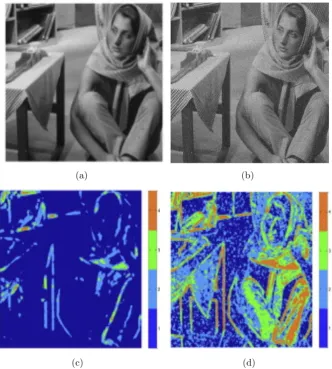
2.2 The improved classification results on Barbara image: (a) Original
image, (b) Noisy imageσ= 20. (c) The structure tensor classification, (d) The improved classification by Hu and Luo [17]. (Orange: texture
with little noise, green: medium region, light blue: texture with high
noise and dark blue is the flat region) . . . 17
2.3 The three basic steps of the WAV reprojection algorithm [34] . . . . 21
2.4 The difference between the (a) centred patches and (b) the decentred
patches in the gathering step [34] (The red patch is the reference patch) 22
2.5 The Gaussian kernel and the Flat kernel . . . 23
2.6 The difference between the influence zone in the centred patch (a),
and the decentred patch (b) [34] (The patch size W = 5, and the
searching window R=15) . . . 24
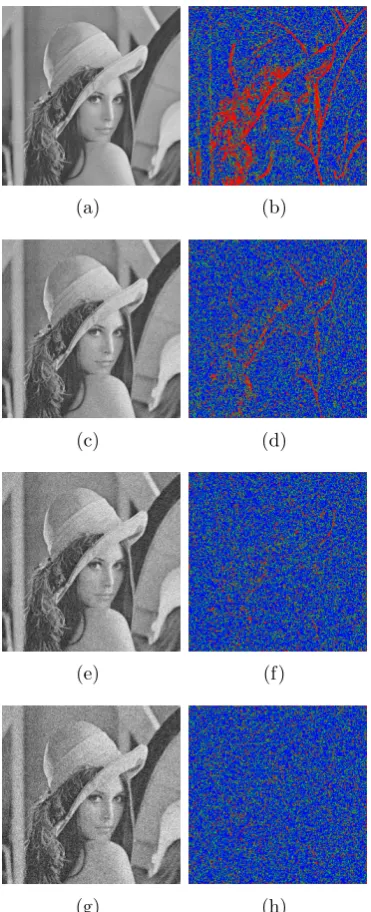
3.1 The classification results using the structure tensor on Lena image:(The
red color represents edge pixels, the blue color represents the smooth
pixels, and the green color represents texture/noise pixels) (a) Noisy
image σ = 10, (b) Classification of noisy image σ = 10, (c) Noisy imageσ= 20, (d) Classification of noisy image σ= 20, (e) Noisy im-ageσ = 30, (f) Classification of noisy image σ= 30, (g) Noisy image
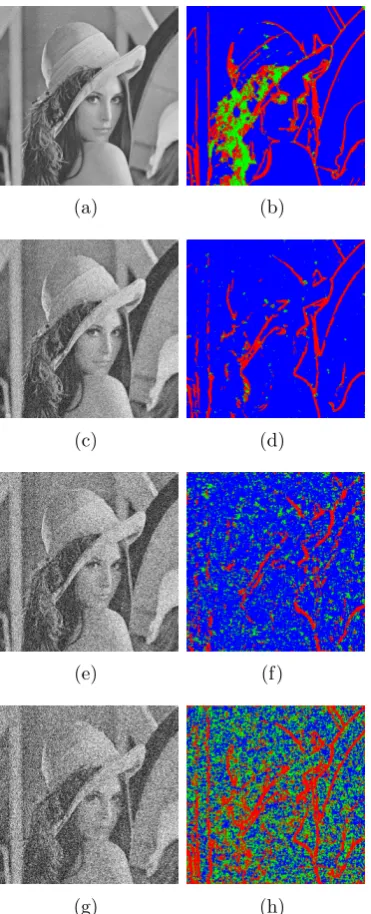
σ= 40, (h) Classification of noisy image σ= 40 . . . 30 3.2 The improved classification results on Lena image: (The red color
shows the edge pixels, the blue color shows the smooth pixels, and
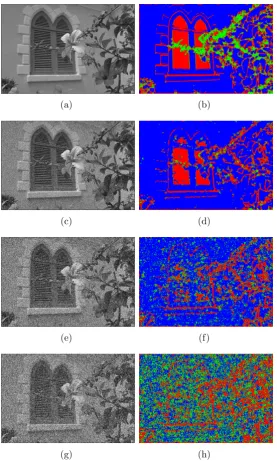
the green color shows texture/noise pixels) (a) Noisy image σ = 10, (b) Classification of noisy image σ = 10, (c) Noisy image σ = 40, (d) Classification of noisy image σ= 40, (e) Noisy image σ = 70, (f) Classification of noisy image σ = 70, (g) Noisy image σ = 100, (h) Classification of noisy imageσ = 100 . . . 33 3.3 The improved classification results on Window image image: (The red
color shows the edge pixels, the blue color shows the smooth pixels,
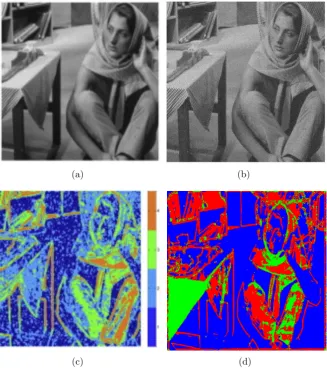
3.4 The classification results comparison on Barbara image: (a) Original
image, (b) Noisy image σ = 20, (c) The improved classification by Hu and Luo [17]. (Orange: texture with little noise, green: medium
region, light blue: texture with high noise and dark blue is the flat
region), (d) Our classification method: (The red color shows the edge
pixels, the blue color shows the smooth pixels, and the green color
shows texture/noise pixels) . . . 35
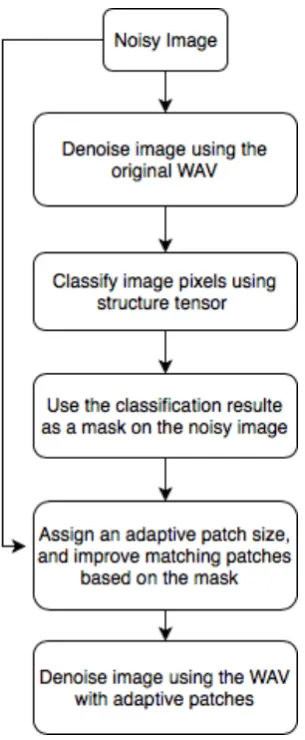
3.5 The basic steps of our improved method . . . 36
3.6 The Mean PSNR values of smooth areas in 25 different natural scene
images: (a) Noiseσ= 10 to 50, (b) Noise σ= 60 to 100 . . . 39 3.7 The Mean PSNR values of edge areas in 25 different natural scene
images: (a) Noiseσ= 10 to 50, (b) Noise σ= 60 to 100 . . . 41 3.8 The Mean PSNR values of texture areas in 25 different natural scene
images: (a) Noiseσ= 10 to 50, (b) Noise σ= 60 to 100 . . . 43 3.9 The performance of different patch sizes around the edges on Lena
image (noise σ = 10): (a) Original Image, (b) Denoised image using patch 5×5, (c) Denoised image using patch 7×7, (d) Denoised image
using patch 9×9, (e) Denoised image using patch 11×11, (f) Denoised
3.10 The performance of different patch sizes on texture part from Lena
image(noise σ = 10): (a) Original Image, (b) Denoised image using patch 5×5, (c) Denoised image using patch 7×7, (d) Denoised image
using patch 9×9, (e) Denoised image using patch 11×11, (f) Denoised
image using patch 13×13. . . 46
3.11 The smooth part from Lena image . . . 47
4.1 The 10 images used in our experiments: (a) Lena image 512×512, (b)
Man image 512×512, (c) Couple image 512×512, (d) Columbia image
480×480, (e) Barbara image 720×850, (f) Boats image 720×576, (g)
House image 768×512, (h) Light House image 512×768, (i) Window
image 768×512, (j) Woman image 512×512 . . . 51
4.2 The mean PSNR values of the 10 images set in 10 different noise levels 54
4.3 The PSNR values of Window image in 10 different noise levels . . . . 55
4.4 The mean SSIM values of the 10 image set in 10 different noise levels 57
4.5 The SSIM values of the Window image in 10 different noise levels . . 58
4.6 The visual comparison of Window image with noiseσ= 10: (a) Origi-nal Image, (b) Noisy image, (c) Denoised image using NLM algorithm,
(d) Denoised image using WAV reprojection algorithm, (e) Denoised
image using Adaptive patch shape NLM algorithm, (f) Denoised image
4.7 The visual comparison of Window image with noiseσ= 30: (a) Origi-nal Image, (b) Noisy image, (c) Denoised image using NLM algorithm,
(d) Denoised image using WAV reprojection algorithm, (e) Denoised
image using Adaptive patch shape NLM algorithm, (f) Denoised image
using our proposed method . . . 61
4.8 The visual comparison of Window image with noiseσ= 50: (a) Origi-nal Image, (b) Noisy image, (c) Denoised image using NLM algorithm,
(d) Denoised image using WAV reprojection algorithm, (e) Denoised
image using Adaptive patch shape NLM algorithm, (f) Denoised image
using our proposed method . . . 62
4.9 The visual comparison of Window image with noiseσ= 70: (a) Origi-nal Image, (b) Noisy image, (c) Denoised image using NLM algorithm,
(d) Denoised image using WAV reprojection algorithm, (e) Denoised
image using Adaptive patch shape NLM algorithm, (f) Denoised image
using our proposed method . . . 63
4.10 Zoomed part from Window image with noise σ = 10: (a) Original Image, (b) Noisy image, (c) Denoised image using NLM algorithm,
(d) Denoised image using WAV reprojection algorithm, (e) Denoised
image using Adaptive patch shape NLM algorithm, (f) Denoised image
4.11 Zoomed part from Window image with noise σ = 30: (a) Original Image, (b) Noisy image, (c) Denoised image using NLM algorithm,
(d) Denoised image using WAV reprojection algorithm, (e) Denoised
image using Adaptive patch shape NLM algorithm, (f) Denoised image
using our proposed method . . . 65
4.12 Zoomed part from Window image with noise σ = 50: (a) Original Image, (b) Noisy image, (c) Denoised image using NLM algorithm,
(d) Denoised image using WAV reprojection algorithm, (e) Denoised
image using Adaptive patch shape NLM algorithm, (f) Denoised image
using our proposed method . . . 66
4.13 Zoomed part from Window image with noise σ = 70: (a) Original Image, (b) Noisy image, (c) Denoised image using NLM algorithm,
(d) Denoised image using WAV reprojection algorithm, (e) Denoised
image using Adaptive patch shape NLM algorithm, (f) Denoised image
using our proposed method . . . 67
4.14 The two horizontal lines used for intensity profile . . . 68
4.15 Difference in intensity profile when the NLM algorithm and our
pro-posed method are applied along line y = 230 . . . 69
4.16 Difference in intensity profile when the WAV reprojection algorithm
and our proposed method are applied along line y = 230 . . . 69
4.17 Difference in intensity profile when the adaptive patch shape NLM
4.18 Difference in intensity profile when the NLM algorithm and our
pro-posed method are applied along line y = 450 . . . 70
4.19 Difference in intensity profile when the WAV reprojection algorithm
and our proposed method are applied along line y = 450 . . . 71
4.20 Difference in intensity profile when the adaptive patch shape NLM
algorithm and our proposed method are applied along line y = 450 . 71
4.21 The PSNR performance of BM3D, the adaptive BM3D, and the
List of Tables
3.1 The mean PSNR values of smooth areas in 25 different natural scene
images using 10 different noise levels . . . 38
3.2 The mean PSNR values of edge areas in 25 different natural scene
images using 10 different noise levels . . . 40
3.3 The mean PSNR values of texture areas (or noise) in 25 different
natural scene images using 10 different noise levels . . . 42
3.4 The mean PSNR values of a part from Lena’s face and the background 46
4.1 The mean PSNR values of the 10 images set in 10 different noise levels 54
4.2 The PSNR values of Window image in 10 different noise levels . . . . 55
4.3 The mean SSIM values of the 10 image set in 10 different noise levels 57
4.4 The SSIM values of the Window image in 10 different noise levels . . 58
4.5 The PSNR performance of BM3D, the adaptive BM3D, and the
List of Abbreviations
NLM Non-Local Means
WAV Weighted Average reprojection algorithm
BM3D Block Matching and 3D collaborative filtering
DCT Discrete Cosine Transform
FFT Fast Fourier Transform
PSNR Peak Signal to Noise Ratio
Chapter 1
Introduction
Digital images are represented as a two-dimensional array of pixels. So, each pixel
defined asf(x, y), wheref is the grey level value or the pixel intensity, and (x, y) are the spatial coordinates of the image pixel. Digital images might be contaminated by
noise during acquisition or transmission processes, which affected the original image
signals. Image noise could cause problems in some other image processing stages
such as image segmentation or image recognition. Therefore, image denoising is an
important process to restore the original clean image signals from its observed noisy
signals.
Over the years, variant image denoising approaches have been proposed. Most of
them achieved denoising by averaging in a way or another. This averaging may be
performed in spatial domain such as Gaussian Smoothing model [15] [20], Anisotropic
Filtering (AF) [27] [37], and Total Variation minimization [32] [31]; or in the
In recent years, patch-based denoising algorithm has drawn a lot of attention in the
image denoising field, where the neighbouring patches (image block) in a specific
search window participate in the denoising process for a certain reference patch in
the noisy image. This helps to find the best estimate for the original image signal
from its noisy signal.
1.1
Motivation
Patch-based denoising algorithms have become extremely popular in the image
de-noising field. They take the advantage of the similarity within the images, where
image signals are restored by performing averaging between the similar patches in the
image. Buades et al. [4] have introduced a patch-based algorithm called Non-Local
Means (NLM) for image denoising.
Variants of NLM algorithm have been proposed to improve its performance by
adaptively selecting some of the internal parameters. Some of these variants have
assigned the smoothing parameter adaptively based on the image structure [7] [36]
[39], or based on the noise level [41]. Some other variants are based on selecting the
patch size adaptively using the image structure [17] [23] [40]. Besides the adaptive
patch size, Deledalle et al [10] proposed a shape adaptive patches to address the
problem of the halo of noise around the edges. Some other variants have improved
the NLM algorithm by improving the method of computing the similarity between
One of the significant improvements in the patch-based denoising methods is the
WAV reprojection algorithm [34] which moved the reprojection method from the
patch space to pixel space. The WAV reprojection algorithm takes the advantage
of the whole patch, i.e., all pixels in the patch are exploited, which enhances the
denoising performance.
The key parameters of the WAV reprojection algorithm have kept fixed, regardless
of the image structure. So, one of our focus is to improve the performance of the
WAV reprojection algorithm by assigning anadaptivepatch size based on the image structure. Also, we propose to improve the WAV reprojection algorithm by
improv-ing matchimprov-ing the similar patches.
1.2
Thesis contribution
Edges are preserved better with a small patch size while smooth regions have
bet-ter denoising performance with large patch size [39] [40]. In the WAV reprojection
algorithm, the patch size has set to be fixed regardless of the image structure. So,
we propose anadaptive patch size WAV reprojection algorithm that is based on the image structure. The image pixels are classified based on our improved classification
method. We improve the classification method provided by [40] that is based on
the eigenvalues of the structure tensor matrix. The improved method is derived by
combining it with the discontinuity indicator [39] that classifies the image pixel into
amount of noise that affected the classification procedure. We classified the image
pixels into three classes: smooth, edge, texture / noise. The classification result is
then used as a mask on the noisy image to assign the patch size adaptively
Moreover, we used the classification scheme to improve the method of finding
similar patches. Two patches consider being similar only if they are from the same
class. Our proposed method has improved the original WAV reprojection algorithm
in term of PSNR and SSIM performance. Also, it has better preserved edges and
texture in the image.
1.3
Thesis Outline
Our thesis consists of five chapters. This chapter, Chapter 1, is an introductory chapter. In Chapter 2, we discuss in detail some patch-based image denoising algorithms. Our methodology is presented inChapter 3 with some experiments to assign the best patch size for each class. InChapter 4, we present the experimental results of our method, and we compare it with some other competitive methods.
Chapter 2
Background
Digital images are often affected by unwanted signals (noise) during the acquisition
or transmission processes. Image noise can cause problems in further image
process-ing processes such as identification, segmentation. Noise comes in different models.
Different methods are used to handle each noise model. This chapter focuses on
Ad-ditive White Gaussian Noise, which is the most common noise considered in image
processing. Different denoising algorithms to address this type of noise are discussed.
2.1
Additive White Gaussian Noise
The additive noise occurs when the noise signal is added to the original image signal,
it is generally modelled as:
wherev is the noisy image, uis the clean image, andn is the noise. In the Additive White Gaussian Noise, the noise has a uniform (constant) power over all frequencies
with amplitude following the Gaussian distribution. So, for a Gaussian variable z
the probability density function is:
p(z) = √1
πσe
−(z2−σµ2)2 (2.2)
whereµ is the mean value, σ is the standard deviation, and σ2 is the variance of z, andz is the amount of noise.
2.2
Noise Level Estimation
There are different methods to estimate the noise variance. They generally classified
as filtered based, patch-based, and statistical based. The filtered based approaches
estimate the noise by a pre-filter process using a low pass filter to suppress the
image structure [35] [19]. Then, the noise is estimated as the difference between
the filtered image and the noisy one. The patch-based noise estimation decomposes
the image into patches. Then, the homogeneous patches are used to estimate the
noise level [24] [25]. The main issue in patch-based methods is how to specify the
homogeneous patches. Also, some patch-based methods require high computation
load as it estimates the noise in an iterative way. The statistical methods analyse the
local variance distribution. Their results are more robust as the statistical methods
used are insensitive to outliers [2] [14].
used one of the filtered-based noise level estimations. It is just a simple method that
doesn’t require any high computation load (See Section 3.2).
2.2.1
Fast Noise Level Estimation
The fast noise level estimation [19] includes two steps, convolution and averaging.
The following Laplacian mask is applied first on the noisy image.
The noise estimation is the mask operation using the mask N, which has zero mean and variance (42 + 4×(2)2 + 4×(1)2)σ2
n = 36σ2n. The variance of the
convolution of the N on the noisy image I gives an estimate of 36 σ2
n at each pixel.
So, the averging is applied to get an estimated noise varianceσ2
n as follow:
σn2 = 1
36(W −2)(H−2)
X
imageI
(I(x, y)∗N)2 (2.3)
2.2.2
Patch-based Noise Estimation
The homogenous patches are targeted in the patch-based noise estimation [24] [25].
So, the image is first decomposed into a number of patches. The homogeneous
patches are then distinguished as the patches with the smallest standard deviation
because they have the least change of intensity among decomposed patches. As
intensity variation of the homogeneous patches is mostly caused by the noise, the
noise level is estimated from the selected patches. Patch-based noise estimation
methods overestimate the noise level in the small noise levels, and they underestimate
the noise in the large noise levels.
2.2.3
Statistical-based Noise Estimation
The analysis of the local variance distribution is used to estimate the noise in the
statistical-based method [2]. The image is decomposed into a number of small blocks.
Then, the local intensity variance of each block is calculated. The variance of all
blocks are averaged to estimate the noise variance. The size of the blocks used
should be as small as possible (e.g. 2×2)
2.3
Image Denoising
Image denoising is an important process to restore the original image signals from the
noisy ones. The main objective in image denoising is to reduce noise while preserving
edges and textures.
them achieved denoising by averaging in a way or another. This averaging may be
performed in the spatial domain, or in the frequency domain. In the spatial domain,
the spatial neighbouring pixels are considered in denoising, such as the convolution
of the Gaussian kernel [15]. In the frequency domain, the image is transformed to the
frequency domain like Fourier transform [8], or Wavelet transform [26]. The filtering
is performed in the frequency domain, then the inverse of the transform is applied
to get the denoised image.
Recently, patch-based denoising algorithms have became extremely popular in the
denoising field. They take the advantage of the similarity within the images. So, the
averaging is performed based on the similarity between image patches. Buades et
al. [4] have introduced the patch-based method for image denoising. They developed
the NLM (Non-Local Means) algorithm. Other patch-based denoising algorithm that
has the best performance results in denoising is BM3D [9]. In this chapter, various
patch-based denoising algorithms are discussed.
2.4
Patch-Based Denoising Algorithm
Natural scene images have a high degree of similarity, which means that each small
block has many similar blocks in the same image. Patch-based denoising algorithms
2.4.1
Non-local Means Algorithm
The (NLM) algorithm [4] estimates the original image signal by considering the
neighbouring area of the current processed pixel. For each pixel, they find all nearby
similar patches in the image that match the patch around the current processed
pixel (See Figure 2.1). Similar patches are chosen under some conditions based
on the similarity in the gray-level value, the geometrical configuration in a whole
neighbourhood, and how far they are from the current pixel. Then, the weighted
average of all centred pixels in all similar patches is calculated. Those weights depend
on the similarity between the patches. That is, pixels that their surroundings are
similar in the gray-level values to the current processed one have more weights than
other pixels, and closer pixels have more weight than the faraway one.
For a noisy imagev, wherev ={v(i)|i∈I}, iis the coordinate of a pixel within the image, the NLM for a pixel at location i,
N L[v](i) =X
j∈i
w(i, j)v(i) (2.4)
wherew is the weight, and it depends on the similarity between pixels at locationsi
andj. Euclidean distance has been used to calculate the distance between patches. Each weightw has to be less than or equal 1 and larger than or equal to 0, while the total of all weights has to equal 1. The weight is calculated as follow:
w(i, j) = 1
Z(i)e
−||v(Ni)−v(Nj)|| 2 2,a
whereZ(i) is the normalizing constant, and it is defined as:
Z(i) =X
j e−||
v(Ni)−v(Nj)||22,a
h2 (2.6)
where v(Ni) and v(Nj) are the intensity gray level vectors of the neighbourhood of
pixels i and j respectively. ||v(Ni)−v(Nj)||22,a is the Euclidean distance between
patches surrounding pixels i and j, a is the standard deviation of the Gaussian kernel and it is greater than 0, and h is the constant that control the decay of the exponential weight function (smoothing parameter).
Fig. 2.1 – The strategy of the NLM algorithm in finding the similar patches [4], the weight of q1, and q2 is larger than the weight of q3 as q1, and q2 have similar neighbourhood to the reference pixel p
2.4.2
Adaptive Smoothing Parameter NLM
for smooth and edges areas, degrades the denoising performance of the NLM
algo-rithm. Denoising smooth areas with the NLM algorithm works better with a larger
smoothing parameter while at edges and textures areas using smaller smoothing
parameter produces better results. Thus, different methods have been proposed to
adaptively select the smoothing parameter for each pixel based on the image features.
Chen and Yang [7] have proposed a method to select the smoothing parameter
adaptively. In their method the smoothing parameter is assigned based on the local
grey-level variance of the image pixel. The local grey-level variance identifies the
image structure, it distinguishes between the noise and the image edge or texture.
The local grey-level variance is provided by:
σl2(x, y) = 1
D2−1 D−1
2
X
i,j=−(D2−1)
[I(x+i, x+j)−ml(x, y)]2 (2.7)
Where D is the size of the sliding window, and ml is the local mean of the pixels
in the window. Based on the resulted classification, a small smoothing parameter is
assigned for pixels on edges, or texture areas, and a large smoothing parameter is
assigned for pixels on smooth areas.
Verma and Pandy [36] provided another method to choose the smoothing
param-eter adaptively. They classify the image regions using the Grey relational analysis,
which is related to the theory of the grey system [11]. The Grey relational analysis
fac-tor to all other facfac-tors in a system. The grade of the grey relations between image
patches is calculated using Grey relational analysis. Then, an adaptive smoothing
parameter is assigned for each pixel based on the resulted classification.
One more method to assign an adaptive smoothing parameter is based on the
discontinuity indicator [39]. A novel discontinuity indicator is proposed to detect
image structure; it also distinguishes between edges and noise. The discontinuity
indicator is derived from the eigenvalues of the structure tensor matrix [22]. It is
obtained as the difference between the two eigenvalues for each pixel.
The resulted discontinuity indicator is used to classify image pixels. If the
dis-continuity indicator is large, the pixel considered to be on edge. If it is small and
the two eigenvalues are also small, the pixel considered to be on smooth region.
The pixel is noise if the discontinuity indicator is small and the two eigenvalues are
large. Hence, an adaptive smoothing parameter is chosen for each pixel based on the
resulted classification.
Zhu et.al. [41] proposed an improved NLM by applying the NLM method twice.
First, the noise variance is estimated using the weak textured patch noise estimation
[24]. The weak textured patches are selected based on the image gradient. Then, the
Principle Component Analysis (PCA) is applied on the selected patches to attain
the estimated noise level. After that, the Non-Local means method is applied on the
noisy image using an adaptive smoothing parameter based on the estimated noise
variance to get the basic estimate. The final estimate is then obtained by applying
removed in the first step.
Adaptive NLM using Weight Thresholding
Khan and El-Sekka proposed the NLM using Weight Thresholding [21]. Their
method is performed as a two-step approach. The basic estimate is generated in
the first step by thresholding the weights of the pixels within the searching area.
All weights above the threshold value are unchanged, but the weights less than the
threshold are assigned to zero, thus those pixels are removed from the weighted
averaging process. In the second step, the weighted thresholding NLM is applied
once again but with different smoothing strength. The threshold value is adaptively
assigned based on the noise level.
2.4.3
Adaptive Patch Size NLM
Adaptive patch size based on image structure
The patch size has set to be fixed in the original NLM algorithm. Using a variable
patch size has a significant improvement on the performance of the NLM method.
Edges are preserved better with a small patch size while smooth regions have better
denoising performance with large patch size. Various adaptive patch size NLM
de-noising algorithm are proposed to overcome the inefficacy of the traditional NLM.
Zeng et al. [40] have proposed an adaptive patch size NLM algorithm. They use the
structure tensor to classify the image into smooth and texture regions. The difference
between the two eigenvalues of the structure tensor is calculated. If the difference
and a large patch size is set to estimate its original value. On the other hand, if the
difference is small, the pixel is considered to be on a texture area and hence a small
patch size is set to estimate its original value.
Hu and Luo [17] has also improved the NLM algorithm by adaptively select the patch
size based on image structure. They use the local geometry of the image and the
noise variance to drive a new metric,
R(i) =f(i)
λ2 1−λ22
λ2 1+λ22
(2.8)
where f(i) is a feature detector based on the image histogram, λ1 and λ2 are eigenvalues of the structure tensors that used to classify the image structure. This
composed metric classifies the image into four regions (c1, c2, c3, and c4) based on their relations to three bin values T1 = 90%, T2 = 70%, and T3 = 30% (See Figure 2.2), i∈
c1 R(i)≥T1
c2 T2 < R(i)< T1
c3 T3 < R(i)≤T2
c4 R(i)≤T3
(2.9)
where c1 represents texture region with a small value of noise variance, c2 is the medium region that has even smaller noise variance and less structure,c4 is the flat region, and c3 represents region with textures and high value of noise. Then, dif-ferent patch sizes are applied to each region. The largest patch size is assigned to
tex-ture. The patch size increases gradually inc1andc2 as the regions have less texture .
Lan et al [23] have also proposed an adaptive patch size NLM scheme based on
region homogeneity. In their method, the patch size and the searching window sizes
are assigned adaptively depending on the local scale measure. The local scale finds
the homogeneous regions in the image according to the image structure [33]. The
homogeneity range is large inside regions and it becomes smaller on edges. So, the
local scale is computed for each pixel, then the patch size and the searching window
size are assigned accordingly.
Adaptive Patch Shape NLM
Besides the adaptive patch size, Deledalle et al [10] proposed a shape adaptive patches
to address the problem of the halo of noise around the edges. Various shapes have
been used including square, disk, pie, slices, and bands. The variety in shapes is
applied to handle the geometrical structure of the image. Fast Fourier Transform
(FFT) is used to deal with the different shapes of patches. For aggregation, the same
weight is assigned for all patch shapes. The proposed algorithm has a noticeable
improvement for the noise halo.
The Patch Size and the Noise Variance
The knowledge of the noise variance improves the performance of the NLM algorithm.
(a) (b)
(c) (d)
using larger patches have better denoising results, i.e, larger patch sizes allow better
discrimination between patches [13]. Thus, it is better to use large patch size for its
robustness to noise. On the other hand, choosing large patch size prevents finding
similarities for the small details, also it degrades the denoising performance around
edges. Thus, the author suggests assigning an adaptive smoothing parameterhwith a global patch size to overcome the issue of smoothing the edges.
2.4.4
NLM with Improved Similarity Computation Method
The Euclidean distance with the geometric image structure are used to find similar
patches. This method is based only on the noisy image, which might not provide
the structure similarity efficiently, especially with high noise variance. Thus, other
approaches have been provided to improve the similarity method.
Curvelet based NLM algorithm
In the curvelet based NLM [38], the Curvelet transform is first applied on the noisy
image. The Curvelet transform is a directional multi-scale transform that produces
an optimal representation of image features like edges [12]. Similar patches are
determined based on the different levels of the resulted reconstructed images by the
Curvelet transform beside the noisy image. The final denoised image is obtained by
K-Means Clustering based NLM
The K-means clustering is combined with NLM algorithm to improve matching the
similar patches [28]. The K-Means algorithm classifies the image pixels into a number
of clusters based on the distance of their intensities from the centroid [16]. First, the
noisy image is smoothed using a Gaussian smoothing filter. Gaussian filtering [15]
recovers the image signals by applying the convolution of the Gaussian kernel on the
noisy imageI0.
I(x, y) =I0(x, y)∗G(x, y) (2.10)
where
G(x, y) = 1 (4πh2)e
−|4xh|22 (2.11)
The K-means technique is then applied on the smoothed imageI to create the mask imageIm.
Im = K
X
i=1
X
xj∈si
kxj−µik2 (2.12)
Whereµis the centroid or the mean of the cluster, and k is the number of the clus-ters and it depends on the image structure. The resulted imageIm is used as a mask
for the noisy image to improve matching the similar patches. Finally, the denoised
image is obtiend as the weighted average of pixels in the similar neighbourhood Ω
within the cluster nas follow:
N L[vn](i) =
X
j∈Ω
DCT-Based Non-Local Means
In order to improve the patch similarity, the spatial distance between patches is
replaced by the distance between the discrete cosine transform (DCT) [1] coefficients
in the frequency domain [18]. The neighbourhood patches are transformed from
the spatial domain to the DCT frequency domain. Then, the DCT coefficients are
obtained through the Zigzag scan. Consequently, the weight in the NLM method is
replaced by:
w(i, j) = 1
Z(i)e −Pd
k=1
(Cd(Ni)k−Cd(Nj)k)2
h2 (2.14)
whereCd(Ni)k is the kth DCT coefficient of the neighbourhood of the subspace Ni, d∈[1, M] where M is number of pixels in Ni, Z is the normalization factor, and h
is the Gaussian smoothing parameter.
2.4.5
Weighted Average Reprojection (WAV)
The Weighted Average (WAV) Reprojection algorithm is one of the significant
im-provements in the patch-based denoising methods. WAV reprojection algorithm [34]
has improved the reprojection method from the patch space to pixel space. The
de-noising is performed in three basic steps: collecting the similar patches, performing
the denoising for each patch, and reprojecting the denoised patch to the pixel domain
Fig. 2.3 – The three basic steps of the WAV reprojection algorithm [34]
In the first step, the chi-squared distributionχ2in conjunction with the Euclidean distance is used to test the similarity between patches. Two patches are considered
to be similar if the Euclidean distance between them is less than the quantile of
χ2(W2). To estimate a pixel x after the grouping step, the weighted average of the different estimators ofx in all patches pixelx is belong to is calculated.
ˆ
IW av(x) = W2
X
i=1
βiPˆi(W2−i+ 1) (2.15)
The weight βi is based on minimizing variance between patches. Because WAV
reprojection algorithm uses the flat kernel,βiis proportional to the number of patches
used to estimate ˆPi, and PW
2
i=1βi = 1.
Only the central pixel in each patch is used to estimate the current processed pixel
in the original Non-local means algorithm, which degrades the performance of the
(a)
(b)
Fig. 2.4 – The difference between the (a) centred patches and (b) the decentred patches in the gathering step [34] (The red patch is the reference patch)
takes the advantage of the whole patch, i.e., all pixels in the patch are exploited,
which enhances the denoising performance. The NLM algorithm performs poorly
around edges because the patches centred on the edges have a few similar patches.
The decentred patches is used in the WAV reprojection algorithm to enhance the
denoising performance around the edges. The decentred patches have more similar
patches than the centred patch, especially around the edges. Figure 2.4 shows the
number of patches that could be considered to denoise the pixels near the edges.
The WAV reprojection algorithm allows a faster implementation for two reasons.
the flat kernel all candidates have the same weight while Gaussian requires more
calculations as the weight varies from candidate to another. The flat kernel has an
advantage also in the denoising performance. it minimizes the problem encountered
by the Gaussian kernel in NLM algorithm when the searching window is too large.
More candidates are considered in the weight, and affects the impact of the good
candidates. The flat kernel robustifies the estimator by hard thresholding the small
coefficients .
Fig. 2.5 – The Gaussian kernel and the Flat kernel
The second reason is related to the searching window size, WAV reprojection
al-gorithm has good results with a small searching window size, e.g., (searching window
= 9). The influence zone is wider as the patches are decentred (See Figure 2.6) .
(a) (b)
Fig. 2.6 – The difference between the influence zone in the centred patch (a), and the decentred patch (b) [34] (The patch size W = 5, and the searching window R=15)
2.4.6
Image Denoising with Block-Matching and 3D
Collab-orative Filtering(BM3D)
BM3D [9] is one of the significant improvements in the patch-based denoising
ap-proach. It consists of two filtering steps; the hard thresholding filtering [5] that gives
the basic estimate, and the Wiener filtering [30] which produces the final estimate
(See Figure 2.7). Each step includes three operations: grouping, collaborative
filter-ing, and aggregation.
In the grouping operation, each reference block is compared with other blocks in the
image. The Euclidean distance is calculated, and the similar blocks are chosen if the
distance is less than a specified threshold.
SxR =
x∈X|d(ZxR, Zx)< τmatch
Then, all matched blocksSxRare stacked to form a 3D arrayZSxR. A 3D transfor-mation τ3D is then applied on the 3D array ZSxR to create a sparse representation. The hard thresholding is applied on the transform coefficients, which resulted in
multiple estimates for each pixel because the estimates may overlap. So, each
esti-mate is given a weight which is inversely proportional to the number of the non-zero
coefficients. In the aggregation operation, a weighted average of all estimates are
calculated to attain the basic estimate of the image.
In the second filtering step, the Weiner filtering is applied on the stacked local
esti-mates ˆYSxR that resulted from the hard thresholding step, and the stacked matched blocks from the noisy image. Then, the weighted average is calculated to get the
final estimate of the image.
Fig. 2.7 – The two steps of the BM3D algorithm [9].
Although BM3D has an effective improvement on the patch-based denoising
BM3D using an Adaptive Thresholding
In order to improve the thresholding process, an adaptive hard-thresholding is
as-signed in the hard thresholding step [3] of the BM3D Method. The adaptive
hard-thresholding is selected based on the geometric and luminance distance similarities
between patches. When a patch is geometrically far from the reference patch, more
thresholding is assigned to the patch transforming coefficients. The collaborative
Weiner filtering step is also improved by assigning more weights for similar patches.
They use weights for the 3D array patches. More weights are assigned for similar
patches. PSNR is used as a patch similarity measure for selecting those weights.
2.5
Conclusion
This chapter discussed different patch-based denoising algorithms. Also, different
variants of the NLM algorithm are described. They improved the NLM algorithm
by the adaptation selection of some internal parameters in the NLM scheme, or by
improving the similarity computation method. In addition, some other algorithms
that have significant improvements in the patch-based domain are discussed. In our
research we focus on the WAV reprojection algorithm. we studied its performance
Chapter 3
Methodology
WAV reprojection algorithm is one of the most powerful patch-based denoising
algo-rithms. It is a simple and effective method that performs the denoising in the spatial
domain. Unlike the NLM algorithm, all the pixels in the patches are exploited in
the WAV reprojection algorithm. A fixed patch size is used in the denoising process.
The similarity between patches is calculated using the Euclidean distance between
patches.
In our thesis, the patch size is assigned adaptively based on the image structure.
The image structures are identified using the structure tensor matrix. It classifies
the image pixels into three classes. In addition, the classification results are used to
improve matching similar patches. Patches similar to the reference patch contribute
3.1
Improved WAV Reprojection Algorithm
The prior knowledge about the image structure helps to set the parameters properly.
Edge information is preserved better with a small patch size, while smooth regions
have better denoising performance with large patch size. In the WAV reprojection
algorithm, the patch size has set to be fixed regardless of the image structure.
In our research, we target setting the patch size adaptively based on the image
structure to enhance the denoising performance. Thus, the image pixels need to be
classified first. We have used our improved method to classify the image pixels. The
next section explains in details our improved classification method.
3.1.1
The Improved Classification Method
The image pixels are first classified using the eigenvalues of the structure tensor
matrix [22]. The structure tensor matrix is defined as follow:
Tσ =
j11 j12
j21 j22
=
Gσ∗(gx(i, j))
2 G
σ∗gx(i, j)gy(i, j) Gσ∗gy(i, j)gx(i, j) Gσ∗(gy(i, j))2
(3.1)
where gx and gy are the gradients information in x and y directions, and Gσ is
the Gaussian kernel. Then, the two eigenvalues are calculated:
λ1 = 1 2
j11+j22+
p
(j11−j22)2+ 4j122
(3.2)
λ2= 1 2
j11+j22−
p
(j11−j22)2+ 4j122
where j11 = Gσ ∗(gx(i, j))2, j22 = Gσ ∗(gy(i, j))2, and j12 = Gσ ∗gx(i, j)gy(i, j).
We follow the classification methods provided by [39] [40] to classify the image into
three regions. The absolute difference between the two eigenvaluesλ1 andλ2 is then calculated.
λ= |λ1−λ2| (3.4)
Then, the following classification scheme is used to classify image pixels:
(i, j)∈
c1 λ(i, j)≤λ2(λ1−nλ2)
c2 λ(i, j)≤λ22(λ1n−λ2)
..
cn λ(i, j)≤λ2n(λ1n−λ2)
(3.5)
This classification is inaccurate, as some pixels may belong to more than one
class. Also, it fails to classify the image pixels in the high noise levels, Figure 3.1
shows the classification result, where the red color represents edge pixels, the blue
color represents the smooth pixels, and the green color represents texture/noise
pix-els. In noise σ = 40, we can notice the described method fails to define the image structure.
Thus, we propose to improve the classification in Equation 3.5 by combining
it with the discontinuity indicator provided by Zeng et.al. [39]. The discontinuity
(a) (b)
(c) (d)
(e) (f)
(g) (h)
Fig. 3.1 – The classification results using the structure tensor on Lena image:(The red color represents edge pixels, the blue color represents the smooth pixels, and the green color represents texture/noise pixels) (a) Noisy imageσ= 10, (b) Classification of noisy image σ = 10, (c) Noisy image σ = 20, (d) Classification of noisy image
pixel is considered to be on an edge. If λ(i, j) is small and the two eigenvalues are also small, the pixel is considered to be on a smooth region. The pixel is noise if
λ(i, j) is small but the two eigenvalues are large.
In our method, we classify the image pixels into three classes based on a comparison
that made upon the two eigenvalues of the structure tensor matrix. We compare the
two eigenvalues of each pixel in each resulted class from Equation 3.5 with a specified
threshold value. If the two eigenvalues are smaller than thethreshold, the pixel is considered to be in a smooth area. If the maximum eigenvalueλ1 is larger than the
threshold and the minimum eigenvalue λ2 is smaller than the threshold, the pixel is considered on edge. The pixel is on texture or a noise if the two eigenvalues are
larger than the threshold.
(i, j)∈
Smooth λ1 < τ, λ2< τ
Edge λ1 > τ, λ2< τ
T exture/N oise λ1 > τ, λ2> τ
(3.6)
where τ is the threshold value, and it has set to be 40.
In addition, we apply a preprocessing step to improve the classification results.
The image is denoised first using the original WAV reprojection algorithm. This
step has improved the classification result, especially at the low noise levels. The
texture areas can be classified as a third class when the noise level is less than 30.
However, when the noise level is high, the third class represents noise. Moreover, our
classification method has identified the image structure even when the noise level is
Figures 3.2 ,3.3 present our classification results on two different natural scene
images. One of them have mostly smooth regions(Lena), and the other one has more
texture region (Window). The classification results are presented with different noise
levels (σ= 10, σ= 40, σ= 70, σ= 100). The blue color presents the smooth areas, the red color presents the edges, and the green color presents the texture or noise
areas. When the noise level is low (σ= 10), the green color shows the texture only. While texture and noise are presented in green color when noise level is high (σ= 40,
σ= 70, andσ= 100). As the noise increase, the texture pixels tend to be presented as smooth pixels because the texture areas are blurred due to the denoising step.
However, our method has identified the edges even if the noise level is high.
Our improved classification method has better results than the method described in
Section 2.4.3. The noise signals could be distinguished from the original image signal,
while in their method the regions classified as texture with low noise or texture with
high noise. In the smooth region, if there is a noise, they just handle it as texture
with high noise. Figure 3.4 shows the comparison between our classification method
(a) (b)
(c) (d)
(e) (f)
(g) (h)
(a) (b)
(c) (d)
(e) (f)
(g) (h)
(a) (b)
(c) (d)
Fig. 3.5 – The basic steps of our improved method
3.1.2
The Improved WAV Reprojection Method
Figure 3.5 shows the block diagram of the proposed scheme. After the classification
step, we used the resulted classification as a mask on the noisy image. The improved
method is then obtained as follow:
averaging process only if their central pixels belong to the same class. That decreases
the number of un-similar patches from contributing in the averaging process.
In addition, an adaptive patch size is assigned to each pixel based on the class the
pixel is belong to. A large patch size is assigned to pixels on smooth areas, and a
small patch size is assigned to pixels on edges. For the texture, a smaller patch size
is assigned.
3.2
Selecting the patch size
In our experiments, we targeted natural scene images. We used 25 natural scene
images to select the best patch size for each class. The images are contaminated by
additive white Gaussian noise with 10 different levels of noise to assess the
perfor-mance of each class at each noise level and when using different patch sizes. Then,
the resulted mean PSNR values are used to assign the best patch size for each class.
We used patch sizes 5×5, 7×7, 9×9, 11×11, and 13×13. The searching window
size has set to be fixed as 9×9. The mean PSNR values of the 25 images in each
Noise level 5×5 7×7 9×9 11×11 13×13
10 37.16 37.27 37.31 37.21 37.00
20 33.12 33.28 33.35 33.36 33.32
30 30.74 30.96 31.03 31.04 31.02
40 29.13 29.40 29.48 29.50 29.49
50 27.86 28.19 28.28 28.30 28.30
60 26.90 27.28 27.39 27.41 27.40
70 26.14 26.58 26.70 26.72 26.72
80 25.48 25.95 26.07 26.10 26.10
90 24.90 25.40 25.53 25.56 25.56
100 24.34 24.88 25.03 25.06 25.06
Mean 28.58 28.92 29.02 29.03 29.00
Table 3.1 – The mean PSNR values of smooth areas in 25 different natural scene images using 10 different noise levels
Figure 3.6 shows the bar chart of the mean PSNR comparison between the
dif-ferent patch sizes on the smooth areas. The results show that the smooth areas have
the best mean PSNR performance in noise level 10 when the patch size of 9×9 is
used (See Table 3.1). The patch size 11×11 have the best mean PSNR value in the
noise levels from 20 to 60. In noise levels more than 70, both patch sizes 11×11 and
13×13 have the best performance, but the algorithm with small patch size executes
(a)
Figure 3.7 plots the mean PSNR comparison when using different patch sizes on
the edge areas. The PSNR values are also reported in Table 3.2.The results show
that the patch size 5×5 has the best mean PSNR performance in noise level 10.
Noise levels from 20 to 90 have the best results when the patch size of 7×7 is used.
Patch 9×9 has the best results when the noise level is 100. The average in all noise
levels shows that the best mean PSNR value for pixels on edges is when the patch
7×7 is used.
Noise level 5×5 7×7 9×9 11×11 13×13 10 32.81 32.62 32.22 31.85 31.58
20 28.46 28.60 28.54 28.34 28.11
30 25.70 25.82 25.77 25.64 25.46
40 23.81 23.87 23.78 23.63 23.44
50 22.47 22.48 22.37 22.21 22.02
60 21.59 21.60 21.48 21.32 21.14
70 20.98 21.02 20.93 20.79 20.64
80 20.68 20.78 20.72 20.61 20.49
90 20.49 20.66 20.64 20.56 20.47
100 20.41 20.65 20.68 20.64 20.57
Mean 23.74 23.81 23.71 23.56 23.39
(a)
Table 3.3 shows the PSNR comparison for the texture/noise pixels for different
patch sizes. Figure 3.8 presents the bar chart of the resulted mean PSNR values.
The results show that the patch size of 5×5 has the best mean PSNR performance
in noise levels less than or equal to 30. In nose level 40, patch size 9×9 has the best
mean PSNR performance. In the noise levels between 50 and 90, the patch size of
11×11 has the best results. Both patch sizes 11×11 and 13×13 perform the same
in the noise level 100.
Noise level 5×5 7×7 9×9 11×11 13×13 10 29.47 29.05 28.78 28.63 28.56
20 25.25 24.89 24.61 24.43 24.34
30 23.29 23.18 23.03 22.94 22.88
40 22.37 22.44 22.45 22.42 22.39
50 22.33 22.53 22.61 22.63 22.58
60 22.67 23.00 23.13 23.17 23.13
70 22.92 23.32 23.49 23.54 23.53
80 22.94 23.39 23.56 23.62 23.61
90 22.79 23.29 23.47 23.53 23.52
100 22.47 23.02 23.22 23.29 23.29
Mean 23.65 23.81 23.84 23.82 23.78
(a)
To clearly show the effect of using different patch sizes on different areas of the
image, we present an example that shows visually the denoising performance on
dif-ferent regions from Lena image, and when using difdif-ferent patch sizes. Figures 3.9,
3.10 show the effect of using a small patch size for edges or texture areas on zoomed
parts from the Lena image. The noisy Lena image (σ = 10) is denoised using the WAV reprojection algorithm using different patch sizes. The results show how the
artifacts are reduced significantly when using patch sizes 5×5 and 7×7. For the
smooth region, smooth parts from Lena’s face and the background are cropped to
test their performance (Figure 3.11 ). Table 3.4 presents the resulted PSNR values
for each patch size on those areas. The results show that patch size 11×11 has the
best PSNR values.
Therefore, we assigned patch size 11×11 for pixels on the smooth areas. Patch
size 7×7 is assigning for pixels on edges. As the third class (texture) represents
two types of pixels based on the noise level, we handle them differently. We assigned
patch size 5×5 for noise levels less than or equal to 30, and patch size 11×11 for
noise levels more than or equal to 30. Thus, the noise level of the noisy image needs
to be estimated to assign the proper patch size for the third class. The noise level
is estimated using the method described in Section 2.2.1. The result is then used to
(a) (b)
(c) (d)
(e) (f)
(a) (b)
(c) (d)
(e) (f)
Fig. 3.10 – The performance of different patch sizes on texture part from Lena im-age(noise σ = 10): (a) Original Image, (b) Denoised image using patch 5×5, (c) Denoised image using patch 7×7, (d) Denoised image using patch 9×9, (e) Denoised image using patch 11×11, (f) Denoised image using patch 13×13.
Noise level 5×5 7×7 9×9 11×11 13×13
Face 38.46 38.46 38.48 38.49 38.47
Fig. 3.11 – The smooth part from Lena image
Summary of the Selected Patch sizes
Different patch size is assigned for each class in our method. The patch size, w×w, is selected as shown below:
w =
11, Smooth, (T exture/N oise (σ >30))
7, Edge
5, T exture/N oise (σ≤30)
(3.7)
3.3
Conclusion
In this chapter, we explained our proposed method to improve the denoising
using our improved classification method. The result is then used as a mask on the
noisy image. An adaptive patch size is assigned for each pixel based on the class the
pixels is belong to. A patch size 11×11 is assigned for pixels on the smooth areas.
For pixels on edges, patch size 7×7 is assigned. For the third class (texture and
noise), 5×5 and 11×11 patch sizes are used based on the noise level. In addition,
the process of matching patches has also improved. Patches are considered to be
similar if the central pixel in each patch belong to the same class. The next chapter
Chapter 4
Experimental Results and Analysis
In our experiments, we used 10 natural scene images to compare our algorithm with
other existing methods in the denoising domain. These images are Lena, Man,
Cou-ple, Columbia, Barbara, Boats, House, Light House, Window, Woman (See Figure
4.1). The images are then contaminated with additive white Gaussian noise with 10
different levels of noise from 10 to 100. We compare our algorithm with the original
NLM algorithm, the WAV reprojection algorithm, adaptive patch shape NLM
algo-rithm, and the state of art BM3D algorithm. The PSNR and the SSIM are used to
compare the denoising performance. Also, we analyzed the performance using the
intensity profile and the visual quality.
4.1
Noisy Images Generation
The additive white Gaussian noise signals are added to the original image signal to
clean image uusing the following equation in Matlab command:
v= u+sigma×randn (size(u)) (4.1)
where sigma is the standard deviation of the Gaussian noise, randn is a function that generates a random matrix with Gaussian distribution, and size is a function that used to get the dimension of the original input image.
4.2
Performance Evaluation
We have used the peak signal to noise ratio (PSNR) and the mean structure similarity
index (MSSIM) to compare the denoising performance of our proposed method with
the other existing methods in the denoising field. Those are the most common
objective measures for the performance of the image denoising algorithms. Also, we
did other subjective comparisons. We compare the visual quality and the intensity
profile of our method with the other competitive methods.
4.2.1
Peak Signal to Noise Ratio (PSNR)
The PSNR is the ratio between the maximum power of the original signal and the
noise that affected its quality. The PSNR is defined via M ean Squared Error
(MSE), which is calculated as the difference between the original image u and the corrupted imagev.
M SE = 1
M×N M X i=1 N X j=1
(a) (b) (c) (d)
(e) (f) (g)
(h) (i) (j)
whereM andN are the dimensions of the images. Then, the PSNR is calculated as:
P SN R = 10 log10
(M AX)2
M SE
(4.3)
where M AX is the maximum pixel intensity value. So, the PSNR is expressed in term of the logarithmic decibel scale. A larger value indicates better denoising.
4.2.2
Mean Structure Similarity Index (MSSIM)
The SSIM is a perceptual difference between two images. It has an advantage over
the PSNR as it considers the similarity between various patches in the images and
not only pixel by pixel. The SSIM between two patches xandy is defined as:
SSIM = (2µx µy+c1)(2σxy+c2) (µ2
x+µ2y+c1)(σx2+σy2+c2)
(4.4)
where µx is the mean of x, µy is the mean of y, σ2x is the variance of x, σ2y is the
variance of y, and σxy is the covariance. c1 andc2 are two variables to stabilize the division. The SSIM produce a value between [0,1]. A larger value indicates better denoising result. The mean SSIM (MSSIM), averaged over all SSIM, is used as a
quality measurement of the denoising performance.
4.3
Results and Discussion
Our proposed method is compared with other denoising methods. It is compared
are presented to show the visual performance.
4.3.1
Performance Analysis using PSNR
Our proposed method is compared with the other denoising algorithms, namely the
original NLM, the WAV reprojection algorithm, and the adaptive patch shape NLM.
The mean PSNR value of the 10 images are shown in Figure 4.2. The PSNR values
are calculated in each noise level for each algorithm (Table 4.1). The values inbold
present the best PSNR performance. Figure 4.2 compares the average PSNR between
the proposed method and the other image denoising schemes.
The results show that our proposed method outperforms the other methods when
the noise levels is less than 90. The mean PSNR value in all noise levels has the best
result with our proposed method.
The PSNR values of the Window image Figure 4.1.(i) is also reported in Table 4.2. It
shows the PSNR performance in 10 different noise levels for each algorithm. Figure
4.3 presents the PSNR comparison between our proposed method and the other
image denoising methods on Window image. The results show that our proposed
Noise level NLM WAV Adaptive shape NLM
Proposed method
10 33.28 33.41 33.89 33.93
20 29.67 30.31 30.41 30.45
30 27.50 28.20 28.19 28.30
40 26.02 26.61 26.57 26.82
50 24.93 25.43 25.39 25.65
60 24.08 24.54 24.52 24.76
70 23.40 23.85 23.86 24.07
80 22.84 23.30 23.33 23.49
90 22.35 22.84 22.89 22.97
100 21.93 22.42 22.51 22.50
Mean 25.60 26.09 26.16 26.29
Noise level NLM WAV Adaptive shape NLM
Proposed method
10 34.94 34.93 35.69 35.39
20 30.82 31.28 31.69 31.49
30 28.20 28.87 28.91 29.09
40 26.47 26.98 26.79 27.26
50 25.28 25.60 25.38 25.96
60 24.42 24.66 24.48 25.05
70 23.75 23.99 23.86 24.37
80 23.21 23.49 23.39 23.81
90 22.75 23.07 23.00 23.32
100 22.35 22.69 22.66 22.86
Mean 26.22 26.56 26.58 26.82
4.3.2
Performance Analysis using MSSIM
The performance of our proposed method is compared in terms of MSSIM with the
other denoising schemes. Table 4.3 presents the resulted MSSIM values for the 10
images set . Figure 4.4 compares the MSSIM values of our proposed method and the
other denoising scheme.
When the noise level is less than 70, our method has the best MSSIM performance.
The adaptive patch shape has the best results when the noise level is high. The
average in all noise levels show that our proposed method has the best result.
The MSSIM performance of the Window image is also reported in Table 4.4, where
our proposed method has the best MSSIM results when the noise level is more than
20. Figure 4.5 shows the MSSIM comparison of the proposed method and the other
Noise level NLM WAV Adaptive shape NLM
Proposed method
10 0.950 0.961 0.959 0.962
20 0.888 0.904 0.901 0.906
30 0.830 0.845 0.845 0.850
40 0.780 0.789 0.792 0.799
50 0.736 0.737 0.744 0.750
60 0.697 0.691 0.702 0.706
70 0.662 0.649 0.666 0.668
80 0.630 0.613 0.634 0.632
90 0.601 0.580 0.604 0.597
100 0.575 0.550 0.578 0.563
Mean 0.735 0.732 0.742 0.743
Noise level NLM WAV Adaptive shape NLM
Proposed method
10 0.971 0.974 0.975 0.974
20 0.922 0.929 0.931 0.930
30 0.864 0.874 0.875 0.880
40 0.807 0.815 0.811 0.825
50 0.755 0.755 0.750 0.771
60 0.709 0.700 0.699 0.723
70 0.670 0.653 0.657 0.679
80 0.635 0.614 0.622 0.638
90 0.604 0.579 0.590 0.601
100 0.576 0.548 0.562 0.564
Mean 0.751 0.744 0.747 0.758
4.3.3
Visual Quality Comparison
It is important to assess the visual quality of the denoised image. The visual quality
of our proposed method is compared with the other denoising algorithms. Figure
4.6, Figure 4.7, Figure 4.8, and Figure 4.9 show the visual comparison of the Window
image when noise σ= 10,σ = 30,σ= 50 and σ= 70, respectively.
To better visualize the improvement, we zoomed in a part of the image. Figure 4.10,
Figure 4.11, Figure 4.12, and Figure 4.13 present the zoomed images, respectively.
We can notice that our proposed method and the adaptive patch shape method have
better attenuating the noise from the flower area when the noise level is 10, while
WAV reprojection algorithm and the NLM algorithm produce artifacts on the same
flower area.
In the noise σ= 50, and σ= 70, the zoomed parts show that our proposed method has better preserved the edges of the window frame area and the texture inside the
(a) (b)
(c) (d)
(e) (f)
(a) (b)
(c) (d)
(e) (f)
(a) (b)
(c) (d)
(e) (f)
![Fig. 2.1 – The strategy of the NLM algorithm in finding the similar patches [4],the weight of q1, and q2 is larger than the weight of q3 as q1, and q2 have similarneighbourhood to the reference pixel p](https://thumb-us.123doks.com/thumbv2/123dok_us/1889190.1246859/27.595.205.395.337.503/strategy-algorithm-nding-similar-patches-weight-similarneighbourhood-reference.webp)
![Fig. 2.4 – The difference between the (a) centred patches and (b) the decentredpatches in the gathering step [34] (The red patch is the reference patch)](https://thumb-us.123doks.com/thumbv2/123dok_us/1889190.1246859/38.595.182.415.122.395/dierence-centred-patches-decentredpatches-gathering-patch-reference-patch.webp)